
SAT and ACT
This guide helps you decide whether to prep for the SAT, ACT, or both by comparing the 2026 format changes, your personal strengths, and the current college admissions landscape.
Updated:
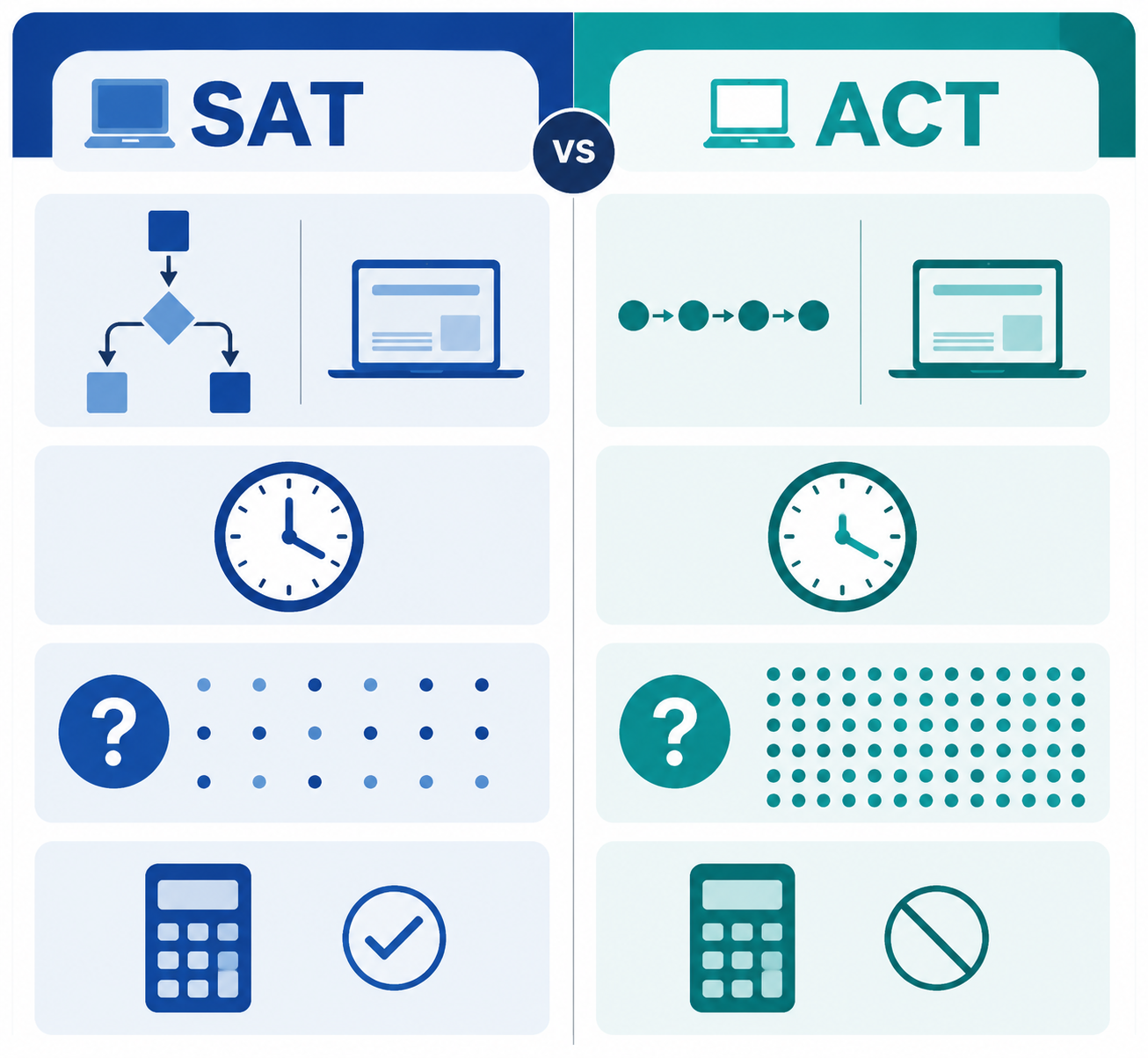
In 2026, the SAT-versus-ACT decision is no longer a polite debate over which test “feels easier.” The Digital SAT is shorter, adaptive, 2 hours and 14 minutes long, and has 98 questions; the Enhanced ACT is non-adaptive, roughly 2 hours for the core test without writing, and has 131 core questions.[1] That difference changes the daily reality of sat and act prep: the student is not just choosing a score scale, but choosing a testing environment.
Two distractions should come off the table early. First, U.S. colleges do not give a preference to the SAT over the ACT or the ACT over the SAT; either score can serve the same admissions purpose when a school accepts testing. Second, test-optional does not mean testing has disappeared. More than 2,000 bachelor-degree-granting institutions remain test-optional, while Harvard, Yale, MIT, Brown, Dartmouth, Stanford, Princeton, and other highly selective schools have reinstated testing requirements as of the 2026 admissions landscape.[2]
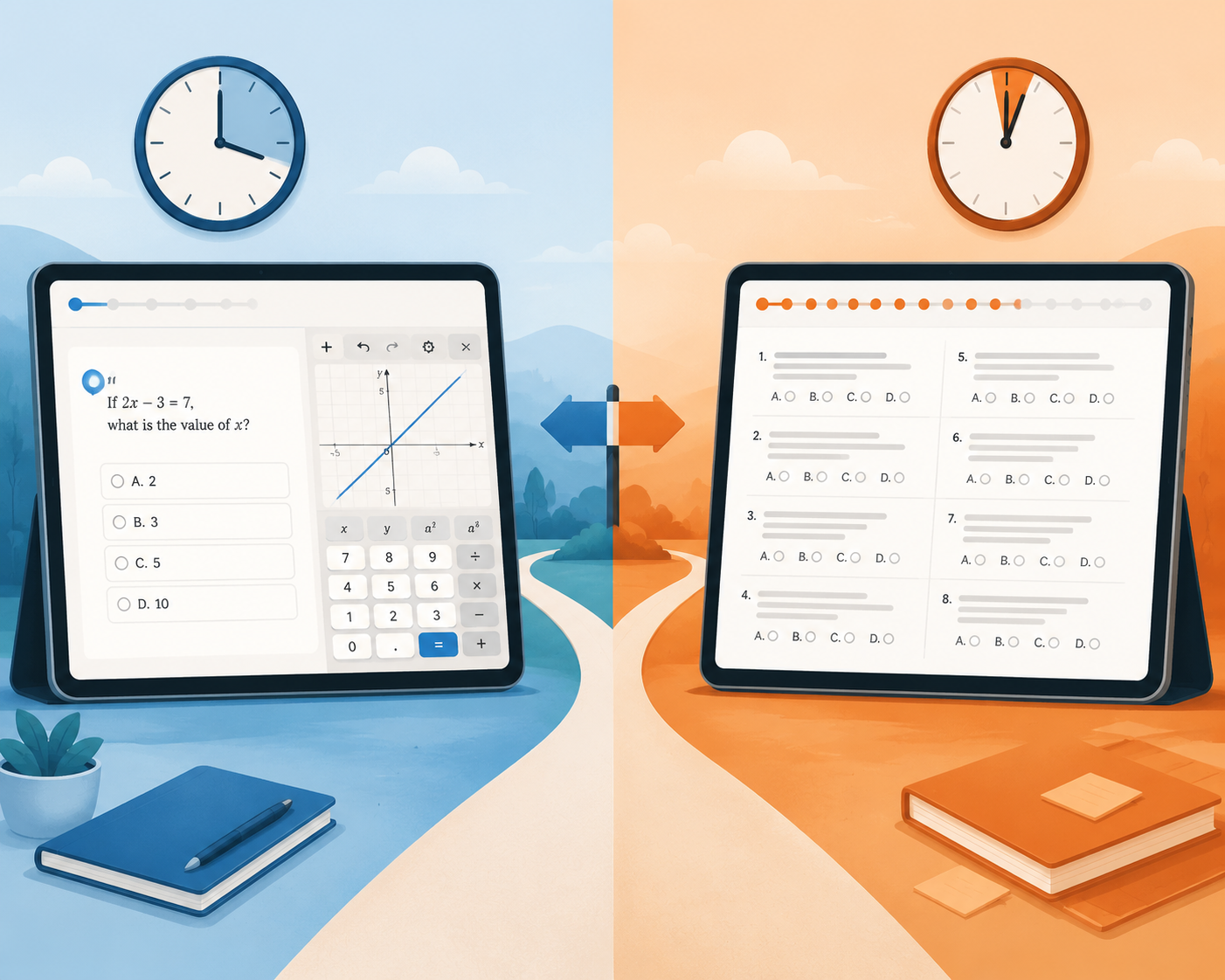
So the useful question is narrower: which exam makes your strongest habits easier to show under timed conditions? A student who says, “I’m an ACT person,” still has to explain what that means. Faster reading? Less stress when many questions are coming? Better comfort with a linear test? Stronger geometry? Or just a family story from an older sibling?
The 2026 Format Difference Is the Main Event
Most poor test-choice advice skips too quickly from “the SAT has more time” to “take the SAT,” or from “the ACT is more straightforward” to “take the ACT.” That is not enough. The format changes affect how students read, recover from mistakes, use calculators, and manage attention.
| Feature | Digital SAT | Enhanced ACT |
|---|---|---|
| Length | 2 hours 14 minutes | Roughly 2 hours for the core test; about 2 hours 55 minutes with writing |
| Question count | 98 questions | 131 core questions |
| Structure | Adaptive by module | Non-adaptive and linear |
| Pacing | About 68% more time per question than the ACT, based on Spark Admissions' analysis | Faster movement through more questions |
| Calculator | Desmos available throughout the math section | Calculator access is more limited by section and format |
| Best first question | Can the student use extra time and adaptive structure well? | Can the student stay accurate while moving quickly? |
The pacing gap is not cosmetic. Spark Admissions identifies pacing as the single biggest differentiator between the exams and estimates that the Digital SAT gives about 68% more time per question than the ACT, though the exact feel varies by section.[3] A student who routinely loses points from rushing may see that as breathing room. A student who overthinks when given extra time may not.
The ACT also changed. The Enhanced ACT gives students about 22% more time per question than the old ACT, according to ConnectPrep’s format comparison, but it is still a higher-question-volume test than the Digital SAT.[1] That matters for students who can maintain accuracy across many shorter decisions. It also matters for students who quietly fall apart when a section asks them to make one decision after another without much pause.
Adaptive SAT vs. Linear ACT
The Digital SAT is adaptive by module: performance on the first module affects the difficulty of the second module.[1] That rewards students who can stay composed after an uncertain question because the test is not just asking, “Can you answer this?” It is also asking whether the student can keep working inside a format where the second half may feel different.
For SAT-focused students, adaptive testing should become part of the prep plan, not a surprise on test day. The work is not only content review; it is learning how to handle Module 1 cleanly, how to avoid panic when Module 2 feels harder, and how to use official-style practice to judge whether the score pattern is stable. A student building an SAT route should pair an SAT exam prep guide with specific work on adaptive Module 2 strategy.
The ACT’s non-adaptive structure gives a different kind of comfort. The test does not shift its second half based on earlier performance. Students who dislike the feeling that the exam is “reacting” to them may prefer the ACT because the task is simpler to understand: move forward, answer accurately, and manage the clock.
Calculator Access Changes the Math Decision
The SAT’s built-in Desmos access is a real advantage for some students, but only if they know how to use it strategically. A student who can graph, test answer choices, inspect intersections, and check algebra efficiently may turn calculator access into both accuracy and confidence. A student who opens Desmos for every minor arithmetic decision may lose the very time the SAT gives them.
The ACT asks for a different math temperament. Because calculator access is not as expansive across the test, students need stronger comfort moving between mental math, written work, and calculator decisions.[1] That does not make ACT math harder in every case. It makes it less forgiving for students who have become dependent on graphing support.
Reading Style May Decide More Than Content
Families often ask whether the ACT reading is “easier” or the SAT reading is “trickier.” Those labels are too blunt. The better question is how the student behaves under pressure. Some students read quickly, locate evidence, and move on without needing every sentence to feel settled. Others are slower but more precise, and their score drops when they are forced into rapid passage-to-question cycling.
The ACT can suit students who tolerate a faster rhythm and do not need much recovery time between questions. The SAT can suit students who benefit from fewer questions and more room to reason, provided they do not turn that room into second-guessing. This is why a practice score alone is not the whole diagnostic. The error pattern matters.
Use a Diagnostic Before Buying a Prep Plan
The cleanest decision starts with two official-format practice tests: one SAT and one ACT. Not a ten-question quiz. Not a neighbor’s memory of what worked in 2019. Not a prep-company placement test that quietly routes every student toward a package. Cosmic NYC and Tutor Doctor both recommend using practice tests in both formats and comparing results before committing to a primary exam.[4][5]

The process is simple enough to fit on one page:
- Take an official Digital SAT practice test under realistic timing conditions.
- Take an official ACT practice test under realistic timing conditions.
- Compare percentile performance, not just raw score comfort.
- Review missed questions by cause: content gap, timing, misread, careless error, anxiety, or unfamiliar format.
- Choose a primary test unless the results are genuinely close.
Percentiles matter because SAT and ACT raw scores do not speak the same language. A student may like one test more because it felt calmer, but if the percentile result is clearly stronger on the other, the family should at least ask why. Comfort is useful; score evidence is better.
For the SAT side of the diagnostic, use official Bluebook testing and high-quality follow-up resources. If the student has not used the official setup before, start with Bluebook and Khan Academy practice test guidance. If you are comparing third-party SAT materials, check which Digital SAT practice tests are most accurate before treating a result as diagnostic.
What the Error Review Should Actually Look For
A useful score review is not a list of wrong answers. It is a pattern hunt. On the SAT, watch for students who had enough time but changed correct answers, underused Desmos, or panicked when the second module felt harder. On the ACT, watch for students who knew the material but lost points in the final stretch of each section, skipped too slowly, or carried one bad passage into the next.
A hypothetical example: if a student misses mostly algebra questions on both exams, the issue is probably content, not test choice. If the same student finishes SAT math with time left but leaves several ACT questions blank, the format is now part of the diagnosis. If ACT English is strong but SAT reading-and-writing errors cluster around careful wording, the student may need SAT-specific practice rather than a wholesale switch.
Score concordance can help, but it should not replace this review. Official concordance tables are meant to approximate relationships between SAT and ACT scores, not to declare that one test is automatically better for a particular student.[6] Rough claims such as “ACT 30 equals SAT 1400” are too easy to misuse when the student’s section profile tells a more specific story.
When SAT Prep Is the Better First Bet
Choose SAT prep as the primary track when the student’s diagnostic shows stronger percentile performance on the SAT, or when the error pattern suggests the SAT format gives the student a fairer chance to show what they know.
- The student benefits from more time per question and does not overthink when time is available.
- The student can learn to use Desmos efficiently rather than compulsively.
- The student prefers shorter question sets and can handle adaptive-module uncertainty.
- The student’s ACT mistakes are mostly timing-related rather than content-related.
- The student has limited prep time and needs one focused plan instead of two half-plans.
Once the SAT is the primary path, build the materials around that choice. A lean SAT prep toolkit is usually better than three platforms nobody uses consistently. Free resources can be enough for some students; others need feedback, structure, or accountability. If cost is part of the decision, compare options such as Khan Academy and AI SAT tutors or a free Gemini SAT practice test before buying more than the student can realistically complete.
When ACT Prep Is the Better First Bet
Choose ACT prep when the student’s percentile result is stronger on the ACT or the student’s working style clearly matches the ACT’s faster, non-adaptive structure. This is not a consolation prize for students who dislike the SAT. For some students, the ACT is cleaner because the test keeps moving and does not ask them to interpret adaptive difficulty while they are still testing.
- The student reads quickly and can answer without lingering.
- The student prefers a linear test where every section feels structurally predictable.
- The student handles many questions without decision fatigue.
- The student is comfortable doing math without relying on Desmos-style graphing support.
- The student’s SAT mistakes increase when the adaptive format or extra time leads to second-guessing.
ACT prep should protect the student’s speed without letting speed become sloppiness. The first few weeks should usually emphasize pacing checkpoints, section timing, and quick review of recurring content gaps. A student who is already carrying AP classes, sports, work, or family responsibilities does not need a heroic study calendar; they need a calendar they can actually obey.
Should You Prep for Both?
Prepping for both can make sense, but it should be earned by the diagnostic. Princeton Review notes that students can prepare for both exams when needed, but that approach requires planning because the tests are not identical.[7] In practice, “both” often means twice the practice tests, twice the review systems, twice the calendar pressure, and twice the chance that a tired student starts doing mediocre work on everything.
Keep both tests alive briefly when the percentile results are close, the student has enough time before target test dates, and the family has not yet seen a stable pattern after at least one round of review. Do not keep both alive because nobody wants to make a decision. Delay is not strategy.
| Diagnostic result | Best next move |
|---|---|
| SAT percentile is clearly stronger | Choose SAT prep and schedule the next official-style checkpoint |
| ACT percentile is clearly stronger | Choose ACT prep and build pacing practice around the ACT format |
| Percentiles are close, but one test felt much less stressful | Review error patterns before deciding; comfort matters if scores are comparable |
| Percentiles are close and error patterns are mixed | Prep both briefly, then retest and choose |
| Both scores are weak for the same content reasons | Fix the content gap first; test choice may not be the main problem yet |
This is also where schedule honesty matters. If a student has fall sports, AP labs, a school musical, or a heavy work schedule, a two-test plan may look impressive in a spreadsheet and collapse by the third weekend. Use a high school revision timetable to mark school deadlines, test dates, and practice-test weekends before committing to both exams.
College Policy Still Matters, But It Should Not Choose the Test for You
The current admissions landscape gives families two jobs. First, verify policies for the student’s actual target schools because testing requirements and test-optional rules remain in flux. Second, avoid turning policy anxiety into bad prep strategy. If a college accepts either exam, the student should submit the score that best represents their ability, not the score attached to the test adults in the room have heard more about.
The reinstatement of testing requirements at several elite schools makes test planning relevant again for many applicants, but it does not make one exam more prestigious than the other.[2] A student applying to test-required schools needs a score plan. A student applying mostly to test-optional schools may still benefit from a score if it strengthens the application. In both cases, the SAT-versus-ACT decision should come from evidence, not folklore.
A Practical Decision Rule for 2026
Choose the SAT if the student benefits from more time per question, can use Desmos strategically, and can stay calm inside an adaptive format. Choose the ACT if the student is steadier with faster movement, shorter decision cycles, and a non-adaptive test. Prep for both only when the diagnostics are close, the calendar can support it, or the student has not yet shown a clear format advantage.
After that, stop shopping for opinions. Pick a primary test, schedule the next official practice checkpoint, and build the prep calendar around the exam that best reveals the student’s strengths. If the plan includes tutoring, decide whether local SAT prep actually matters or whether online practice and feedback will do the job. The right plan is the one the student can follow well enough to produce a real score, not the one that sounds most comprehensive in July.
References
- ACT vs SAT 2026-2027: Which Test Is Right for You?, ConnectPrep
- The Ultimate Guide to the SAT, ACT, and College Admissions in 2026, Summit Prep
- SAT vs ACT 2026, Spark Admissions
- SAT vs ACT in 2026, Cosmic NYC
- ACT vs. SAT in 2025: Which Test Should Your Child Take?, Tutor Doctor
- ACT vs SAT, UWorld
- How to Prep for Both the SAT and ACT, The Princeton Review
Supporting Resources
- How to Use ASVAB Study Apps Effectively: A Study Plan Framework for Scoring 50+ on the AFQT →
Most recruits download an ASVAB app but don't use it systematically. This guide provides a step-by-step study plan framework — from diagnostic testing to timed simulations — to help you turn app access into a competitive AFQT score of 50 or higher.
- MCAT Study Tools in 2026: Courses, Question Banks, and Flashcard Apps Compared →
A practical comparison of the top MCAT prep courses, question banks, and flashcard apps for 2026, with decision frameworks to help you build the right study stack for your budget and score target.
- Life Application Study Bible App: Complete Profile and Review for 2026 →
A complete profile and review of the Life Application Study Bible app for Christians and Bible students. We break down its features, pricing options, recent 2026 updates, and how it compares to free alternatives like YouVersion.
Comments
Join the discussion with an anonymous comment.