
ASVAB Exam Hub
Partial Lunar Eclipse, Explained for Students
A partial lunar eclipse is a safe, naked-eye demonstration of Earth's shadow geometry — and the one on the night of August 27–28, 2026 will be unusually deep and visible across the Americas, Europe, and Africa. This explainer helps students understand the umbra-versus-penumbra mechanism, why eclipses don't happen every full moon, what causes the reddish shadow, and exactly when to step outside to watch.
- gre
- mcat
- asvab
- sat
- act
- digital-adaptive
- official-material
- section-strategy
- test-date-timeline
On the night of August 27–28, 2026, the Moon gives students a useful live example of sky geometry: a partial lunar eclipse that is almost, but not quite, total. Greatest eclipse happens around 4:12–4:13 UTC on August 28, which is 12:12–12:13 a.m. EDT for the eastern United States. [1][2][3]
What you should expect to see is not the Moon disappearing like a light switch. A dark, curved bite from Earth’s central shadow will cover most of the full Moon. The covered part may look dull red or coppery, while the remaining sunlit sliver stays much brighter. That contrast is the useful part for a student: the eclipse draws Earth’s shadow on the Moon where your eyes can catch it.
The numbers explain why this one is worth stepping outside for. Time and Date lists the eclipse at 96.2% obscuration with an umbral magnitude of 0.930; NASA’s Scientific Visualization Studio says 96.3% of the lunar disk is within the umbra; Sky & Telescope describes it as 96%, magnitude 0.93. [1][2][3] Those are not three different eclipses and they should not be mashed into one fake-perfect decimal. They are three close ways of reporting the same practical fact: nearly the whole Moon enters Earth’s dark inner shadow, but a thin part stays outside it.
A lunar eclipse is safe to view with the naked eye. You do not need eclipse glasses for a lunar eclipse; those rules belong to solar eclipses. [4][5] If you want a separate safety checklist, use the August 2026 blood moon safety study guide. Here, the main job is understanding what the shadow is doing.
The short timeline: when the shadow changes
This is not meant to replace a full observing plan, but the timing matters because each stage shows a different part of the model. Time and Date gives the partial phase as about 3 hours 18 minutes and the full penumbral-to-penumbral event as about 5 hours 38 minutes. [1]
| Stage | What it means for the Moon | What a student should notice |
|---|---|---|
| Penumbral eclipse begins | The Moon enters Earth’s faint outer shadow. | The change can be subtle; the Moon may only look slightly shaded. |
| Partial eclipse begins | Part of the Moon enters Earth’s dark inner shadow, the umbra. | The curved dark bite becomes the obvious feature. |
| Greatest eclipse, about 4:12–4:13 UTC / 12:12–12:13 a.m. EDT | The Moon is deepest in the umbra. | Almost the whole disk is shadowed, but the eclipse is still partial. |
| Partial eclipse ends | The Moon leaves the umbra. | The dark bite shrinks and the umbral darkening ends. |
| Penumbral eclipse ends | The Moon leaves Earth’s outer shadow. | The event is over, even if the last faint shading was hard to detect. |
For more location-specific watching notes, the blood moon observation tips for astronomy students can handle the practical checklist. The table above is the science version: penumbra first, umbra next, deepest umbra at greatest eclipse, then the same sequence in reverse.
Build the eclipse backward from what you see
Start with the visible clue: a curved shadow moves across the Moon. That curve is not the Moon’s own shadow. It is Earth’s shadow falling on the Moon.
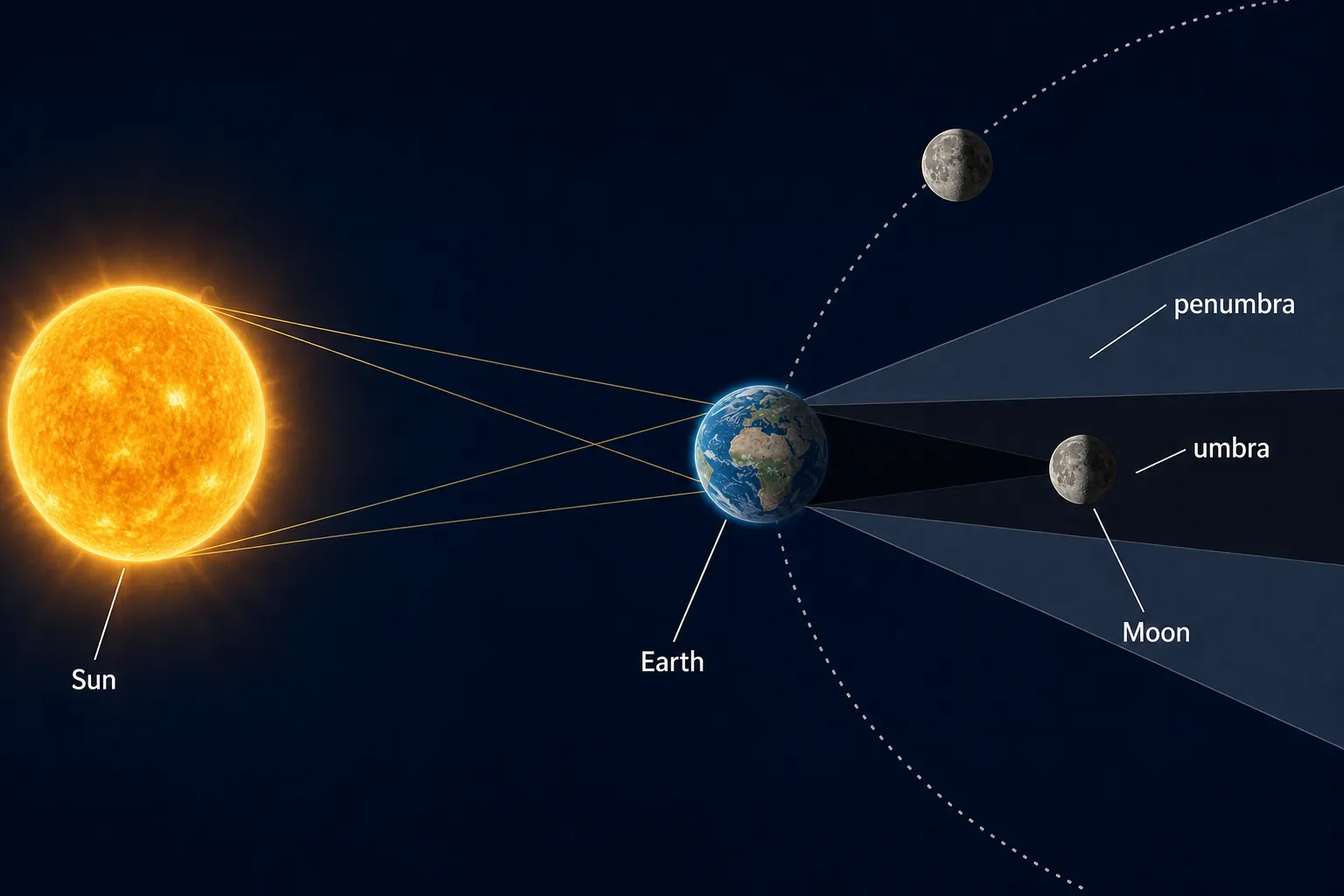
For Earth’s shadow to fall on the Moon, the Moon has to be on the opposite side of Earth from the Sun. That is why lunar eclipses happen at full Moon. The order is Sun, Earth, Moon, with Earth in the middle.
Earth’s shadow has two useful parts. The penumbra is the lighter outer shadow, where Earth blocks only part of the Sun’s light. The umbra is the darker central shadow, where Earth blocks direct sunlight much more completely. In a partial lunar eclipse, only part of the Moon enters the umbra. In a total lunar eclipse, the whole Moon enters the umbra. In a penumbral lunar eclipse, the Moon stays in the faint outer shadow and never enters the umbra.
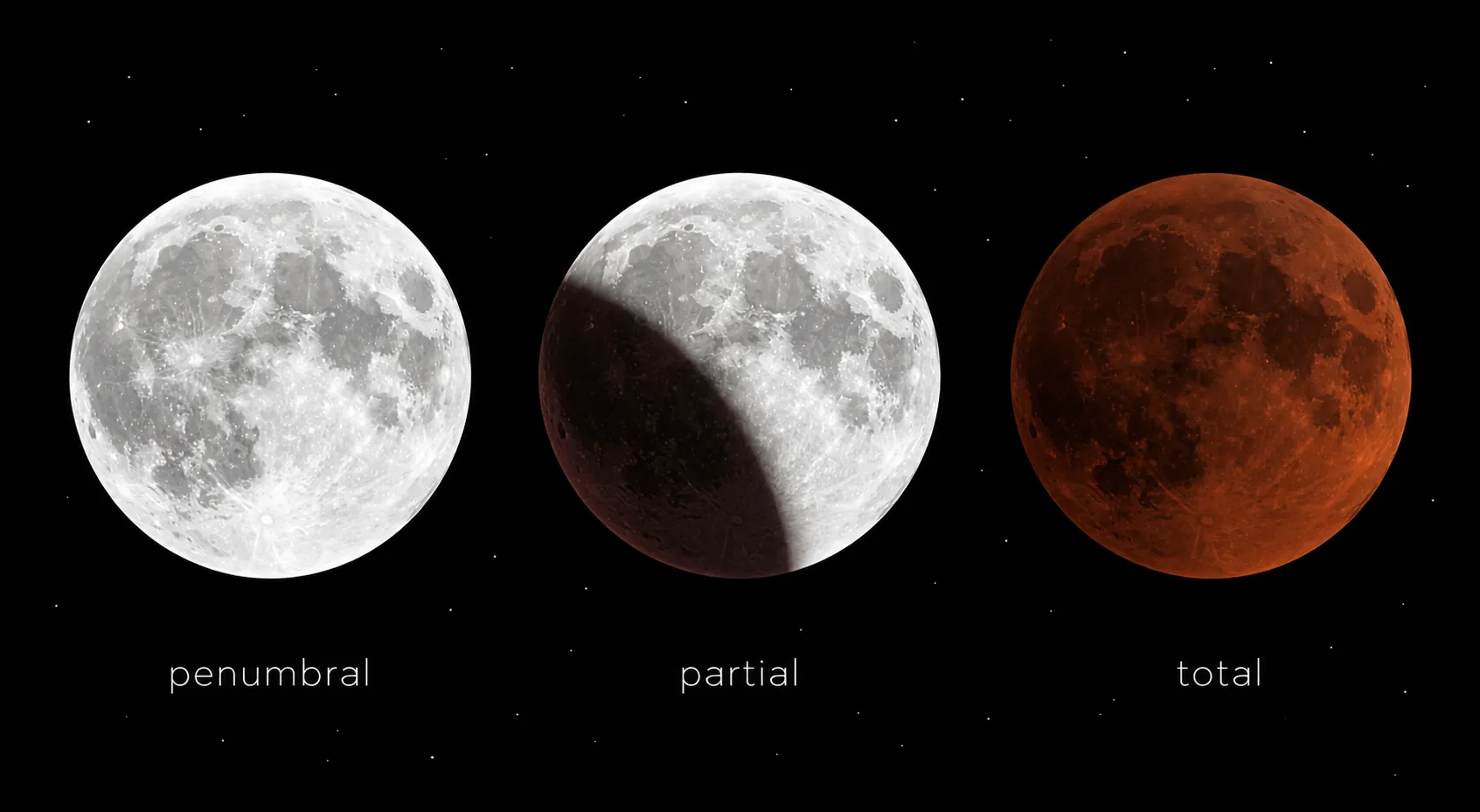
That last distinction is why the word “partial” matters. This August 2026 eclipse is deep enough that it may look dramatic, but “nearly total” is not the same as total. A remaining bright edge means part of the Moon is still outside the umbra.
Do not picture Earth’s umbra as too tiny to cover the Moon. At the Moon’s average distance, Earth’s umbral shadow is roughly 5,800 miles wide, while the Moon is about 2,200 miles across. [6] NASA eclipse material also describes the umbral shadow at the Moon as roughly 2.7 times the Moon’s diameter, and Fred Espenak notes that during a partial lunar eclipse the bright sunlit part can appear about 500 times brighter than the shadowed portion. [7] So if the Moon is not totally eclipsed, the problem is not that Earth’s shadow is too small. The problem is alignment.
Why Earth’s shadow does not hit the Moon every month
This is the question that trips up a lot of students who actually understand the first half. If a lunar eclipse requires a full Moon, and a full Moon happens every month, why is there not a lunar eclipse every month?
Because the Moon’s orbit is tilted about 5° compared with Earth’s path around the Sun. Most full moons pass a little above or below Earth’s shadow instead of through it. [8][9][5] On a flat worksheet diagram, it is easy to draw the Sun, Earth, and Moon in one perfect line every time. In space, the Moon’s path is tilted, so the full Moon usually misses the shadow.
The points where the Moon’s tilted orbit crosses Earth’s orbital plane are called nodes. Eclipses happen when the full Moon occurs near one of those nodes, so the Moon is not just full but also lined up closely enough with Earth’s shadow. NASA/JPL describes eclipse seasons as periods of about 34 days that occur just shy of every six months. [10]
That one idea explains a lot of the calendar. The August 27–28 lunar eclipse is the second eclipse of its season, coming about two weeks after the August 12, 2026 total solar eclipse. [1] Solar and lunar eclipses use the same alignment vocabulary, but with the shadows swapped. If you want the solar-eclipse version of the model, use the August 2026 solar eclipse astronomy guide or the ASVAB solar eclipse astronomy guide.
If Moon phases themselves still feel slippery, review the Moon phases astronomy study guide before trying to memorize eclipse types. A lunar eclipse is not a random phase. It is a full Moon plus the right node alignment.
Why the shadowed part can look red
If Earth blocks direct sunlight, the Moon should seem to go dark. It does, partly. But Earth has an atmosphere, and that atmosphere changes the light that reaches the umbra.
Shorter blue wavelengths scatter more strongly in Earth’s atmosphere, while redder light is bent, or refracted, into Earth’s shadow. NASA, Space.com, and the Natural History Museum all connect this reddish lunar-eclipse light to the same basic physics that makes sunsets look red. [4][6][5] For the scattering side of that idea, see the Rayleigh scattering explainer.
Vocabulary matters here. A total lunar eclipse is the event most people usually mean by a “blood moon,” because the whole Moon is inside the umbra and can take on a red color. During this August 2026 partial lunar eclipse, the shadowed part may look red, but the Moon is not fully inside the umbra. [5][6]
Who can see it, and how unusual is it?
The eclipse is visible across the Americas, Europe, and Africa. Time and Date estimates that about 1.28 billion people can see all of the partial phase and about 987 million can see the entire eclipse. [1] NASA gives the same broad visibility emphasis for the Americas, Europe, and Africa. [2]
Frequency claims need careful handling because sources are measuring slightly different things. NASA’s grades 5–8 eclipse page says at least two partial lunar eclipses occur each year, while the Natural History Museum says there are about three lunar eclipses of all types per year on average. [11][5] Those statements are useful, but they are not the same statistic.
The depth is what makes this one stand out for students in the Americas. Sky & Telescope and Space.com both point to the total lunar eclipse of June 26, 2029 as the next eclipse near this deep for the Americas. [3][6] That does not make the 2026 event rare in every possible way; it makes it a strong, timely example of a partial eclipse that is easy to recognize without equipment.
Why this is testable
ASVAB General Science may ask basic Earth–Moon–Sun astronomy: phases, shadows, seasons, or why eclipses require alignment. ACT Science is more likely to give you a diagram, table, or short passage and ask what the data show. The August 2026 eclipse works nicely for both because the visible event, timing table, and geometry all point to the same model.
- Umbra versus penumbra: the umbra is the dark central shadow; the penumbra is the faint outer shadow.
- Full Moon requirement: a lunar eclipse happens when Earth is between the Sun and Moon, so the Moon must be full.
- Not every full Moon: the Moon’s orbit is tilted about 5°, so most full moons pass above or below Earth’s shadow.
- Partial versus total: in a partial lunar eclipse, only part of the Moon enters the umbra, even if the partial eclipse is very deep.
- August 2026 data: greatest eclipse is around 4:12–4:13 UTC on August 28, or 12:12–12:13 a.m. EDT, with roughly 96% of the Moon in the umbral shadow depending on the source’s reporting.
- Red tint: blue light scatters in Earth’s atmosphere while redder light is bent into the umbra, the same basic reason sunsets look red.
For practice beyond this single sky event, use the ASVAB General Science astronomy practice, the ASVAB exam hub, or the ACT exam hub.
References
- Partial Lunar Eclipse on 27–28 August 2026, Time and Date.
- August 27-28, 2026 Deep Partial Lunar Eclipse, NASA Scientific Visualization Studio.
- Next Up! A Deep Partial Lunar Eclipse on Aug. 27–28, Sky & Telescope.
- Lunar Eclipses, NASA.
- What is a lunar eclipse?, Natural History Museum.
- Lunar eclipse guide: What they are, when to see them and where, Space.com.
- Visual Appearance of Lunar Eclipses, NASA Eclipse Web Site.
- What is a lunar eclipse?, Britannica.
- Moon's Orbit and Rotation, NASA.
- Why Do Eclipses Happen?, NASA/JPL.
- Lunar Eclipse, NASA Space Place.
Related exhibits & inventory
Verified outcomes
No verified outcomes on file for this exam yet
See Methodology for how outcome evidence is disclosed once logged.
Planners
No planner filed for this exam yet
A downloadable timeline template for this exam hasn't been published yet.
Tool verdicts
AI-tool cautions
No AI tools tested for this exam yet
No hands-on AI-accuracy logs have been filed for this exam.
Questions about this plan
Ask a question about a specific section, timeline, or citation in this plan — or flag something that needs correcting.
Comments
Join the discussion with an anonymous comment.