
DSST Exam Hub
Moon Phases Study Guide for Your Astronomy Final
Cramming for a college astronomy final? This question-type guide maps the moon phase concepts exams actually reuse — phase cause, order, moonrise and moonset timing, the 27.3- vs. 29.5-day months, eclipse alignment, and tidal locking — so you can study the tested facts instead of the whole chapter.
- gre
- mcat
- asvab
- sat
- act
- digital-adaptive
- official-material
- section-strategy
- test-date-timeline
What moon-phase questions are really testing
If your astronomy final is tomorrow, “study moon phases” is too vague to be useful. The testable version is smaller: know what causes phases, put the eight phases in order, connect each major phase to rise and set times, separate the 27.3-day orbital month from the 29.5-day phase cycle, recognize when eclipses can happen, and explain why the Moon keeps the same face toward Earth.
The first trap is also the most popular wrong answer: lunar phases are not caused by Earth’s shadow. They come from Sun-Earth-Moon geometry. The Moon is always half illuminated by the Sun; from Earth, we see different fractions of that sunlit half as the Moon orbits us.[1]
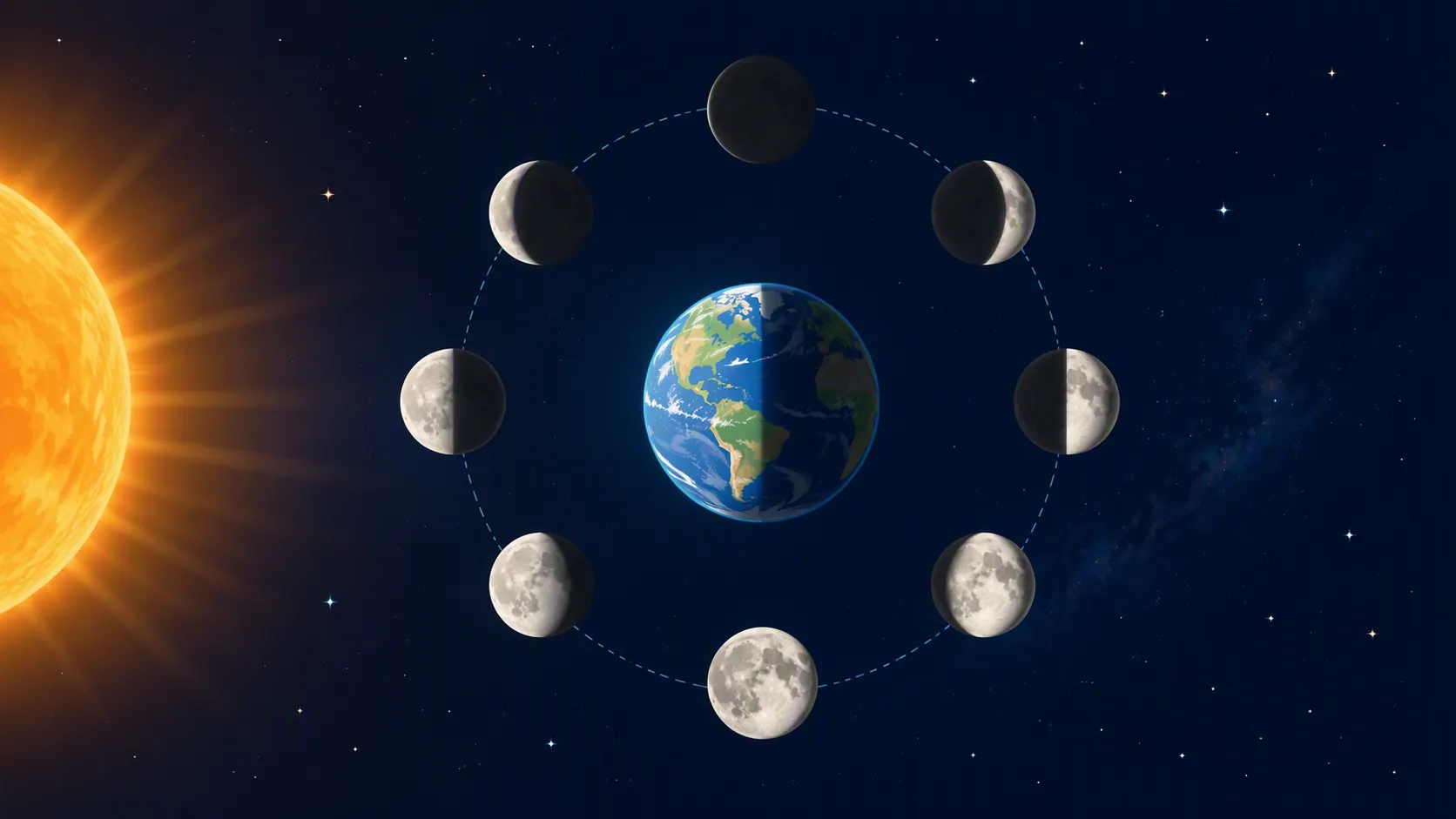
That distinction matters because exam choices are often written to sound visually plausible. “The Moon is dark because Earth blocks sunlight” feels right if you are picturing a shadow. For ordinary phases, it is wrong. Earth’s shadow belongs to lunar eclipses, not to the monthly phase cycle.
Phase order is the easy memorization part
The order is not where most students lose the whole problem, but it is the base layer. If the order is shaky, the timing questions become guesswork.
| Phase | What the lit part is doing | Exam cue |
|---|---|---|
| New Moon | Near side is mostly dark | Moon is in the same general direction as the Sun |
| Waxing crescent | Lit fraction is growing, less than half | Visible after sunset in the western sky |
| First quarter | Half of the near side is lit | A quarter of the way through the phase cycle |
| Waxing gibbous | Lit fraction is growing, more than half | Between first quarter and full |
| Full Moon | Near side is fully illuminated | Moon is opposite the Sun in the sky |
| Waning gibbous | Lit fraction is shrinking, more than half | After full, before third quarter |
| Third quarter | Half of the near side is lit | Also called last quarter |
| Waning crescent | Lit fraction is shrinking, less than half | Visible before sunrise in the eastern sky |
Two vocabulary checks sit inside that table. “Waxing” means the illuminated fraction is increasing. “Waning” means it is decreasing. “Crescent” is less than half lit; “gibbous” is more than half lit. Once those words are automatic, many phase-identification questions become word decoding rather than astronomy.
For the four principal phases, astronomy diagrams often describe the Moon-Sun angle, or elongation, as 0°, 90°, 180°, and 270° around the cycle. That is why quarter phases line up with half-lit appearances: the Moon is roughly at a right angle from the Sun as seen from Earth.[2]
Moonrise and moonset: the section worth slowing down for
This is the part that turns “I know the phases” into points on a final. A phase-timing question may ask when a full Moon rises, what phase is overhead at sunset, or which phase is visible before sunrise. The answer comes from one idea: the Moon’s phase tells you where it is relative to the Sun in the sky.
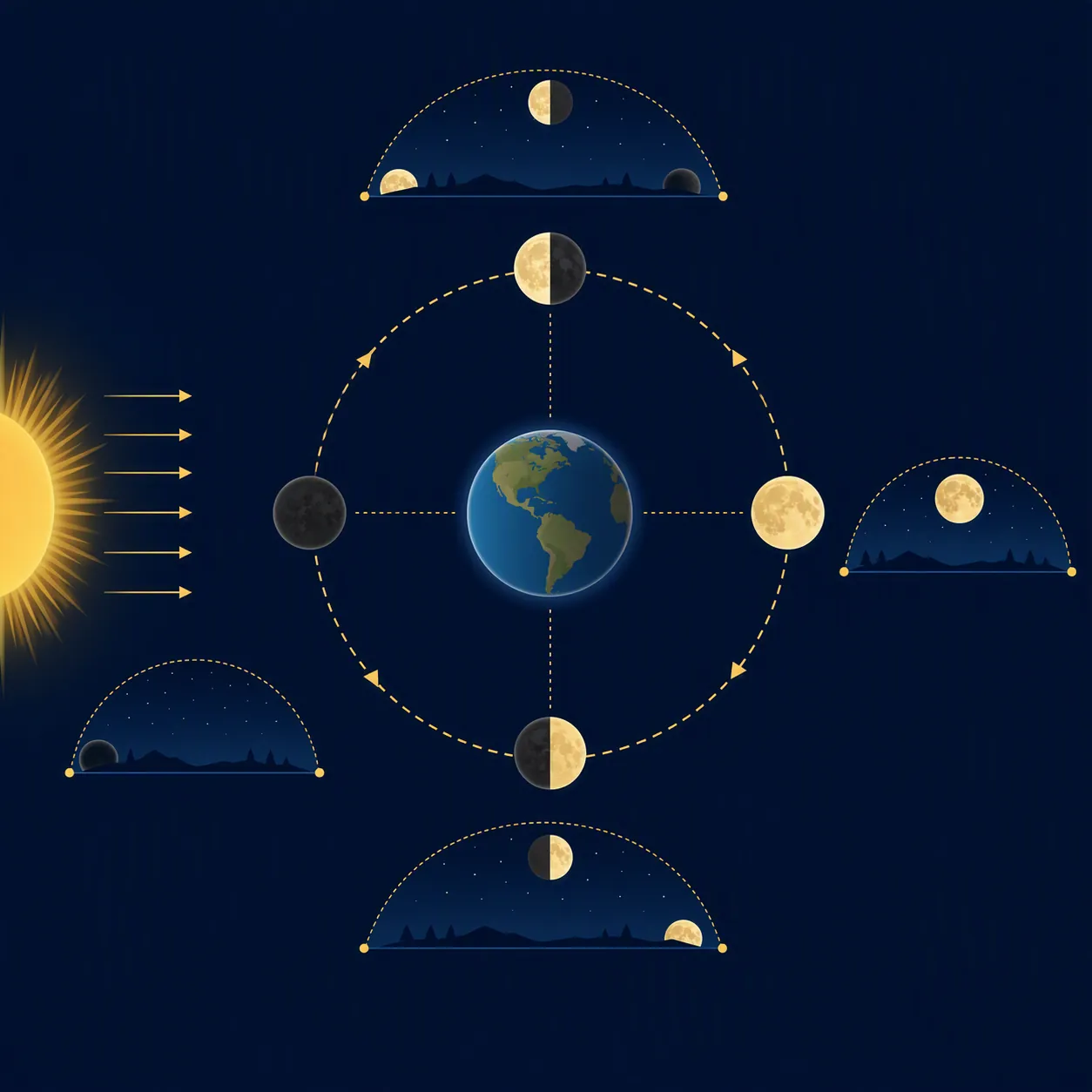
Start with the Sun’s daily pattern: it rises around sunrise, is highest around noon, and sets around sunset. Then place the Moon relative to that. A new Moon is in the same direction as the Sun, so it rises and sets with the Sun. A full Moon is opposite the Sun, so it rises around sunset and sets around sunrise. First quarter is about 90° east of the Sun, so it rises around midday and sets around midnight. Third quarter is about 90° west of the Sun, so it rises around midnight and sets around midday.[3]
| Phase | Rises around | Highest around | Sets around |
|---|---|---|---|
| New Moon | Sunrise | Noon | Sunset |
| First quarter | Noon | Sunset | Midnight |
| Full Moon | Sunset | Midnight | Sunrise |
| Third quarter | Midnight | Sunrise | Noon |
Do not try to memorize every intermediate phase as a separate clock fact. Put it between the nearest anchors. A waxing crescent is between new and first quarter, so it rises after sunrise and sets after sunset. A waxing gibbous is between first quarter and full, so it rises between noon and sunset and sets between midnight and sunrise. A waning gibbous comes after full, so it rises after sunset and sets after sunrise. A waning crescent comes before new, so it rises before sunrise and sets before sunset.
The “roughly six hours” rule is the useful mental shortcut. A 90° separation in the sky corresponds to about a quarter of a daily rotation, so the quarter phases are offset from the Sun by about six hours. A 180° separation puts the full Moon about twelve hours opposite the Sun. That is the whole clock model.
Here is the kind of problem that used to separate the students who had a diagram in their heads from the students who only knew the names: if the Moon is highest in the sky at sunset, what phase is it? At sunset, the Sun is on the western horizon. Something highest in the sky is about 90° east of the Sun. That is first quarter.
Another common version: which phase rises at sunset? Do not picture a pretty Moon. Use the opposition rule. If it rises when the Sun sets, it is opposite the Sun, so it is full.
The 27.3-day month and the 29.5-day month are not competing facts
When a question asks for “the Moon’s period,” check what the period is being measured against. The Moon takes about 27.3 days to return to the same position relative to the background stars. That is the sidereal month. It takes about 29.5 days to return to the same phase, such as new Moon to new Moon. That is the synodic month.[1][4]
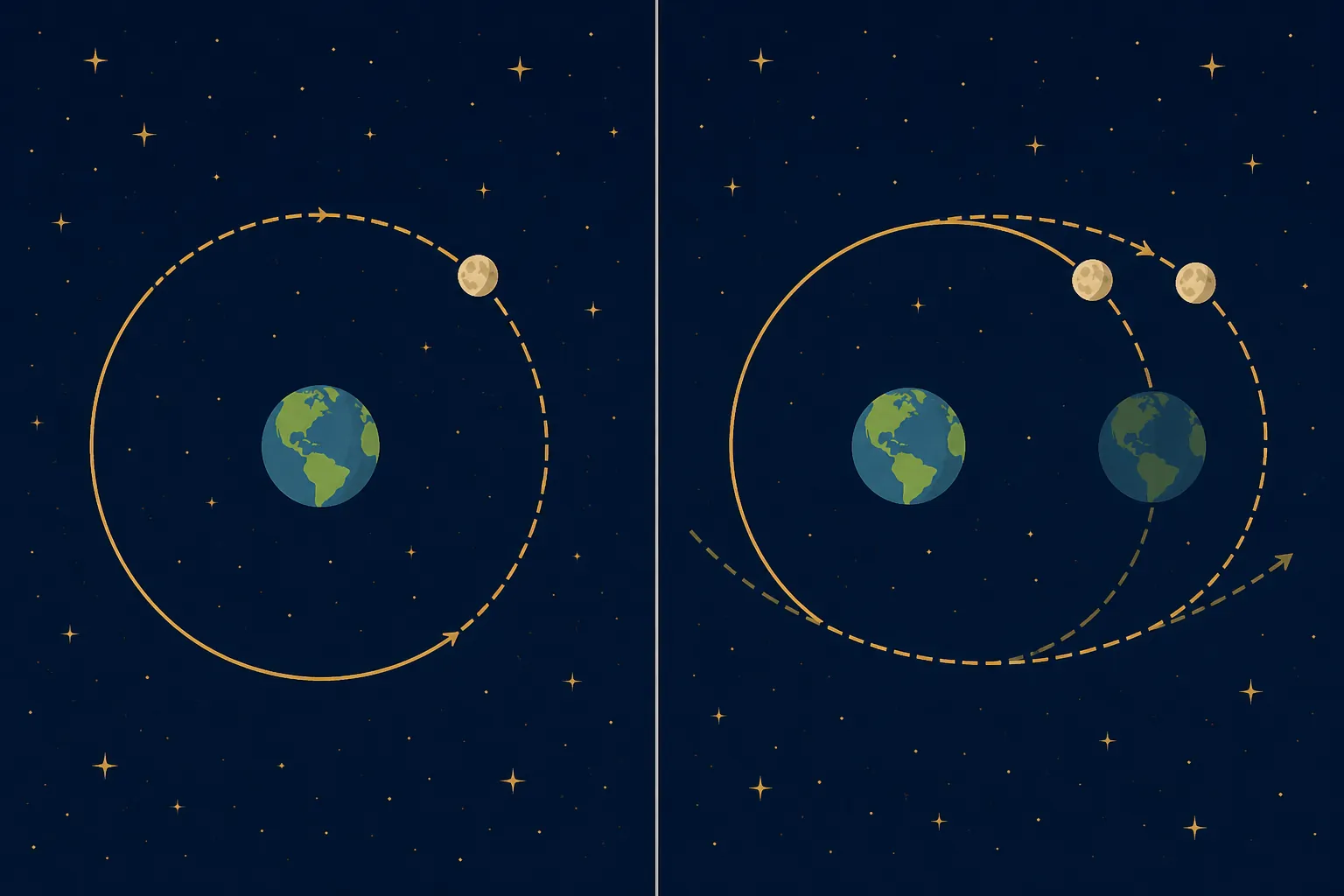
The extra time is not a rounding error. While the Moon is orbiting Earth, Earth is also moving around the Sun. After the Moon has completed one orbit relative to the stars, the Sun-Earth-Moon angle has not quite returned to the same phase geometry. The Moon has to travel a little farther, which adds roughly 2.2 days.[4]
| If the question says... | Use this month | Approximate length |
|---|---|---|
| Return to the same position against the stars | Sidereal month | 27.3 days |
| Return to the same phase | Synodic month | 29.5 days |
| New Moon to new Moon | Synodic month | 29.5 days |
| One orbit measured relative to distant stars | Sidereal month | 27.3 days |
For final-cram purposes, the best spoken explanation is short: “Sidereal is stars, 27.3. Synodic is same phase, 29.5, because Earth moved along its orbit.” If you can say that without looking, you can usually handle the multiple-choice version.
Eclipses require the right phase and the right alignment
Eclipse questions are where the Earth-shadow misconception comes back in a more legitimate form. A lunar eclipse really does involve the Moon passing through Earth’s shadow, but that can only happen at full Moon. A solar eclipse can only happen at new Moon, when the Moon is between Earth and the Sun.[2][5]
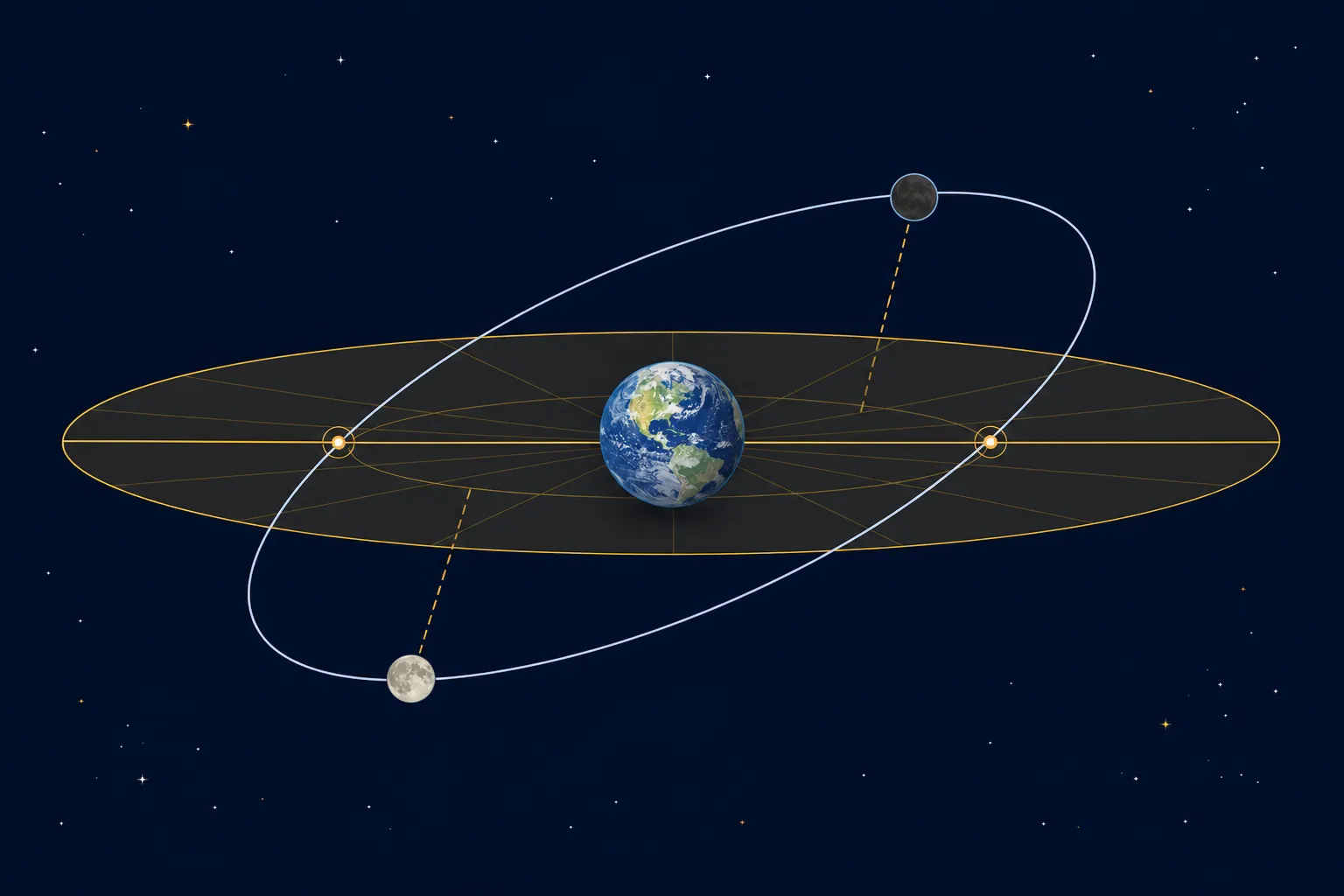
The phase requirement is necessary, but it is not enough. The Moon’s orbit is tilted by about 5° relative to Earth’s orbital plane, so most new Moons and full Moons pass above or below the exact Sun-Earth line. Eclipses occur when the Moon is near one of the orbital nodes, the crossing points of those two planes, at the same time the phase is new or full.[5]
| Event | Required phase | Alignment condition |
|---|---|---|
| Solar eclipse | New Moon | Moon near a node, between Earth and Sun |
| Lunar eclipse | Full Moon | Moon near a node, passing through Earth’s shadow |
That is why “there is a new Moon” is not the same as “there is a solar eclipse.” Calendar years have only a limited number of eclipses, commonly described as roughly four to seven total solar and lunar eclipses in a year, not one at every new and full Moon.[2][5]
If your instructor likes current-sky examples, the same node-and-new-Moon logic is the useful part of a solar eclipse story. The site’s 2026 solar eclipse astronomy guide applies that alignment model in an exam-practice frame.
Tidal locking: same face does not mean no rotation
The Moon keeps nearly the same face toward Earth because it is tidally locked: its rotation period matches its orbital period. In plain exam language, the Moon rotates once for each orbit around Earth.[1][4]
The tempting wrong answer is “the Moon does not rotate.” If it did not rotate, observers on Earth would see different sides over the course of its orbit. Instead, the matching spin-and-orbit timing keeps the same hemisphere generally pointed toward us.
There is a small refinement: because of libration, observers can see about 59% of the Moon’s surface over time, not exactly one unchanging 50% forever. That detail is usually secondary to the main test point, but it can appear as a “same face” qualification.[2][4]
A one-night drill for the final
Do the drill in the order the concepts support each other. It is not glamorous, but it hits the answer patterns.
- Say the cause out loud: phases come from Sun-Earth-Moon geometry, not Earth’s shadow.
- Write the eight phases in order twice, marking waxing as growing and waning as shrinking.
- Recite the four timing anchors: new with the Sun; first quarter rises noon and sets midnight; full rises sunset and sets sunrise; third quarter rises midnight and sets noon.
- Practice two timing conversions: “rises at sunset” means full; “highest at sunset” means first quarter.
- Explain the month distinction without notes: sidereal is 27.3 days against the stars; synodic is 29.5 days for the same phase because Earth moved.
- Check eclipse requirements: solar means new Moon near a node; lunar means full Moon near a node.
- Finish with tidal locking: same face because the Moon rotates once per orbit, not because it fails to rotate.
If your “astronomy exam” is a credit-by-exam course rather than a campus final, pair this with the Blood Moon DSST astronomy study guide. If you are reviewing lunar ideas for a different exam scope, the Buck Moon ASVAB General Science article keeps the same sky mechanics inside the ASVAB frame.
References
- Moon Phases — NASA Science
- Lunar phase — Wikipedia
- What Causes the Moon’s Phases? — NASA Space Place
- Lecture 8: Phases of the Moon — Ohio State Astronomy 161
- The phases of the Moon explained — The Planetary Society
Related exhibits & inventory
Verified outcomes
No verified outcomes on file for this exam yet
See Methodology for how outcome evidence is disclosed once logged.
Planners
No planner filed for this exam yet
A downloadable timeline template for this exam hasn't been published yet.
Tool verdicts
AI-tool cautions
No AI tools tested for this exam yet
No hands-on AI-accuracy logs have been filed for this exam.
Questions about this plan
Ask a question about a specific section, timeline, or citation in this plan — or flag something that needs correcting.
Comments
Join the discussion with an anonymous comment.