
ASVAB Exam Hub
ASVAB Astronomy Study Guide for the 2026 Solar Eclipse
ASVAB General Science test-takers can use the August 12, 2026 total solar eclipse as a mnemonic anchor for the astronomy concepts that appear across GS practice banks: new-moon eclipse geometry, umbra vs. penumbra, the Moon's orbital tilt, and eclipse seasons. Worked GS-format questions show how each concept appears in test-style items, with every claim attributed to its source.
- gre
- mcat
- asvab
- sat
- act
- digital-adaptive
- official-material
- section-strategy
- test-date-timeline
What the August 12 eclipse is allowed to do for ASVAB prep
Last reviewed August 3, 2026, this page is looking nine days ahead to NASA’s August 12, 2026 total solar eclipse listing for one reason: it gives ASVAB General Science students a clean memory hook for a small astronomy cluster that practice banks like to test in fast, recognition-based form.[1]
This is a 2026 solar eclipse astronomy study guide for students taking ASVAB General Science. It is not a viewing guide, not the full eclipse primer, and not a multi-exam overview. For subtest planning, start from the ASVAB exam prep guide. For the broader astronomy explanation, use How the 2026 Solar Eclipse Teaches Students Astronomy. For school viewing and glasses, go to How to Get Safe Solar Eclipse Glasses for Science Class. Here, the only useful question is: if an eclipse item appears with four answer choices, what must you recognize in under a minute?
Before the astronomy: the ASVAB evidence boundary
General Science is timed tightly enough that this topic has to be learned as a recognition pattern, not as a mini astronomy course. Mometrix lists the CAT-ASVAB General Science subtest as 15 questions in 12 minutes.[2] TestPrepReview gives the same CAT-ASVAB figure and lists the paper-and-pencil General Science version as 25 questions in 11 minutes.[3]
There is a format conflict worth saying out loud. This site’s companion Buck Moon ASVAB General Science article cites 16 questions in 8 minutes for CAT General Science. Mometrix and TestPrepReview, by contrast, both state 15 questions in 12 minutes for CAT-ASVAB General Science.[2][3] Until your official test instructions settle the timing for your administration, do not build strategy around a prep-page minute count. Build it around the safer fact: General Science moves fast, so eclipse mechanics need to be automatic.
The content claim also has a boundary. This article is not saying official ASVAB item writers have promised an eclipse question. The narrower, supportable claim is that eclipse-style mechanics appear in major General Science prep materials, with CrackASVAB providing a concrete example that asks what occurs when Earth is between the Sun and the Moon.[4]
First recognition: which body is in the middle?
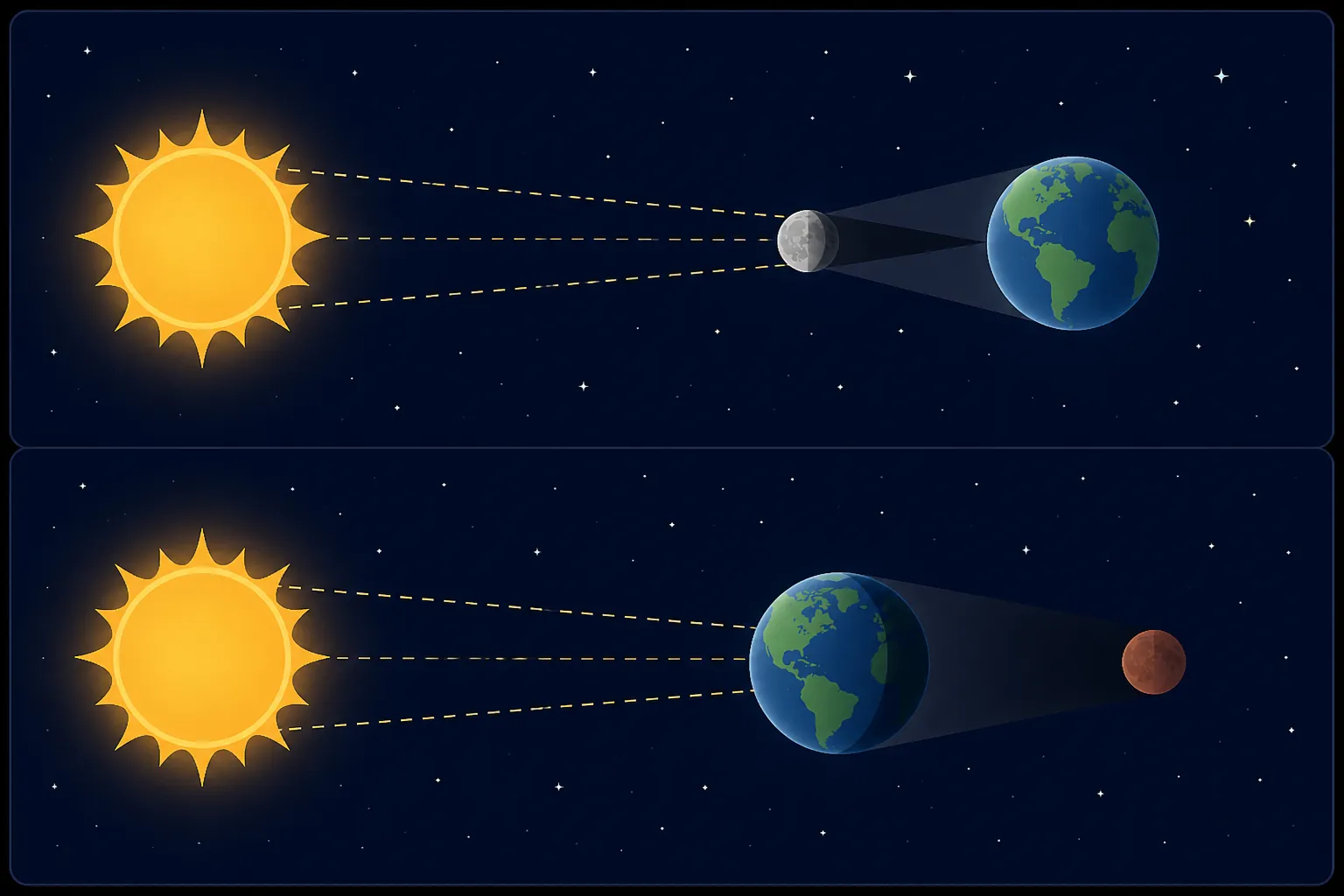
Most ASVAB-style eclipse misses come from swapping “solar” and “lunar” under pressure. Do not start with the vocabulary. Start with the lineup.
- Solar eclipse: Sun — Moon — Earth. The Moon is between the Sun and Earth.
- Lunar eclipse: Sun — Earth — Moon. Earth is between the Sun and Moon.
NASA Space Place explains the same distinction in plain terms: during a solar eclipse, the Moon blocks sunlight from reaching Earth; during a lunar eclipse, Earth blocks sunlight from reaching the Moon.[5] That is enough astronomy for the first ASVAB decision.
Worked GS-format item: Earth in the middle
CrackASVAB’s Question 68 asks what occurs when Earth is between the Sun and the Moon. The correct recognition is a lunar eclipse, because Earth is the body blocking sunlight from reaching the Moon.[4][5]
Why the wrong answer is tempting: the word “eclipse” makes some students grab “solar” automatically, especially if a solar eclipse is in the news. But the middle body decides the answer. If Earth is in the middle, it cannot be the August 12 solar-eclipse arrangement. It is lunar-eclipse geometry.
GS-style drill: the 2026 solar eclipse lineup
Question: During the August 12, 2026 total solar eclipse, which object is directly between the Sun and Earth?
- A. Earth
- B. The Moon
- C. Mars
- D. A comet
Answer: B. The Moon. A solar eclipse happens when the Moon comes between the Sun and Earth and blocks sunlight from reaching part of Earth.[5] Choice A describes the middle-body clue for a lunar eclipse, not a solar eclipse.
Second recognition: a solar eclipse needs a new Moon
Once the lineup is clear, the phase clue is quick. A solar eclipse can happen only at new Moon, because that is when the Moon is positioned between Earth and the Sun from our point of view.[6] For an ASVAB item, “new Moon” is usually not there to make the question poetic. It is there to check whether you know the geometry.
This is also where students who have memorized Moon phases without alignment can lose an easy point. Full Moon puts Earth between the Sun and Moon, so it belongs with lunar-eclipse possibilities. New Moon puts the Moon between the Sun and Earth, so it belongs with solar-eclipse possibilities. If Moon phases are still shaky, review the Moon phases study guide before trying to memorize eclipse vocabulary.
GS-style drill: phase clue
Question: Which Moon phase is required for a solar eclipse to occur?
- A. New Moon
- B. First quarter
- C. Full Moon
- D. Last quarter
Answer: A. New Moon. The tempting wrong choice is C, full Moon, because “eclipse” and “Moon” feel connected. But full Moon is the lunar-eclipse side of the alignment. Solar eclipse means the Moon must be between the Sun and Earth.[6]
Third recognition: umbra means total, penumbra means partial
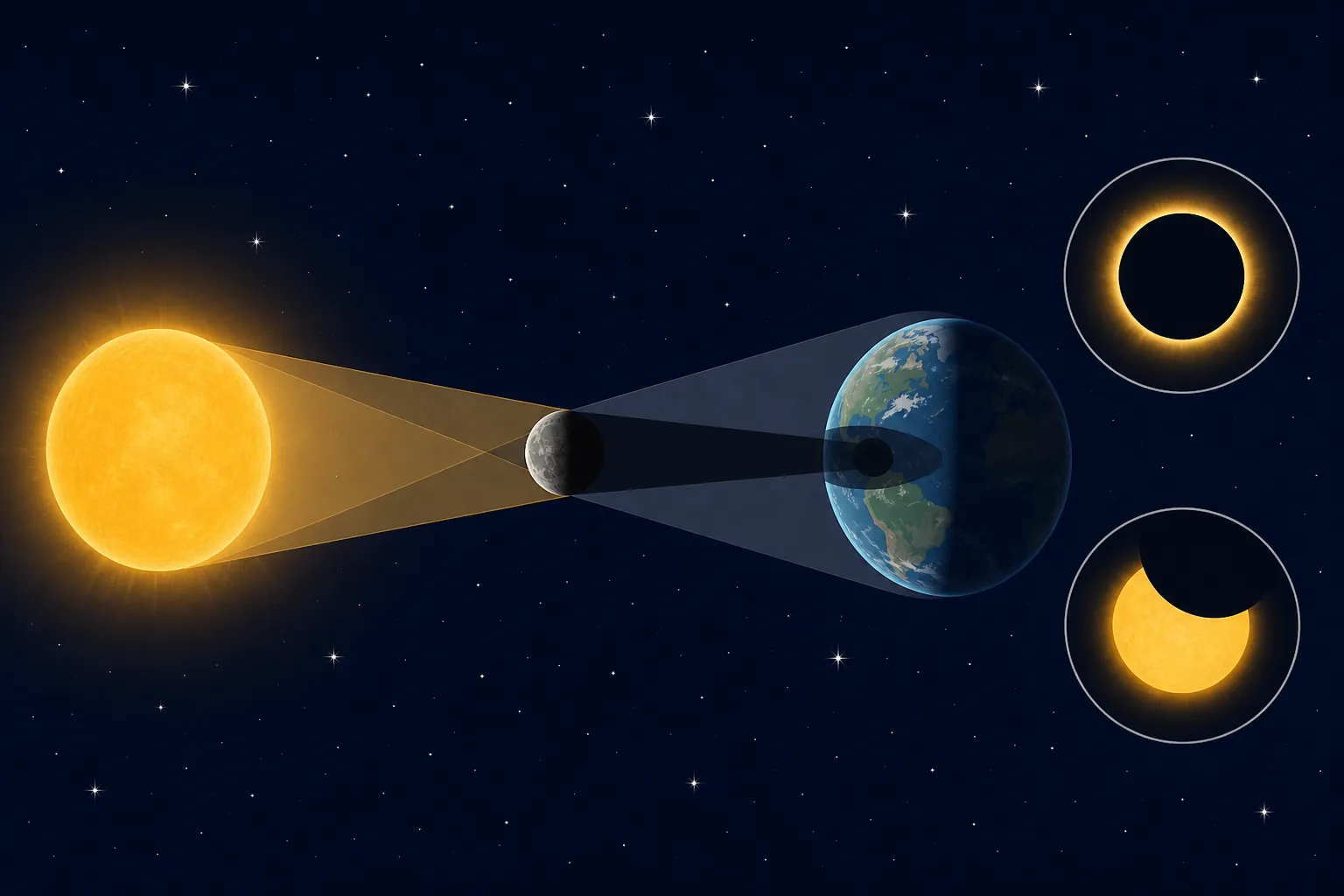
Shadow vocabulary is another common pressure point because the words look similar and neither one sounds like everyday English. NASA defines the umbra as the inner shadow where the Sun is completely blocked and the penumbra as the outer shadow where the Sun is only partially blocked.[7]
| Term | ASVAB-speed meaning | Result in a solar-eclipse question |
|---|---|---|
| Umbra | Dark inner shadow | Sun fully blocked; total eclipse for someone in that path |
| Penumbra | Lighter outer shadow | Sun partly blocked; partial eclipse for someone in that region |
The useful shortcut is not “umbra is darker” by itself. The useful shortcut is what the darkness means for the observer: in the umbra, the Sun is fully blocked; in the penumbra, only part of the Sun is blocked.[7]
GS-style drill: shadow region
Question: During a solar eclipse, an observer is located in the Moon’s umbra. What would that observer experience?
- A. A total solar eclipse
- B. A partial solar eclipse
- C. A lunar eclipse
- D. No eclipse because the Moon is full
Answer: A. A total solar eclipse. Choice B belongs to the penumbra. Choice C changes the alignment from solar to lunar. Choice D mixes in the wrong Moon phase; a solar eclipse requires new Moon, not full Moon.[6][7]
Fourth recognition: why eclipses do not happen every month
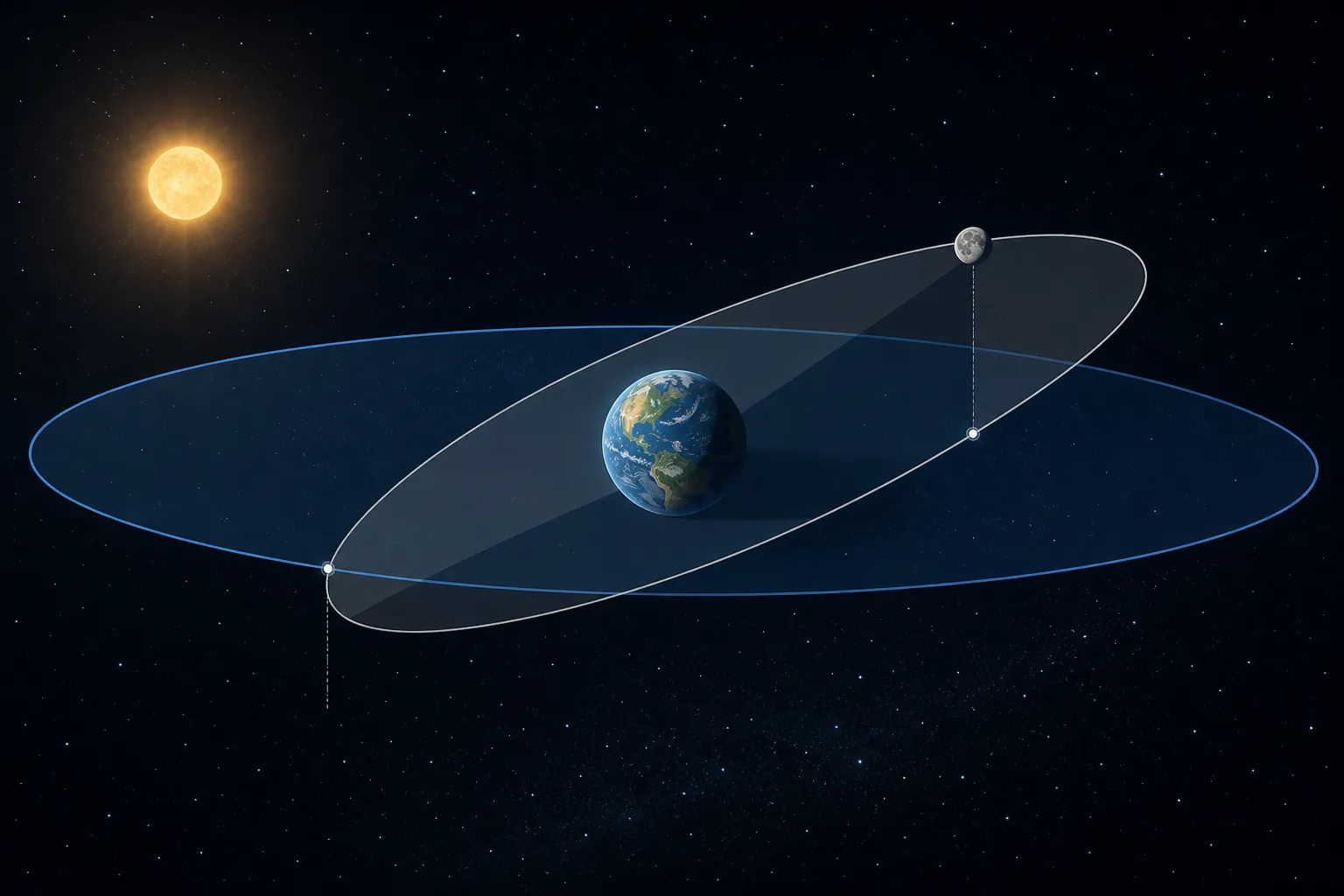
A decent trap question goes like this: if there is a new Moon every month, why is there not a solar eclipse every month? The answer is the Moon’s tilted orbit. NASA explains that the Moon’s orbit is tilted by about 5 degrees relative to Earth’s orbit around the Sun, so the Sun, Moon, and Earth usually do not line up perfectly at every new Moon.[6]
That tilt also explains why eclipse seasons matter. Eclipses occur when the Moon is near one of the points where its tilted orbit crosses Earth’s orbital plane and the Sun, Moon, and Earth can line up closely enough.[6] For General Science, you do not need to calculate nodes. You need to reject the answer choice that says “because the Moon is new every month, solar eclipses happen every month.”
GS-style drill: monthly-eclipse trap
Question: Solar eclipses do not occur at every new Moon mainly because:
- A. The Moon does not orbit Earth
- B. The Moon’s orbit is tilted relative to Earth’s orbit around the Sun
- C. Earth stops rotating during some new Moons
- D. Solar eclipses can occur only during a full Moon
Answer: B. The Moon’s orbit is tilted relative to Earth’s orbit around the Sun. Choice D is the phase swap. Choice A is obviously false if you slow down, and choice C is a nonsense mechanism dressed up as science vocabulary.[6]
The compact decision pattern
For ASVAB General Science, the August 12 event is useful because it lets you attach five decisions to one picture: Moon in the middle, new Moon, umbra for total, penumbra for partial, and tilted orbit for “not every month.” That is the cluster worth learning. The city timing tables, live-stream schedules, and safe-viewing details belong elsewhere.
- If the Moon is between the Sun and Earth, think solar eclipse.
- If Earth is between the Sun and Moon, think lunar eclipse.
- If the question asks the solar-eclipse phase, choose new Moon.
- If the observer is in the umbra, choose total.
- If the observer is in the penumbra, choose partial.
- If the question asks why eclipses do not happen every month, use the Moon’s roughly 5-degree orbital tilt.
That does not make eclipses an official ASVAB promise. It makes them a small practice-bank concept cluster that is easy to secure while the 2026 total solar eclipse is fresh. For broader subtest priority decisions, return to the ASVAB Exam Prep Guide; for another General Science event hook, use the ASVAB hurricane science guide.
References
- Total Solar Eclipse on August 12, 2026, NASA
- ASVAB General Science Practice Test, Mometrix Academy
- ASVAB General Science Practice Test, TestPrepReview
- ASVAB General Science Question 68 Answer and Explanation, CrackASVAB
- Eclipses, NASA Space Place
- Why Don’t We Have a Solar Eclipse Every Month?, NASA
- Why Do Eclipses Happen? (Eclipse Geometry), NASA
Related exhibits & inventory
Verified outcomes
No verified outcomes on file for this exam yet
See Methodology for how outcome evidence is disclosed once logged.
Planners
No planner filed for this exam yet
A downloadable timeline template for this exam hasn't been published yet.
Tool verdicts
AI-tool cautions
No AI tools tested for this exam yet
No hands-on AI-accuracy logs have been filed for this exam.
Questions about this plan
Ask a question about a specific section, timeline, or citation in this plan — or flag something that needs correcting.
Comments
Join the discussion with an anonymous comment.