
DSST Exam Hub
Blood Moon Observation Tips for Astronomy Students
A practical, region-specific guide to observing the August 27–28, 2026 partial lunar eclipse, including timezone timelines, equipment checklists, and a printable observation worksheet for astronomy students who need to produce a graded report.
- gre
- mcat
- asvab
- sat
- act
- digital-adaptive
- official-material
- section-strategy
- test-date-timeline
The August 27–28, 2026 event is a partial lunar eclipse, not a total lunar eclipse. That correction matters for a student report, even though the view may feel close to total: the Moon reaches 96.2% umbral coverage, with eclipse magnitude 0.930, a partial phase lasting 3 hours 18 minutes, and a full penumbral-to-penumbral event lasting 5 hours 38 minutes.[1] In ordinary language, people will call this an “almost blood moon.” In an observation log, call it a deep partial lunar eclipse and then describe the reddish umbral portion you actually saw.
The first useful blood moon observation tip for astronomy students is not “look east.” It is: find out whether the Moon is already eclipsed when it rises, still eclipsed when it sets, or high enough in your sky that you can follow the phase without a horizon fight. TimeandDate estimates that roughly 3.34 billion people are in the visibility zone for this eclipse, but that wide visibility does not mean equal observing conditions.[1]
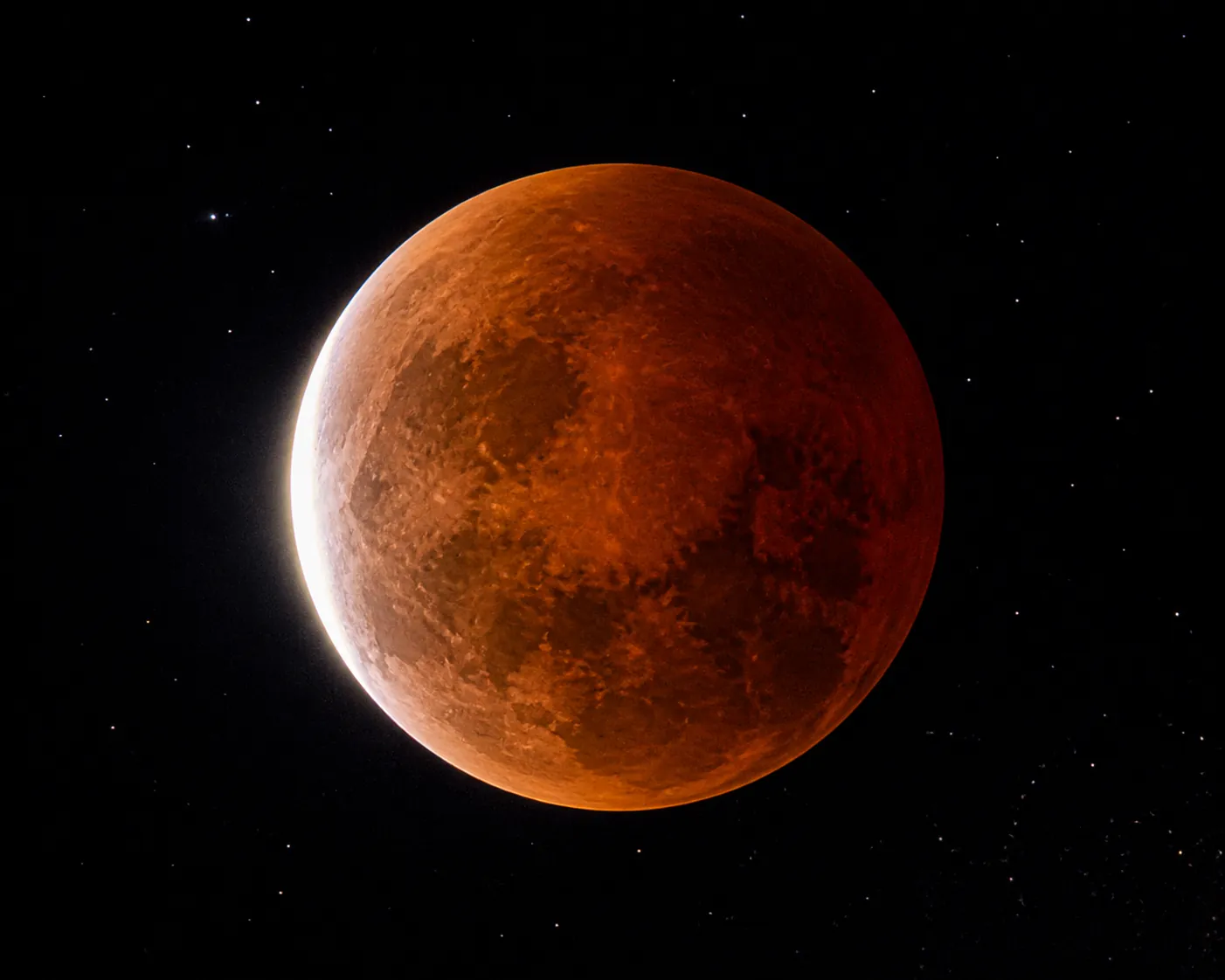
There is also some urgency for students in the Americas. Space.com and BBC Sky at Night both identify this as the last deep lunar eclipse widely visible from the Americas until December 31, 2028.[2][3] That does not make the eclipse rare in a mystical sense; it makes it a good assignment target. If your class asks for a real sky observation rather than a simulation, this one is worth planning correctly.
Start With Your Region, Not With the Photograph You Hope to Take
Before you choose equipment, choose the observing problem. The same eclipse asks different things from a student in eastern North America, western Europe, or Africa. Your job is to turn the global event into a local timeline with a defensible observing position.
| Region | Main observing problem | Planning priority | What your notes must make clear |
|---|---|---|---|
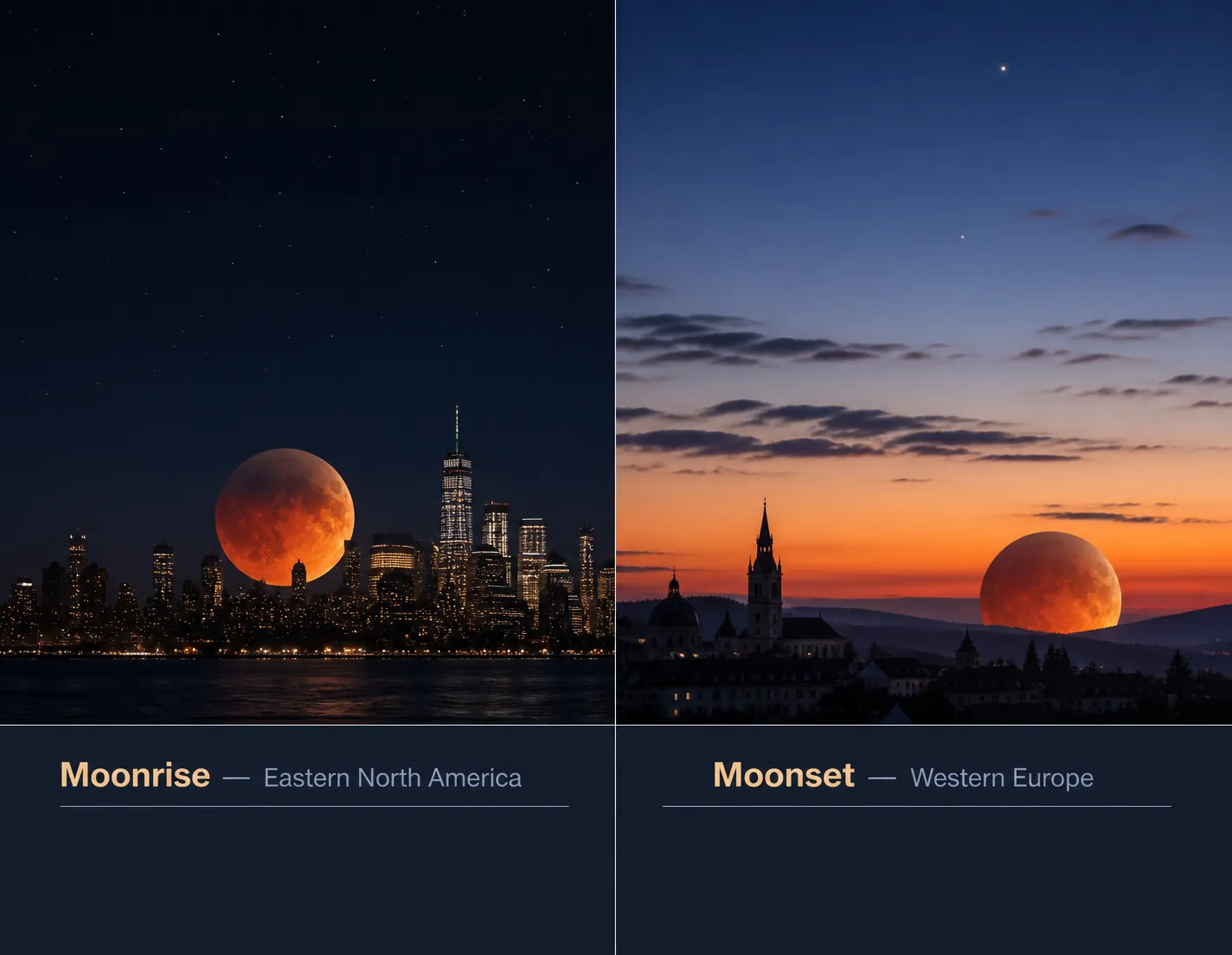
| Eastern North America | The Moon may rise already in eclipse | Find a clear eastern horizon and arrive before local moonrise | Whether your first view was limited by buildings, trees, haze, or low altitude |
| Western Europe | The Moon may be setting as dawn twilight increases | Find a clear western horizon and check local moonset and twilight | Whether the fading sky, low altitude, or horizon obstruction ended the observation |
| Africa and other visible regions | Visibility depends strongly on local conversion from UTC | Convert the event times and compare them with moonrise, moonset, and twilight | Which eclipse phases were actually above your horizon |
Use UTC as the master time standard in your notes, then add your local time beside it. Do not rely on a screenshot that only shows one city if you are observing from a different suburb, campus, field site, or time zone boundary. The TimeandDate eclipse page is useful here because it provides event timing, local conversion, duration, magnitude, and visibility mapping for the August 27–28 eclipse.[1]
A good local timeline has five entries: penumbral eclipse begins, partial eclipse begins, maximum eclipse, partial eclipse ends, and penumbral eclipse ends. For a graded visual report, the partial phase and maximum eclipse usually deserve the most attention because that is when the umbral shadow is obvious. Still, record the penumbral limits if they are visible from your site; they show that you understood the whole event, not just the dramatic part.
Build a Timeline You Can Actually Use Outside
Do the conversion before the night of the eclipse. A lab notebook with “about sunset” or “late evening” is not an observation record; it is a memory prompt. Use a table like this and fill it with the exact UTC and local times for your site.
| Event | UTC time | Local time | Moon altitude / horizon note | Observation plan |
|---|---|---|---|---|
| Penumbral eclipse begins | Fill from eclipse table | Convert for your location | Above horizon, below horizon, or twilight-limited | Optional first sky condition note |
| Partial eclipse begins | Fill from eclipse table | Convert for your location | Check whether the Moon is rising, setting, or high enough | Start required visual notes if visible |
| Maximum eclipse | Fill from eclipse table | Convert for your location | Record altitude and obstructions | Make naked-eye, binocular, and color estimates |
| Partial eclipse ends | Fill from eclipse table | Convert for your location | Check whether twilight or moonset interferes | Record final umbral-shadow note if visible |
| Penumbral eclipse ends | Fill from eclipse table | Convert for your location | Often subtle or not visible from poor conditions | Optional closing note |
If you are in eastern North America, your site choice is mostly a moonrise problem. Scout the eastern horizon in daylight. A parking garage, lakeshore, athletic field, or hilltop may be better than a familiar backyard if the familiar backyard has trees exactly where the Moon appears. Low altitude also means more atmosphere, haze, and local obstructions, so write down whether the first minutes were genuinely invisible or merely blocked from your position.
If you are in western Europe, treat the eclipse as a moonset and dawn-twilight problem. A clear western horizon matters more than a dark rural sky if the Moon is sliding toward the skyline. Your report should not pretend the eclipse ended when you stopped seeing it. Say whether the Moon set, the sky brightened, clouds moved in, or the contrast became too weak for reliable estimates.
If you are observing from Africa or another visible region, do the same logic rather than borrowing someone else’s regional advice. Convert the event times, compare them with local moonrise and moonset, and mark which phases are actually observable. A student who writes “maximum eclipse occurred below my horizon, so I observed the later partial phase after moonrise” has produced a better record than a student who copies the global maximum time and never checks the sky geometry.
Minimum Equipment: Less Than You Think, More Organized Than Usual
You do not need a telescope to make a useful lunar eclipse observation. NASA JPL’s observing guidance treats the Moon as a strong classroom target for naked-eye and simple optical observing, and common eclipse-observing guidance from Celestron points students toward binoculars such as 8×42 or 10×50, preferably stabilized or tripod-mounted for steadier viewing.[4][5] A telescope can help with crater-edge detail, but it is not the price of entry.
- Required: phone or watch set to reliable time, notebook or printed worksheet, pencil, and a location with the correct horizon.
- Strongly useful: binoculars, small tripod or monopod, red flashlight, weather app, and a compass or sky map app for horizon planning.
- Optional: telescope, camera, interval timer, voice recorder, and printed lunar map for crater timing.
- Do not bring: solar eclipse glasses for lunar safety reasons. They are not needed and make the Moon unnecessarily dim.
No eye protection is required for a lunar eclipse. NASA states this plainly in its lunar eclipse FAQ: lunar eclipses are safe to view directly, unlike solar eclipses.[6] The practical safety concerns are ordinary nighttime concerns: traffic, footing, weather, cold, insects, and whether you have permission to use the observing site.
What to Record Before, During, and After Maximum Eclipse
The report-quality part begins before the Moon looks impressive. Write down the facts another student would need to understand your observation without standing beside you. Location does not have to mean your home address; a city, campus, park name, or approximate coordinates are enough for most class reports. What matters is that the observing conditions are not hidden.
| Moment | Record this | Why it matters |
|---|---|---|
| Before first observation | Location, time zone, time source, weather, cloud cover, horizon direction, and instrument | Shows whether the eclipse was observable from your site and whether your clock can be trusted |
| At first view | Moon altitude impression, obstruction, visible shadow shape, naked-eye color, and whether the Moon was already eclipsed | Separates a regional visibility problem from a missed observation |
| Near maximum eclipse | Time, color of umbral portion, brightness contrast, visible bright crescent, binocular detail, and sky transparency | Captars the deepest visible phase and supports your interpretation |
| After maximum or before you stop | Whether the umbral shadow changed, why you ended, and what limited the final view | Prevents the report from ending with an unexplained gap |
Descriptions should be plain and visual. “The upper-left portion looked copper-red, while a narrow bright limb remained uneclipsed” is more useful than “the Moon looked amazing.” If you use a camera, do not let the photograph replace the log. Camera exposure can exaggerate or suppress color; your report needs to say what your eye saw and what the instrument showed.
Use the Danjon Scale Carefully
The Danjon Scale is the familiar L0–L4 brightness scale for lunar eclipses, ranging from very dark eclipses to bright copper or orange eclipses.[7] For this event, use it with a caveat: the scale strictly belongs to total lunar eclipses. Because the August 2026 eclipse is partial, apply a Danjon-style estimate only to the fully shadowed umbral portion of the disk, not to the uneclipsed bright crescent.
| Danjon-style entry | What to look at | What not to do |
|---|---|---|
| L0–L1 estimate | Only the darkest fully umbral region | Do not average it with the bright uneclipsed edge |
| L2 estimate | A dark red or rust-colored umbral zone with low contrast details | Do not call the whole Moon L2 if part of it is outside the umbra |
| L3–L4 estimate | A brighter red, orange, or copper-toned umbral zone | Do not treat a camera-enhanced image as your naked-eye estimate |
One careful sentence is enough: “Near maximum eclipse, I estimated the fully umbral portion as about L2, while the remaining uneclipsed crescent was much brighter and was not included in the Danjon estimate.” That sentence tells an instructor you know both the appeal and the limitation of the scale.
Optional Extension: Crater Timings
If you want a more serious add-on than a color description, try crater timing. Sky & Telescope describes a method in which observers record when selected lunar craters enter or leave Earth’s umbra; the project is useful because the observed umbra is about 2% larger than simple geometry predicts.[8] This is a timing exercise, not a photography contest.
The important uncertainty is event-specific. Sky & Telescope has published crater entry and exit predictions for other lunar eclipses, including March 2026 methodology, but August 2026 crater predictions may need to be checked closer to the eclipse date.[8] If no August-specific list is available when you prepare, you can still use a lunar map to practice identifying obvious craters near the shadow edge, but label that work as practice rather than a formal crater-timing submission.
- Print or save a lunar map with crater names before the observing session.
- Choose only a few craters; missed timings are better than a cluttered, unreliable table.
- Use UTC or clearly marked local time for every entry and exit estimate.
- Record uncertainty honestly: “edge hard to judge,” “cloud passed,” “lost crater in low contrast,” or “Moon too low.”
A Printable Observation Worksheet
Copy this into a document or lab notebook before eclipse night. Fill the timing table in advance, then leave enough blank space for field notes. The worksheet is deliberately plain; the point is to keep your observation from turning into a paragraph written from memory the next morning.
| Field | Your entry |
|---|---|
| Observer name / class | |
| Observing site | |
| Latitude/longitude or city-region description | |
| Time zone | |
| Time source used | |
| Weather and sky transparency | |
| Cloud cover estimate | |
| Horizon direction needed | |
| Horizon obstructions | |
| Instrument used: naked eye, binoculars, telescope, camera |
| Eclipse event or observing check | UTC time | Local time | Observed? yes/no | Notes |
|---|---|---|---|---|
| Penumbral eclipse begins | ||||
| Partial eclipse begins | ||||
| First personal observation | ||||
| Maximum eclipse | ||||
| Post-maximum observation | ||||
| Partial eclipse ends | ||||
| Penumbral eclipse ends |
| Observation category | What to write |
|---|---|
| Naked-eye description | Describe shadow shape, color, brightness contrast, and the visible uneclipsed portion. |
| Binocular description | Describe edge sharpness, surface detail, color differences, and any atmospheric distortion. |
| Danjon-style estimate | Estimate only the fully umbral portion; state that the eclipse is partial. |
| Optional crater timing | List crater name, entry/exit, time, instrument, and uncertainty. |
| Reason observation ended | Moonset, sunrise/twilight, clouds, obstruction, schedule, safety, or completed planned sequence. |
| Short interpretation paragraph | Explain what your observations show about Earth’s umbra and why local visibility affected the record. |
For the interpretation paragraph, keep the claim matched to the evidence. You can say the curved umbral edge is consistent with Earth’s round shadow on the Moon. You can say the reddish color came from sunlight filtered and refracted through Earth’s atmosphere. You should not claim that your single observation proves atmospheric composition, global dust levels, or eclipse frequency unless your instructor has given you additional data to support that argument.
Where This Fits With Study Planning
If you are taking the DSST Astronomy exam, combine this observation with our exam-focused blood moon guide so the eclipse becomes both a sky observation and a review of lunar phases, shadows, and orbital geometry. If the eclipse lands during a crowded academic month, the fall 2026 exam study-plan article can help you place the observing night inside a larger schedule. For students following the broader 2026 observing season, the 2026 eclipse and Perseids study guide gives useful context without replacing the local planning work for this lunar eclipse.
The August 2026 eclipse is worth observing because it is deep, widely visible, and visually close to the popular idea of a blood moon. The student version of success is narrower and better: convert the times, solve the horizon problem, record the conditions, estimate the umbral color carefully, and submit a report that another observer could check.
References
- Partial Lunar Eclipse on August 27–28, 2026, TimeandDate
- This is the best lunar eclipse until New Year’s Eve 2028. Here’s how to spot the almost blood moon on Aug. 27, Space.com
- Lunar eclipse August 2026, BBC Sky at Night Magazine
- How to Watch a Total Lunar Eclipse and Get Students Observing the Moon, NASA Jet Propulsion Laboratory
- The Ultimate Guide to Observing Lunar Eclipses, Celestron
- March 2026 Total Lunar Eclipse: Your Questions Answered, NASA
- Danjon Scale of Lunar Eclipse Brightness, EclipseWise
- Useful Projects for a Lunar Eclipse, Sky & Telescope
Related exhibits & inventory
Verified outcomes
No verified outcomes on file for this exam yet
See Methodology for how outcome evidence is disclosed once logged.
Planners
No planner filed for this exam yet
A downloadable timeline template for this exam hasn't been published yet.
Tool verdicts
AI-tool cautions
No AI tools tested for this exam yet
No hands-on AI-accuracy logs have been filed for this exam.
Questions about this plan
Ask a question about a specific section, timeline, or citation in this plan — or flag something that needs correcting.
Comments
Join the discussion with an anonymous comment.