

Who Qualifies for Social Security? Rules for Every Benefit Type
Understand the specific eligibility rules for Social Security retirement, disability, survivor, and SSI benefits. This guide breaks down age thresholds, work credits, and qualifying relationships to help you ace exam questions and plan your financial future.
Updated:
In a Social Security exam question, “Who qualifies?” is not the first question. The first question is: qualifies for which benefit type? A 62-year-old worker, a 58-year-old disabled worker, a surviving spouse, a high school student whose parent has died, and a low-income person with limited resources may all appear under the broad Social Security umbrella, but they are not using the same eligibility rule.
That distinction matters in personal finance courses, insurance licensing, CFP coursework, and Social Security disability representative training because many questions are written as short fact patterns. They give an age, a work history, a relationship, a disability status, or an income clue, then expect the student to choose the correct program logic.
Start with the benefit type
The Social Security Administration organizes benefits into retirement, disability, survivors, family, and Supplemental Security Income categories, but the financing and eligibility tests are not identical across those categories.[1] For study purposes, the cleanest first pass is this: retirement, disability, and survivor benefits are tied to a worker’s Social Security-covered earnings record; SSI is a need-based program for people who meet age, blindness, or disability criteria and financial limits.
| Benefit type | Who is the eligibility built around? | Age or status trigger | Work-credit logic | Relationship rule | Other major test |
|---|---|---|---|---|---|
| Retirement | The retired worker | Earliest claiming age is 62; full retirement age depends on birth year | Usually 40 credits; in 2026, one credit requires $1,890 of covered earnings, up to 4 credits per year [2] | Worker’s own record; spouses and children may qualify separately on the worker’s record | Claiming before full retirement age reduces the worker’s monthly benefit [3] |
| Disability | The disabled worker | Disability must meet SSA’s definition; age affects the required work-credit pattern | Credits vary by age at disability onset; workers age 31 or older generally need 20 credits from the 40-credit period before disability began [2] | Worker’s own record; some family members may qualify on that record | Substantial gainful activity and a five-step medical evaluation apply [5] |
| Survivor | A deceased worker’s family | Triggered by the worker’s death and the survivor’s qualifying status | Based on the deceased worker’s covered work record | Surviving spouse, child, dependent parent, and some other family relationships may qualify | Age, school status, disability status, marital status, and dependency can change the answer [1] |
| SSI | The applicant’s need and status | Age 65 or older, blindness, or disability | Not based on payroll-tax work credits | Individual eligibility, though household and living arrangements can matter | Income and resource limits are central; SSI is separate from OASDI payroll-tax benefits [8] |
For an exam, do not treat “Social Security” as one bucket. Ask what the fact pattern gives you first. If it gives the worker’s age and lifetime earnings, think retirement. If it gives inability to work and recent earnings, think disability. If it gives a death and a family relationship, think survivor or dependent benefits. If it gives low income, limited resources, and age or disability, separate SSI from payroll-tax Social Security.
Retirement eligibility: age plus enough covered work
The retirement rule is the one most students memorize first: a worker generally needs 40 Social Security credits to qualify for retirement benefits. In 2026, a worker earns one credit for each $1,890 in covered earnings, with a maximum of four credits per year.[2] That means the 40-credit requirement usually represents about 10 years of covered work, but the test is credits, not calendar years.
| Retirement concept | Rule to apply |
|---|---|
| Minimum claiming age | A retired worker can claim as early as age 62, if otherwise eligible [3] |
| Full retirement age | Full retirement age is 66 for people born in 1954, rises by two-month steps for birth years 1955 through 1959, and is 67 for people born in 1960 or later [3] |
| Work credits | The standard retirement eligibility threshold is 40 credits [2] |
| 2026 credit amount | One credit requires $1,890 in covered earnings, up to four credits for the year [2] |
| Early claiming effect | Claiming at 62 permanently reduces the monthly benefit; for someone whose full retirement age is 67, the benefit can be reduced to 70% of the primary insurance amount [3] |
A common trap is to read “age 62” as enough by itself. It is not. Age 62 opens the door to early retirement claiming, but the worker still needs sufficient covered work. Another trap is to confuse full retirement age with eligibility age. Full retirement age controls unreduced benefits; it is not the earliest age at which retirement benefits can begin.
Benefit amount questions are different from eligibility questions. The SSA benefit formula uses average indexed monthly earnings and a primary insurance amount, and 2026 figures include a 2.8% cost-of-living adjustment, a $184,500 maximum taxable earnings base, and a $4,152 maximum monthly benefit for someone claiming at full retirement age.[4] Those numbers may appear in finance courses, but they do not replace the eligibility test: age plus covered work.
If a question asks when a qualified person receives a payment rather than whether the person qualifies, shift topics. Payment timing is a benefit administration issue, not an eligibility threshold. For that separate study task, use A Student’s Guide to the Social Security Payment Schedule.
Disability eligibility: work credits first, then the medical sequence
Social Security Disability Insurance is where students most often merge two separate tests. A disabled worker must satisfy a work-credit test and SSA’s disability standard. Passing only one side does not settle the question.
The work-credit test depends on age when disability begins. SSA describes a sliding scale for younger workers, but for workers age 31 or older, the usual shortcut is the 20/40 rule: the worker generally needs at least 20 credits earned in the 40-quarter period ending with the quarter disability began.[2] In plain study language, that means recent covered work matters for disability in a way it does not for basic retirement eligibility.
| Disability eligibility piece | What the exam clue may look like | What to do with it |
|---|---|---|
| Insured status | Age at disability onset plus number and timing of credits | Apply the age-based work-credit rule; for age 31 or older, check the 20/40 pattern [2] |
| Substantial gainful activity | Monthly earnings while applying | Compare earnings with the 2026 SGA amount: $1,690 per month for non-blind applicants and $2,830 per month for blind applicants [5] |
| Severe impairment | A medically determinable condition that limits work activity | Decide whether the condition significantly limits basic work activities [5] |
| Listings or equivalent severity | A named severe condition or medical evidence matching SSA criteria | If the impairment meets or equals a listing, the medical analysis can end in allowance [5] |
| Residual functional capacity | What the applicant can still do despite limitations | If no listing is met, SSA considers past work and then other work [5] |
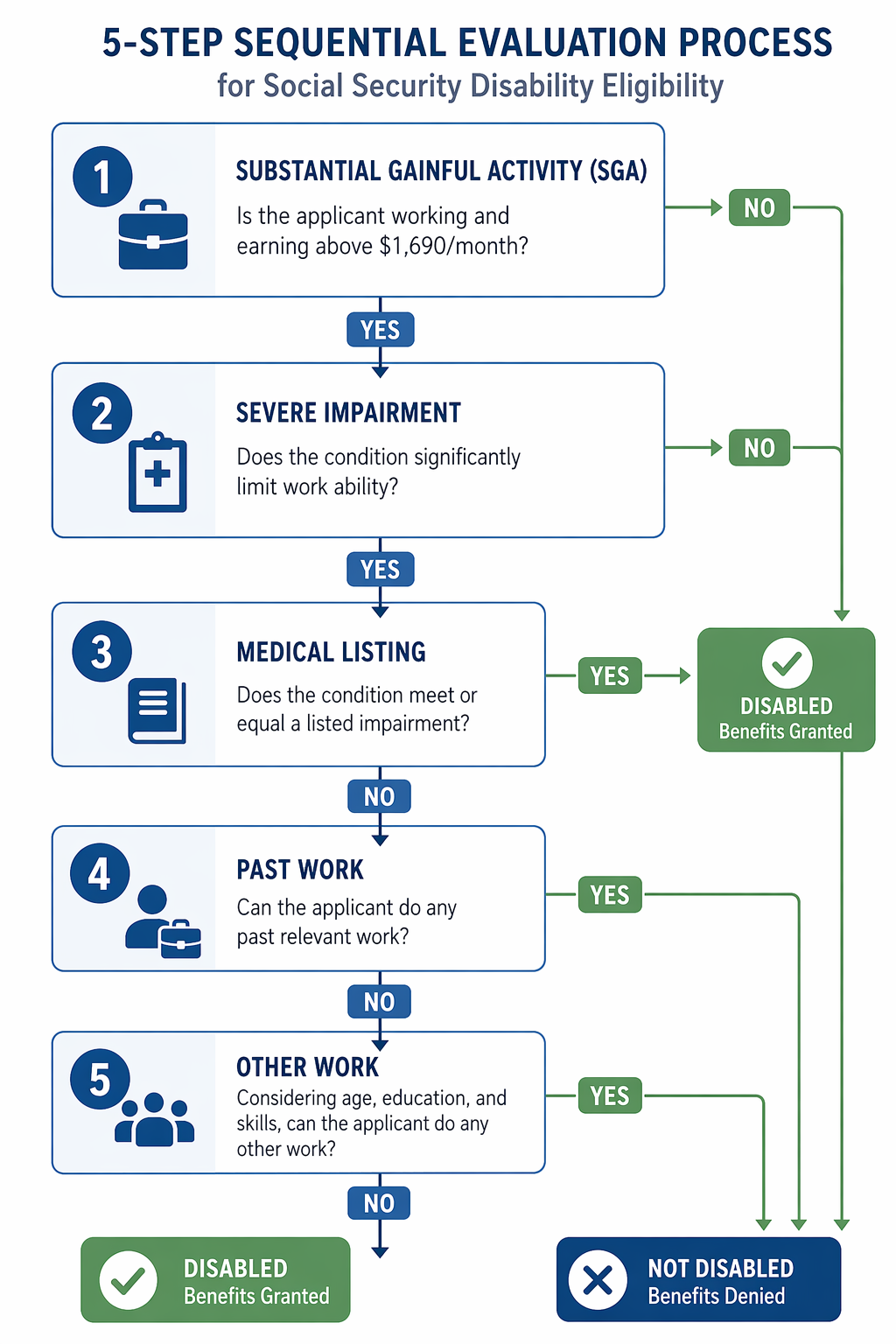
SSA’s disability evaluation follows a five-step sequence: whether the person is doing substantial gainful activity, whether the impairment is severe, whether it meets or equals a listed impairment, whether the person can do past relevant work, and whether the person can adjust to other work.[5] The order matters because a fact pattern can stop at an early step.
Suppose a hypothetical question says a 58-year-old applicant has a serious impairment and 28 work credits. That is not enough information to answer “disabled under Social Security” unless the credit timing is supplied. If the person is age 31 or older, the recent-work part of the test asks whether enough credits fall inside the relevant 40-quarter window, not merely whether the total lifetime credits sound substantial.
Another hypothetical question may give strong medical facts but current earnings above the SGA level. In that setup, the earnings clue is not decorative. For 2026, SSA lists SGA at $1,690 per month for non-blind individuals and $2,830 per month for blind individuals.[5] A student who jumps straight to the medical listing may miss the non-medical screen.
Survivor and family benefits: the worker’s record plus the right relationship
Survivor and dependent questions begin with a different anchor: someone else’s earnings record. The worker may be retired, disabled, or deceased, but the person claiming is a spouse, child, surviving spouse, surviving child, dependent parent, or another qualifying family member under SSA rules.[1]
| Person in the fact pattern | Eligibility clue that matters |
|---|---|
| Spouse or divorced spouse | Relationship to the worker, age, marital status, and duration rules may matter depending on the benefit type |
| Surviving spouse | The worker’s death triggers survivor analysis; the survivor’s age, disability status, remarriage, and care of a child may affect eligibility |
| Child under 18 | A child may qualify on a parent’s record if other dependency and relationship rules are met [6] |
| Full-time high school student age 18 | Benefits can continue for a full-time elementary or secondary school student until age 19, subject to SSA rules [6] |
| Disabled adult child | A child may qualify at age 18 or older if the disability began before age 22; SSA describes no upper age limit for that category if the rule is met [6] |
The child and student ages are worth memorizing because they create clean exam turns. A child under 18 is not analyzed the same way as a retired worker. A full-time high school student who is 18 may still fit the child-benefit rule, but the exception generally runs only up to age 19 under SSA’s student rule.[6] A disabled adult child is different again: the key fact is disability onset before age 22.[6]
That modern student rule is narrower than the older student-benefit program. SSA’s historical account says the post-1965 student benefit program peaked at about 900,000 beneficiaries in 1977, was eliminated in 1981 with termination effective April 1985, and today’s student beneficiaries number about 100,000 per year.[7] For current eligibility questions, use today’s child, full-time high school student, and disabled adult child rules rather than assuming college attendance extends benefits.
For a fuller treatment of the student angle, use Yes, Students Can Get Social Security Benefits. In this guide, the important point is narrower: student status can preserve eligibility for some dependent children, but it does not turn every student into a Social Security beneficiary.
SSI belongs in the study guide, but not in the same box
Many classes and prep materials place Supplemental Security Income near Social Security because SSA administers it and the public often talks about it that way. For exam purposes, keep the boundary visible. Social Security retirement, disability, and survivor benefits are part of the OASDI system tied to covered earnings and payroll taxes; SSI is a separate need-based program funded from general revenues, not Social Security payroll taxes.[8]
| Question | OASDI retirement/disability/survivor answer | SSI answer |
|---|---|---|
| Does the applicant need a covered work record? | Usually yes for the worker’s own retirement or disability benefit; survivor and dependent benefits use the worker’s record | No payroll-tax work-credit requirement |
| What starts the eligibility analysis? | Age, disability, death, or family relationship tied to a covered worker | Age 65 or older, blindness, or disability, plus financial need |
| What financial test matters most? | Covered earnings history and benefit formula for worker benefits | Income and resources |
| Why students confuse it | SSA administers multiple benefit categories | SSI is administered by SSA but follows different funding and eligibility logic [8] |
If a scenario says “low income, limited resources, age 67, no work history,” retirement benefits may fail because the worker lacks enough credits. SSI may still be the relevant program if the person meets SSI’s age and financial rules. If the scenario says “age 67, 40 credits, wants to claim,” the retirement track is active even if the person is not poor. Those are different eligibility logics, not two phrasings of the same rule.
Exam traps that change the answer
Most wrong answers come from applying a true rule to the wrong benefit. Use these checks before choosing an answer.
- Age 62 is a retirement claiming age, not a disability requirement and not a survivor rule by itself.
- Forty credits is the standard retirement threshold, but disability credits depend on age at onset and recent work; for workers 31 or older, the 20/40 rule is the key shortcut.[2]
- Full retirement age affects reduction or unreduced benefits; it does not erase the possibility of early retirement claiming at 62.[3]
- A child’s eligibility is based on a parent’s record and the child rule, not the child’s own work history in the usual dependent-benefit question.[6]
- A full-time high school student can be treated differently from a college student; current SSA student-child rules focus on elementary or secondary school and generally run only up to age 19.[6]
- SSI should trigger income and resource analysis, not the 40-credit retirement rule.[8]
A quick way to classify a fact pattern
When a practice question feels crowded, strip it down in this order:
- Name the benefit category: retirement, disability, survivor/dependent, or SSI.
- Identify whose work record matters: the applicant’s, a parent’s, a spouse’s, a deceased worker’s, or no work record for SSI.
- Apply the age rule: 62, full retirement age, child under 18, student up to 19, disability onset before 22, or age 65 for SSI.
- Apply the credit rule only where it belongs: 40 credits for retirement, age-based and recent-work tests for disability, the worker’s record for survivor or dependent benefits.
- Add the extra screen: SGA and medical evaluation for disability; relationship and school status for family benefits; income and resources for SSI.
For broader personal finance study, Social Security eligibility fits alongside topics such as building financial literacy as a student and student investing basics. For economics students studying the system’s macro setting, pair eligibility rules with inflation and bond-yield concepts. For policy reform context, keep that separate from eligibility memorization and use How to Study the Moreno-Warren Social Security Reform.
For the target question “who qualifies for Social Security,” the usable answer is never one sentence. A worker qualifies for retirement by meeting the age and covered-work rules. A disabled worker must satisfy insured-status rules, SGA limits, and SSA’s medical sequence. A survivor or dependent qualifies through the worker’s record and a qualifying relationship. SSI uses age, blindness, or disability plus financial need, not payroll-tax credits. Once the category is right, the rest of the rule has somewhere to go.
References
- Benefits, Social Security Administration.
- Social Security Credits and Benefit Eligibility, Social Security Administration.
- Retirement Age and Benefit Reduction, Social Security Administration.
- Benefit Formula Bend Points, Social Security Administration.
- Disability Benefits | How You Qualify, Social Security Administration.
- Can children and students get Social Security benefits?, Social Security Administration.
- Student Benefits, Social Security Administration.
- Top Ten Facts About Social Security, Center on Budget and Policy Priorities.
Comments
Join the discussion with an anonymous comment.