

Yes, Students Can Get Social Security Benefits — Here's How
Many people assume students cannot receive Social Security, but eligible children of retired, disabled, or deceased parents can collect monthly benefits until age 18 (or 19 if still in high school). This guide explains who qualifies, how to apply, and why college student benefits were ended in 1981.
Updated:
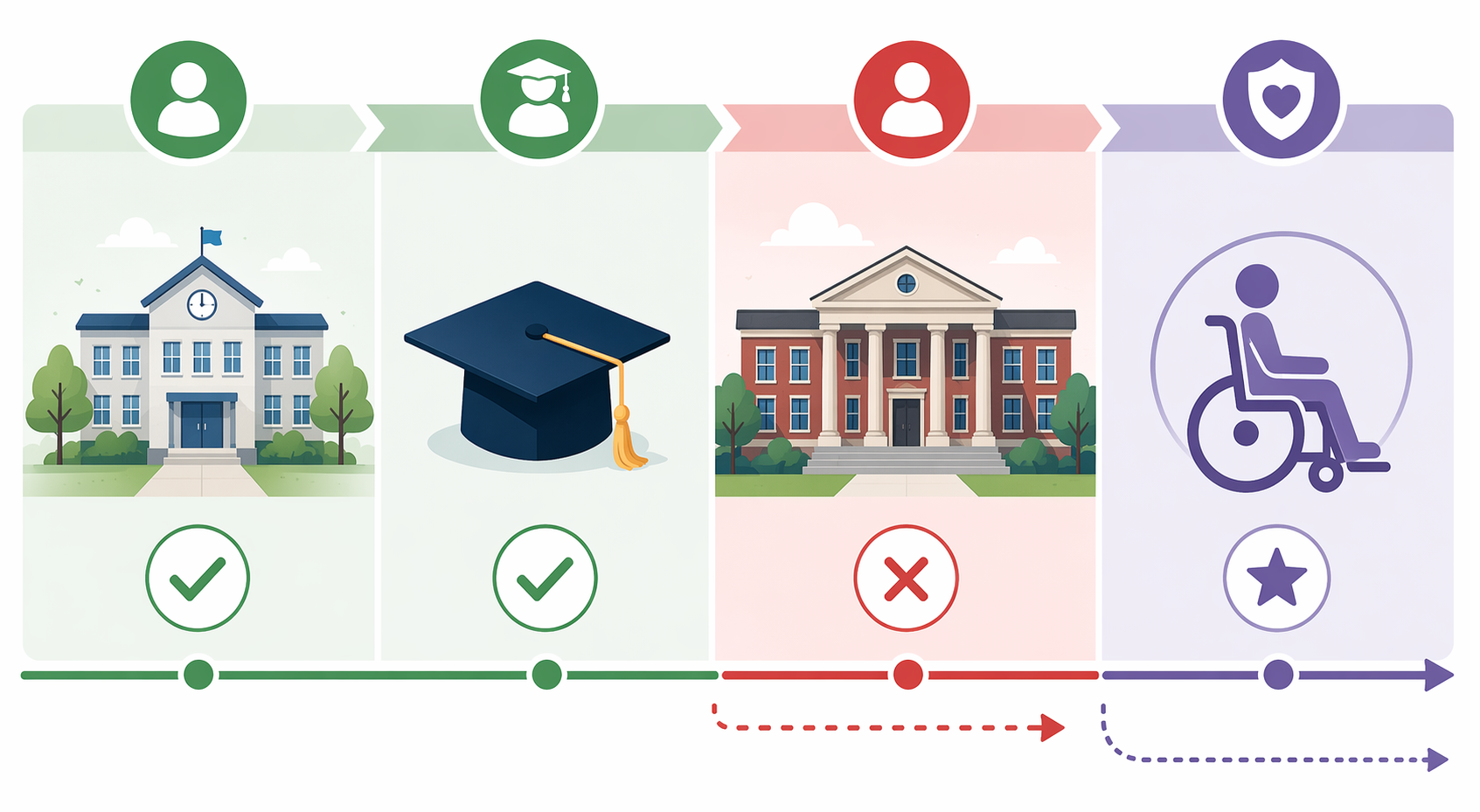
Yes, students can get Social Security benefits. The catch is that Social Security uses “student” in a narrower way than most families do. For current benefits, it usually means a child of a retired, disabled, or deceased parent who is still under 18, or who is 18 and still attending elementary or secondary school full time. It does not mean a college student applying for a general education grant.
That distinction matters because this is not a forgotten rule sitting in a filing cabinet. About 100,000 students receive Social Security student benefits each year, which means families are still using this part of the system right now.[1] The missed-benefit risk is real: a student may be told “you’re too old now” when the actual question is whether they are still a full-time K-12 student under Social Security’s rules.
The short answer: which students can receive benefits
A student is not eligible just because they are enrolled somewhere. The benefit has to be tied to a parent’s Social Security record. That parent is retired and receiving Social Security, disabled and receiving Social Security disability benefits, or deceased and covered under survivor benefits.
For survivor benefits, Social Security says an unmarried child may qualify if they are under 18, or up to age 19 if they are attending elementary or secondary school full time. A child may also qualify at any age if they have a disability that began before age 22.[2]
| Student situation | Current Social Security treatment |
|---|---|
| Under 18 and eligible through a retired, disabled, or deceased parent | Generally within the child-benefit age rule |
| 18 and still a full-time elementary or secondary student | May continue up to age 19 if SSA school-attendance rules are met |
| College or vocational school only | Not covered by the current student-benefit rule |
| Disabled adult child whose disability began before 22 | Separate route that can continue beyond the ordinary student age cutoff |
AARP’s plain-language explanation lines up with the same basic rule: children can receive benefits on a parent’s record, and benefits may continue past 18 only when the child is still a full-time student in elementary or secondary school, generally ending at 19.[3]
What “full-time” means to Social Security
This is where the office details start deciding the outcome. Social Security does not simply ask whether a student thinks of school as their main activity. For student benefits after age 18, the student must attend an elementary or secondary school full time, and the course must be non-correspondence, last at least 13 weeks, and require at least 20 hours of attendance per week.[4]
There is also a school-standard piece. The student must be carrying a subject load that the school considers full time. That can be the part families overlook because it may depend on the school’s own rules and, in practice, on how the school documents enrollment. A student taking a reduced schedule should not assume it counts until the school official who certifies attendance can say it meets the full-time standard.
Summer break does not automatically cut off eligibility. Social Security says benefits may continue during a school vacation of four months or less if the student was attending full time before the break and intends to return full time after it.[4] That matters for students who turn 18 near the end of a school year or during summer; the calendar gap is not the whole answer.
Benefits stop when the first stopping event happens: the student turns 19, marries, or drops below full-time attendance.[4] A schedule change, withdrawal, early completion, or move to a different type of program can therefore become a benefits issue, not just a school-office update.
The school is part of the proof chain
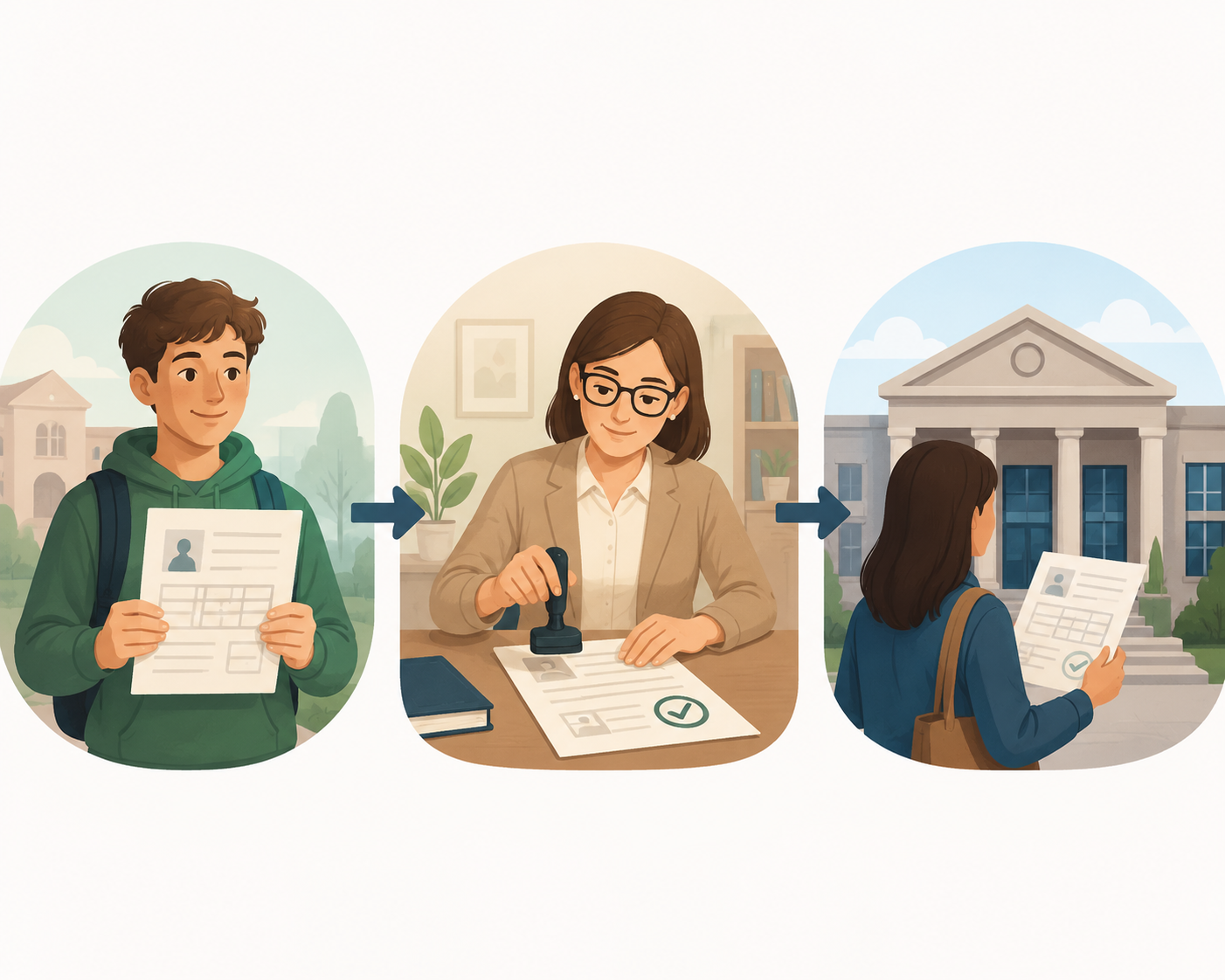
For an 18-year-old student trying to continue benefits, the key document is Form SSA-1372-BK, “Student’s Statement Regarding School Attendance.” Social Security uses it to confirm that the student is attending school full time under the student-benefit rules.[4]
The student completes their part, but the form does not live only with the student. A school official must certify attendance. Depending on the school, that person may be a counselor, registrar, principal, or another staff member authorized to verify enrollment. This is why vague advice at the front desk is not enough; someone has to match the student’s actual schedule to the school’s full-time standard and sign off.
A practical sequence looks like this:
- Confirm the benefit basis: the parent is retired, disabled, or deceased and the student may be eligible on that parent’s record.
- Check the age rule: under 18, or 18 and still full-time in elementary or secondary school.
- Ask the school who can certify Form SSA-1372-BK and whether the student’s schedule is considered full time.
- Submit the certified form to Social Security as instructed, usually through the local Social Security office.
- Report changes quickly if the student leaves school, reduces hours, marries, or otherwise no longer meets the rule.
Applying for child benefits is not the same as filling out a school-aid form
If the student is not already receiving benefits, the family is generally dealing with an application for child’s benefits, not a scholarship application. Social Security’s Form SSA-4 page lists the application for child’s insurance benefits and notes that applicants may need documents such as proof of the child’s birth, proof of the worker’s death when applying for survivor benefits, and other records depending on the case.[5]
For survivor benefits in particular, families should not count on completing everything online. Social Security states that people cannot report a death or apply for survivors benefits online; they should contact Social Security, and the agency can help them apply.[2] That is inconvenient, but it is better to know it before losing time looking for an online child-survivor application that is not there.
A local Social Security office may ask for documents that fit the family’s exact situation. The school may separately need time to verify attendance. Those are two different queues. A family trying to prevent an interruption should treat both as time-sensitive: the agency needs the benefit application or continuation paperwork, and the school needs enough information to certify what it can truthfully certify.
What happens around age 18
Age 18 is the point where many families get bad shorthand. It is true that childhood benefits often stop at 18. It is also true that Social Security allows benefits to continue until age 19 for a student who is still attending elementary or secondary school full time.[6]
The safer question is not “Do benefits stop at 18?” but “Is the student still full time in K-12 under SSA rules, and has the school certified it?” A senior who turns 18 before graduation is the ordinary example. A student who has already moved into college, vocational school, or another post-secondary program is in a different category.
Disabled adult child benefits should also be kept separate. If a child has a disability that began before age 22, they may qualify for benefits beyond the standard child-student cutoff.[2] That is not an extension of the high-school student rule; it is a different eligibility route with its own proof issues.
Why college students usually hear an old answer
Families are not imagining it when they remember a time when college students could receive Social Security student benefits. The rule used to be broader. Social Security’s historical account says Congress ended post-secondary student benefits through the Omnibus Budget Reconciliation Act of 1981, with a projected savings rationale of $10.6 billion over five years.[1]
That history explains the confusion, but it does not create a current claim. As of Q3 2026, college and vocational students should not plan around the old post-secondary student benefit. If a student’s only school status is college enrollment, the current student-benefit rule described by SSA does not cover them.
There have been policy discussions about extending student benefits to older post-secondary students, including options that would reach age 22 or 26. Those are proposals, not enacted rules for a family trying to decide what paperwork to submit now. Current law is the form, the school certification, and the K-12 age limit families actually have to meet.
Before assuming a benefit is gone
If the student is under 18, start with the parent-based eligibility question: retired, disabled, or deceased. If the student is 18, add the school question immediately: full-time elementary or secondary attendance, at least 20 hours a week, non-correspondence, a course lasting at least 13 weeks, and a full load by the school’s standard.[4]
The student or parent should then speak with both sides of the process: Social Security for the benefit record and application requirements, and the school office for Form SSA-1372-BK certification. A counselor or registrar cannot decide Social Security eligibility, but their certification may be the piece that lets SSA see the student is still in the covered category.
If the student is in college or vocational school only, the answer is less comforting but cleaner: the old college-student benefit ended in 1981 and should not be counted as part of a financial plan.[1] For everyone still within the under-18 or under-19 K-12 window, it is worth checking the actual SSA rule before accepting a hallway version of it.
References
- Social Security Student Benefits, Social Security Administration Historian’s Office, https://www.ssa.gov/history/studentbenefit.html
- Survivor benefits: Eligibility, Social Security Administration, https://www.ssa.gov/survivor/eligibility
- Can children get Social Security benefits?, AARP, https://www.aarp.org/social-security/faq/for-children/
- Frequently Asked Questions for Students, Social Security Administration, https://www.ssa.gov/schoolofficials/faqs_students.htm
- Form SSA-4 | Information You Need To Apply for Child's Benefits, Social Security Administration, https://www.ssa.gov/forms/ssa-4.html
- Becoming an adult, Social Security Administration, https://www.ssa.gov/life-events/becoming-adult
Comments
Join the discussion with an anonymous comment.