
A Student's Guide to the Social Security Payment Schedule
Learn the four simple rules behind the Social Security payment schedule. This guide explains the 2026 calendar, the reason for the staggered system, and how to predict your payment dates without memorizing dates.
Updated:
The Social Security payment schedule is much easier to study once you stop looking at it as twelve separate months. For most learners, the useful question is not “What is every payment date in 2026?” It is “Which rule puts my payment on the calendar?”
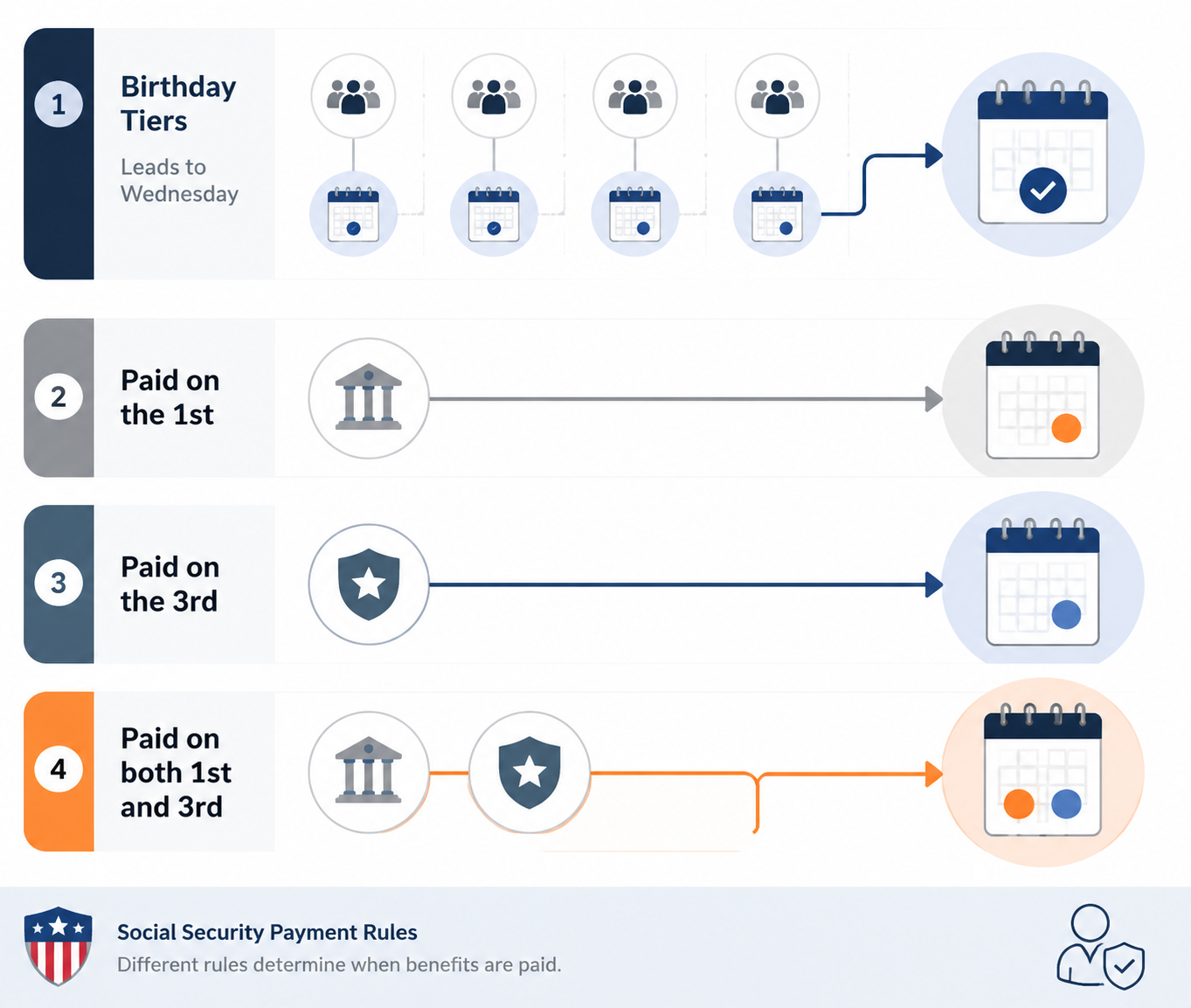
There are four main tracks. People who started receiving Social Security after May 1997 usually follow a Wednesday schedule based on their day of birth. Supplemental Security Income, or SSI, is usually paid on the 1st. People who started receiving Social Security before May 1997 are usually paid on the 3rd. People who receive both SSI and Social Security usually receive SSI on the 1st and Social Security on the 3rd. SSA, AARP, Kiplinger, and NerdWallet all describe the schedule around this same framework.[1][2][3][4]
The Four Payment Tracks
Start by finding the track, not the date. Once the track is known, the date usually follows from one short rule.
| Track | Who usually belongs here | Regular payment rule |
|---|---|---|
| Birth-date Wednesday track | People who began receiving Social Security after May 1997 | Birth date 1st-10th: second Wednesday; 11th-20th: third Wednesday; 21st-31st: fourth Wednesday |
| SSI track | People receiving Supplemental Security Income | Usually the 1st of the month |
| Pre-May-1997 Social Security track | People who began receiving Social Security before May 1997 | Usually the 3rd of the month |
| Dual-recipient track | People who receive both SSI and Social Security | Usually SSI on the 1st and Social Security on the 3rd |
The birth-date rule is the one that usually needs practice. The month does not matter first; the birthday does. A person born on the 8th looks for the second Wednesday. A person born on the 16th looks for the third Wednesday. A person born on the 27th looks for the fourth Wednesday. The year can change the date printed in the square, but it does not change the tier.
The weekend and holiday adjustment is the second half of the system. If a scheduled payment date falls on a Saturday, Sunday, or federal holiday, payment moves to the preceding business day.[5] That one sentence explains why some SSI payments appear at the end of the prior month and why a “3rd of the month” payment may sometimes arrive on the 2nd or even the 1st.
Why the Schedule Was Split
The staggered calendar did not begin as a puzzle for beneficiaries to solve. AARP’s overview, citing SSA history, explains that the staggered payment schedule was adopted in June 1997 because paying more than 74 million beneficiaries on the 3rd of each month had become administratively difficult.[2]
That history also explains the dividing line. People already receiving benefits before May 1997 generally stayed with the 3rd. People who started after that point were generally placed into the Wednesday system. The rule looks arbitrary until the administrative purpose appears: the system spreads work across the month instead of forcing nearly everyone through one payment date.
How to Apply the Rule on a Blank Calendar
A good study method is to use the same sequence every time. First, identify whether the person receives SSI, Social Security, or both. Second, ask whether Social Security benefits began before May 1997 or after May 1997. Third, if the person is in the post-May-1997 Social Security group, use the birthday tier. Last, check whether the date lands on a weekend or federal holiday.
- SSI only: start with the 1st, then adjust backward if the 1st is not a business day.
- Social Security before May 1997: start with the 3rd, then adjust backward if needed.
- Social Security after May 1997: find the correct Wednesday from the birthday tier, then adjust backward if that Wednesday is a federal holiday.
- Both SSI and Social Security: apply the SSI rule to the SSI payment and the 3rd-of-the-month rule to the Social Security payment.
For example, a hypothetical beneficiary who started Social Security after May 1997 and was born on the 12th would use the third Wednesday. If the month is April 2026, the Wednesdays are April 1, 8, 15, 22, and 29. The third Wednesday is April 15, so that is the date the rule produces.
The 2026 Calendar as a Worked Example
The 2026 calendar is useful after the rules are visible. Kiplinger’s 2026 payment calendar provides the full set of dates, and it is the most complete usable date set available in the reviewed sources; the official SSA PDF calendar was not directly available in the source set, so the table below treats the secondary calendar as the working reference while keeping SSA’s rules in view.[3]
| 2026 month | SSI payment | Pre-May-1997 Social Security | Birth dates 1st-10th | Birth dates 11th-20th | Birth dates 21st-31st |
|---|---|---|---|---|---|
| January | Dec. 31, 2025 | Jan. 2 | Jan. 14 | Jan. 21 | Jan. 28 |
| February | Jan. 30 | Feb. 3 | Feb. 11 | Feb. 18 | Feb. 25 |
| March | Feb. 27 | Mar. 3 | Mar. 11 | Mar. 18 | Mar. 25 |
| April | Apr. 1 | Apr. 3 | Apr. 8 | Apr. 15 | Apr. 22 |
| May | May 1 | May 1 | May 13 | May 20 | May 27 |
| June | May 29 | Jun. 3 | Jun. 10 | Jun. 17 | Jun. 24 |
| July | Jul. 1 | Jul. 3 | Jul. 8 | Jul. 15 | Jul. 22 |
| August | Jul. 31 | Aug. 3 | Aug. 12 | Aug. 19 | Aug. 26 |
| September | Sep. 1 | Sep. 3 | Sep. 9 | Sep. 16 | Sep. 23 |
| October | Oct. 1 | Oct. 2 | Oct. 14 | Oct. 21 | Oct. 28 |
| November | Oct. 30 | Nov. 3 | Nov. 10 | Nov. 18 | Nov. 25 |
| December | Dec. 1 | Dec. 3 | Dec. 9 | Dec. 16 | Dec. 23 |
The table is long, but the pattern is not. The three Wednesday columns march across the second, third, and fourth Wednesdays. The SSI column mostly stays on the 1st. The pre-May-1997 column mostly stays on the 3rd. The exceptions are doing exactly what the weekend and holiday rule says they should do.
The Early SSI Dates That Feel Like Mistakes
Early SSI deposits are often the dates that unsettle people, because the money for one month may arrive in the prior month. In 2026, the especially easy-to-misread SSI dates include Jan. 30 for February SSI, May 29 for June SSI, July 31 for August SSI, and Oct. 30 for November SSI.[3]
The important study habit is to label the benefit month, not just the deposit month. A payment arriving on Jan. 30 is not an extra January SSI payment; it is the February SSI payment arriving early because the usual date is not available. The same logic applies when the calendar moves a payment to the prior Friday.
When Two Rules Land on the Same Date
Sometimes two tracks point to the same business day. In May 2026, SSI is paid on May 1, and the pre-May-1997 Social Security payment also moves to May 1 because May 3 falls on a Sunday. That does not merge the rules. It simply means two separate rules happen to produce the same payment date.
That distinction matters most for dual recipients. A person receiving both SSI and Social Security should think in two lines: SSI follows the SSI rule, and Social Security follows the 3rd-of-the-month rule. In an ordinary month the dates are separate; in an adjusted month, the calendar may place them closer together.
Benefit Amounts Are Context, Not the Schedule
Payment timing and payment amount are related in a household budget, but they are not the same lesson. For 2026, Social Security benefits received a 2.8% cost-of-living adjustment, and Kiplinger reported an average monthly retirement benefit of about $2,082.76 for May 2026, citing SSA snapshot data.[3]
For SSI, the federal maximum monthly amounts for 2026 are $994 for an eligible individual and $1,491 for an eligible couple, according to the SSA Office of the Actuary.[6] Those figures help with planning, but they do not change which calendar rule applies.
How Payment Day Is Usually Experienced
For most beneficiaries, payment day now means an electronic deposit rather than waiting for a paper check. SSA directs beneficiaries to receive payments electronically through direct deposit or a Direct Express debit card.[7] AARP reported that as of mid-2026, only about 283,000 beneficiaries, or less than 0.4%, still received paper checks, with electronic payment federally mandated.[2]
That is why a payment-date study should include the bank. A calendar can tell you when SSA intends the payment to be made; the account view tells you whether the deposit has posted. SSA also provides an online benefit payment schedule view for people who want to check their own benefit timing directly.[8]
If the Payment Seems Late
The standard troubleshooting rule is practical: if a payment does not arrive on the expected date, wait three business days, then contact your bank or financial institution before calling SSA. This advice is widely repeated in payment-schedule guidance because posting delays can occur outside the schedule rule itself.[3][4]
Before calling, it helps to write down three facts: the benefit type, the expected rule date, and whether a weekend or federal holiday adjustment applies. That turns “my payment is missing” into a clearer question: “My post-May-1997 Social Security payment for a birthday in the 11th-20th tier was expected on the third Wednesday, and it has been more than three business days.”
The Social Security payment schedule is not a calendar to memorize from scratch each year. It is a small administrative system. Find the track, apply the date rule, then move the payment back if the scheduled date falls on a weekend or federal holiday. Once those steps are familiar, the monthly question becomes much calmer: which track am I in, what date does that imply, and does the calendar require an adjustment?
References
- Schedule of Social Security Payments — SSA.gov
- Payment Schedule Overview — AARP
- 2026 Payment Schedule & Calendar — Kiplinger
- 2026 Payment Dates — NerdWallet
- FAQ on holiday/weekend adjustments — SSA.gov
- SSI amounts for 2026 — SSA Office of the Actuary
- Direct Deposit info — SSA.gov
- View benefit payment schedule — SSA.gov
Comments
Join the discussion with an anonymous comment.