

How Students Can Start Stock Investing With Just $20 a Month
Starting to invest as a student doesn't require a large income or finance expertise. This guide explains the simple strategies—low-cost ETFs, fractional shares, dollar-cost averaging, and Roth IRAs—that let students build wealth with as little as $20 a month.
Updated:
Six dollars a day is not rich-kid money. It is a campus coffee plus a snack, a few tutoring sessions spread across a month, or one weekend shift divided into small pieces. A commonly cited compound-interest projection shows why that small number gets attention: investing $6 a day, or about $180 a month, starting at age 18 could grow to roughly $1 million by age 62 if the money earned a 7% average annual return.[1]
That is not a promise. Markets do not hand out smooth 7% returns, and a student’s income may disappear during finals, unpaid internships, family emergencies, or a bad semester. The point is narrower and more useful: time makes small investing habits matter earlier than they feel like they should. If $180 a month is impossible, $50, $20, or even $5 can still teach the system.
Students are not weird for wanting this skill. A 2026 CFP Board study found that 56% of college students expect to need investment advice after graduation, and 65% want to learn more about personal finance.[2] Schwab’s 2026 teen investing survey found that 70% of teens are interested in investing.[3] The demand is real; the problem is that beginner investing advice often talks as if everyone already has a parent with a brokerage account and a few hundred dollars sitting around.
The student version of investing is a system, not a stock-picking contest
The most workable stock investment strategies for students are boring on purpose: use earned income if you are opening a Roth IRA, choose a low-cost brokerage with no account minimum, buy fractional shares of one broad ETF, automate the purchase, and stop checking it like it is a class group chat.
That sequence matters because it removes the two lies that keep beginners frozen. The first lie is that you need a lot of money. Fractional shares let investors buy pieces of stocks or ETFs rather than a whole share, and several beginner-friendly platforms now support fractional investing starting around $1.[4][5][6] The second lie is that you need to know which individual company will win. For a beginner, the cleaner move is usually to own a low-cost diversified ETF that already holds many companies.
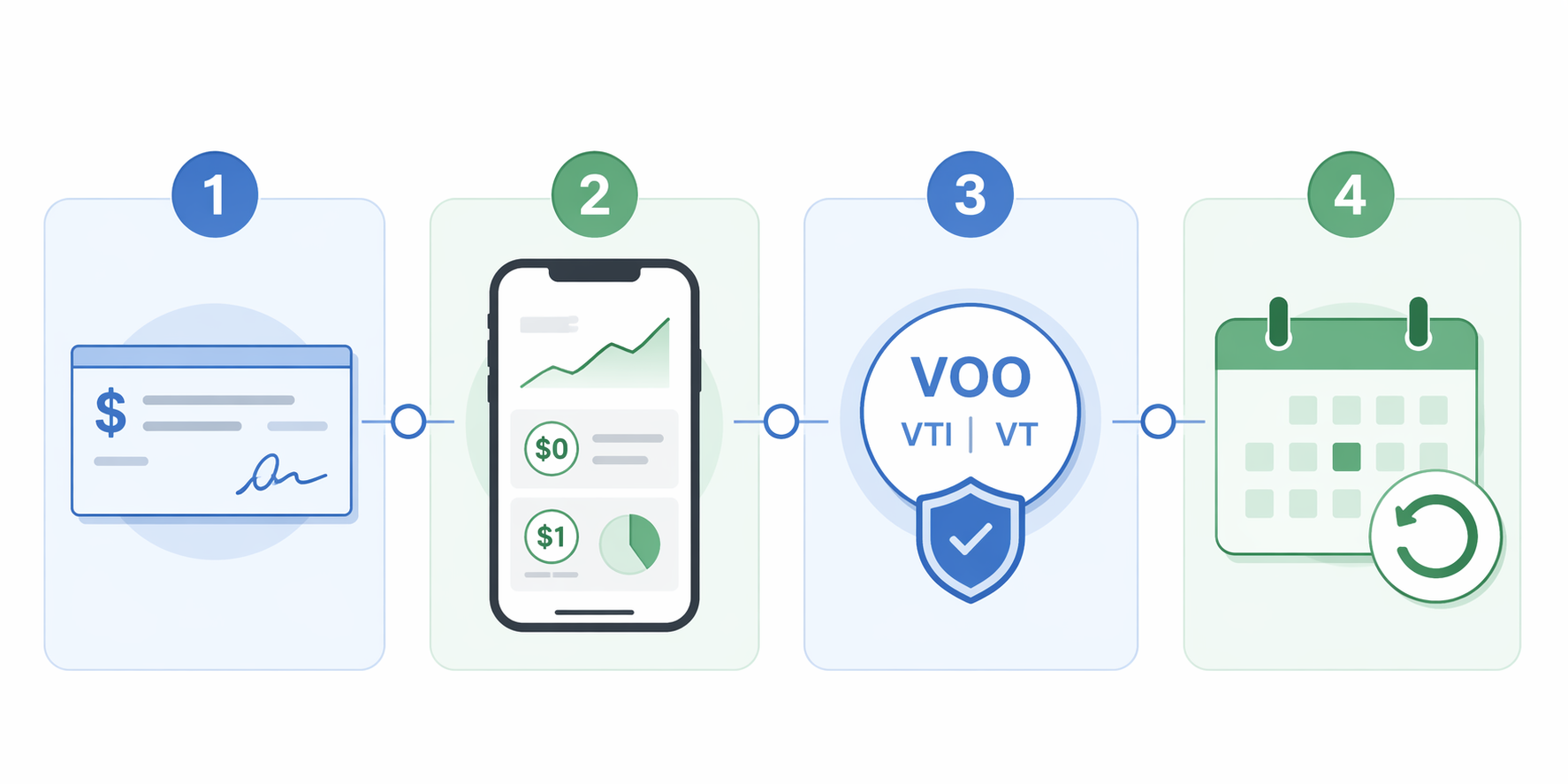
The basic setup
- Confirm earned income if you want to use a Roth IRA. Wages from a job, tutoring, summer work, or other eligible earned income are what make an IRA contribution possible.
- Open an account at a brokerage that has $0 minimums, $0 commissions, and fractional shares.
- Choose one broad ETF, such as VOO, VTI, or VT, instead of trying to assemble a mini portfolio of favorite companies.
- Set a recurring monthly buy for an amount you can keep through normal student life.
- Review occasionally, not daily. The habit is the assignment.
A broad ETF is not exciting in the way a brand-name stock is exciting. Nobody is bragging in the dining hall about owning a tiny slice of the whole U.S. market. But that is exactly why it works for beginners. A single diversified ETF spreads your money across many companies, so your first investing decision is not secretly a bet that one company, one CEO, or one trend will behave perfectly.
VOO tracks the S&P 500, VTI covers the total U.S. stock market, and VT gives global stock exposure. A student does not need all three. The practical choice is one fund that is broad, low-cost, and easy to keep buying. The goal is not to create the most impressive portfolio screenshot; it is to build a portfolio that can survive boredom.
Pick the account before you pick the app
For a student with earned income, a Roth IRA is often the strongest long-term wrapper because qualified withdrawals in retirement can be tax-free, and contributions—not earnings—can generally be withdrawn at any time without tax or penalty.[7] That flexibility matters for students because life is not always neat. The point is not to treat a Roth IRA like a savings account. It is to know that the money you contributed is not locked behind the same wall as retirement earnings.
The earned-income rule is the part to respect. If you did not earn income, do not pretend you did just to open an IRA. If you did earn income from a campus job, tutoring, lifeguarding, restaurant shifts, freelance work, or summer work, then the Roth IRA becomes worth considering before a regular taxable brokerage account. If your situation involves financial aid, family tax questions, or unusual income, that is where a tax professional or official IRS guidance matters more than a TikTok comment thread.
| If you can invest | What it can do | How to treat it |
|---|---|---|
| $5/month | Builds the habit and proves the account setup works | Use it without embarrassment; the first win is starting |
| $20/month | Makes fractional ETF investing realistic for a student budget | Automate it only if it will not create overdraft stress |
| $50/month | Starts to feel visible over a school year | Keep it steady instead of increasing it every time you feel motivated |
| $180/month | Matches the $6/day compound-interest example | Use it only if your income and basic cash needs can support it |
The highest number is not morally better. A student covering books, transportation, groceries, or family expenses may be making the smarter decision by starting with $20 and keeping cash available. Investing is not supposed to create panic every time rent, tuition, or a delayed paycheck hits.
The brokerage only has one job: make the simple plan cheap
A brokerage app should not be the main character. Its job is to let you open the right account, buy the ETF you chose, automate the amount, and avoid fees that punish small balances.
| Platform | Why a student might consider it | Watch-out |
|---|---|---|
| Fidelity | $0 commissions, $0 minimums, $0 IRA fees, and fractional shares from $1 are especially useful for tiny starter portfolios.[4] | The interface has more features than a beginner needs, so ignore the parts that invite over-managing. |
| Robinhood | It has 27.7 million funded customers and is widely used by younger investors.[6] | A simple interface can still encourage frequent checking and trading if you let it. |
| SoFi | It combines banking, investing, and Roth IRA access with $0 minimums, which can be convenient for students who want fewer apps.[5] | Convenience is not the same as a better investment strategy. |
| Acorns | Automatic spare-change investing can reduce friction for someone who struggles to start. | A $3/month fee can be heavy for very small balances; on $20/month, the fee is not tiny. |
Fees deserve extra attention when the balance is small. A $3 monthly fee sounds harmless until the monthly investment is only $20. That fee is not proof an app is bad; it is proof that convenience has a price, and students should calculate that price before choosing the easiest-looking option.
Why one ETF beats a few “interesting” stocks
Individual stocks feel more personal. Buying a company you use every day can make investing feel less abstract. The problem is that familiarity is not the same as diversification. A student buying three favorite companies may feel informed while still making a concentrated bet.
A broad ETF changes the question. Instead of asking, “Which company will do best?” you ask, “Can I keep buying a low-cost basket through school, graduation, and my first few years of work?” That is a better beginner question because it depends less on prediction and more on behavior.
This is also where fractional shares matter. If a full ETF share costs more than your monthly amount, fractional investing lets your $20 still go into the same broad fund. You do not have to wait until you can afford a whole share, and you do not have to buy a cheaper stock just because it fits your cash balance.
Dollar-cost averaging is a behavior tool
Dollar-cost averaging means investing a set amount on a regular schedule. For a student, the point is not that it magically beats every other timing strategy. The point is that it removes the weekly debate over whether the market is too high, too low, too scary, or too confusing.
If the recurring buy is $20 on the first Friday of each month, the system keeps moving even when your brain is busy with exams. Some months your $20 buys a little more of the ETF because the price is lower. Some months it buys a little less because the price is higher. The routine matters because most beginners do not fail from choosing a slightly imperfect day to invest. They fail from never making the second or third purchase.
The amount should match your actual cash flow. If your income comes in uneven chunks from summer work, you might set a small automatic monthly buy during school and make an extra contribution after a paycheck clears. If your job hours change every semester, keep the recurring amount low enough that it does not become another bill you dread.
What to avoid when the app makes investing feel like entertainment
The easiest way to make student investing harder is to turn it into a performance. Hot stocks, constant portfolio checking, options trading, and “I just found this company” advice can make a $20 habit feel too small to matter. That is backwards. The small habit is the part you can control.
Be especially careful with advice that depends on urgency. Schwab’s teen survey found that teens interested in investing most often trust parents for advice, while the CFP Board study found that only 5% of college students trust financial advice from social media influencers.[3][2] That skepticism is useful. An influencer does not have to live with your overdraft fee, your tax paperwork, or your regret if you trade money you needed for school.
- Avoid buying a stock only because the company is famous.
- Avoid trading more often because the app makes it easy.
- Avoid fees that look small but consume a large share of a tiny monthly investment.
- Avoid investing money you know you will need for near-term bills.
- Avoid treating a Roth IRA contribution rule as casual advice; earned income matters.
A $20/month setup you can actually finish
Here is the clean version. If you have earned income, open a Roth IRA at a low-cost brokerage with $0 minimums and fractional shares. If you do not have earned income, use a regular taxable brokerage account for now or wait until you do. Choose one broad ETF, such as VOO, VTI, or VT. Set a recurring $20 monthly buy. Leave the dividend setting on reinvest if the platform asks. Then stop trying to improve the plan every week.
If $20 is too tight, start with $5. If $20 is comfortable, do not rush to $50 just because you are excited on setup day. If $180 is realistic because your job, scholarship refund planning, or summer income supports it, use it as a strong target, not as proof that smaller amounts are pointless.
The first automated investment is the finish line for this week. Not becoming a stock expert. Not building a complicated portfolio. Not proving that you understand every financial term online. Choose the account, choose the ETF, set the recurring buy, and review only occasionally. Twenty dollars a month is not about getting rich this semester. It is about graduating with your money already in motion.
References
- The College Investor compound-interest calculation — The College Investor.
- Gen Z College Students Hungry for Financial Education — CFP Board, February 2026.
- Schwab Teen Investing Survey 2026 — Charles Schwab, 2026.
- Best Brokerage Accounts for Beginners 2026 — The Motley Fool, 2026.
- 6 Best Investing Apps for College Students in 2026 — Benzinga, 2026.
- Best Brokerage App for College Students 2026 — StockTrak, 2026.
- Building Wealth: A Roadmap for Students — SEC Investor.gov.
Comments
Join the discussion with an anonymous comment.