

How to Build Financial Literacy as a Student Without Overwhelm
Feeling lost when it comes to money? This guide breaks down the best free apps, courses, and a simple 4-week action plan to help students build real financial literacy without overwhelm.
Updated:
A student can sit through a required money lesson, nod through the parts about saving early, and still freeze later at the very normal question: can I afford this bill and still buy groceries next week? That is the real problem with financial literacy for students. Exposure is not the same as being able to use the skill when rent, textbooks, subscriptions, gas, family obligations, and a late fee are all competing for the same balance.
The gap is not imaginary. In the 2026 TIAA Institute-GFLEC Personal Finance Index, Gen Z answered 38% of personal finance questions correctly, the lowest score among generations; the same report found that 25% of U.S. adults have very low financial literacy.[1] At the same time, college students are not shrugging this off: a 2026 CFP Board study found that 65% of Gen Z college students want to learn more about personal finance, and 95% of those already receiving financial education find it helpful.[2] Intuit’s financial literacy statistics also report that financial stress negatively affects 57% of people overall and 71% of Gen Z.[3]
So the useful question is not whether money skills matter. They do. The better question is how to build usable skill this month without adding another giant dashboard, paid course, or guilt-heavy “adulting” project to your life.
Start With a Small Resource Shelf, Not a Giant Course List
A good student money toolkit has three jobs. One tool makes your actual money visible. One resource teaches the vocabulary. One routine forces a little practice before the information evaporates. If a resource does not serve one of those jobs, save it for later.
| Tool type | Good options to consider | What it is for | Best student use |
|---|---|---|---|
| Budgeting or tracking app | A free bank app, a spreadsheet, or a budgeting app with a free tier | Seeing where money goes | Checking spending once or twice a week, not building a perfect finance command center |
| Structured lessons | Khan Academy Financial Literacy, FDIC Money Smart, CashCourse | Learning terms and basic concepts in order | Completing short modules on budgeting, credit, saving, borrowing, and taxes |
| Public consumer resources | CFPB youth financial education tools | Getting plain-language explanations and classroom-style activities | Using worksheets or guides when a topic feels fuzzy, especially borrowing or banking |
| Gamified practice | Zogo, Financial Football, and similar light practice tools | Reducing avoidance and making repetition less boring | Reviewing concepts in short sessions when you would otherwise scroll |
For tracking, the simplest option usually wins. If your bank or credit union already categorizes transactions, use that before downloading three more apps. If you like seeing numbers in your own words, a spreadsheet can be better than an app. If you do choose a budgeting app, check whether the free tier actually lets you track spending after setup, whether it requires linking accounts, and whether the paid version starts automatically after a trial.
For learning, choose one structured path first. Khan Academy Financial Literacy is useful when you want short, student-friendly explanations. FDIC Money Smart is more formal and works well for banking, borrowing, and planning basics. CashCourse is designed around college student money decisions. CFPB’s youth financial education materials are especially helpful when you want worksheets, activities, or plain explanations from a public agency; the CFPB describes these as resources for teaching and building youth financial capability.[4]
The point is not to collect resources. It is to pick one tracker, one learning path, and one practice habit, then use them long enough to notice patterns.
A Four-Week Plan That Turns Exposure Into Practice
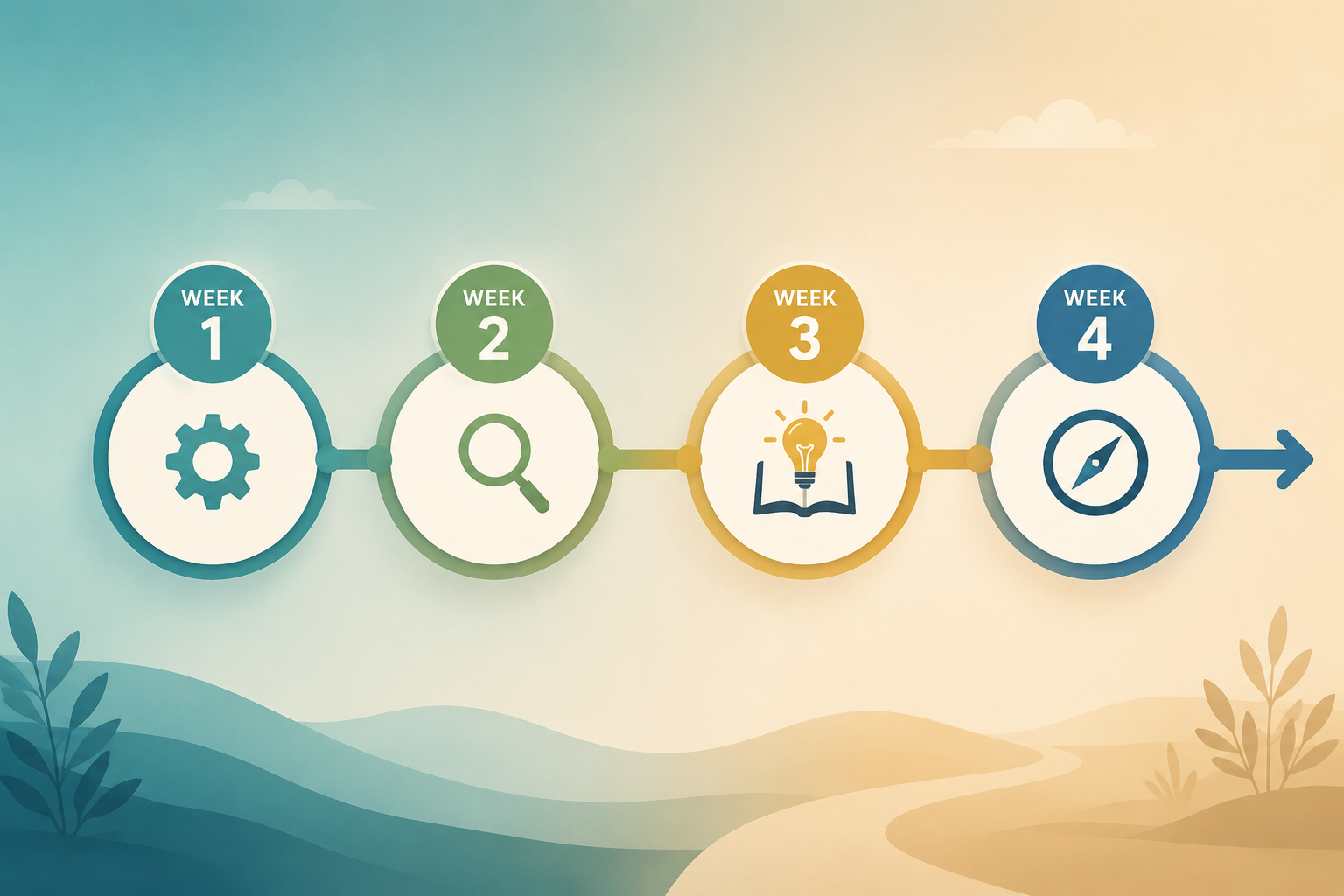
This plan is built for a student schedule, so it assumes limited time and imperfect income. If your pay changes week to week, someone at home depends on you, or debt payments are already stressful, the plan still works better when treated as information gathering first. The first goal is not to fix your whole financial life. It is to stop guessing.
| Week | Main action | Time needed | Result by the end of the week |
|---|---|---|---|
| Week 1 | Set up a simple money view | 45 to 60 minutes total | You know your accounts, fixed bills, next due dates, and current balance picture |
| Week 2 | Track spending without judging it | 10 minutes, twice this week | You can name the categories where money disappears fastest |
| Week 3 | Complete one short learning path and apply one concept | 60 to 90 minutes total | You connect a lesson to a real choice, such as credit, savings, or comparison shopping |
| Week 4 | Make three small decisions and pick the next topic | 45 minutes total | You leave with a repeatable routine instead of a one-time burst of motivation |
Week 1: Build a Money View You Will Actually Reopen
Week 1 is where most students either make this easy enough to continue or accidentally build a system they will abandon by Wednesday. Do not start with investing, credit card optimization, or a twelve-tab spreadsheet. Start with the parts that cause late fees and panic.
- List every account you use: checking, savings, campus card, prepaid card, cash app balance, and any credit card.
- Write down fixed monthly costs: rent, phone, insurance, subscriptions, transportation, minimum debt payments, and school-related fees.
- Add the next due date beside each bill, even if the amount is small.
- Choose one tracking method: your bank’s built-in categories, a free budgeting app, or a spreadsheet.
- Set one weekly money check-in on your calendar for the same day you usually check grades, work schedules, or assignments.
This is not a budget yet. It is a map. A budget says what should happen. A map shows what is already happening. Most students need the map first because the missing information is often basic: when the subscription renews, how much food costs between grocery trips, or whether a paycheck arrives before the bill does.
If linking bank accounts to an app feels uncomfortable, skip it. Manual tracking is slower, but it has one advantage: typing in a purchase makes it harder to pretend the purchase did not happen. If manual tracking makes you avoid the whole process, use automatic categories and clean them up later. The best tool is the one you will reopen when you are tired.
Week 2: Track the Last Seven Days Without Turning It Into a Trial
In Week 2, look backward before you make rules. Pull up the last seven days of spending and group purchases into plain categories: food, transportation, school, bills, fun, family, health, fees, and “I do not remember.” The last category is allowed. It is also useful, because forgotten spending is one of the fastest ways a balance becomes confusing.
Then choose one category to watch for the rest of the week. Not five. One. Food is a common starting point because it includes groceries, dining hall gaps, vending machines, delivery fees, and late-night convenience purchases. Transportation is another good one if gas, rideshares, parking, or transit passes keep changing your available cash.
The behavior change this week is small: before one purchase, compare two options. That might mean checking whether a used textbook is available before buying new, comparing grocery totals between two stores you already use, or looking at the total cost of delivery after fees instead of the menu price. The point is not to become a bargain hunter in every corner of life. It is to practice the muscle of pausing before money leaves.
This is where financial literacy starts to feel less like vocabulary and more like behavior. A student who knows the definition of opportunity cost has exposure. A student who notices that one convenience purchase trades off against laundry money has usable skill.
Week 3: Learn One Topic Because You Need It, Not Because a Course Listed It
This week, choose one short module from Khan Academy Financial Literacy, FDIC Money Smart, CashCourse, or a CFPB youth resource. Pick the topic based on the decision in front of you.
- If your balance keeps dropping faster than expected, choose budgeting or spending plans.
- If you are considering a credit card, choose credit scores, interest, and minimum payments.
- If you have a refund check, paycheck, or summer earnings, choose saving goals and emergency funds.
- If you are signing paperwork for housing, loans, or a bank account, choose borrowing, fees, and consumer protections.
After the lesson, do one real action. If you studied credit, read the terms on a card offer or your current account and find the interest rate, fees, and payment due date. If you studied saving, move a small amount into savings or set a target for the next paycheck. If you studied budgeting, adjust one category instead of rewriting your entire life.
Gamified tools can fit here if they keep you moving. A few short rounds in a practice app or game can make terms less intimidating, especially when you are too tired for a full lesson. Just do not confuse streaks with mastery. The test is whether you can use the idea on your own money.
Week 4: Make Three Decisions and Decide What Comes Next
By Week 4, you should have enough information to make a few small choices. Keep them modest, because dramatic plans are easy to admire and hard to maintain during exams, work shifts, or family emergencies.
- Choose one bill or due date that needs an alert earlier than the day it is due.
- Choose one spending category to cap, reduce, or simply keep watching for another month.
- Choose one savings target, even if it is small enough to feel almost boring.
- Choose the next topic that deserves deeper study: credit, student loans, taxes, renting, insurance, or investing basics.
A good result after four weeks is not total confidence. It is knowing where your money goes, recognizing which decisions repeat, and having one place to learn before you click, sign, borrow, or ignore something expensive.
How to Choose Between Apps, Courses, and Games
Use the tool that matches the problem. If the problem is “I do not know where my money went,” choose tracking. If the problem is “I do not understand the term,” choose a lesson. If the problem is “I keep avoiding this,” choose a lower-friction practice tool for a few minutes, then return to the real decision.
A budgeting app is worth using when it saves time or makes patterns clearer. It is not worth using if setup takes a whole afternoon, the free version hides the feature you need, or notifications make you feel worse without helping you act. Before connecting accounts, check the privacy policy, security practices, cancellation terms, and whether the app sells a paid upgrade you do not want.
A course is worth using when it answers the next real question. You do not need to complete every lesson on every topic before making progress. Start with budgeting if cash flow is confusing, credit if you are borrowing, saving if income is irregular, and taxes if a job or scholarship has changed your paperwork.
A game or quiz is worth using when it lowers the barrier to starting. It is a warm-up, not the whole workout. If you can answer a question correctly in a game but still do not know what to do with your own bill, statement, or paycheck, go back to the document in front of you.
What This Can Realistically Do in a Month
Four weeks will not erase low income, high rent, medical costs, family responsibilities, or debt. It also will not make every student excited about personal finance. That is fine. The goal is smaller and more useful.
After a month, you should be able to open one tracker and understand your recent spending. You should have finished at least one basic learning module. You should have compared at least one purchase before paying for it, set or revised one savings target, and identified the next topic that could cost you money if you keep guessing.
That is what practical financial literacy looks like at the student level: not knowing everything, and not pretending an app fixes life, but having enough structure to make the next money decision less blurry than the last one.
References
- TIAA Institute-GFLEC Personal Finance Index, TIAA Institute/GFLEC, 2026
- Gen Z College Students Hungry for Financial Education, New CFP Board Study Finds, CFP Board, February 2026
- 40 Financial Literacy Statistics, Intuit
- Youth Financial Education, Consumer Financial Protection Bureau
Comments
Join the discussion with an anonymous comment.