

Which Odyssey Translation Should You Read?
Not sure which translation of Homer's Odyssey to read for class? This guide compares the major English translations — Wilson, Fagles, Fitzgerald, and more — to help you choose based on your reading goal, whether you need to speed-read, write an essay, or study alongside Christopher Nolan's film.
Updated:
Before you choose an Odyssey translation, look at the first problem the translator has to solve. The Greek poem opens with Odysseus described as polytropos, a word that can point toward many turns, many ways, versatility, wandering, cleverness, and complication. English cannot hold all of that in one neat word, so every translator has to choose which Odysseus walks onto the page first.
| Translator | Opening description of Odysseus | What a student notices first |
|---|---|---|
| Emily Wilson | "Tell me about a complicated man" | A psychologically and morally layered person |
| Robert Fagles | "the man of twists and turns" | A dramatic hero shaped by motion, danger, and cunning |
| Robert Fitzgerald | "the man of many ways" | A seasoned survivor whose identity stays open to interpretation |
| Richmond Lattimore | "the man of many ways" | A closer, plainer echo of the Greek phrase |
| Stanley Lombardo | "the man of many turns" | A direct, performable phrase with verbal snap |
That is the whole issue in miniature. Wilson's "complicated man" gives a student an immediate interpretive handle: Odysseus is not simply brave, clever, or homesick; he is difficult to judge. Fagles' "man of twists and turns" sounds bigger and more theatrical, already moving like a storm scene. Fitzgerald and Lattimore hold closer to the older phrasing of "many ways," while Lombardo's "many turns" keeps the line quick and oral. These are not decorative differences. They change what kind of evidence a student begins collecting from line one.[1][2]
So the most useful answer is not "read the best Odyssey." It is: choose the translation that fits the job you need it to do. For a first student read, Emily Wilson's 2017 translation is the strongest default. For a class that wants sweep, momentum, and a familiar modern classroom edition, Robert Fagles' 1996 translation remains a very safe choice. For serious essay work, the best move is to read Wilson and Fagles side by side, because the gap between them shows you where interpretation is happening.
The Short Answer: Which Odyssey Translation Should You Pick?
If you are standing in a bookstore, scrolling a library catalog, or staring at a PDF search result five minutes before you need to make a decision, use this as the working guide.
| Your situation | Best choice | Why |
|---|---|---|
| First time reading The Odyssey for school | Emily Wilson | Clear, modern, controlled, and alert to social realities that matter for interpretation |
| Your teacher assigned a common classroom edition | Robert Fagles | Dramatic, readable, widely taught, and easy to discuss aloud |
| You need to write an essay | Wilson plus Fagles | Their differences give you evidence for close reading |
| You want the poem to sound huge and cinematic | Fagles | The free verse has force, speed, and grandeur |
| You are listening instead of reading silently | Wilson read by Claire Danes, or Fagles read by Ian McKellen | Both audiobook pairings match the strengths of the translations |
| You are intimidated by verse | E. V. Rieu | The prose format can make the plot easier to enter |
| You want a close line-by-line relation to Greek | Richmond Lattimore | Useful for comparison, though less friendly as a first read |
| You want something new and performance-minded | Daniel Mendelsohn | A recent version attentive to oral texture |
No major translation on that list is a fake Odyssey. The question is what it makes easy, what it makes harder, and what kind of Odysseus it teaches you to notice.
Why Wilson Is the Best First Translation for Most Students
Wilson's translation is unusually good at removing the wrong kinds of difficulty. It does not make The Odyssey simple, because the poem is not simple. It does make the sentences clean enough that a first-time reader can follow who is speaking, where the action is moving, and why a word choice might matter.
That matters more than it sounds. Many students do not get stuck because the Cyclops episode is impossible, or because Telemachus' search for news of his father is too subtle. They get stuck because the translation puts a layer of antique English, inflated diction, or blurred social language between them and the poem. Once that happens, they start summarizing vaguely: Odysseus is heroic, Penelope is faithful, the suitors are bad, the gods interfere. Those statements are not useless, but they are too blunt for a good class discussion or essay.
Wilson's "complicated man" helps because it gives students permission to read Odysseus as admirable and troubling at the same time. The phrase does not settle the argument for them. It opens the argument early. A student can track how complication appears in his storytelling, his disguises, his violence, his longing for home, and his pleasure in being known.
Wilson is also often described as using modern iambic pentameter, which gives the translation formal discipline without making it feel like a museum label.[2] For students, that combination is useful: readable enough for the first pass, shaped enough to remind you that this is still poetry.
Why Fagles Is Still the Classroom Powerhouse
Fagles is the translation to choose when you want the poem to move. His Odyssey has a rolling, public sound: strong verbs, emotional lift, and enough grandeur to make speeches and sea passages feel large. If Wilson is often the better first study tool, Fagles is often the better performance engine.
That is one reason it remains so classroom-friendly. Students can hear the stakes quickly. The Cyclops is frightening, the sea is wide, the suitors have presence, and Odysseus feels like a figure built for oral storytelling. Fagles' free verse is not trying to reproduce Greek meter in a strict way; it is trying to make the poem surge in English.[2]
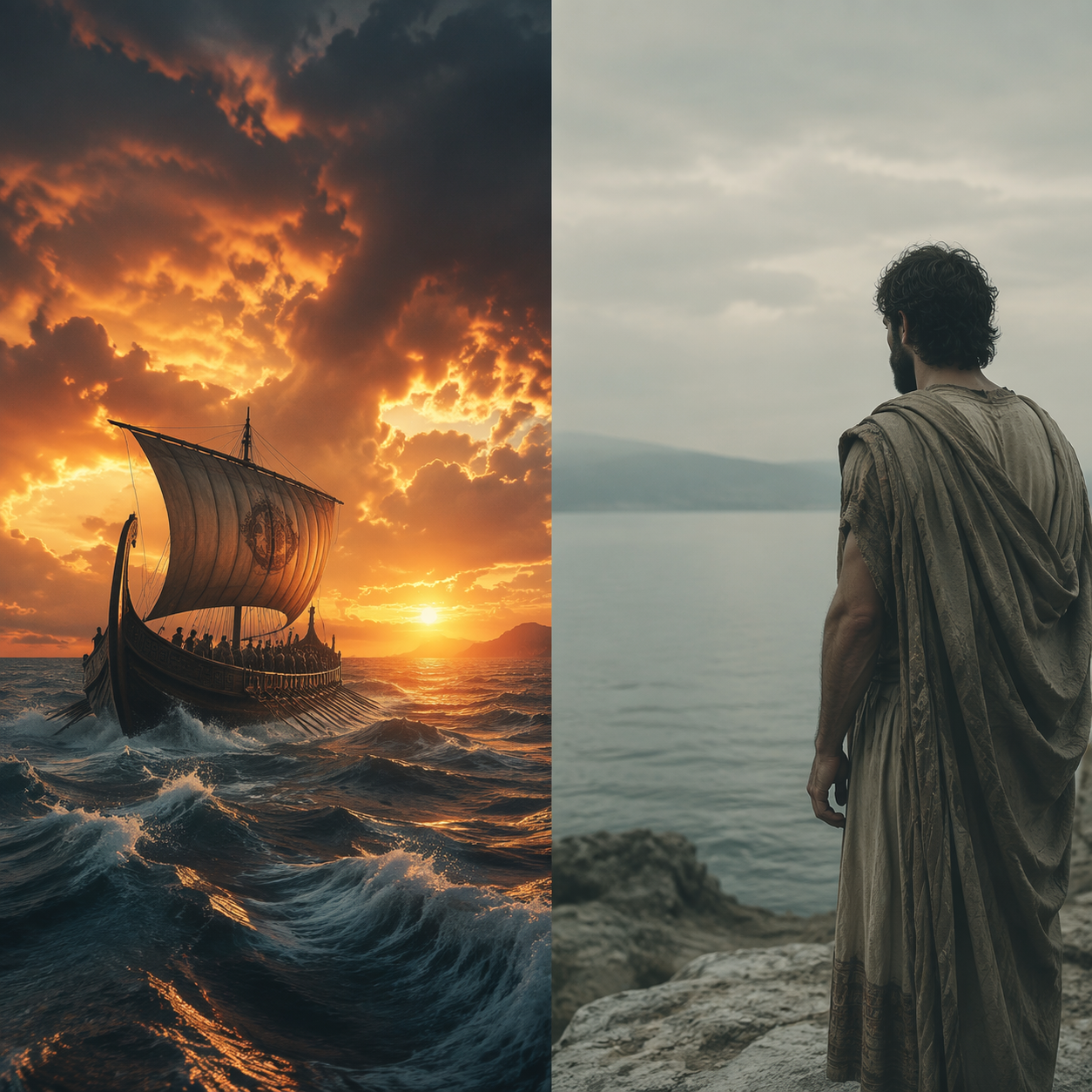
The tradeoff is that drama can steer interpretation. "The man of twists and turns" foregrounds energy, skill, and danger. It is a terrific phrase, and it fits much of the poem. But if a student only reads Fagles, they may need a nudge to ask whether Odysseus' turns are also evasions, manipulations, or moral evasions. That is exactly why pairing Fagles with Wilson works so well.
If You Need to Read Fast
Choose Wilson if you need to get through the poem quickly without losing the thread. Speed-reading The Odyssey is never ideal, because the poem rewards patterns: hospitality scenes, repeated epithets, disguise, recognition, storytelling inside storytelling. But if the practical assignment is a quiz tomorrow, you want a translation that lets you identify the plot without constantly decoding the English.
Read with a pencil or notes app open and mark only four things: where Odysseus is, who knows his identity, who controls the household, and when a guest-host relationship goes wrong. That will carry more of the poem than trying to underline every beautiful phrase.
If even verse itself is the barrier, Rieu's prose translation can be a legitimate entry point. It is not the best choice for analyzing Homeric poetic texture, but it can help a nervous reader understand the route from Troy to Ithaca before moving into a verse translation. For students who need book-by-book help after choosing an edition, a dedicated Odyssey summary and analysis for students is the better next stop than trying to substitute a translation choice for actual reading.
If You Need to Write an Essay
Use at least two translations. Wilson plus Fagles is the most useful pairing for many students because the contrast is easy to see and academically productive. You are not comparing them to declare a winner. You are using the gap between them as evidence.
Suppose your essay is about Odysseus' identity. Wilson's "complicated man" points you toward instability of character and moral judgment. Fagles' "man of twists and turns" points you toward strategy, motion, and survival. Fitzgerald and Lattimore's "many ways" leaves more interpretive space but gives less immediate guidance. A good paragraph can begin with that difference and then test it against scenes of disguise, lying, recognition, and revenge.
For essay work, do not quote one translation as if it were the Greek itself. Say which translation you are using. If a word is doing major interpretive work, check how another translator renders it. If the translations diverge sharply, that is not an inconvenience; it is often where the best analysis begins.
A simple comparison method
- Pick one short passage, not a whole book.
- Read it first in your assigned translation.
- Read the same passage in Wilson or Fagles.
- Circle words that change the moral tone: loyal, clever, slave, maid, stranger, guest, rage, grief.
- Ask what kind of argument each translation makes easier to write.
That method is especially useful for essays on gender, slavery, hospitality, heroism, disguise, and homecoming. It keeps the essay anchored in language instead of drifting into plot recap.
If Your Class Is Using a Common Edition
If your teacher has assigned Fagles, use Fagles. This sounds obvious, but students sometimes create unnecessary trouble by buying the edition that online lists call "best" and then discovering that page numbers, line references, and quoted passages do not match class discussion.
The assigned edition is the classroom's shared map. You can still keep Wilson nearby for comparison, especially for passages where the wording affects interpretation. But when the teacher asks the class to look at a passage, you need to be able to find the same place quickly.
If the class has not assigned a translation and leaves the choice open, Wilson is the best default for most students. It is clear without being flat, modern without pretending the ancient world is modern, and direct about parts of the poem that older translations sometimes soften.
If You Are Listening
Audiobook choice matters because The Odyssey is an oral poem in origin, and because many students absorb plot and tone better by hearing it. Wilson's translation is read by Claire Danes, while Fagles' is read by Ian McKellen.[2] Those are not minor packaging details. The narrator can either clarify a long speech or make it blur into background noise.
For a first read, Wilson's audiobook is a strong choice because the language is already clean on the page. For grandeur and theatrical force, McKellen reading Fagles is hard to beat. If you are using audio for class, keep the printed or digital text open while listening. The test, essay, or discussion will usually ask you to work with words, not just memories of the story.
If You Are Reading Because of Christopher Nolan's Film
Christopher Nolan's The Odyssey opened on July 17, 2026, which means many students are now arriving at Homer through the film rather than through a syllabus. That is fine. The danger is letting the movie become the version of the poem in your head before you have noticed what the poem actually does.
Wilson is especially relevant in that context because Nolan reportedly cited her opening phrase, "Tell me about a complicated man," as shaping his film's portrayal of Odysseus; SYFY Wire discusses that point through reference to an Empire interview from November 2025.[3] That does not mean Wilson is the official movie key, and it does not make other translations obsolete. It does mean that a student reading alongside the 2026 film has a good reason to start with the version whose first line helps frame Odysseus as psychologically and morally difficult.
After that, use the film comparatively rather than defensively. Ask what the movie simplifies, intensifies, rearranges, or leaves out. For that kind of work, pair the translation with a focused Odyssey movie and book comparison, or use a broader guide to studying Homer's Odyssey through Christopher Nolan's film. The goal is not to catch the film being "wrong" every time it changes something. The goal is to see what each medium makes visible.
The Greek Words That Change the Assignment
You do not need to know Greek to notice when a translation is steering you. You do need to know that certain English words are carrying interpretive weight. Four cases are especially useful for students: polytropos, dmōē, the Cyclops pun, and the famous "wine-dark sea."
Polytropos: what kind of man is Odysseus?
Polytropos is the first fork in the road. Render it as "complicated," and Odysseus enters as a problem of character. Render it as "twists and turns," and he enters as a figure of movement and cunning. Render it as "many ways," and the English stays closer to the Greek structure while leaving the reader to infer more. NYU classics professor Alex Forte, interviewed by SYFY Wire, discusses the difficulty and richness of this kind of Greek phrasing in relation to Odyssey translation.[3]
For a student, the practical result is simple: your opening quotation can shape your thesis. An essay that begins from "complicated" will probably ask different questions than one that begins from "twists and turns." Neither is automatically better. The stronger essay is the one that notices the translation's pressure and then proves its claim in later scenes.
Dmōē: maids, servants, or enslaved women?
This is where translation stops being a matter of style and becomes a matter of moral visibility. Some older translations use words such as "maids" or "serving women" for enslaved women in Odysseus' household. Wilson's translation is more direct, using language such as "slave women" or "enslaved women." The difference affects how students understand power, sexual vulnerability, punishment, and blame in the Ithacan household.[1][3]
"Maid" can make a brutal social arrangement sound like ordinary domestic employment. "Enslaved woman" makes the coercive structure harder to miss. A student writing about justice near the end of the poem cannot treat those phrases as interchangeable. The translation has already influenced who appears responsible, who appears disposable, and whose suffering is easy to overlook.
Nobody, Noman, and the Cyclops joke
In the Cyclops episode, Odysseus survives partly through a pun: he tells Polyphemus that his name is Nobody, so when the blinded Cyclops cries out, the other Cyclopes misunderstand the complaint. Translators have to decide how to make that Greek wordplay work in English, often through forms such as "Nobody" or "Noman." The choice affects whether the scene feels like a clever joke, a linguistic trap, or a slightly awkward footnote.[1][3]
This is a good reminder that Odysseus' intelligence is not abstract. He wins time by controlling names, timing, and audience. If the pun lands, students see why language itself is one of his weapons. If the pun feels clumsy, the episode can shrink into "he tricked the monster," which is accurate but thin.
Wine-dark sea: keep the strangeness or clarify the image?
"Wine-dark sea" is one of the most famous Homeric phrases in English. Fagles keeps that traditional strangeness, while Wilson is more willing to vary repeated epithets for clarity.[1][3] This is not a small aesthetic preference. Repeated phrases help create the poem's oral texture, but they can also puzzle students who expect every adjective to behave like a precise modern color label.
If you love the alien feel of ancient poetry, you may miss some of that texture when a translation smooths or varies the formula. If you are trying to follow the story on a first pass, variation can help keep the line alive in English. This is one place where older poetic texture and modern readability genuinely pull in different directions.
Where the Other Major Translations Fit
Wilson and Fagles get the most attention because they solve the most common student problems. The other major translations still have real uses. They are not leftovers; they are tools with different handles.
| Translation | Best use | Possible drawback for students |
|---|---|---|
| Emily Wilson, 2017 | Best first read for most students; clear, modern, formally controlled, and direct about social realities | Some readers may want more archaic grandeur |
| Robert Fagles, 1996 | Best dramatic classroom read; strong for oral reading and cinematic scale | Its energy can make some interpretive choices feel more settled than they are |
| Robert Fitzgerald, 1961 | Best for students who want a richly poetic mid-century English Odyssey | The period style may feel less immediate |
| Richmond Lattimore, 1965 | Best for closer comparison with Greek phrasing | Can feel stiff or less welcoming as a first translation |
| Daniel Mendelsohn, 2025 | Best for readers curious about a recent translation attentive to oral performance texture | Less classroom-established than Fagles |
| Stanley Lombardo, 2000 | Best for a conversational version designed to be read aloud | May not satisfy readers looking for a more elevated poetic register |
| E. V. Rieu, 1946 | Best prose entry point for students intimidated by verse | Less useful for analyzing poetic form |
Fitzgerald deserves more respect than a quick "older translation" label. His version can be beautiful, and for some readers that beauty is the doorway into the poem. Lattimore is valuable when you want to see more of the Greek sentence-shape showing through the English. Lombardo is useful when the poem needs to be heard rather than admired from a distance. Rieu's prose can help a reader who would otherwise never get past the first page. Mendelsohn's recent version gives students and teachers another way to think about the poem's performed quality.[2]
A Practical Buying Rule
If your class names a required translation, buy or borrow that edition first. If your class does not specify one, start with Wilson. If your teacher values dramatic reading aloud, or if most class materials quote Fagles, choose Fagles. If you are writing a serious paper, use both.
The edition itself also matters. A student edition with an introduction, maps, notes, and line numbers is usually worth more than a bare text with a prettier cover. For The Odyssey, notes can save you from losing time on genealogy, geography, divine names, and Trojan War backstory. If that background is the problem, use a Trojan War history study guide before you blame the translation.
One more caution: do not use a random public-domain translation just because it is free unless your assignment allows it and you know what you are getting. Older free versions can be useful, but they may bring exactly the kind of language barrier that makes capable students think they are bad at reading Homer.
The Best Study Pairing
For most students, the strongest two-translation setup is Wilson plus Fagles. Read Wilson for clarity and moral precision. Check Fagles when you want momentum, grandeur, and a sense of why the poem keeps attracting directors, actors, and teachers. When they differ, slow down. The difference is usually telling you where a word, scene, or value is under pressure.
That pairing also protects against two common mistakes. Wilson alone can make the poem feel more immediately legible than it is in its ancient context. Fagles alone can make the poem feel more heroically settled than it is in its moral texture. Together, they give a student a wider field of view without requiring a graduate seminar in Greek.
Once you have chosen the translation, stop shopping and start reading. If this is your first pass, pick Wilson. If your class or your ear wants sweep and drama, Fagles will serve you well. If you are writing about the poem seriously, compare at least two translations before building your argument. Then move from the edition question into the work itself: the plot, the recognitions, the lies, the homecoming, and the uncomfortable words that make The Odyssey worth studying rather than merely finishing.
References
- Best Odyssey Translation, jsusannewilson.com, https://jsusannewilson.com/post/best-odyssey-translation
- The Odyssey Translations Guide, Ink and Imaginings, https://inkandimaginings.com
- The Odyssey Translations to Read Before Christopher Nolan Film, SYFY Wire, https://www.syfy.com/syfy-wire/the-odyssey-translations-to-read-before-christopher-nolan-film
Comments
Join the discussion with an anonymous comment.