
Learn History and Ethics from The Shootist Filming History
A practical study guide that uses The Shootist's precise historical setting, production backstory, and thematic depth to teach U.S. history, literary analysis, and ethical reasoning — all from a single 100-minute film.
Updated:
If you have one film and need to learn more than plot, The Shootist is a workable choice because it gives you three study handles at once: a precise historical date, a clear literary conflict, and a production story that changes how the ending reads. The film is rated PG, runs 100 minutes, and is set on January 22, 1901, a date that places the story at the edge of the old frontier and just after Queen Victoria’s death, which the film references.[1][2]
That matters for a student because “the Old West is ending” is too vague to study well. January 22, 1901 is something you can put at the top of a notes page. From there, you can connect the film to U.S. history from 1865 to 1913, to the Western hero as a literary type, and to ethical questions about violence, reputation, illness, and dignity.[1]
Start with the film as a study object, not a trivia object
A useful first pass is simple: watch for what can become evidence. The main character, J.B. Books, is an aging gunfighter with cancer. Gillom, the younger character, is close enough to admire him and young enough to misunderstand what that admiration costs. The story’s tension is not only whether Books will die, but what kind of code he will leave behind.
The Teach with Movies lesson plan is the best load-bearing resource because it already turns the film into student work: historical background, discussion questions, and more than 11 student research assignments.[1] Use it before you search for scattered reviews or location facts. A review can help you sharpen an interpretation; a curriculum guide helps you decide what to write down while watching.
| Study need | What The Shootist gives you | What to record while watching |
|---|---|---|
| U.S. history | A story dated January 22, 1901, near the transition from frontier violence to modern public order | References to time, technology, law, medicine, reputation, and changing social rules |
| English or film analysis | A Western hero whose old code is tested by age, illness, and a younger witness | Scenes where Books performs, explains, or refuses the gunfighter identity |
| Ethics | A conflict between the gunfighter’s code and the Golden Rule | Choices where dignity, revenge, self-defense, and example-setting pull against each other |
| Research practice | A film with curriculum questions, adaptation history, critical responses, and documented locations | One research question that can be answered with sources, not opinion alone |
Use the Teach with Movies guide as your working notebook
The mistake many students make with film assignments is to watch first and invent a topic afterward. With The Shootist, reverse that order. Read the Teach with Movies framing first, then divide your notes into history, character, and ethics. The guide’s value is that it does not treat the movie as a self-contained entertainment product. It treats it as an entry point into the closing of the frontier, the behavior expected of men in a violent honor culture, and the moral alternatives the film places beside that culture.[1]
For a first viewing, do not try to catch every symbol. Track moments where a character’s decision could become a discussion question. When does Books act according to the gunfighter’s code? When does someone ask for a more humane standard? When does Gillom seem to be learning from Books, and when does the film make that learning uncomfortable?
- Before viewing: write the date January 22, 1901 and list three historical questions it raises.
- During viewing: mark scenes about illness, reputation, weapons, law, money, and manners.
- After viewing: choose one Teach with Movies discussion question and answer it with two scene references.
- For research: pick one of the guide’s research assignments, then connect it back to a specific scene.
This approach keeps the film from becoming a memory test. You are not proving that you noticed the most obscure detail. You are showing that a scene can support a historical claim, a literary claim, or an ethical argument.
The history lens: January 1901 is the anchor
The date is the cleanest way into the history work. January 22, 1901 places the story after the Civil War and frontier expansion period, but before the United States fully enters the twentieth-century world of automobiles, mass media, and modern policing. Teach with Movies frames the useful historical window as 1865 to 1913, which lets students study the post-Civil War frontier, industrialization, and the changing meaning of public violence in one arc.[1]
The Queen Victoria reference helps because it reminds students that the film’s date is not decorative. A monarch’s death across the Atlantic signals the end of one era, while Books’s illness signals the end of another. The film is not a complete history of 1901, and it should not be treated as one. It is better used as a prompt: what had changed enough by 1901 that a famous gunfighter now looks like a leftover from another social order?
Good history notes should therefore be less about whether every costume button is accurate and more about transition. Look for who has authority, who wants publicity, who profits from Books’s reputation, and who expects violence to follow him. Those observations can become a paragraph about how the film dramatizes the closing of the frontier without pretending to document the whole period.
The literary lens: a Western hero watched by a younger student
For English or film analysis, the most useful relationship is between Books and Gillom. Gillom is not just a side character; he gives students a way to study influence. A coming-of-age story often asks what a young person should imitate and what he should reject. Here, that question is sharpened by the Western genre, because Books carries the authority of the gunfighter myth.
That myth has recognizable parts: courage, skill, independence, a private code, and a reputation built through violence. The film gives those traits to Books, but it also places them inside a body that is failing. This is where characterization becomes more interesting than admiration. A student can write about how the film honors Books’s competence while still making the younger character’s inheritance morally unstable.
The adaptation history also gives students something concrete to compare. The Shootist was adapted from Glendon Swarthout’s 1975 novel, with the film released in 1976.[2] If your assignment allows source comparison, you can ask a narrow question: what does the film emphasize through performance, setting, and ending that a prose version might handle differently?
The casting history is worth one careful sentence, not a detour. Paul Newman, George C. Scott, Charles Bronson, Gene Hackman, and Clint Eastwood were associated with the project before John Wayne ultimately played Books.[2] That matters because Wayne’s screen history makes the role feel like a conversation with the Western itself, but the point is not to imagine alternate versions. The point is to explain why this version carries extra symbolic weight.
The ethics lens: the gunfighter’s code meets the Golden Rule
The ethical center of the film is not simply “violence is bad” or “Books is honorable.” The Teach with Movies guide explicitly places the gunfighter’s code beside the Golden Rule, which gives students a productive contrast for discussion.[1] The gunfighter’s code is about reputation, retaliation, courage, and control. The Golden Rule asks how one person’s conduct should account for another person’s dignity.
That contrast becomes harder because Books is dying. Illness changes the stakes of action. A choice that might look like pride in a younger man can look like a search for dignity in a man facing pain and loss of control. At the same time, the presence of Gillom keeps the film from letting Books’s final choices belong only to him. Someone younger is watching, interpreting, and possibly copying.
The ending is especially useful for ethics work because it was not a neutral production detail. John Wayne objected to the novel’s ending and helped reshape the film’s conclusion in a way that protected the screen image audiences associated with him.[3] Since Wayne was also dealing with cancer, the story’s illness and the actor’s public persona become difficult to separate.[1][3]
For a discussion response, avoid flattening that into one lesson. A stronger answer might say: the film gives Books a death that preserves dignity, but it also asks what kind of example such a death leaves for Gillom. That phrasing leaves room for evidence instead of forcing a verdict before the scene has been examined.
Production history helps when it explains construction, not sightseeing
Filming history belongs in the study plan because it shows how a historical atmosphere is built. Carson City, Nevada, was not just a pretty backdrop. The city’s elevation, about 4,600 feet, and its existing historic architecture helped the production give Books’s world a physical texture.[1][5]
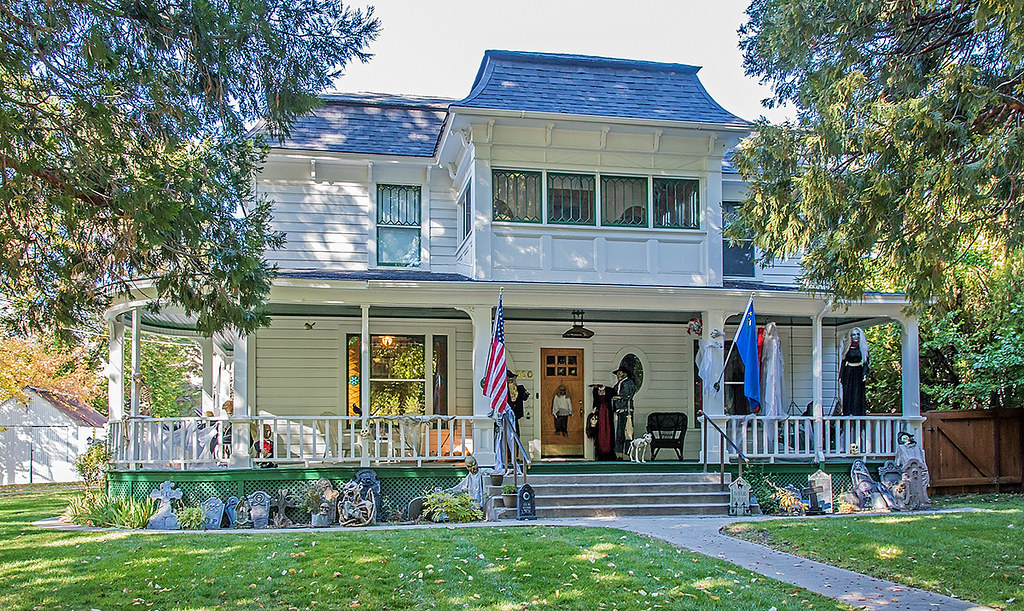
The Krebs-Peterson House at 500 Mountain Street in Carson City was used as the boarding house associated with Lauren Bacall’s character, and Washoe Lake State Park is also identified among the film’s Nevada locations.[5][6] These details are most useful when tied to a question: how does the film use real places to make Books appear out of time?
The production also relied on constructed history. Oscar-nominated production designer Robert F. Boyle built a period set on the Warner Bros. backlot at a reported cost of $400,000.[1] That is a good reminder for students: film history is not the same thing as historical reality. A movie can use real locations and artificial sets together to create a believable past.
Use critics as checkpoints, not as answer keys
Once you have your own notes, outside criticism can help test whether your reading is too thin. Roger Ebert’s review is useful because it gives an accessible critical response to the film as a drama and as a late John Wayne Western.[4] Use it after viewing, not before, so that your paragraph does not become a summary of someone else’s reaction.
CBR is useful for students who want to understand why the ending matters in Wayne’s career and in the Western genre.[3] It should support a claim about the film’s final moral shape, not replace close attention to the scene itself.
For advanced readers, the Jump Cut essay offers a more ideological reading, placing The Shootist in the context of the 1976 Bicentennial period and post-Watergate America.[7] Treat that as an interpretation, not as the film’s official meaning. If you use it, name the author’s argument as an argument and then decide whether specific scenes support it.
A practical note-taking plan for one viewing
For a school assignment, a single viewing can work if the notes are organized before the film starts. Make three columns: history, literary or cinematic choices, and ethics. You do not need equal notes in every column. Some scenes will carry more than one kind of evidence.
| When you notice this | Write down this kind of note | Possible paragraph use |
|---|---|---|
| A reference to date, empire, law, medicine, or public order | What the detail suggests about 1901 as a transition point | History paragraph on the end of the frontier |
| Books explaining or performing his code | What the code rewards and what it ignores | Literary analysis of the Western hero |
| Gillom watching Books | What Gillom seems to admire, misunderstand, or reject | Coming-of-age paragraph |
| A scene about illness or death | How dignity, fear, pain, and control shape the choice | Ethics response |
| A location or set that feels historically specific | Whether the place looks lived-in, staged, public, private, old, or changing | Filming history paragraph |
If you are building a larger study guide, the same method works with other film or history assignments. A comparison with Study Film Analysis through A Nightmare on Elm Street can help you see how genre changes the questions you ask. A historical comparison with the Trojan War history study guide can also help separate myth, evidence, and later storytelling. If your assignment begins with a syllabus rather than a film, use How to Create a Study Guide from Your Syllabus in 5 Steps to turn course requirements into questions before you start collecting sources.
Turn the film into three possible assignments
A history paragraph can begin with the date: The Shootist uses January 22, 1901 to place J.B. Books at a moment when frontier violence is becoming socially obsolete. Then use two kinds of evidence: one scene detail from the film and one contextual point from the Teach with Movies guide.
A literary analysis paragraph can focus on Gillom. Instead of saying only that Books is a hero or antihero, ask what Gillom learns from watching him. That lets you discuss characterization, the Western hero myth, and coming of age in the same paragraph.
An ethics response can focus on the gunfighter’s code and the Golden Rule. The strongest version will not pretend the answer is obvious. It should name what Books is trying to preserve, what his choices cost others, and what Gillom is left to understand.
- Choose one research assignment from Teach with Movies if you need an evidence-based extension.
- Use the Wikipedia article only for basic film facts such as setting, adaptation, and casting history.
- Use CBR for the ending controversy, then return to the ending scene for your own evidence.
- Use Giggster and Visit Carson City when your paragraph needs location or production support.
- Use Jump Cut only if your assignment can handle a more advanced ideological interpretation.
References
- The Shootist, Teach with Movies.
- The Shootist, Wikipedia.
- John Wayne Western The Shootist Meaning Explained, CBR.
- The Shootist movie review & film summary (1976), RogerEbert.com.
- Where Was The Shootist Filmed?, Giggster.
- From Silver Barons to Silver Screen: Filming in Carson City, Visit Carson City.
- The Shootist, Jump Cut.
Comments
Join the discussion with an anonymous comment.