Quizlet AI Features Review 2026: Are Q-Chat and Magic Notes Worth It for Students?
Quizlet's AI Stack: What's Under the Hood?
Quizlet has pushed four AI-powered features into its platform over the past eighteen months: Q-Chat, Magic Notes, AI Study Guides, and Smart Grading. Together they aim to turn a classic flashcard app into a semi-automated study assistant. This article examines each tool with specific accuracy data and honest limitations — no marketing gloss. If you already know how Quizlet works for basic flashcards, skip the intro; we're going straight into the AI layer.
- Q-Chat — an AI tutor that guides you through your study sets using conversational prompts.
- Magic Notes — converts handwritten notes, PDFs, and typed documents into flashcard sets automatically.
- AI Study Guides and Practice Tests — generate summary guides and test questions from your materials.
- Smart Grading — evaluates typed answers on the flashcard back, accepting close or partially correct responses.
Q-Chat: The AI Tutor in Practice
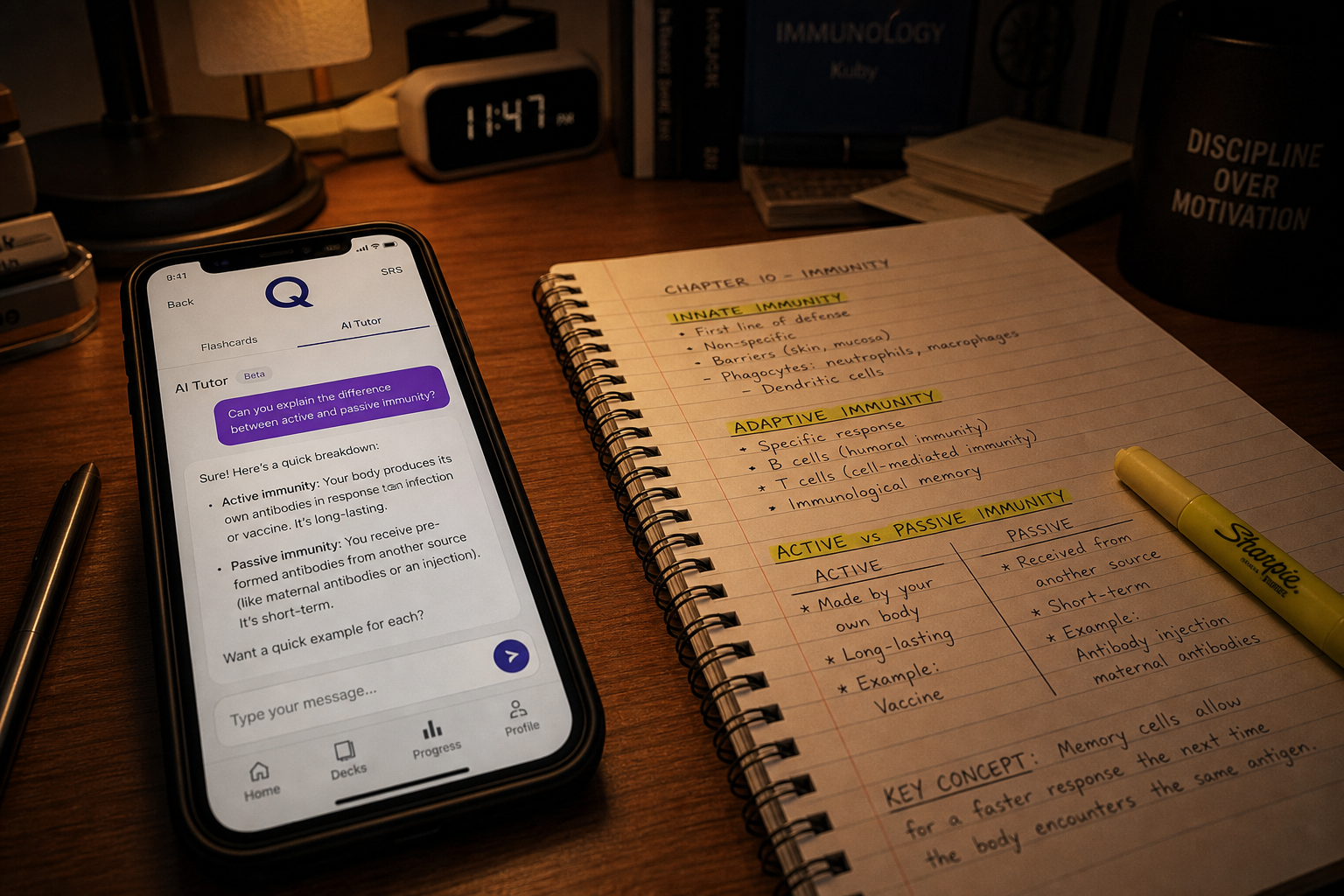
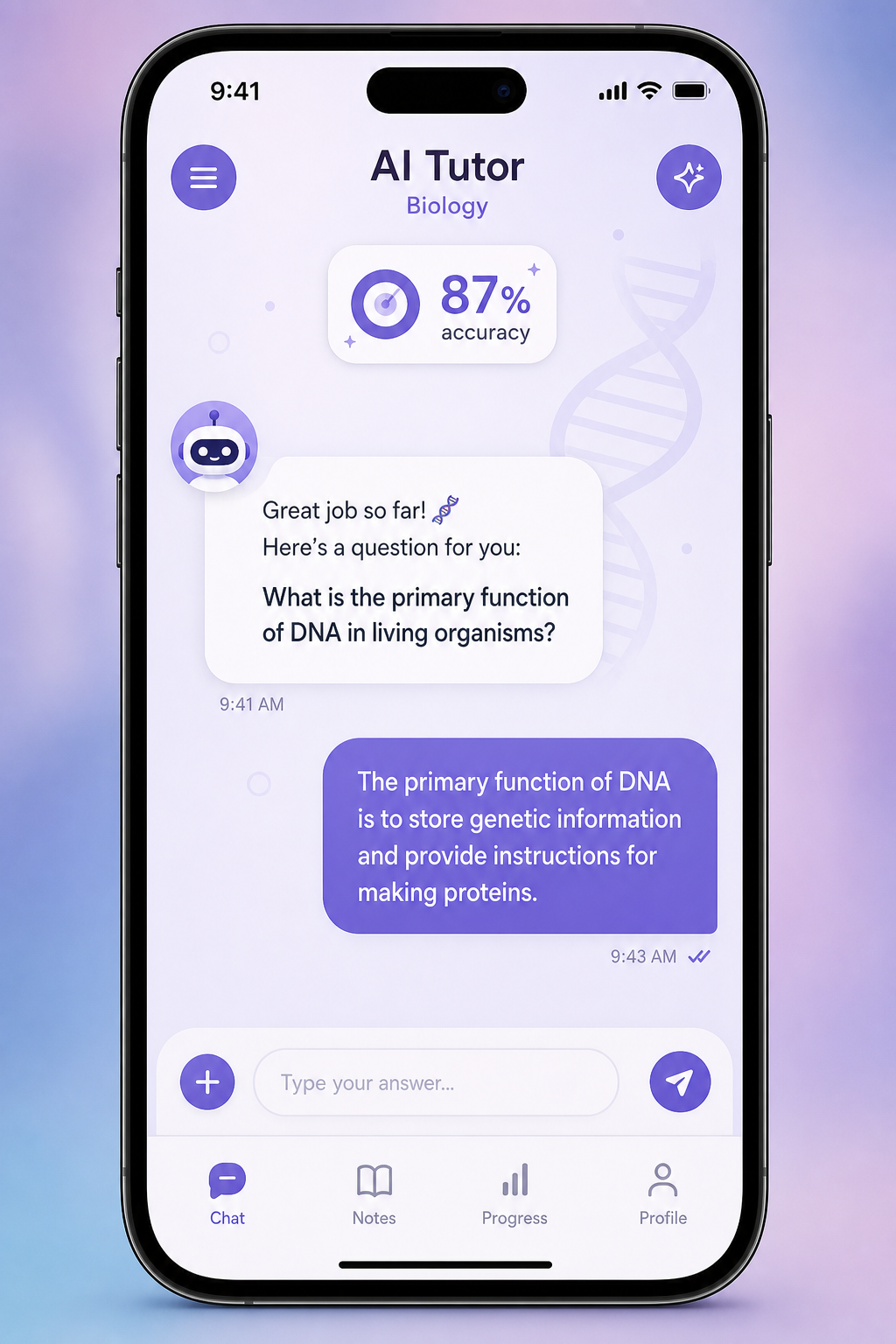
Q-Chat functions as a large-language-model tutor that works exclusively with the content of your own study sets. Instead of showing a flashcard and waiting for a pass/fail judgment, it asks you to type out answers, explain why you got something wrong, and prompts you to think through the material. In a six-month test spanning over 200 interactions across psychology, Spanish, and biology, the AI delivered clear, helpful explanations about 87% of the time. The remaining ~13% of responses were either unhelpful or outright incorrect. These figures come from a single test run by StudyDrome and are not peer-reviewed, but they offer a concrete benchmark that most reviews lack.
Q-Chat is not available everywhere. As of September 2024, access is restricted to eight countries: the United States, the United Kingdom, Canada, Australia, France, Germany, Ireland, and New Zealand. That list may have expanded by now, but international students outside those countries cannot use the AI tutor at all.
Language handling also has rough edges. Q-Chat works well in English but can struggle with closely related languages or mixed-language study sets. If you're learning Spanish and your cards contain English definitions, the AI occasionally confuses which language to respond in.
| Aspect | Finding |
|---|---|
| Explanation accuracy (good/helpful) | ~87% of 200+ interactions |
| Unhelpful or incorrect responses | ~13% |
| Subject areas tested | Psychology, Spanish, biology |
| Countries available | 8 (US, UK, CA, AU, FR, DE, IE, NZ) |
| Language support | Strong in English; weaker for mixed-language sets |
Magic Notes: Turning Notes into Flashcards Automatically
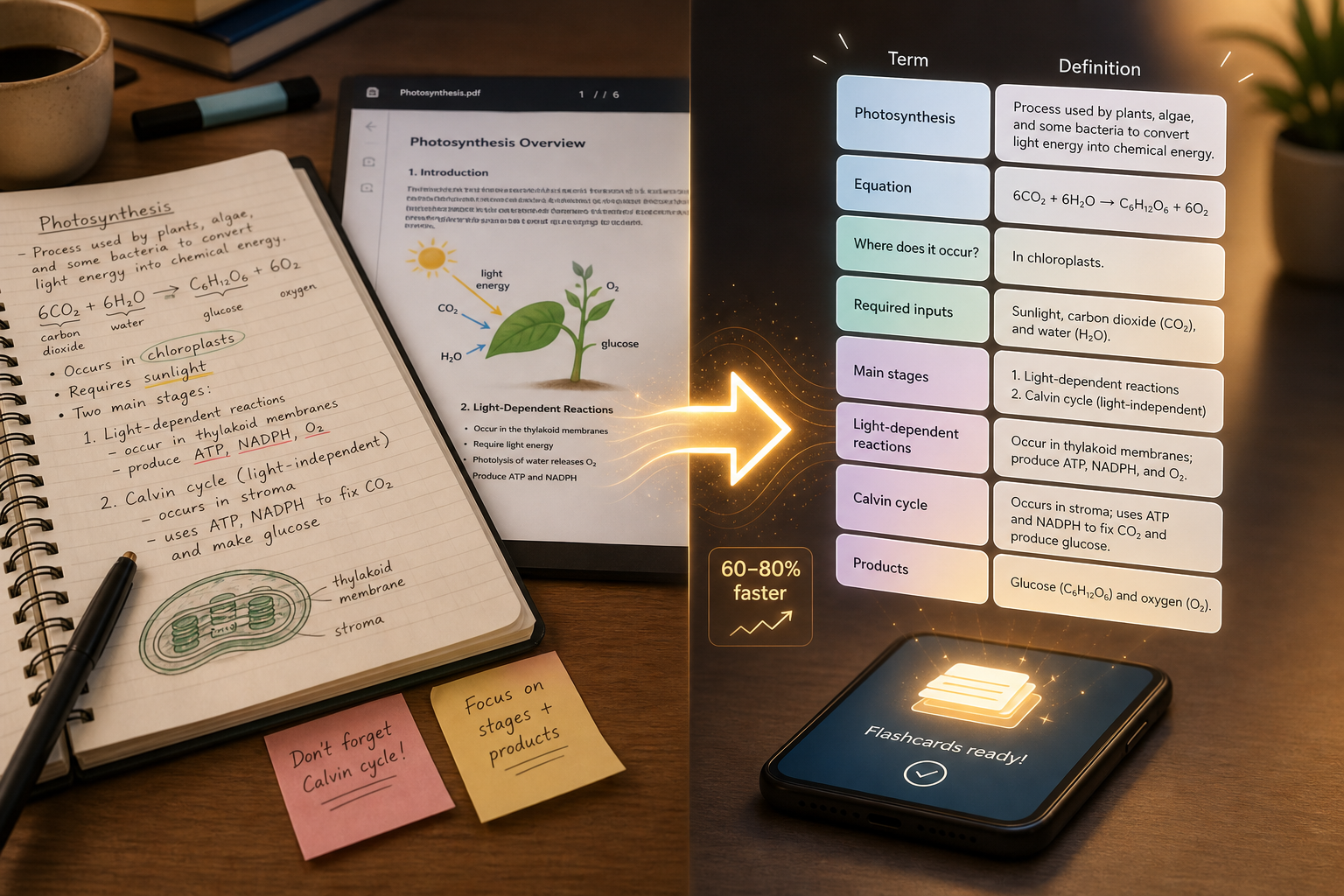
Magic Notes lets you upload handwritten notes, typed documents, or PDFs and have them converted into flashcard sets. According to an instructional design review by Atomisystems, this can reduce flashcard creation time by an estimated 60–80%. A 20-page PDF becomes a structured study set in roughly five seconds. That kind of speed is a real game-changer if you're facing a midterm with a stack of lecture slides.
In the same testing, about 85% of auto-generated cards required no editing. That still means one out of every six or seven cards will need manual correction. Common issues include misreading abbreviations, oversimplifying complex sentences, and missing the context of a detailed paragraph. As the Nibble blog puts it: "Use the output as a first draft, not a finished study guide."
AI Study Guides and Practice Tests
Beyond single flashcards, Quizlet's AI can generate study guides and practice tests from your sets or uploaded materials. The AI takes your terms and definitions and reorganizes them into a summary guide, or crafts multiple-choice and written-answer questions that mimic exam formats. For quick revision sessions, these tools save the time you'd normally spend creating your own practice quiz.
- AI Study Guides: Condense a set into key points and relationships, useful as an overview before drilling.
- AI Practice Tests: Generate randomized quizzes from your set with instant feedback.
The downside: these outputs are only as good as the source material. If your flashcard set contains shallow or incomplete definitions, the study guide will compound those gaps. For complex subjects like organic chemistry or pathophysiology, the AI cannot infer deeper connections — it can only repackage what you've already typed. Treat AI-generated guides as a supplement to, not a replacement for, thorough manual review.
Smart Grading: How Quizlet's AI Evaluates Answers
The Smart Grading feature in Learn mode assesses typed answers on the back of flashcards. Instead of marking you wrong for a slight misspelling or a synonym, the AI recognizes close or partially correct responses. This is most useful for subjective subjects like languages, history, or the humanities, where exact wording matters less than conveying the right idea. Forcing exact matches in those contexts would be frustrating and unproductive.
That said, Smart Grading can be too forgiving. If you consistently type approximate answers, the AI may give you credit when you actually need to nail the precise term — a problem in vocabulary-heavy subjects like medical terminology or legal definitions. It's a useful feature when used with awareness of its tolerance level.
Where Quizlet's AI Falls Short
Despite the genuine time savings, Quizlet's AI has hard boundaries that students need to understand before they rely on it for high-stakes exams.
- No higher-order reasoning: The AI cannot handle complex branching scenarios, multi-step problem solving, or Socratic-style probing. If you're studying for the MCAT or a professional certification that requires critical thinking, Q-Chat is a drill companion, not a substitute for practice questions and review sessions.
- Accuracy floor: With ~13% of Q-Chat responses being unhelpful or wrong, and 15% of Magic Notes flashcards needing edits, blind trust can lead to studying incorrect information. Every AI output should be cross-checked against your original materials.
- Geographical gate: Q-Chat is locked to eight countries as of late 2024. Students in many parts of Asia, Africa, and South America cannot access it at all.
- Free-tier restrictions: Most AI features sit behind the Plus ($35.99/year) or Unlimited ($44.99/year) plans. The free account gives you limited access to Q-Chat sessions and no Magic Notes or AI Study Guides. Students on a tight budget may find the value proposition weak.
What Users Are Saying About the AI Features
User sentiment is split. On the App Store, Quizlet holds a 4.8-star rating on iOS and 4.6 on Android. Positive reviews frequently highlight Q-Chat as a helpful study buddy and Magic Notes as a massive time-saver during exam crunch. Negative reviews, meanwhile, focus on the paywall: many students feel the best AI tools are locked behind a subscription and that the free tier has become too limited to be useful. A recurring complaint is that Magic Notes sometimes misinterprets symbols or handwritten abbreviations, requiring manual fixes that eat into the time saved.
Forum discussions (where accessible) echo these themes. Students who use the AI critically — reviewing generated flashcards, double-checking Q-Chat explanations — report positive experiences. Those who trust the output blindly occasionally run into errors that cost them on practice tests.
Verdict: Should You Rely on Quizlet's AI Tools?
Quizlet's AI features are a genuine leap forward in speed and interactivity, but they are not a replacement for the critical review that real learning requires. The answer depends on your student profile.
| Student Type | Recommendation |
|---|---|
| Language learners | Q-Chat's conversational format and Smart Grading are strong fits. Magic Notes works well for converting textbook passages into vocabulary cards. |
| High school / early college lecture-based courses | Magic Notes and AI Study Guides save significant prep time. Just budget 10–15 minutes to proofread the output. |
| Medical students / MCAT candidates | Use Magic Notes for initial card generation but treat Q-Chat as a supplement to AAMC practice materials and Anki decks. The 13% error rate is too high for high-stakes content. |
| Budget-conscious students | The free tier restricts AI access heavily. Consider free alternatives like Knowt or Anki for core flashcard work without the paywall. |
| Students outside the 8 supported countries | Q-Chat may not work at all. Use the standard flashcard and practice test features, or explore region-available alternatives. |
If you're put off by the paywalled AI or limited country availability, you can explore free Quizlet alternatives for core flashcard needs, or check our Quizlet vs Knowt comparison for a head-to-head look at free plans.
Related comparisons & exam hub
No matching exam hub found
Browse tool comparisons to find other verdicts for this exam.
Did this match your own testing?
Report whether your hands-on experience with this tool matched the verdict, or flag a pricing or accuracy change.
Comments
Join the discussion with an anonymous comment.