
What Does a Red Flag Warning Mean? Study Guide
This guide explains the National Weather Service's Red Flag Warning criteria, how it differs from a Fire Weather Watch, and key terms like Extreme and PDS designations — giving students a clear reference for meteorology, fire science, and emergency management exams.
Updated:
The first point to lock down is that “Red Flag Warning” is not just a general danger label. The National Weather Service glossary defines a Red Flag Warning as a product issued “when the combination of dry fuels and weather conditions supports extreme fire danger and the conditions are expected to occur within 24 hours.”[1]
That definition already contains the exam answer in compressed form: fuels must be receptive, weather must support rapid fire spread, and the timing must be near enough for warning-level action. A Red Flag Warning is not issued simply because the day is hot, or because the wind is uncomfortable, or because the landscape looks dry from a car window.
Red Flag Warning vs. Fire Weather Watch
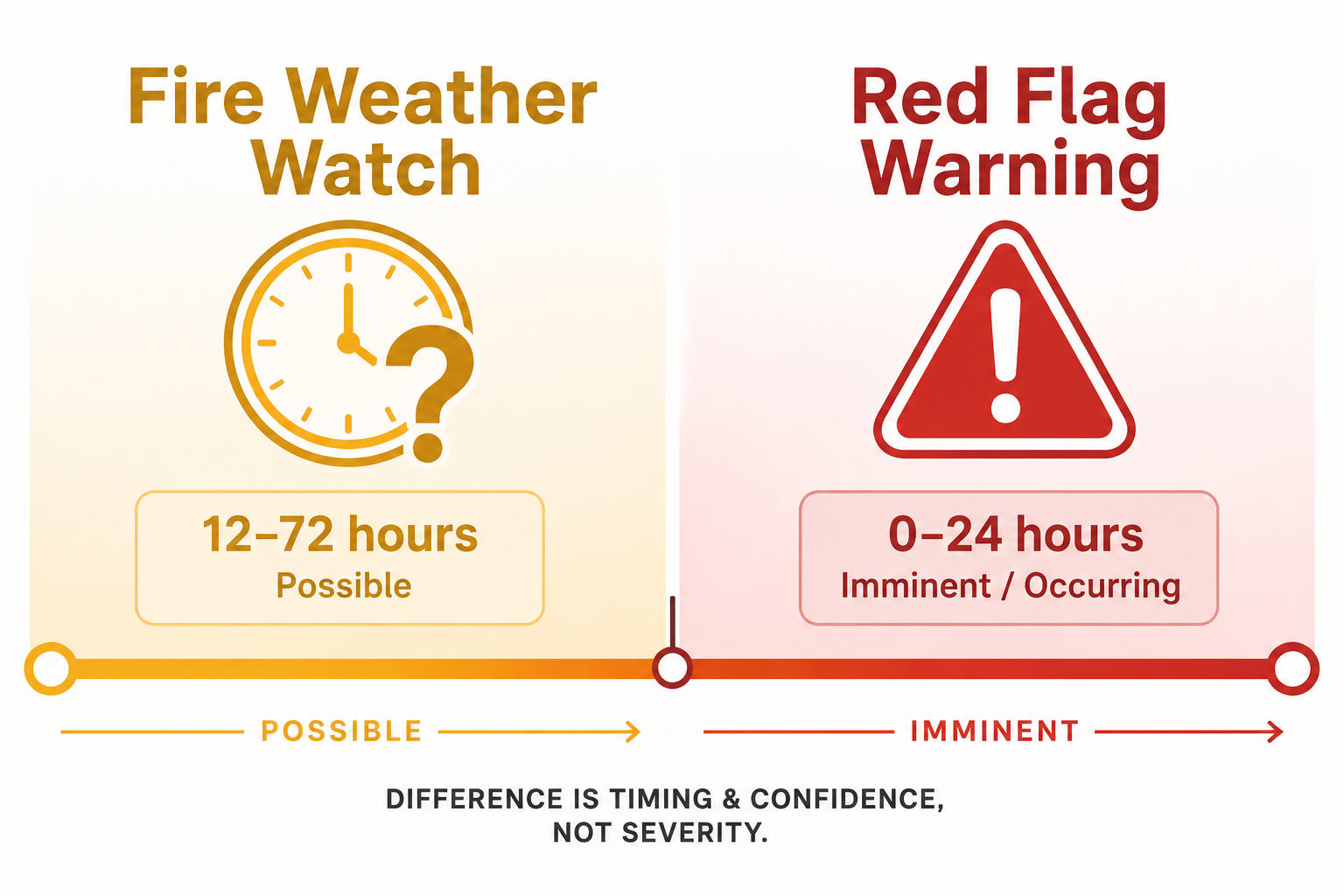
The cleanest study distinction is timing and confidence. A Fire Weather Watch means critical fire weather conditions are possible, usually in the 12–72 hour range; a Red Flag Warning means those conditions are imminent or already occurring, commonly within 12–24 hours.[2][3]
| Product | Exam meaning | Typical timing | What not to assume |
|---|---|---|---|
| Fire Weather Watch | Critical fire weather conditions are possible | About 12–72 hours out | Not automatically less severe than a warning |
| Red Flag Warning | Critical fire weather conditions are imminent or occurring | About 0–24 hours out | Not a single national checklist of numbers |
This is where many wrong answers come from. In several familiar NWS products, students learn a rough mental ladder: watch first, warning later, warning more urgent. That pattern still helps, but it can mislead if it turns into “watch means mild.” In fire weather, the watch can describe a potentially serious setup; the difference is that forecasters have less certainty, more lead time, or both.[2][3]
On an exam, the safer wording is: a Fire Weather Watch is possible critical fire weather; a Red Flag Warning is expected, imminent, or occurring critical fire weather. Severity may be comparable. The product name is telling you about readiness and timing, not giving you a universal fire-behavior scale.
What conditions usually trigger a Red Flag Warning?
Common study baselines often include sustained winds around 15 mph or higher, gusts around 25 mph or higher, relative humidity around 15–25% or lower, temperatures above 75°F, and a duration requirement such as several hours within a broader forecast window. Treat those as common examples, not national law. NWS offices set local fire weather criteria in coordination with fire partners, and Grand Junction’s fire weather criteria page states the important rule directly: there is “no single quantitative definition.”[4]
- Wind matters because it can increase fire spread, spotting, and control difficulty.
- Relative humidity matters because low humidity helps fuels dry and stay receptive.
- Temperature often matters because warm conditions can support drying, though temperature alone is not enough.
- Fuel condition matters because the same weather over wet fuels and dry fuels does not create the same operational fire risk.
- Duration matters because a brief dip in humidity may not meet the same threshold as several hours of critical conditions.
The common phrase “high winds and low humidity” is useful only as a first pass. It leaves out fuels, duration, local climatology, and the issuing office’s criteria. It also hides the fact that a fire weather product is operational: it is meant to support decisions by land managers, emergency managers, fire agencies, and the public.
Why the numbers change by region
A relative humidity value of 20% in Florida is not the same fire-weather signal as 20% in Nevada. The number is identical; the local climate, vegetation, fuel adaptation, and seasonal context are not. This is why a single national Red Flag Warning threshold would be too blunt for exam precision and too blunt for field use.
Western NWS offices may include factors such as dry lightning coverage, Lightning Activity Level, and fuel moisture thresholds in their criteria. Grand Junction, for example, includes dry lightning criteria using at least 15% coverage and LAL 6, along with fuel-related thresholds.[4] In parts of the Midwest, fire weather criteria more often emphasize wind speed, relative humidity, and drought-related indicators.[2]
This is the point students should remember when a multiple-choice option gives one tidy set of numbers and calls it the national definition. The numbers may be plausible. The word “national” is the problem. Red Flag Warning criteria are local and are commonly documented through office-level fire weather procedures and Annual Operating Plans, not through one fixed nationwide formula.[4]

The fuel part of the definition is not optional
The NOAA definition begins with “dry fuels” for a reason.[1] Fire weather is not only weather. If fuels are not dry enough to carry fire, a windy and dry forecast may not have the same meaning as it would after a long drying period. This is also why drought indicators, seasonal curing, and fuel moisture appear in local criteria.
For study purposes, think of the warning as an overlap zone: receptive fuels plus weather that can support rapid ignition or spread plus a near-term forecast window. Removing any one of those pieces weakens the definition.
Terms likely to appear near Red Flag Warning questions
You do not need to turn a Red Flag Warning study guide into a full fire behavior textbook, but you should recognize the vocabulary that often surrounds local criteria and forecast discussions.
| Term | Study meaning |
|---|---|
| Haines Index | An index related to atmospheric stability and dryness, used as one clue for potential large fire growth. |
| NFDRS | National Fire Danger Rating System; a system used to estimate fire danger from weather, fuels, and related inputs. |
| ERC | Energy Release Component; an NFDRS index associated with potential energy release from available fuels. |
| LAL | Lightning Activity Level; a scale used to describe lightning frequency, important where dry lightning can start fires. |
| Dry lightning | Lightning with little or no wetting rain reaching the ground, making ignition more likely in dry fuels. |
| Fuel moisture timelag classes | Fuel moisture categories such as 1-hour, 10-hour, 100-hour, and 1000-hour fuels, reflecting how quickly fuels respond to moisture changes. |
The Grand Junction fire weather terms page lists these kinds of terms in the fire weather vocabulary used by forecasters and fire managers.[5] For an exam, the key is recognition: LAL and dry lightning point toward ignition potential; ERC and fuel moisture point toward fuel receptiveness and fire intensity potential; Haines Index points toward atmospheric support for fire growth.
Extreme and PDS Red Flag Warnings
After the basic watch-versus-warning distinction, students may see the labels “Extreme” or “PDS.” These are advanced communication labels, not replacements for the core definition. KQED/NPR reports that “Extreme Red Flag Warning” was introduced in October 2019 and that PDS, meaning “Particularly Dangerous Situation,” is reserved for exceptionally rare, life-threatening fire weather setups.[6]
The important limitation is that these labels do not have hard national numerical thresholds. They are used at forecaster discretion for unusually dangerous events.[6] Do not study PDS as if it means “wind above X and humidity below Y everywhere.” That kind of false precision is more dangerous than a careful, narrower definition.
What a Red Flag Warning changes in practice
A Red Flag Warning is not only a vocabulary term. Fire agencies may use the warning to preposition resources before starts occur or before existing fires become harder to control.[7] For the public, the practical message is to avoid activities that can create sparks, including debris burning, unsafe campfires, and equipment use that can ignite dry vegetation.[7][8]
For exam writing, keep that consequence attached to the definition. The warning exists because the weather-fuel setup can turn a small ignition into a difficult incident quickly. It is not just an announcement that wildfire is somewhere nearby.
Exam-ready wording
If you need a compact answer, use this: A Red Flag Warning is an NWS fire weather alert issued when dry fuels and critical weather conditions support extreme fire danger and those conditions are expected within about 24 hours or are already occurring.[1][2][3]
- Do memorize: Red Flag Warning means imminent or occurring critical fire weather.
- Do memorize: Fire Weather Watch means critical conditions are possible, often farther out in time.
- Do not memorize: one national set of wind, humidity, and temperature thresholds as if it applies everywhere.
- Do recognize: fuels, local criteria, duration, and regional practice are part of the real definition.
- Do treat: Extreme and PDS labels as rare, serious, forecaster-discretionary enhancements rather than fixed formulas.
If you are turning this into a course-specific review sheet, start with the NWS definition, add the watch-versus-warning timing distinction, then append your local forecast office’s criteria. A broader method for organizing course material is available in this guide to creating a study guide from a syllabus.
The answer that survives most exam traps is narrow and accurate: know the NWS definition, separate watch from warning by timing and confidence, use common thresholds only as examples, and check the local NWS office criteria when exact numbers matter.
References
- Red Flag Warning, NOAA NWS Glossary.
- Fire Weather Definitions, National Weather Service Chicago.
- Red Flag Warning Definitions, National Weather Service Boulder.
- Fire Weather Criteria, National Weather Service Grand Junction.
- Fire Weather Terms, National Weather Service Grand Junction.
- ‘Particularly Dangerous Situation’ Red Flag Warning and Other Wildfire Terms, Explained, KQED.
- What Is a Red Flag Warning? Fire Prevention Tips, NPR.
- What is a Red Flag Warning?, Oregon State University Extension.
Comments
Join the discussion with an anonymous comment.