
How to Create a Study Guide from Your Syllabus in 5 Steps
✓ After this tutorial: A syllabus-based study guide with exam topics, study questions, condensed notes, and self-test prompts.
This tutorial walks you through a repeatable five-step process for turning your course syllabus into a targeted study guide — extracting exam topics, converting learning objectives into study questions, and organizing everything for active recall.
Open the syllabus, not a blank study guide template. By the end of this process, you should have five things in front of you: a list of exam topics, study questions built from the course objectives, a format that fits the material, condensed notes, and self-test prompts you can trace back to the syllabus.
That last part matters. When students ask how to make a study guide from a syllabus, the hard part usually is not effort. It is extraction. The topics, verbs, dates, and grading weights are often sitting in the document already; they just do not look like a study plan yet.
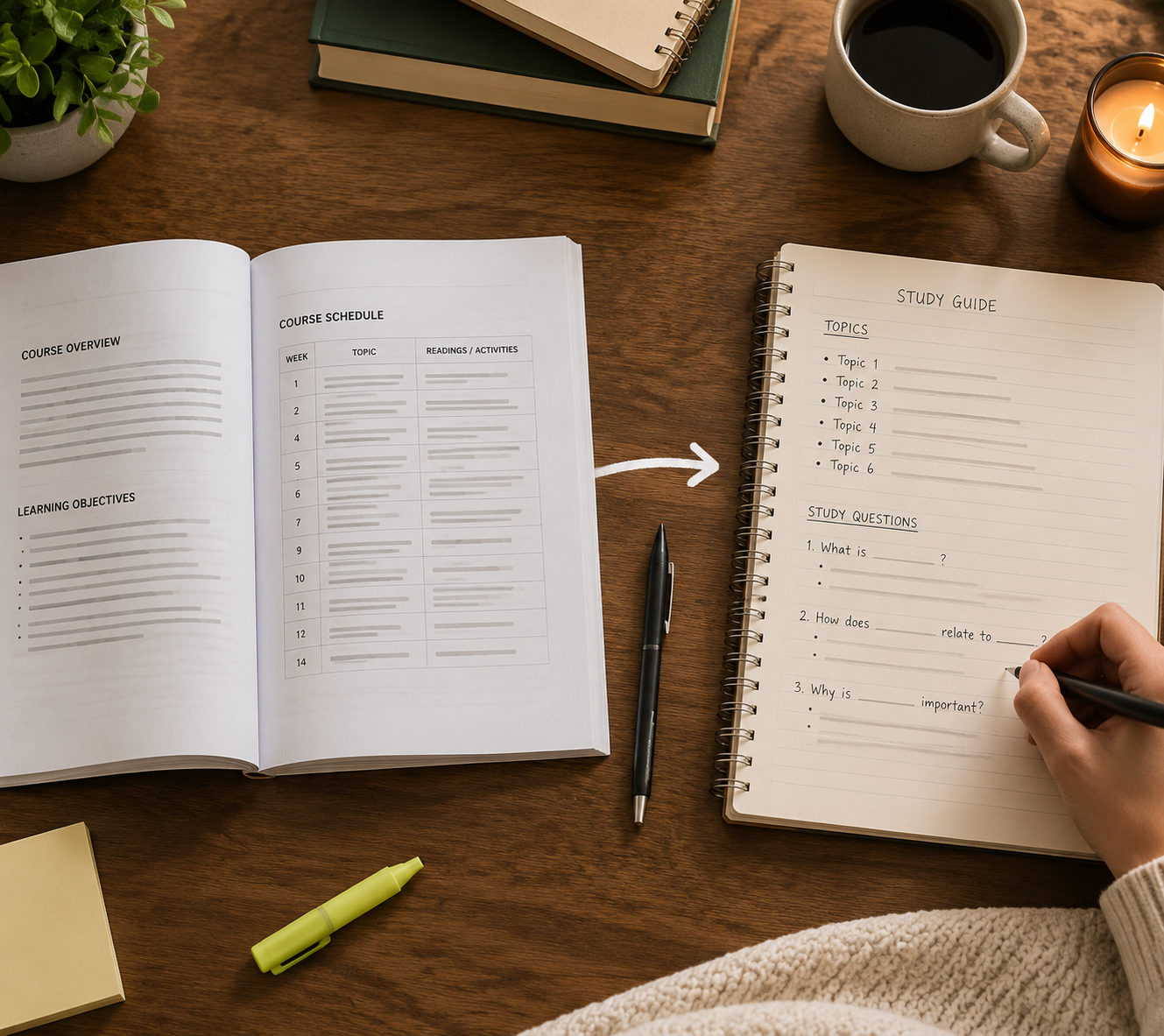
| Step | What You Pull From the Syllabus | What It Becomes |
|---|---|---|
| 1 | Course schedule, exam range, unit titles | Topic list |
| 2 | Learning objectives and action verbs | Study questions |
| 3 | Type of material | Guide format |
| 4 | Lecture notes, readings, examples | Condensed explanations |
| 5 | Topics, objectives, grading priorities | Self-test prompts and final check |
One limit before we start: this method works best when your syllabus includes a course schedule, learning objectives, and a grading breakdown. If your syllabus is minimal, you can still use the workflow, but you will need backup documents such as lecture slides, your notes, or the textbook table of contents. If the course is project-based instead of exam-based, treat “exam topics” as “project criteria” or “portfolio outcomes” and adapt the guide around what will be evaluated.
Step 1: Extract the Exam Topics From the Course Schedule
Start with the course schedule because it is the most load-bearing part of the syllabus. The Dennis Learning Center at Ohio State University teaches students to make their own study guide by first listing the topics from the syllabus or course schedule, then turning those topics into questions to answer while studying. The University of Toronto Scarborough’s Learning Strategies guidance also starts exam study guide creation with the syllabus, using it to identify topics, learning objectives, and weighting.[1][2]
Do not begin by rereading everything. Begin by making a topic inventory. Find the part of the syllabus that looks like a calendar, weekly schedule, course outline, module list, or unit plan. Then copy the topic names into a separate document exactly as they appear.
- Look for columns labeled week, date, topic, module, reading, lecture, unit, assignment, or exam.
- Mark the exam range first: “Exam 1 covers Weeks 1–5,” “Midterm covers Chapters 1–4,” or “Final is cumulative.”
- Copy every topic inside that range before opening your notes.
- Circle repeated concepts, because repetition usually means the instructor kept returning to an idea for a reason.
- Flag vague entries such as “applications,” “review,” or “case study” so you can fill them in from lecture notes later.
A schedule line like “Week 3: Cell membranes and transport” is not yet a study guide. It is a topic label. Your first draft should be plain and almost boring:
| Syllabus Entry | Study Guide Topic |
|---|---|
| Week 2: Scientific method and experimental design | Scientific method; experimental design |
| Week 3: Cell membranes and transport | Cell membrane structure; diffusion; osmosis; active transport |
| Week 4: Enzymes and metabolism | Enzyme function; activation energy; metabolic pathways |
| Exam 1: Weeks 1–4 | Stop topic extraction at Week 4 unless instructor says otherwise |
The point is not to make the guide beautiful yet. The point is to stop guessing. If the syllabus says the exam covers Weeks 1–4, your first topic list should not quietly drift into Week 5 because those notes look important. If the instructor later says Week 5 is included, add it. Until then, let the syllabus hold the boundary.
For messy syllabi, use a second pass. Some instructors put the real topics in reading titles instead of the topic column. Others list only chapter numbers. In that case, copy the chapter headings from the textbook table of contents or lecture slide titles into the same topic list, but label them as backup material. That keeps your guide honest: “from syllabus” and “filled in from notes” are not the same kind of evidence.
Step 2: Turn Learning Objectives Into Study Questions
Now move to the learning objectives, course outcomes, module goals, or “by the end of this unit, students will be able to” statements. These are easy to skip because they sound like institutional furniture. They are not furniture. They often tell you what kind of thinking the exam may ask you to do.
Utah State University’s Academic Support materials describe study guide questions as ranging from recall-level tasks, such as defining terms, to more critical-thinking tasks, such as comparing and contrasting ideas. That distinction matters because “define,” “compare,” and “evaluate” should not produce the same study prompt.[3]
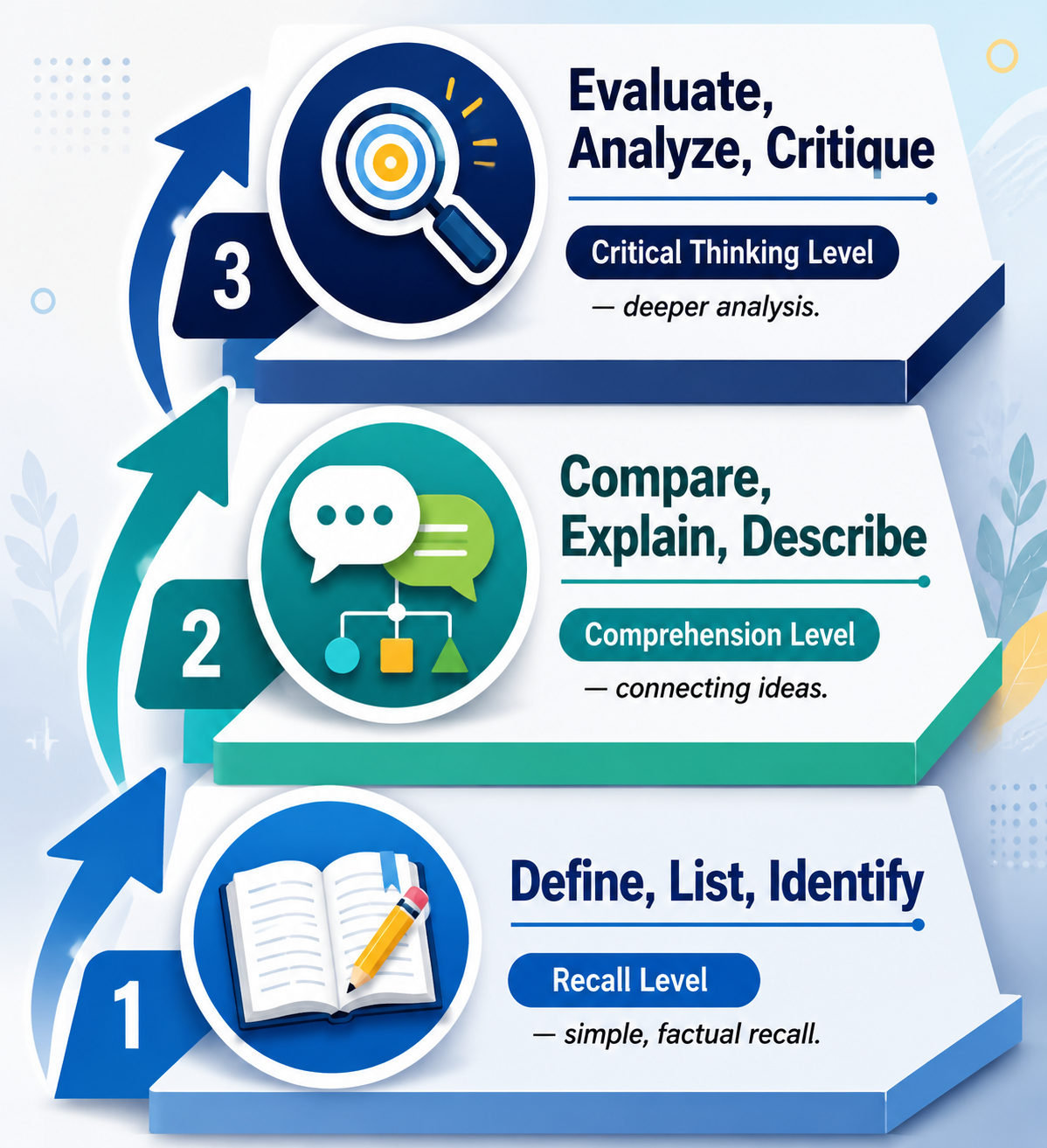
Read each objective and underline the verb. That verb is your instruction manual.
| Objective Verb | What the Exam May Ask | Study Question You Should Write |
|---|---|---|
| Define | Recall a term accurately | What does this term mean, and what example proves I understand it? |
| Identify | Recognize a concept, part, author, event, or process | Can I pick this out from a list, diagram, passage, or problem? |
| Explain | Describe how or why something works | Can I explain this process without reading my notes? |
| Compare | Show similarities and differences | How are these two concepts alike, and where do they separate? |
| Analyze | Break something into parts and interpret relationships | What parts are involved, and how does one part affect another? |
| Evaluate | Make a judgment using criteria | Which option is stronger, weaker, more ethical, more efficient, or better supported, and why? |
Suppose a syllabus objective says, “Compare classical and operant conditioning.” A weak study guide entry would be “Classical vs. operant conditioning.” That is only a label. A usable entry asks:
- What is classical conditioning?
- What is operant conditioning?
- What do both types of learning have in common?
- How are stimulus, response, reinforcement, and consequence different in each?
- Can I classify a new example as classical or operant and explain why?
Notice the last question. “Compare” usually does not stop at memorizing two definitions. It asks you to hold both ideas in your head at once and decide where they overlap and where they do not. If your study guide only contains copied definitions, you may feel prepared until the exam asks you to apply the difference.
Do this topic by topic. Match each course schedule topic with any objective that belongs to it. If your syllabus has objectives at the course level rather than the unit level, reuse the same objectives across several topics. For example, “evaluate evidence” may apply to every research article in a sociology course, not just one week.
| Topic From Schedule | Objective Verb | Study Question |
|---|---|---|
| Experimental design | Identify | Can I identify independent variables, dependent variables, controls, and confounds in a study description? |
| Experimental design | Evaluate | Can I evaluate whether a study design supports the conclusion being claimed? |
| Cell transport | Explain | Can I explain how diffusion, osmosis, and active transport move substances across a membrane? |
| Cell transport | Compare | Can I compare passive and active transport using energy use, concentration gradient, and examples? |
If there are no learning objectives, make temporary questions from the topic titles, then upgrade them with lecture cues. A lecture slide titled “Why active transport requires ATP” gives you a better question than “active transport notes.” A professor who spends ten minutes comparing two theories has given you a depth clue, even if the syllabus did not spell it out.
Check the Grading Breakdown Before You Overbuild One Corner
Before you choose a format, check the grading breakdown. This is where a lot of study guides become emotionally satisfying and strategically strange. A student may spend three hours making perfect flashcards for a small quiz category while barely touching the exam or project category that carries much more weight.
Absolutely Studying’s guidance on syllabus grading breakdowns emphasizes using assignment weights to understand how much each category contributes to the final grade. For a study guide, that means weights should influence priority, not panic.[4]
| Syllabus Grading Item | What It Tells You | How It Changes the Guide |
|---|---|---|
| Midterm exam: high-weight category | This assessment matters heavily | Give every covered topic a question and self-test prompt |
| Weekly quizzes: lower-weight category | Frequent but smaller checks | Use brief recall cards or quick review questions |
| Lab practical or oral exam | Performance or identification may matter | Add diagrams, examples, or practice explanations |
| Final exam: cumulative | Earlier topics may return | Keep old topic-question pairs instead of deleting them |
Do not turn this into a long calculation session unless your course requires it. You are looking for proportion. If the syllabus tells you an exam is central to the grade, your guide should be broad enough to cover all listed topics. If a small reading response is the only item attached to one week, that week still matters, but it probably should not swallow the whole guide.
Step 3: Choose the Format That Fits the Material
After topic extraction and question writing, format becomes a practical choice. You are not choosing an aesthetic. You are choosing the shape that makes the material easiest to test.
| Use This Format | When the Material Looks Like | Example |
|---|---|---|
| Outline | A sequence of units, chapters, events, or processes | History timeline, biology pathway, literature unit |
| Concept map | Interconnected systems with causes, effects, or feedback loops | Ecosystems, economic systems, anatomy, political institutions |
| Comparison table | Concepts that are often confused or contrasted | Theories, authors, formulas, legal standards |
| Q&A sheet | Fact-heavy material or objective-driven review | Vocabulary, anatomy labels, AP exam review, terminology |
For linear material, an outline is usually enough. For connected material, a concept map can reveal relationships you would miss in a bullet list. For contrast-heavy courses, a table prevents the classic problem where you know each term separately but cannot explain how they differ. If you are deciding between note and guide structures, the research discussion in Does the Cornell Method Actually Work? can help you think through when a question-and-summary structure is useful.
You can also mix formats inside one guide. A psychology exam might use an outline for the unit order, a comparison table for theories, and flashcard-style Q&A for vocabulary. The only rule is that each format should answer a need the syllabus reveals. Do not add a concept map just because it looks serious.
Step 4: Condense Notes Into the Guide, Not Around It
Now bring in lecture notes, slides, readings, problem sets, and textbook examples. The order matters. If you open every document first, the guide becomes a storage unit. If you use the syllabus topic-question structure first, your notes have a job: answer the questions.
A StudyPDF guide recommends condensing study material to roughly one quarter of the original volume. Treat that as a checkpoint, not a law. The useful idea is that a study guide should be smaller than the pile it came from, because its purpose is to select, organize, and test the material rather than preserve every sentence.[5]
- Keep definitions only when the syllabus topic or objective requires them.
- Keep examples that help you apply, compare, analyze, or evaluate.
- Cut repeated wording once one clear explanation remains.
- Mark weak spots with “review lecture,” “ask instructor,” or “redo problem” instead of pretending the guide is finished.
- Move long textbook passages into brief answers written in your own words.
Structured study guides have been associated with better performance in at least one education-journal context cited by Coursera, with reported improvements of 13 to 34 percentage points. Because that statistic is presented through Coursera and the original Language Arts Journal of Michigan article was not directly reviewed here, it is best read as directional support for structure, not as a guarantee that any one guide will raise a grade by that amount.[6]
The safer takeaway is simpler: a condensed guide reduces the number of places your attention has to search. That matters most in the last day or two before an exam, when “I’ll just reread my notes” can turn into flipping through pages without making decisions.
Step 5: Add Active Recall So the Guide Can Test You
A study guide that only summarizes material is still halfway passive. The University of North Carolina Learning Center’s study guidance emphasizes active studying strategies such as creating questions, testing yourself, and spacing practice rather than relying only on rereading.[7]
For each syllabus-derived question, add a way to answer it without looking first. That can be as simple as folding a page, covering the answer column, using flashcards, or recording yourself explaining a process.
| Guide Entry | Active Recall Prompt |
|---|---|
| Define osmosis | Close notes and write the definition plus one original example |
| Compare mitosis and meiosis | Fill a blank comparison table from memory |
| Evaluate a research design | Read a new scenario and identify one strength and one limitation |
| Explain a historical cause | Speak a two-minute explanation without looking, then check for missing evidence |
If you want a digital tool, use it after the extraction work is clear. Quizlet can turn definitions and short-answer prompts into flashcards. Obsidian can hold linked topic pages if your course has many connected ideas. AI tools may help draft questions or reorganize notes, and the comparison in AI Study Apps in 2026 is useful if you want to test that route. None of those tools should decide what matters before the syllabus has had its turn.
Ask Maeve cites a claim that structured information is recalled 40% more easily than unstructured information. As with many study-stat claims shared outside the original research context, that number should be treated cautiously. It does, however, point in the same practical direction: structure helps only when it gives your brain something retrievable to do.[8]
Final Check: Trace the Finished Guide Back to the Syllabus
Before you call the guide finished, return to the syllabus one more time. Herzing University’s study guide advice includes checking the completed guide against the syllabus, which is the right final move because it catches both missing topics and overbuilt distractions.[9]
- Every exam topic in the course schedule has a place in the guide.
- Every learning objective has been turned into at least one question.
- The verbs in the objectives match the depth of the questions.
- High-weight graded items receive enough space and practice.
- Vague or missing syllabus entries are filled in from notes, slides, readings, or instructor clarification.
- The guide includes self-test prompts, not just cleaned-up notes.
If something in the guide cannot be traced to a syllabus topic, learning objective, assigned reading, lecture emphasis, or graded requirement, ask why it is there. It may still belong, especially if your instructor added it later in class. But it should not stay just because it was highlighted at midnight.
A good syllabus-based study guide is not the longest document, the prettiest template, or the most AI-enhanced summary. It is the guide that shows what the course said mattered, turns that material into answerable questions, and gives you a way to test whether you can answer them.
References
- How to Make Your Own Study Guide, OSU Dennis Learning Center
- Create an Exam Study Guide, UTSC Learning Strategies
- Creating Study Guides, USU Academic Support
- How to Read a Syllabus, Absolutely Studying
- StudyPDF Guide, StudyPDF
- How to Make a Study Guide, Coursera
- Studying 101: Study Smarter Not Harder, UNC Learning Center
- Ask Maeve, Ask Maeve
- How to Create a Study Guide, Herzing University
Next Steps
- Anki Settings for Beginners: The 5 Changes That Actually Matter (FSRS Edition) →
Overwhelmed by Anki's settings panels? This guide cuts through the noise. Learn the only five settings you need to change as a beginner in 2026 — enabling FSRS, setting retention, limiting new cards, choosing learning steps, and unlocking max reviews — so you can start studying with confidence and ignore the rest.
- How to Make Flashcards on Quizlet Using AI: From Notes, PDFs, and Lecture Slides →
Tired of typing flashcards by hand? This tutorial walks you through three AI-powered methods on Quizlet — Magic Notes, the AI Flashcard Generator, and Smart Assist — so you can turn your existing class materials into study sets in seconds. We also cover the free tier limits and how to get the best results from each method.
- How to Create a Quizlet Study Set: Manual, Import, and AI Methods →
A step-by-step guide for high school and college students who want to build their own Quizlet study sets from scratch — covering manual entry, bulk text import, and AI generation from notes, plus card design tips and folder organization.
Comments
Join the discussion with an anonymous comment.