
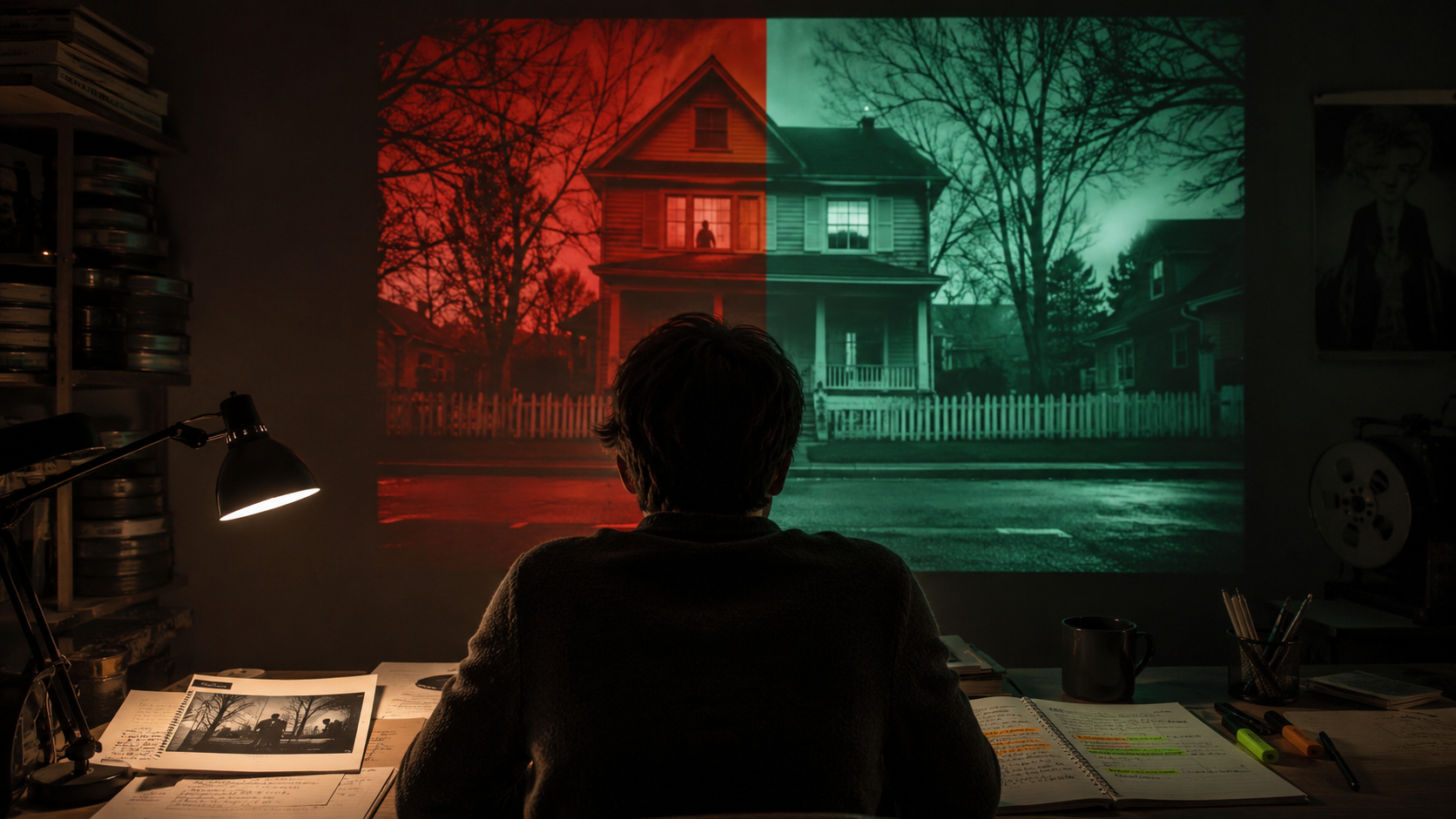
Study Film Analysis through A Nightmare on Elm Street
This guide walks students through a proven 7-step film analysis methodology using A Nightmare on Elm Street as a case study. Readers will learn how to identify formal elements, apply critical lenses like psychoanalysis and feminist theory, and build an interpretive argument that goes beyond summary.
Updated:
The first problem in a film analysis paper is usually not that you have nothing to say. It is that you have too much plot in your head and not enough method. For an A Nightmare on Elm Street film analysis study, the useful question is not “What happens to Nancy?” but “How do the film’s images, sounds, spaces, and narrative rules make Nancy’s situation mean something?” Northwestern University’s Writing Place draws the essential line clearly: a review evaluates whether a film is good, while an analysis explains how film elements create meaning.[1]
That distinction saves the paper before it begins. Summary says Freddy attacks teenagers in dreams. Review says the film is frightening, dated, inventive, or uneven. Analysis asks why the red and green lighting keeps the bedroom from feeling safe, why adults fail at exactly the moments when ordinary authority should work, why Nancy becomes more active as the rules become stranger, and why the boundary between waking and dreaming matters formally rather than just as a plot twist.
The 7-Step Process
Use the seven steps first as a map, not as seven equal paragraphs. Some steps take five minutes. Others, especially the move from observation to question and the choice of a critical lens, deserve most of the thinking time.

| Step | Action | What It Prevents |
|---|---|---|
| 1 | Separate summary, review, and analysis | Opening with plot recap or personal taste |
| 2 | Choose a small set of scenes or formal details | Trying to cover the whole movie |
| 3 | Describe what is actually visible and audible | Jumping to themes before evidence |
| 4 | Turn observations into interpretive questions | Leaving the paper at the level of description |
| 5 | Select and test a critical lens | Dropping theory onto the film without proof |
| 6 | Draft a working thesis | Writing a topic instead of an argument |
| 7 | Build paragraphs around evidence and consequence | Listing details without explaining their effect |
Step 1: Do Not Let Plot Do the Paper’s Work
A plot sentence can be useful. Three plot paragraphs are usually a warning sign. If the assignment is analysis, the plot only matters when it gives you a place to examine form: a bedroom, a boiler room, a classroom, a bathtub, a phone, a doorway, a parent’s explanation, a cut between waking and dreaming.
A usable opening move might look like this: “In A Nightmare on Elm Street, the threat does not stay outside the home; the film uses color, sound, and unstable dream logic to make ordinary domestic spaces unreliable.” That sentence does not prove anything yet, but it gives the paper an object of study. It names film elements and proposes a consequence.
A weaker version would say: “A Nightmare on Elm Street is about fear.” Fear is a topic, not an argument. Whose fear? Produced by which formal choices? Attached to what spaces, rules, or relationships? A film analysis paper earns its claim by answering those smaller questions.
Step 2: Choose Evidence Small Enough to Control
A Nightmare on Elm Street is a good teaching case because it gives beginners unusually visible evidence. The production history supplies details students can actually connect to interpretation: the film has been reported as a 32-day shoot with a budget of about $1.1 million and worldwide box office of about $57 million; its effects work included roughly 500 gallons of fake blood, the spandex hallway effect, Jacques Haitkin’s red and green color strategy, and Charles Bernstein’s electronic score.[2]
Those facts are not interpretations by themselves. “The film used 500 gallons of fake blood” is trivia unless the paper asks what excess, spectacle, or bodily instability does in a specific scene. “The score is electronic” is a production note unless the paper explains how that sound changes the viewer’s relation to sleep, machinery, teenage space, or threat.
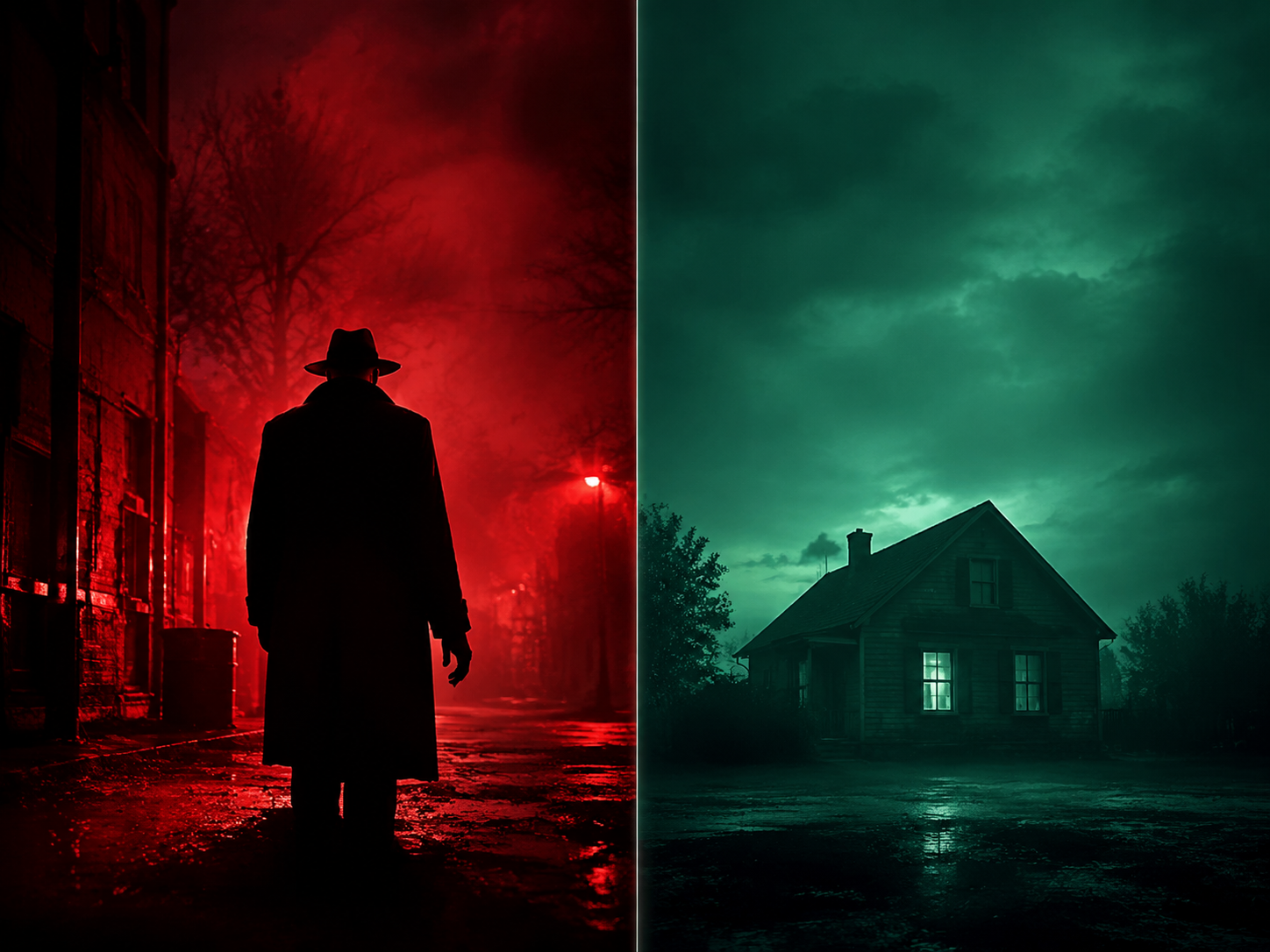
For a short paper, choose two or three clusters rather than the whole film. One student might track red and green lighting in bedroom and dream spaces. Another might follow Nancy’s movement from being watched, attacked, and disbelieved to setting traps and testing the rules. Another might compare adult explanations with what the film shows the viewer directly. Each cluster can support a real argument because each one can be observed, quoted visually, and tested across more than one moment.
Step 3: Describe Before You Interpret
Before choosing psychoanalysis, feminism, political allegory, or formalism, write down what the film is doing. This is slower than announcing a theme, but it produces better sentences. Good notes often begin with plain verbs: the camera holds, the light shifts, the sound pulses, the parent refuses, Nancy tests, the room changes, the cut withholds certainty.
| Observation | Better Analytical Question |
|---|---|
| Red and green appear in charged dreamlike spaces. | How does the color clash make familiar spaces feel unsafe or divided? |
| The score uses electronic textures. | How does the sound design make the threat feel less human, less local, or less separable from the environment? |
| Nancy’s parents know more than they first admit. | How does adult secrecy change the film’s idea of protection? |
| Nancy becomes more active as the film continues. | How does the film shift her from victimized observer to strategist? |
| Dream and waking scenes contaminate each other. | How does uncertainty about reality change the viewer’s trust in evidence? |
Notice the difference between a label and a question. “The colors symbolize danger” is too quick. “How does the red/green clash make the room feel divided between ordinary teenage space and invasion?” gives the paragraph something to prove. It can point to lighting, set design, blocking, and the viewer’s changing expectations.
Step 4: Turn Details into Claims
This is where many papers either stop too early or jump too far. Description says, “Nancy’s bedroom is not safe.” Interpretation asks how the film makes the bedroom unsafe and why that matters. The claim should connect a formal detail to an effect, then to a larger meaning.
A useful sentence pattern is not a formula for the whole essay, but it helps during drafting: “By using [formal element] in [specific scene or pattern], the film makes the viewer [feel, know, doubt, expect], which suggests [interpretive claim].” For example: “By carrying dream imagery into domestic spaces, the film makes the viewer doubt whether the home can function as protection, which turns the family house into part of the horror rather than a refuge.”
That sentence is still broad, but it is analytical. It does not merely identify a theme. It names a technique, a viewer effect, and an interpretive consequence. The rest of the paragraph would need to prove it with scene evidence.
A Working Evidence Chain
- Start with a precise detail: a color contrast, a sound cue, a cut, a prop, a line of dialogue, a body position, or a change in Nancy’s behavior.
- Name what the detail does to the viewer: it confuses, delays, exposes, isolates, intensifies, contradicts, or confirms.
- Connect that effect to a larger pattern: unsafe domestic space, damaged authority, gendered survival, dream logic, inherited violence, or unstable evidence.
- Check whether the pattern repeats. One image may be interesting; a repeated pattern can support a thesis.
If the evidence chain breaks, the claim is probably too large. “The film proves all parents destroy their children” asks more than the evidence can carry. “The film links parental secrecy to teenage vulnerability” is narrower and easier to prove.
Step 5: Choose a Lens After You Have Evidence
A critical lens is not a costume placed over the film at the end. It is a way of asking sharper questions about evidence you have already noticed. The same red/green lighting, parental failure, dream confusion, and Nancy arc can lead to different papers depending on the lens.
The strongest academic models in the available material treat the film as a contested system rather than a one-message machine. Thompson and Reardon’s M/C Journal article reads Nancy in relation to family structure, gendered authority, and the attempted restoration of the nuclear family; it includes the striking claim “mommy killed him” as part of a matriarchal counter-narrative.[3] Thomsen’s 2024 article in a peer-reviewed Taylor & Francis journal reads Freddy through commodification and capitalism, a different lens that shifts attention toward the figure’s cultural and economic circulation.[4]
More accessible readings can still help students enter the conversation, as long as they are treated as entry points rather than final authorities. Mawr Gorshin’s psychoanalytic reading uses a Kleinian framework, reading Freddy as a “bad father” internal object and Nancy’s movement through unconscious and conscious conflict.[5] A Rutgers class taught by Dr. Anthony Tobia has also used the film to discuss psychiatric disorders, which shows how the film can become a teaching object for psychology, though that classroom use is not the same thing as proving a single interpretation.[6]
For feminist analysis, Carol Clover’s Final Girl framework is the obvious reference point, and Nancy is commonly treated as a key example in discussions of the Final Girl.[7] The Geekiary’s feminist reading is useful for students because it emphasizes Nancy as feminine while still active, observant, and strategic.[8] Producer Sara Risher’s 2026 interview also matters because she retrospectively describes the franchise’s feminist force in terms of “the kids, and often the women,” rising to the occasion; because this is a memory-based interview decades after the original film, it should support rather than replace scene analysis.[9]
How Different Lenses Reshape the Same Evidence
| Lens | What to Watch | Model Working Thesis |
|---|---|---|
| Psychoanalytic | Dream logic, repression, parental violence, Freddy’s return, Nancy’s movement from confusion to confrontation | As a model, a paper could argue that the film turns dreams into a visible form of repressed family violence, making Freddy less a random monster than a figure of what the adults have failed to contain. |
| Feminist / Final Girl | Nancy’s observation, planning, refusal to remain passive, contrast with adult authority, survival rules | As a model, a paper could argue that Nancy becomes the film’s interpretive authority because she studies the threat more carefully than the adults who claim to protect her. |
| Family / 1980s Cultural Lens | Damaged parents, secrecy, suburban houses, failed protection, attempts to restore order | As a model, a paper could argue that the film both depends on and distrusts the nuclear family, presenting the home as the place where protection is promised and repeatedly compromised. |
| Formalist | Color, electronic score, editing between dream and waking, practical effects, spatial instability | As a model, a paper could argue that the film’s horror comes from unstable boundaries: between sleep and waking, body and room, teenage space and adult history. |
| Political / Capitalist | Freddy’s circulation as image, commodity, and recurring figure; the relation between monster and market | As a model, a paper could ask how Freddy becomes more than a character by turning into a repeatable, sellable horror icon. |
These are models of method, not finished arguments to copy. A real thesis has to match the scenes the student can discuss in detail. If a paper has no space to examine advertising, sequels, or cultural circulation, the capitalist lens may be too large. If the paper has strong notes on Nancy’s behavior, adult disbelief, and survival strategy, the feminist or Final Girl lens may be more manageable.
Step 6: Draft a Thesis That Can Be Tested
A working thesis should be arguable, specific, and attached to evidence. “A Nightmare on Elm Street uses dreams to create fear” is true but thin. “The film’s dream sequences collapse private bedroom space and inherited adult violence, forcing Nancy to become an analyst of danger when her parents cannot explain it” gives the paper something to test.
A testable thesis usually contains three parts: a formal pattern, an interpretive claim, and a reason the pattern matters. The formal pattern might be color, sound, editing, performance, or narrative structure. The interpretive claim might concern gender, family, repression, capitalism, or unstable reality. The reason it matters should tell the reader what the film changes in our understanding of the characters, the viewer’s knowledge, or the rules of survival.
| Too Broad | More Usable |
|---|---|
| The film is about fear. | The film makes fear spatial by turning bedrooms, bathrooms, and family homes into unreliable zones. |
| Nancy is a strong female character. | Nancy gains authority because she observes patterns, tests rules, and acts when adult systems fail. |
| Freddy represents evil. | Freddy functions as the return of concealed adult violence, appearing where parental explanations break down. |
| The movie criticizes the family. | The film presents the family as both the promised shelter and the source of the danger Nancy must learn to read. |
The better thesis is not necessarily longer. It is more accountable. You can point to scenes that support it, and you can imagine what evidence would weaken it. That is a good sign. A thesis that cannot be challenged usually cannot be developed.
Step 7: Build Paragraphs Around Consequences
Once the thesis is working, each body paragraph should do more than mention a scene. It should show what changes because of the scene. Does Nancy know something she did not know before? Does the viewer lose confidence in a boundary? Does a parent’s authority shrink? Does a sound cue make the threat feel present before Freddy appears? Does a practical effect turn the body into part of the room?
One paragraph might begin with the bedroom as an ordinary teenage space, then show how color and staging make it unstable. Another might turn to adult explanation and secrecy, asking why the parents’ knowledge does not protect the children. A third might follow Nancy’s method: she observes, gathers evidence, plans, and acts. The paper does not need to cover every famous scene. It needs to make the chosen scenes speak to one argument.
Production context belongs inside this chain only when it clarifies effect. The low-budget production and practical effects can support a formalist paragraph if the paper explains how material invention shapes the viewer’s experience. The red/green strategy can support a visual analysis if the paper connects the clash to emotional and spatial tension. Bernstein’s electronic score can support a sound paragraph if the paper describes what the sound does before interpreting what it means.[2]
A Sample Plan You Could Adapt
Here is one possible analytical plan, written as a model rather than a finished essay. It uses a feminist/Formalist blend because that combination fits Nancy’s arc and the film’s visible design choices.
| Paper Element | Planning Choice |
|---|---|
| Lens | Feminist analysis supported by formal attention to space, color, and sound |
| Working thesis | A Nightmare on Elm Street makes Nancy the film’s strongest interpreter of danger by showing her read patterns that adults deny, turning survival into an analytical act. |
| Evidence cluster 1 | Bedroom and domestic spaces that should protect teenagers but become unstable |
| Evidence cluster 2 | Adult secrecy, disbelief, or damaged authority |
| Evidence cluster 3 | Nancy’s shift from threatened daughter to active strategist |
| Likely sources | Northwestern for method; Clover/Final Girl discussion and The Geekiary for accessible feminist framing; M/C Journal for a stronger academic model |
A different student could use almost the same scenes for a psychoanalytic paper. The bedroom would become a site where unconscious threat enters ordinary life. Parental secrecy would become repression or disavowal. Nancy’s planning would become an attempt to make the hidden visible and manageable. The evidence has not changed much; the questions have.
If you are building study materials before drafting, the same approach used in a syllabus-based study guide can help: divide the assignment into tasks, list the evidence you need, and turn broad topics into testable questions. A step-by-step system like creating a study guide from your syllabus transfers well to film analysis because both depend on sorting material before trying to write.
What to Have Before You Start Drafting
- A one-sentence distinction between your paper and a plot summary
- One critical lens, or a clearly controlled combination of two
- A working thesis that names a formal pattern and an interpretive consequence
- Two or three scenes or formal details you can describe precisely
- At least one academic source if the assignment requires scholarly support
- A reason each production fact matters to interpretation, not just a place to mention trivia
A Nightmare on Elm Street works well for this method because it does not hide all its evidence. The color clashes, electronic score, dream/reality confusion, damaged adults, practical effects, and Nancy’s changing agency give students things they can point to before they move into theory. The film is not useful because it has one secret meaning waiting to be decoded. It is useful because it lets a student practice the central habit of film analysis: connecting form, context, and interpretation inside a claim that can be proven.
References
- How to Write a Film Analysis, Northwestern University Writing Place
- A Nightmare on Elm Street, Wikipedia
- Mommy Killed Him: Gender, Family, and the Return of the Repressed in A Nightmare on Elm Street, M/C Journal
- Freddy Krueger and the Political Economy of Horror, Taylor & Francis Online, 2024
- Analysis of A Nightmare on Elm Street, Infinite Ocean
- Psychology Class Analyzed Nightmare, Nightmare on Elm Street Films
- Final Girl, Wikipedia
- A Feminist Look at A Nightmare on Elm Street, The Geekiary
- A Nightmare on Elm Street Secrets Revealed: Longtime Producer Talks Franchise Secret Meaning, Dread Central, 2026
Comments
Join the discussion with an anonymous comment.