
How to Structure Your SAT Prep with Khan Academy and Bluebook
Learn a five-step study cadence that combines Khan Academy's free SAT prep with College Board's Bluebook app to build an effective study plan for the Digital SAT, targeting 20–40 total hours with daily sessions of 20–60 minutes.
Updated:
The easiest way to waste khan academy sat prep is to open the course, feel responsible, and start clicking whatever looks weak. A student does ten minutes of linear equations, then a grammar lesson, then a harder math quiz, then stops because the dashboard now looks even bigger than it did before.
Khan Academy is useful. Free practice is useful. But useful material is not the same thing as a study plan. For the Digital SAT, the cleaner route is: use Bluebook to diagnose, use Khan Academy to repair the skills Bluebook exposed, then use Bluebook again to see whether the repair actually held under test conditions.
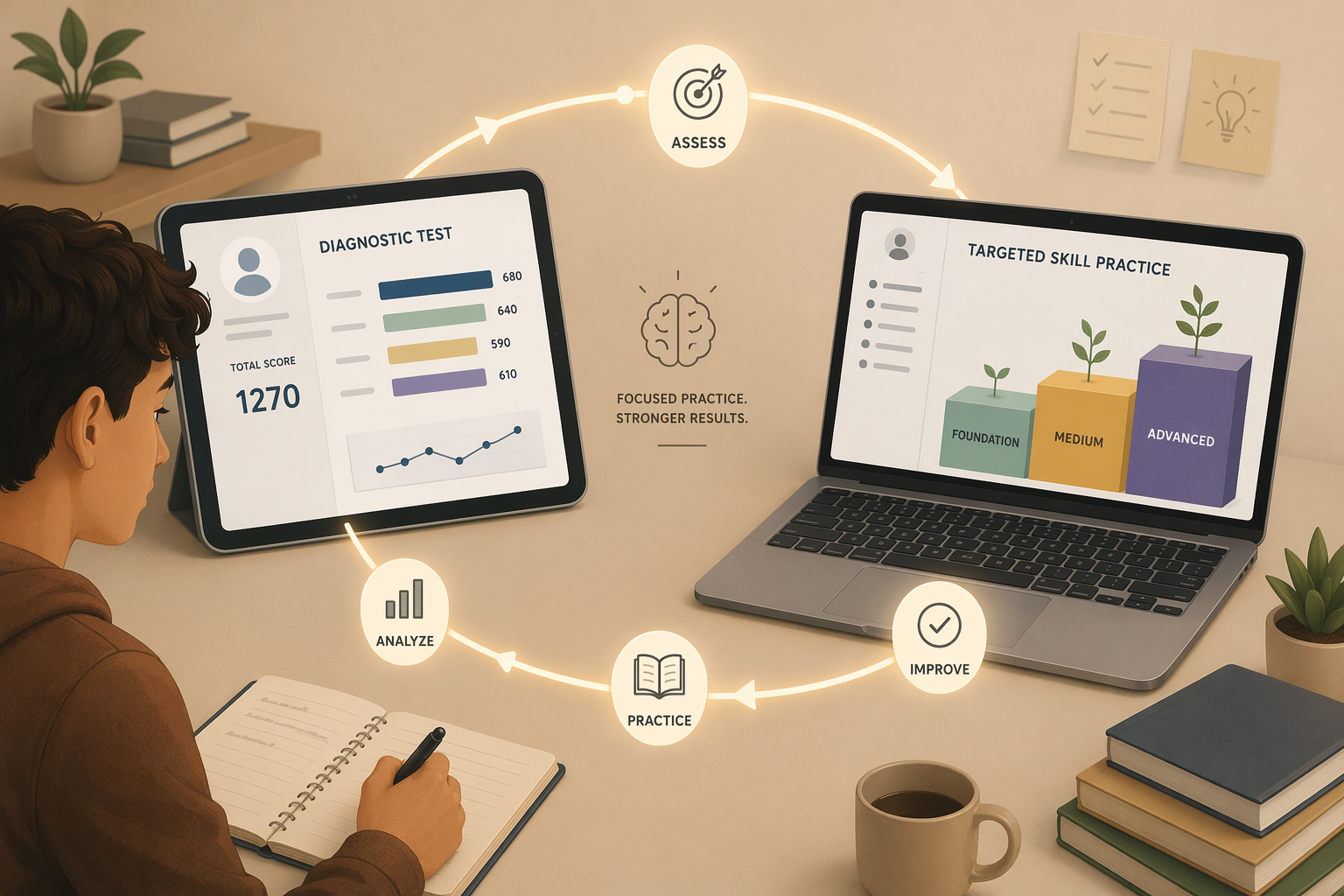
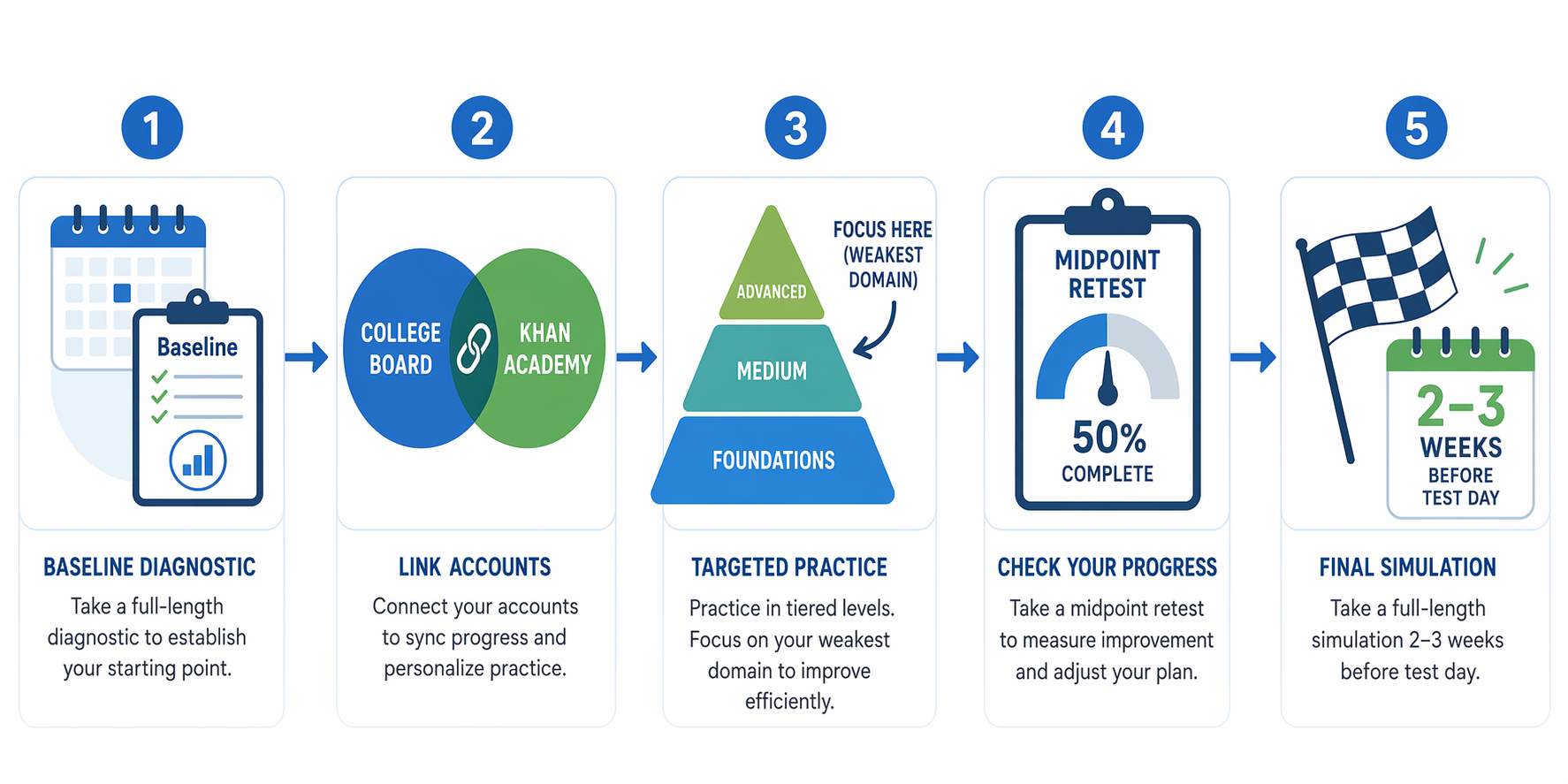
A workable free plan does not need ten apps. It needs a loop: one full Bluebook baseline, account linking, targeted Khan Academy practice, a midpoint Bluebook retest, and one final full simulation before test day. Most students can run that loop in 20–40 total hours, usually in 20–60 minute sessions.
The Five-Step Cadence
| Step | What to do | Why it matters |
|---|---|---|
| 1 | Take one full Bluebook practice test before starting Khan Academy. | You need a baseline score and domain-level weaknesses, not a general feeling that you are “bad at math.” |
| 2 | Link your College Board account to Khan Academy. | Your Bluebook results can feed Khan Academy’s personalized skill recommendations. |
| 3 | Work Khan Academy’s tiered practice from Foundations to Medium to Advanced, starting with the weakest domains. | You avoid treating every unit as equally urgent. |
| 4 | Take a midpoint Bluebook test around month 3. | You check whether practice is changing test performance, not just lesson completion. |
| 5 | Run a final full simulation 2–3 weeks before the real SAT. | You test timing, stamina, and section habits while there is still time to fix small problems. |
That is the whole plan. The part that deserves the most care is not downloading Bluebook or finding Khan Academy; it is making sure the first test controls the next practice choice.
Start With Bluebook, Even If the Score Hurts
The first full Bluebook practice test should happen before a student starts serious Khan Academy work. That feels backwards to some students. They want to “learn a little first” so the score is less embarrassing. The problem is that an untested student usually does not know which work deserves the next two weeks.
Bluebook gives the baseline that Khan Academy alone cannot create from casual practice. After the test, the student should pull three things from the report: the total score, the section scores, and the domain-level breakdown. The total score tells you where you are starting. The section scores tell you whether Reading and Writing or Math deserves more minutes. The domain breakdown tells you what to do on Tuesday after school.
A student who sees weak Math performance should not immediately start all 12 Khan Academy Math units. A student who misses Reading and Writing questions should not treat all 4 Reading and Writing units as equally urgent. The first pass is triage: choose the domains Bluebook flagged, then find the matching Khan Academy units and lessons.
If the mechanics of the two platforms are confusing, use a dedicated walkthrough for taking SAT practice tests with Bluebook and Khan Academy. The important rule is simpler than the interface: do not let Khan Academy become the diagnostic tool when Bluebook is the test environment.
Link the Accounts Before You Build the Calendar
Once the first Bluebook test is complete, link the College Board account to Khan Academy. This is the handoff that turns a score report into a practice queue. Without it, the student is manually guessing which Khan Academy lessons correspond to the test result. With it, Bluebook results can generate personalized skill recommendations inside Khan Academy.
This is where the free plan becomes more than “do some SAT practice.” Khan Academy has 12 Math units and 4 Reading and Writing units for the SAT. The student’s job is not to finish everything in order. The job is to let the diagnostic narrow the field.
- If Bluebook shows weak algebra, start with the Khan Academy math units tied to that skill before spending time on stronger domains.
- If the score report points to expression of ideas or standard English conventions, start there before doing random reading passages.
- If one section is far lower than the other, give it more days per week, not just more good intentions.
- If everything looks weak, begin with Foundations in the highest-impact domains instead of bouncing among hard questions.
Khan Academy has reported district case-study results in which students using Bluebook and Khan Academy together saw an average 39-point SAT score gain. That figure is useful because it supports the exact two-platform workflow here, but it should be read as Khan Academy’s own case-study material, not independent proof that every student will gain that amount.[1]
Use Khan Academy for Repair, Not Wandering
The Khan Academy work period is where most plans either become real or dissolve into dashboard clicking. A reasonable daily session is 20–60 minutes. Shorter than that, many students barely settle in. Longer than that, the work often becomes answer-chasing unless the student has strong stamina and a very specific task.
For each weak domain, move through the tiered difficulty system in order: Foundations, then Medium, then Advanced. Foundations is not a punishment. It is where a student finds the missing rule, formula, grammar pattern, or reading move that made the harder questions feel mysterious.
A simple weekly rhythm can look like this:
- Day 1: Review the weakest Bluebook domain and do Foundations lessons or practice.
- Day 2: Continue the same domain at Foundations or Medium, depending on accuracy.
- Day 3: Switch to the next weakest domain so one problem area does not consume the whole month.
- Day 4: Return to the first domain and try Medium or Advanced questions.
- Day 5: Review missed questions and write down the error pattern in plain language.
The error note matters more than students expect. “I missed question 17” is almost useless. “I chose an answer that matched the topic but not the author’s claim” is a study direction. “I solved for x but the question asked for 2x” is a test-day warning. “I used the calculator but did not know how to graph the equation efficiently” tells the student that Khan Academy practice may need help from another tool or a teacher.
There is an encouraging data point here, but it needs a label. College Board and Khan Academy reported that students who completed 20 hours of Official SAT Practice on Khan Academy had an average score gain of 115 points in a 2017 study of about 250,000 students.[2][3] That is a reason to take the free practice seriously. It is not a current Digital SAT guarantee; the study came from the paper-SAT era, and there is not yet an equivalent large-scale Digital SAT study.
The practical takeaway is modest and still valuable: 20 hours is not nothing, but it is also not a second job. A student studying 30 minutes on most weekdays can reach that mark in a couple of months. A student aiming for 40 hours has room for review, a midpoint retest, and a final simulation without turning every evening into SAT night.
Around Month 3, Bluebook Gets Another Turn
After several weeks of targeted Khan Academy work, take another full Bluebook practice test around month 3. This is not a celebration lap. It is a check on whether the practice is transferring to the real testing format.
Some students complete lessons beautifully and still lose points under timing. Some improve in one Math domain and slide in Reading and Writing because they stopped touching it. Some raise accuracy but spend too long on the first module. Khan Academy progress can show effort; Bluebook shows whether that effort survives the SAT’s format.
After the midpoint test, do not simply compare total scores and move on. Review the test the way a coach would review film. A guide to using SAT practice tests to raise your score can help if the student tends to look only at right and wrong answers.
- Keep practicing domains that stayed weak on both Bluebook tests.
- Reduce time on domains that improved and stayed stable under timing.
- Flag questions missed because of pacing, calculator use, or misreading, since more Khan Academy lessons may not fully solve those.
- Update the weekly schedule instead of starting over from scratch.
The Final Simulation Is for Habits, Not New Content
Two to three weeks before test day, take one more full Bluebook test as a final simulation. This is late enough to reflect the student’s preparation, but early enough to adjust sleep, pacing, calculator setup, and review habits.
At this point, Khan Academy should not become a panic buffet. The student should use it for specific repairs only: one grammar pattern, one math skill, one reading question type, one recurring mistake. The final weeks are a bad time to pretend every unit deserves equal attention.
Students comparing different practice-test options can use a broader guide to free SAT practice tests in 2026. For this plan, though, Bluebook remains the anchor because it is the closest match to the Digital SAT testing environment.
Where This Free Plan Is Strongest
This Bluebook-and-Khan-Academy loop is especially sensible for students below roughly the 1100–1200 range. In that band, there are often real skill gaps to repair: algebra that never settled, grammar rules that were half-learned, reading habits that work in class but not in short SAT passages. Khan Academy’s structured units and difficulty tiers can do useful work there.
For students already chasing 700+ section scores, Khan Academy can still help, but it is less complete as a whole plan. The known gaps matter more: limited adaptive routing, no full Desmos calculator instruction, and not much direct pacing or strategy training. A student in that range may need harder review, better timing analysis, calculator fluency, or outside feedback. A fuller discussion of those tradeoffs belongs in how far Khan Academy SAT prep can take you.
This does not make Khan Academy weak. It makes it specific. It is strongest when the student has a diagnosis, a short list of weak domains, and enough time to move from Foundations to harder practice without rushing.
Optional Supports, If the Free Loop Is Not Enough
Some students do not need more content; they need another human expecting them to show up. Schoolhouse.world offers free SAT bootcamps built around 75-minute sessions, two times per week, for 4 weeks, with groups capped at 10 students. Its SAT bootcamp eligibility is limited to students scoring 400–690 per section.[4]
That makes Schoolhouse a good optional layer for a student who fits the score range and wants live accountability. It should not replace the Bluebook diagnostic or the Khan Academy repair cycle. It sits on top of them.
Khanmigo can also be considered as a paid Khan Academy add-on for students who want AI-style help while studying. It is not part of the free core plan, and it should not be treated as a substitute for reviewing Bluebook results or doing targeted practice.
Students who want to compare the wider prep ecosystem can use the SAT exam prep guide or the broader SAT study tools guide for 2026. Just do not let tool-shopping replace the next assigned practice block.
A Practical 20–40 Hour Version
For most students, the plan can stay plain:
- Take one full Bluebook practice test before starting serious prep.
- Link the College Board account to Khan Academy.
- Spend 20–60 minutes most study days on the weakest domains first.
- Move through Foundations, Medium, and Advanced instead of jumping straight to hard questions.
- Take a midpoint Bluebook test around month 3 and adjust the practice list.
- Take a final full Bluebook simulation 2–3 weeks before test day.
The best free 2026 SAT plan is not “use Khan Academy more.” It is a disciplined loop: Bluebook tells the student what is weak, Khan Academy gives the student a place to repair it, and Bluebook checks whether the repair works under test conditions. For many students below the upper score bands, that 20–40 hour loop is a better use of time than collecting more resources.
References
- How to use Bluebook tests to drive real SAT gains, Khan Academy, blog.khanacademy.org/how-to-use-bluebook-tests-to-drive-real-sat-gains/
- Studying for the SAT for 20 hours on Khan Academy associated with 115-point average score increase, Khan Academy, blog.khanacademy.org
- Studying for the SAT for 20 hours on Khan Academy associated with 115-point average score increase, College Board Newsroom, newsroom.collegeboard.org
- SAT Bootcamp, Schoolhouse.world, schoolhouse.world/sat-bootcamp
Comments
Join the discussion with an anonymous comment.