GRE Prep Hub: Best Study Tools, Anki Decks, and Study Schedule for 2026
A single organized starting point for GRE preparation in 2026 — covering the current test format, the best study tools by prep phase, top community Anki decks for vocabulary, and modular schedule templates for 1, 2, and 3 months of study time.
- GRE
- Anki decks
- study schedule
- vocabulary
- free resources
- graduate school
- high-stakes exam
GRE 2026 Format at a Glance
The GRE changed significantly in September 2023. If you've found a study schedule or resource list from before that date, it describes a different test. The current format is shorter, simpler, and has no experimental section.
| Element | Current Format (Sept 2023–present) |
|---|---|
| Total time | Approximately 1 hour 58 minutes |
| Total sections | 5 |
| Analytical Writing | 1 section — one 'Analyze an Issue' task, 30 minutes, scored 0–6 |
| Verbal Reasoning | 2 sections — 12 questions (18 min) + 15 questions (23 min) |
| Quantitative Reasoning | 2 sections — 12 questions (21 min) + 15 questions (26 min) |
| Scored questions | 54 (27 Verbal + 27 Quant) |
| Section order | Analytical Writing always first; Verbal and Quant in any order after |
| Scheduled break | None |
| Unscored experimental section | None |
| Argument essay | Removed — no longer part of the test |
The section-order flexibility means you cannot predict whether Verbal or Quant appears first after the essay. Practice staying mentally sharp regardless of order. With no scheduled break, pacing and focus management matter more than they did on the old format.
How to Choose Tools by Prep Phase
The most common GRE prep mistake is trying to use every tool at once — a practice test on day one, vocabulary flashcards, a video course, and a problem set, all in the same week. This leads to shallow engagement with everything and mastery of nothing.
A more efficient approach is to match your tools to your current prep phase. Each phase has a specific goal, and the tools that serve that goal well are different from the tools you'll need in the next phase.
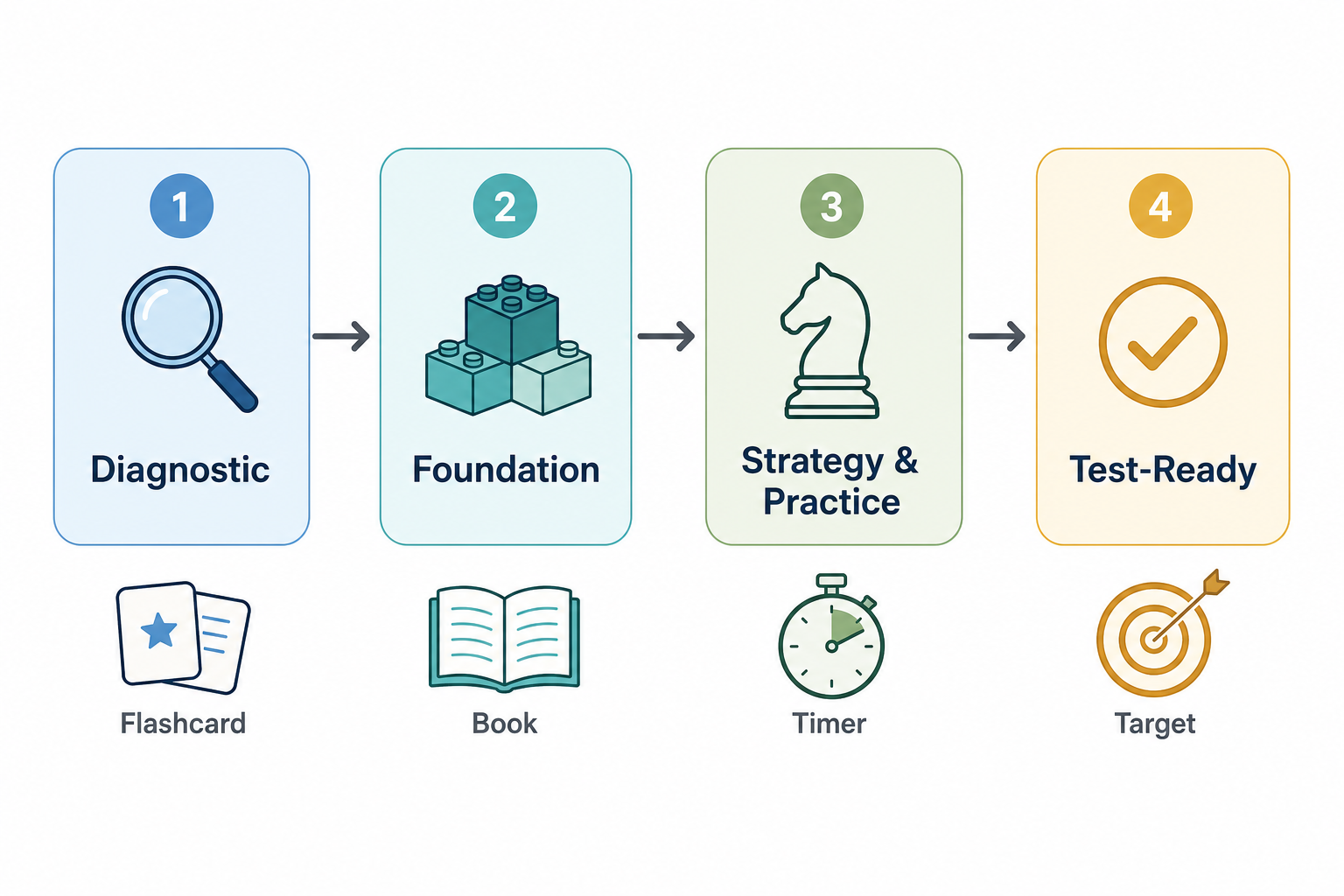
- Phase 1 — Diagnostic: Take POWERPREP 1 untimed. Don't study first. The goal is to see where you actually stand — which question types feel unfamiliar, where your timing breaks down, and how far your baseline score sits from your target. This shapes everything that follows.
- Phase 2 — Foundation: Build vocabulary and math concepts from the ground up. Daily Anki or Magoosh Flashcards for vocab; ETS Math Review PDF and Khan Academy for quant fundamentals. No timed tests yet.
- Phase 3 — Strategy and Practice: Learn the specific strategies for each question type — Text Completion, Sentence Equivalence, Reading Comprehension, Problem Solving, Data Interpretation. Work through untimed official ETS questions with an error log. This is where GregMat+ and the Manhattan 5lb book earn their place.
- Phase 4 — Test-Readiness: Shift to timed, full-length conditions. Take POWERPREP 2 timed within two weeks of your test date. Review errors, reinforce weak areas, and stop introducing new material.
The sections below organize every tool recommendation by this phase framework. You don't need to use all of them — pick the tools that fit your timeline and your weakest areas.
Best GRE Study Tools by Category
GRE prep tools fall into four functional categories. Understanding what each category does — and what it doesn't do — prevents redundant spending and keeps your prep focused.
Vocabulary and Flashcard Tools
| Tool | Cost | Best For | Recommended Phase |
|---|---|---|---|
| Anki (with community deck) | Free | Efficient spaced-repetition vocab with full deck customization | Phase 2 through Phase 4 (daily) |
| Magoosh GRE Flashcards app | Free | Curated 1,000+ word list with basic/advanced/common tiers — no setup required | Phase 2 (especially for beginners) |
| GregMat Vocab Mountain | Included in GregMat+ subscription | Interactive, structured word groups with context — best alongside GregMat video lessons | Phase 2–3 |
Quant and Math Tools
| Tool | Cost | Best For | Recommended Phase |
|---|---|---|---|
| ETS Math Review PDF | Free | Comprehensive review of every GRE math topic — 100+ pages, official source | Phase 2 (foundational concepts) |
| Khan Academy (via ETS topic mapping) | Free | Topic-by-topic video instruction aligned to GRE math content areas | Phase 2 (foundational concepts) |
| Manhattan Prep 5lb Book of GRE Practice Problems | ~$40 | High-volume concept repetition across all quant topics — best for students who need drill volume | Phase 3 (strategy and practice) |
The ETS Math Review PDF is free and covers every math topic that appears on the GRE. It's the right starting point for Phase 2 regardless of your quant background. Khan Academy's free video lessons fill in gaps for students who need more explanation before drilling problems.
Practice Tests
| Test | Cost | Questions | Best For | Recommended Phase |
|---|---|---|---|---|
| ETS POWERPREP 1 (free) | Free | Real retired GRE questions | Baseline diagnostic — take untimed first | Phase 1 |
| ETS POWERPREP 2 (free) | Free | Real retired GRE questions | Timed full-length practice — save for close to test day | Phase 4 (within 2 weeks of test) |
| ETS POWERPREP Plus (paid) | $44.95 per test | 3 additional tests with real retired questions | Additional timed full-length practice for students who need more test repetitions | Phase 3–4 |
| Manhattan Prep free practice test | Free (account required) | Third-party questions | Second free full-length option for untimed or early timed practice | Phase 3 |
Structured Course Platforms
Course platforms are most useful in Phase 3, when you need to learn strategies for specific question types rather than just build foundational knowledge. Not every student needs a course platform — the free stack described in the budget section below covers all prep needs for most self-directed students.
| Platform | Price | Strengths | Limitations | Best For |
|---|---|---|---|---|
| GregMat+ | $7.99/month (verify at gregmat.com) | Verbal strategy, structured study plans, Vocab Mountain, live and recorded lessons, Quant Mountain | May need supplementation for students targeting near-170 quant | Budget-conscious self-directed students; especially strong for verbal strategy |
| Magoosh GRE | Varies by package — check gre.magoosh.com/plans | Video lessons, 1,600+ practice questions, 6 practice tests, score predictor | Fixed question bank; pricing varies by package length and promotions | Video learners who want structured lesson progression |
| Achievable | $199/year | Adaptive AI platform, 10,000+ questions, 30+ full-length tests | Higher upfront cost | Students who want maximum practice test volume and adaptive quizzing |
| Target Test Prep | Check targetTestPrep.com for current pricing | Quant-focused, 15-point score guarantee, deep concept explanations | Less emphasis on verbal strategy | Students with significant quant weaknesses |
| Manhattan Prep | $299+ (varies by package) | 7,500+ practice questions, 13 tests, comprehensive curriculum | Higher cost; may be more than needed for focused self-studiers | Students who want a premium all-in-one curriculum |
Top Anki Decks for GRE Vocabulary
Spaced repetition works because it fights the forgetting curve. Research going back to Ebbinghaus shows that roughly 70% of new information is forgotten within 24 hours without active review. Anki's algorithm surfaces cards at the moment you're about to forget them, which means you spend review time on words that actually need it — not on words you already know cold.
For GRE vocabulary specifically, this makes Anki the most time-efficient free option available. But the deck you choose matters as much as the tool itself. A poorly curated deck wastes review sessions on low-frequency words that rarely appear on the test.
Recommended Community Decks
- GRE Ultimate Vocabulary List — A community-built deck that combines GregMat Groups 1–32, Magoosh vocabulary, and Manhattan word lists with duplicates removed. Definitions are drawn from Oxford Learner's Dictionary. This is the most widely recommended community deck in GRE prep communities for its breadth and source diversity. Find it on AnkiWeb and verify the current card count and last-updated date before downloading.
- Best GRE Vocab — Magoosh/Kaplan/GregMat/Manhattan Combined (AnkiWeb ID: 298946902) — A combined vocabulary deck pulling from four major GRE word sources. Verify current card count, last-updated date, and download availability directly on ankiweb.net before using. Community deck details can change without notice.
The Critical Limitation: Anki Is Not Enough for GRE Verbal
Anki's default card format — front: word, back: definition — trains isolated recall. You see "garrulous" and recall "excessively talkative." That's useful, but it's not what Sentence Equivalence questions actually test.
Sentence Equivalence requires you to recognize that "garrulous," "loquacious," and "voluble" are close enough in meaning to both complete a sentence correctly. The GRE is testing synonym clusters and contextual usage — not whether you can recall a definition in isolation.
Modular Study Schedule Templates
The right schedule length depends on your baseline score, your target score, and how many hours per day you can realistically commit. Most students need 8–12 weeks to see meaningful improvement. A one-month plan is possible but requires hard prioritization choices. A three-month plan allows more gradual progression and more practice test repetitions.
All three templates below are tool-stack agnostic — they specify which tools to use by phase, not which single platform's curriculum to follow. Plug in the tools from the budget tier that fits your situation.
1-Month Template (Prioritization Focus)
| Week | Phase | Daily Non-Negotiables | Main Focus | Tools |
|---|---|---|---|---|
| Week 1 | Diagnostic + Foundation | 30 min vocab (Anki or Magoosh Flashcards) | Take POWERPREP 1 untimed on Day 1. Identify your two biggest weak areas. Begin ETS Math Review PDF for quant gaps. | POWERPREP 1, Anki community deck, ETS Math Review PDF |
| Week 2 | Foundation + Strategy Intro | 30 min vocab + error log review | Learn verbal strategies for your weakest question type. Continue quant concept review via Khan Academy for specific gaps. | Anki, GregMat+ (verbal strategy lessons), Khan Academy |
| Week 3 | Strategy + Official Practice | 30 min vocab + error log review | Untimed official ETS practice questions by section. Build error log. Draft one Issue essay and self-evaluate against ETS scoring guide. | Official ETS practice questions, GregMat+ or Manhattan 5lb, ETS Issue Essay Pool |
| Week 4 | Test-Readiness | 30 min vocab + error log review | Timed sections Monday–Thursday. Take POWERPREP 2 timed on Saturday. Final error log review. Stop new material by Thursday. | POWERPREP 2, timed ETS section sets |
2-Month Template (Balanced Coverage)
The 2-month structure below is based on the phase logic from Vince Kotchian's 8-week plan, adapted here to be tool-stack agnostic. The original plan targets approximately 4 hours per day; a scaled 2-hour version maintains the same phase sequence with fewer daily problems.
| Weeks | Phase | Daily Non-Negotiables | Main Focus | Tools |
|---|---|---|---|---|
| Weeks 1–2 | Foundation | 30 min vocab + error log | Verbal strategy introduction (Text Completion, Sentence Equivalence). Arithmetic foundation. | Anki community deck, GregMat+ verbal lessons, ETS Math Review PDF (arithmetic sections) |
| Weeks 3–4 | Foundation + Strategy | 30 min vocab + error log | Reading Comprehension strategies. Algebra concepts. | GregMat+ or Magoosh for RC strategy, ETS Math Review PDF (algebra), Khan Academy for gaps |
| Weeks 5–6 | Strategy + Practice Tests Begin | 30 min vocab + error log | Geometry and data interpretation concepts. First timed POWERPREP test on weekend of Week 5 or 6. | Manhattan 5lb (quant drills), POWERPREP Plus or Manhattan Prep free test, ETS official practice questions |
| Weeks 7–8 | Test-Readiness | 30 min vocab + error log | Data analysis continued. One timed full-length test each weekend. Error log review daily. Final Issue essay practice. | POWERPREP 2 (save for Week 8 weekend), ETS Issue Essay Pool, error log review |
3-Month Template (Gradual Progression)
| Weeks | Phase | Daily Non-Negotiables | Main Focus | Tools |
|---|---|---|---|---|
| Weeks 1–2 | Diagnostic + Foundation | 20–30 min vocab | POWERPREP 1 untimed in Week 1. Begin ETS Math Review PDF and vocab deck. No time pressure yet. | POWERPREP 1, Anki community deck, ETS Math Review PDF |
| Weeks 3–5 | Foundation | 30 min vocab + error log starts | Verbal foundations: Text Completion and Sentence Equivalence strategies. Arithmetic and algebra. | GregMat+ verbal lessons, ETS Math Review PDF, Khan Academy |
| Weeks 6–8 | Strategy | 30 min vocab + error log | Reading Comprehension strategies. Geometry. Untimed official ETS questions with error log. | GregMat+, ETS official practice questions, Manhattan 5lb for quant |
| Weeks 9–10 | Strategy + Timed Practice | 30 min vocab + error log | Data analysis. First full-length timed practice test. Begin timed section sets. | POWERPREP Plus or Manhattan Prep free test, ETS official timed sets |
| Weeks 11–12 | Test-Readiness | 30 min vocab + error log | Two timed full-length tests (one per weekend). Issue essay practice. Final error log review. Stop new material in final 3 days. | POWERPREP 2 (Week 12 weekend), ETS Issue Essay Pool |
Recommended Tool Stacks by Budget
You do not need to spend hundreds of dollars to prepare effectively for the GRE. The free-plus-GregMat+ stack below covers every prep need for most self-motivated students at under $10 per month — and in many cases outperforms single expensive courses because it forces you to engage actively rather than passively watch videos.
| Budget Tier | Tools Included | Estimated Monthly Cost |
|---|---|---|
| Free Only | ETS POWERPREP 1 + 2 (free tests) · ETS Math Review PDF · ETS Math Conventions PDF · Khan Academy (via ETS topic mapping) · Magoosh GRE Flashcards app · Manhattan Prep free practice test (account required) · ETS Analyze an Issue essay pool · Anki (free app) + community vocabulary deck | $0 |
| Under $10/month | Everything in the free stack, plus GregMat+ ($7.99/month — verify at gregmat.com). Adds structured verbal strategy lessons, Vocab Mountain, Quant Mountain, day-to-day study plans, and live/recorded classes. | ~$7.99/month |
| Under $25/month | Free stack + GregMat+ + one POWERPREP Plus test ($44.95 one-time, used strategically in Phase 3 or 4). Alternatively, substitute a Magoosh short-term subscription for video-based learners — check gre.magoosh.com/plans for current pricing. | ~$8–$20/month depending on timing |
The free-only stack is genuinely complete. ETS POWERPREP tests use real retired questions — the same quality as the actual exam. The ETS Math Review PDF covers every quant topic. Anki with a community deck handles vocabulary retention. The only meaningful gap in the free stack is structured verbal strategy instruction, which GregMat+ fills for $7.99/month.
Frequently Asked Questions
- How long should I study for the GRE? Most students need 8–12 weeks to see meaningful score improvement. Students with strong baseline scores in both sections may need less time; students with significant gaps in quant fundamentals or vocabulary may need more. A 1-month plan is possible but requires accepting that you won't cover everything — prioritize your weakest section and the question types with the highest point-per-hour return.
- How many times can I retake the GRE? You can take the GRE once every 21 days, up to five times in any rolling 365-day period. Most graduate programs accept your best score, and ETS's ScoreSelect option lets you choose which scores to send.
- Is Anki enough for GRE vocabulary on its own? No. Anki is highly effective for building a large vocabulary and retaining it over time, but it trains isolated recall by default. GRE Sentence Equivalence questions require recognizing synonym clusters in context — a skill that requires additional practice with actual GRE-format questions. Use Anki daily for retention, and supplement with GRE-style sentence practice.
- Should I use third-party practice questions from Kaplan, Princeton Review, or Magoosh? Third-party questions vary in how closely they match actual GRE question style. Official ETS questions — from POWERPREP tests and official prep materials — are the essential foundation because they use real retired questions. Third-party questions are useful for additional volume after you've exhausted official material, but they should not replace official practice.
- When should I take POWERPREP 2? Take POWERPREP 2 timed within two weeks of your test date. It's your most realistic full-length simulation using actual retired questions, and it gives you the most accurate prediction of your test-day score. Saving it for close to test day means you get actionable data while there's still time to address any gaps you find.
- Do I need to write an Argument essay? No. The Argument task was removed from the GRE in September 2023. The current Analytical Writing section contains only one task: Analyze an Issue (30 minutes). Practice using the ETS Issue Essay Pool, which contains the complete list of prompts that can appear on the actual test.
Related exhibits & inventory
Verified outcomes
No verified outcomes on file for this exam yet
See Methodology for how outcome evidence is disclosed once logged.
Planners
No planner filed for this exam yet
A downloadable timeline template for this exam hasn't been published yet.
Tool verdicts
AI-tool cautions
No AI tools tested for this exam yet
No hands-on AI-accuracy logs have been filed for this exam.
Questions about this plan
Ask a question about a specific section, timeline, or citation in this plan — or flag something that needs correcting.
Comments
Join the discussion with an anonymous comment.