
SAT
With only seven official digital SAT practice tests available on Bluebook, each test is a scarce resource. This guide explains the strategic approach — spacing tests, logging errors by type, and targeting weak areas — that helps students raise their scores more effectively than simply taking more tests.
Updated:
The most important moment in an SAT practice test is not when the timer ends. It is the hour after, when you decide what the score is going to change about next week’s studying.
That sounds obvious until a student says, “I took another practice test,” and then has no answer for which question types improved, which mistakes repeated, or what got studied differently afterward. A full sat practice test is not a workout badge. It is a diagnostic instrument. If it does not change the next two weeks of practice, it mostly measured anxiety.
That distinction matters more on the digital SAT because official full-length tests are scarce. College Board’s official practice test page currently provides seven full-length digital SAT practice tests in Bluebook, listed as Tests 4–10.[1] Those tests matter because they reproduce the digital testing environment, including the timing and adaptive structure students will see on test day.
The digital SAT lasts 2 hours and 14 minutes: 64 minutes for Reading and Writing and 70 minutes for Math. Each section has two modules, and the second module adapts based on performance in the first.[2] That is why an unofficial PDF or a random online quiz can be useful for practice, but it is not the same thing as an official Bluebook simulation.

Use Each Official Test To Make A Decision
A useful SAT practice cycle has a simple shape: test, review, adjust, practice, retest. The score report starts the process; it does not finish it.
| Stage | What You Do | What It Should Produce |
|---|---|---|
| Diagnostic baseline | Take one official Bluebook test under realistic timing. | A starting score, section balance, pacing notes, and an initial weak-area list. |
| Review | Go back through missed, guessed, and slow questions. | A categorized error log, not just a list of wrong answers. |
| Targeted practice | Study the patterns that caused the misses. | Focused drills, skill review, and timing practice. |
| Spaced retest | Take another official test after two to three weeks of practice. | Evidence of what changed and what still needs work. |
| Adjustment | Revise the next study block based on the new pattern. | A narrower, more accurate plan. |
The baseline test should be official if possible. If you are just starting, the goal is not to protect your ego; it is to find out what the test is actually asking of you. A student who begins with a 540 Math score and a student who begins with a 700 Math score may both say “I need math,” but they do not need the same math.
If you want a more detailed way to handle the first test, use a SAT Practice Test 1 diagnostic approach: take the test cleanly, record timing honestly, and resist the temptation to explain away every miss as “I knew that.” The diagnostic is supposed to be slightly uncomfortable. That is where it gets useful.
Do Not Spend Official Bluebook Tests Too Quickly
Seven official full-length tests can feel like plenty in September and very few by March. A junior who takes one every weekend can use the entire set before the score has had time to respond to new studying. A senior trying to make a final decision before an application deadline may need an authentic simulation and discover there are no fresh official tests left.
Most students do not need a full official practice test every few days. Several prep organizations converge on a more useful rhythm: take a full test about every two to three weeks, and use the time between tests for review and targeted practice.[4][5][6] That spacing is not about being conservative. It gives the next score a chance to measure changed behavior instead of the same habits under a new test number.
For many students, four to six full tests can be enough to prepare well when those tests are reviewed deeply and spaced across the prep window.[5][6] That does not mean every student should stop at six. It means the count alone is the wrong measurement. A student who takes five tests, reviews every miss, fixes the patterns, and retests under real conditions is usually using practice better than a student who takes ten tests and only reads the score.
Save at least one or two official Bluebook tests for moments when authenticity matters: a final pre-test simulation, a timing check after major pacing work, or a score prediction close to an actual test date. Third-party tests can fill other roles, especially for extra repetition, stamina practice, and lower-stakes drills. PrepMaven notes that high-scoring students often use third-party materials as supplements while reserving official tests for full mock simulations.[7]
If you are sorting through practice sources, a free SAT practice tests guide is the right next stop. The short version is this: official Bluebook tests are the best simulations; third-party materials are best used for volume, skill repetition, and practice between official tests.
The Review Matters More Than The Score
A score tells you where you are. A review tells you why. Without the second part, students tend to study whatever feels familiar: more grammar rules, more algebra, more vocabulary, more videos. Sometimes that helps. Often it avoids the real problem.
Start by reviewing three groups of questions, not just the wrong ones:
- Missed questions, because they show visible score loss.
- Guessed questions, because they may become misses next time.
- Slow questions, because they may have cost you later points.
Then classify each one by cause. IVY Lounge Test Prep recommends separating errors by type so students can target study time more efficiently instead of treating every miss as the same problem.[4] I would make that non-negotiable. A wrong answer caused by not knowing semicolon rules needs a different fix from a wrong answer caused by rushing the last four Math questions.
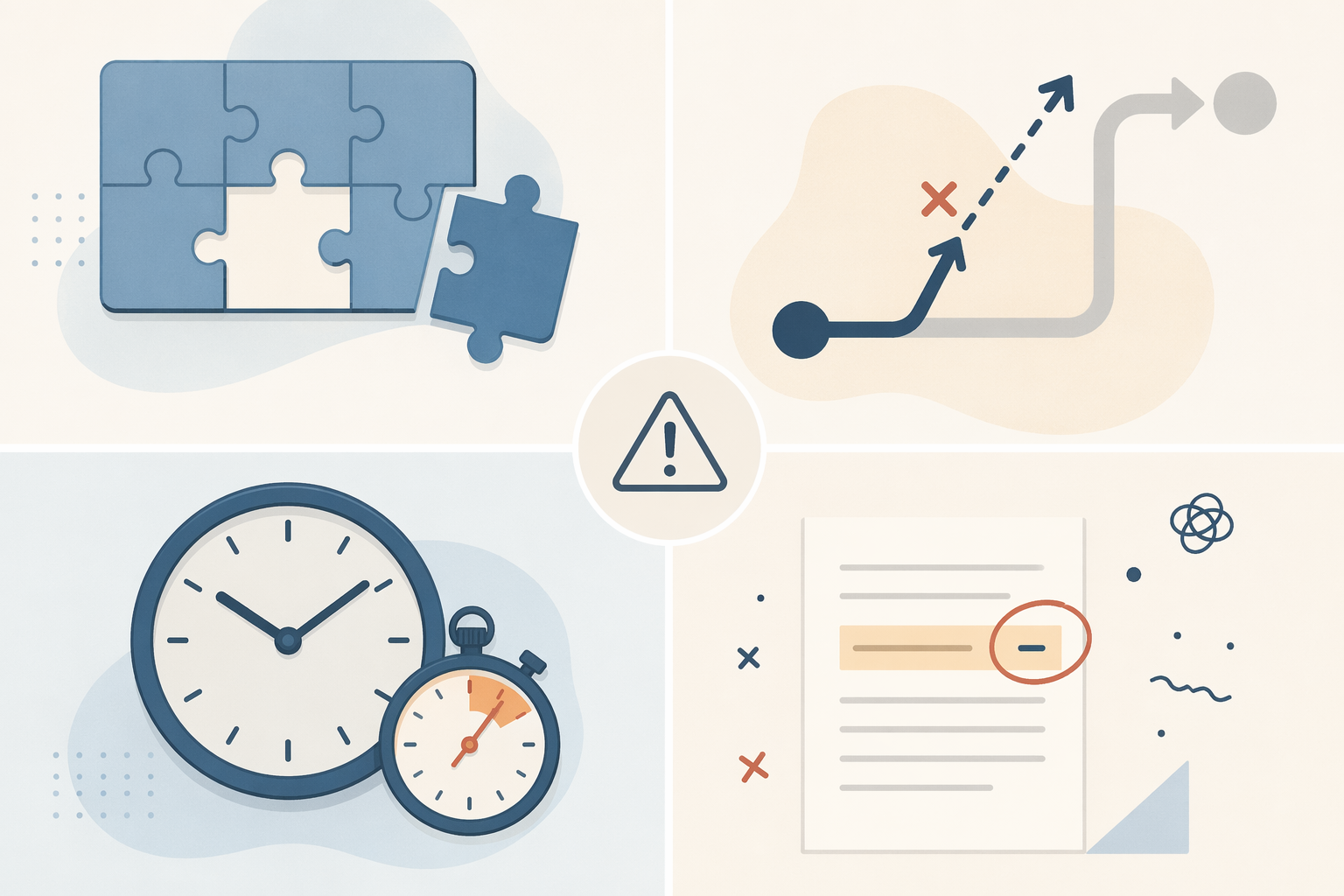
Content Gaps
A content gap means you did not know the tested skill well enough when the question appeared. In Reading and Writing, that might be transitions, boundaries, rhetorical synthesis, or command of evidence. In Math, it might be linear equations, quadratics, functions, ratios, percentages, or data analysis.
The test for a content gap is simple: if you could not explain the rule or method after seeing the answer, you need instruction before more timed practice. Do not keep throwing full tests at a missing skill. Learn it, drill it, then put it back under time.
Process Errors
A process error happens when you had the knowledge but used a weak method. You solved for the wrong variable. You chose an answer that was true but did not answer the question. You read the graph correctly and then ignored the units. You eliminated two choices and then picked the prettier of the remaining two without returning to the evidence.
These are not “silly mistakes” just because you understand them later. A repeated process error is a habit. The fix is usually procedural: underline the actual task, write the target variable, predict before looking at answer choices, or require textual evidence before selecting a Reading and Writing answer.
Timing Problems
A timing problem is not just “I ran out of time.” That is the symptom. The cause may be spending too long on medium questions, refusing to skip, rereading without a purpose, or doing algebra by hand when a faster Desmos strategy would have worked.
Record where the time went. If the last five questions in a module are rushed, look earlier. Which question took three minutes? Which passage got reread twice? Which Math problem became a full-page solution when a graph or substitution would have been cleaner? Timing improves when students change specific decisions inside the module, not when they simply promise to “go faster.”
Carelessness
Carelessness is the most overused label in SAT prep. Use it only when you genuinely knew the content, used a sound method, had enough time, and still made a slip. Even then, write down the kind of slip: sign error, copied number incorrectly, missed “except,” answered in the wrong form, clicked too fast.
The point is not to shame yourself for being careless. It is to build a prevention rule. If you repeatedly answer the wrong form of a Math question, your rule might be: before selecting an answer, reread the final sentence and circle what the question asks for. That is a study action. “Be more careful” is not.
Build An Error Log You Will Actually Use
An error log does not need to be beautiful. It needs to make the next study session obvious. If it becomes a color-coded museum of regret, it will not last.
| Column | What To Record | Why It Matters |
|---|---|---|
| Test and module | Bluebook test number, section, and module. | You can see whether problems cluster in adaptive second modules or late in a section. |
| Question type or skill | Grammar rule, evidence question, algebra topic, data question, or other tested skill. | This turns scattered misses into patterns. |
| Error category | Content, process, timing, or carelessness. | The category decides the fix. |
| Cause | One sentence explaining what actually happened. | This prevents vague labels like “bad at math.” |
| Fix | The drill, rule, or habit you will practice next. | The log becomes a study plan. |
| Retest result | Whether the same issue appears on the next timed set or full test. | Improvement is measured by repeated patterns disappearing. |
A weak log says: “Math, wrong, careless.” A useful log says: “Module 2 Math, systems of equations, process error: solved for x but question asked for y. Fix: write target variable before solving; do ten systems questions and check final variable before answer.”
For Reading and Writing, a weak log says: “Reading, hard.” A useful log says: “Rhetorical synthesis, content/process mix: chose answer with correct fact but wrong purpose. Fix: identify the task verb first, then choose the option that performs that task.”
You do not need to log every easy correct answer. Spend your attention where it can change future points: wrong answers, lucky guesses, slow solves, and questions where you narrowed to two and picked without a reason.
What To Do Between Full Tests
The two or three weeks between official practice tests are where the score has a chance to move. A reasonable study block does not need to be dramatic. It needs to be specific.
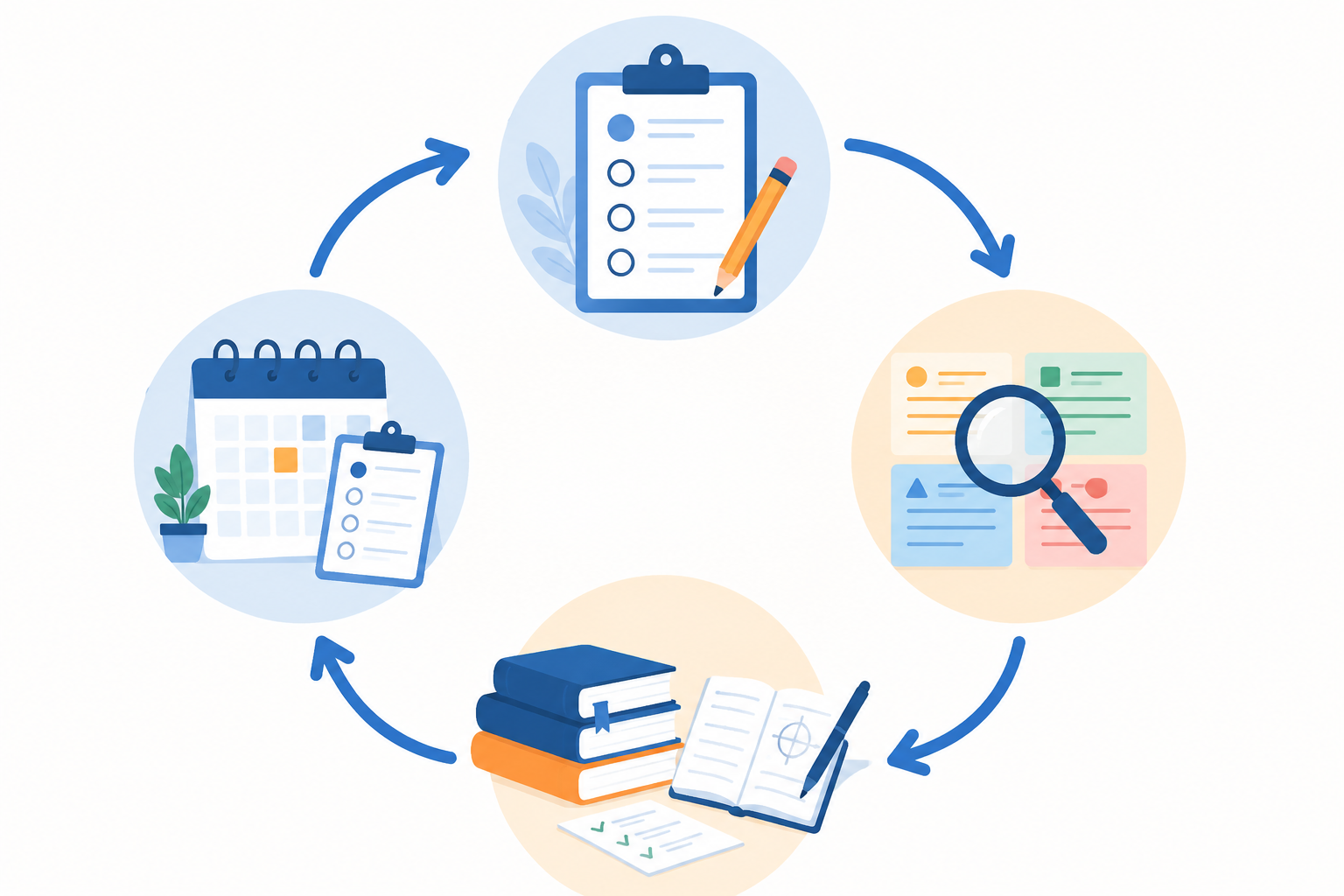
Use Bluebook for official full-length testing and Khan Academy for targeted practice. College Board provides Bluebook practice tests, and Khan Academy’s SAT materials are designed for skill practice between those tests.[1] If you need a walkthrough of that two-platform setup, use this guide to taking SAT practice tests with Bluebook and Khan Academy rather than trying to make every tool do every job.
A useful between-test week might look like this:
- Review the full test and complete the error log before starting new drills.
- Choose two or three high-value patterns, not every weakness at once.
- Do untimed practice first if the problem is content or method.
- Move to timed sets once accuracy improves.
- End the block with mixed practice so the skill is not obvious from the drill label.
That last point matters. If a page is labeled “linear equations,” your brain already knows what tool to reach for. The SAT will not be that polite. After skill drills, use mixed sets so you practice recognizing the problem type without being told.
The often-cited Khan Academy score-gain data supports this basic idea, but it needs careful handling. In 2017, College Board reported that 20 hours of personalized practice on Official SAT Practice on Khan Academy was associated with an average 115-point score gain, and 6–8 hours was associated with an average 90-point gain.[3] That study referred to the paper-based SAT era, not a fresh digital SAT study, so it should not be treated as a precise promise for the current exam.
Still, the direction of the lesson is useful: personalized practice between tests matters. The same College Board report noted that gains of 200 points or more happened for about 6.4% of students in the studied group, which is real but not typical.[3] Be wary of any plan that sells a 200-point jump as the normal result of simply taking more practice tests.
For students using Khan Academy as the main practice engine, a Khan Academy SAT Prep plan works best when it follows the error log instead of replacing it. Let the practice test tell you which skills deserve attention first.
When To Use Third-Party Tests
Third-party SAT practice tests are not useless. They are just easy to misuse. The safest way to think about them is by job.
| Use Case | Best Source | Why |
|---|---|---|
| Full simulation close to test day | Official Bluebook test | The adaptive format, interface, timing, and scoring are the closest match. |
| Baseline score | Official Bluebook test | You want the starting point to be as realistic as possible. |
| Extra skill repetition | Khan Academy or third-party drills | You do not need to spend a full official test to practice one weak area. |
| Additional stamina work | Third-party full test or section set | Useful when official tests need to be saved. |
| Final score prediction | Fresh official Bluebook test | Unofficial scoring may not reflect the adaptive digital SAT as well. |
If a third-party test exposes that you are slow on Math module-style work, that is useful. If it gives you a score that does not match your Bluebook score, do not panic. Treat unofficial scores as rough signals, not as final predictions.
The common mistake is using official and unofficial tests interchangeably. They are not interchangeable. Official tests are your best measurement tools. Unofficial materials are extra practice tools. Once that boundary is clear, third-party practice becomes much less confusing.
A Practical Testing Schedule
The right schedule depends on your test date, starting score, target score, school workload, and how much time you can study without pretending sleep is optional. But the basic rhythm is stable enough to plan around.
| Prep Window | Official Full Tests | How To Use Them |
|---|---|---|
| 6–8 weeks | 3–4 tests | Baseline, one or two spaced retests, and one final simulation. |
| 10–12 weeks | 4–5 tests | Baseline, retests every two to three weeks, and one saved near the real exam. |
| Semester-long prep | 5–6 tests | Baseline, periodic checkpoints, and at least one protected fresh test late in the process. |
| Very short runway | 1–2 tests | One diagnostic and one final simulation if time allows; rely on targeted practice between them. |
Do not schedule a full test just because you feel nervous. Nervousness asks for measurement, but it often needs review. If you took a full test last Saturday and have not finished analyzing the errors, the next full test is probably premature.
Also avoid the opposite problem: months of drills with no full-length check. The SAT is a timed, adaptive digital test. At some point, skills have to survive the full sequence. A student who can solve every algebra drill untimed still needs to know what happens after 50 minutes of Reading and Writing, a break, and then Math under pressure.
If Bluebook practice has started to feel like a slot machine — take test, hope number goes up, feel relieved or crushed — pause before using another official test. The Bluebook digital SAT practice mistakes worth fixing are usually not dramatic. They are ordinary: testing too often, reviewing too lightly, ignoring guessed questions, and failing to practice the exact pattern that caused the miss.
What The Next Test Should Tell You
Before taking the next full SAT practice test, write down what you expect to change. Not the dream score. The behavior.
- If you studied punctuation, expect fewer boundary errors.
- If you worked on Math pacing, expect fewer rushed final questions.
- If you practiced evidence questions, expect better elimination notes and fewer attractive wrong answers.
- If you used Desmos strategies, expect some problems to take fewer steps.
Then compare the next test against those expectations. If the score rises and the error pattern improves, keep going. If the score is flat but the target errors decreased, you may be closer than the number suggests; look for the new bottleneck. If the same errors repeat, the study plan did not actually address the cause.
This is where students often need the most honesty. “I reviewed” can mean “I looked at the correct answer and nodded.” That is not review. Review means you can explain why your answer was wrong, why the right answer is right, what category the mistake belongs to, and what you will do differently next time.
For a broader study plan that includes content review, practice sources, and timing strategy, use the SAT Exam Prep Guide. But for practice tests specifically, keep the rule plain: take a baseline, protect the official tests, review harder than you test, study the error pattern for two to three weeks, then retest under real conditions.
References
- Full-Length SAT Suite Practice Tests, College Board, https://satsuite.collegeboard.org/practice/practice-tests
- How the SAT Is Structured, College Board, https://satsuite.collegeboard.org/sat/whats-on-the-test/structure
- New Data Links 20 Hours of Personalized Official SAT Practice on Khan Academy to 115-Point Average Score Gains, College Board Newsroom, https://newsroom.collegeboard.org
- How to Use Digital SAT Practice Tests, IVY Lounge Test Prep, https://ivyloungetestprep.com
- How to Prepare for the SAT, McMillan Education, https://mcmillaneducation.com
- A Guide to SAT Practice Tests, Score At The Top, https://scoreatthetop.com
- Best Digital SAT Practice Tests, PrepMaven, https://prepmaven.com
Supporting Resources
- Are SAT Prep Classes Worth the Cost? →
This article compares score improvement data from free resources like Khan Academy with paid SAT prep programs to help students and parents decide when the investment makes sense based on starting scores, goals, and budget.
- Is Anki Actually Evidence-Based for the MCAT? What the Research Says About Spaced Repetition and Score Improvement →
Skeptical about the time investment Anki requires for MCAT prep? This article examines the peer-reviewed evidence — including a 2023 cohort study showing 6.2–12.9% higher exam scores for Anki users — alongside the valid critiques about the 'Anki trap,' so you can make an informed decision about whether and how to use it.
- How to Build Your SAT Prep Toolkit: A Step-by-Step Guide to Choosing Tools by Budget and Score Goal →
Stop choosing SAT prep tools before you know what you need. This diagnostic-first guide walks you through a step-by-step decision framework: take a baseline test, define your score gap, then match tools to your budget, timeline, and learning style. Includes sample toolkits for four student profiles and a decision tree to simplify your choices.
Comments
Join the discussion with an anonymous comment.