
SAT
Learn how to choose the SAT prep course that fits your learning style, target score, and study timeline. Compare top providers like UWorld, Magoosh, Kaplan, Princeton Review, and Prep Expert based on your personal needs.
Updated:
The hardest moment in choosing among SAT prep courses usually comes right before checkout. A student has a test date, a parent has a credit card, and every sales page seems to promise the same calm ending: better score, better plan, less stress. The problem is that the same course can be exactly right for one student, too loose for another, and wildly overbuilt for a third.
In 2026, that choice has a few extra complications. The SAT is now digital, shorter than the old paper test, adaptive, and includes tools such as the built-in Desmos calculator; courses that still feel designed around the old paper rhythm deserve a harder look.[1] At the same time, the admissions landscape is uneven: more than 75% of colleges remain test-optional for 2026, while some highly selective schools have reinstated testing requirements.[2] For many students, prep still matters — but the right amount of prep depends on the student in front of you.

So do not start with “Which SAT course is best?” Start with three quieter questions: Will the student actually use a self-paced plan? How much score movement is needed? How much time is left before the test?
Start With The Prep Environment The Student Will Actually Use
A disciplined sophomore with four months to study and a scattered junior trying to break 1400 in six weeks are not shopping for the same product. One may need a deep bank of digital SAT questions and clean analytics. The other may need a teacher, a calendar, a small enough class to notice silence, and someone expecting homework on Tuesday.
That is why learning style comes first. Not the learning style label students sometimes give themselves, but the pattern adults see after two weekends: does the student open the dashboard without being reminded, review missed questions carefully, and adjust? Or does the student need a live appointment before prep becomes real?
| Student situation | Course type to consider first | Providers that fit the problem | What to check before paying |
|---|---|---|---|
| Self-directed, question-driven learner | Question bank with analytics | UWorld | Enough digital SAT-style questions, clear explanations, and mistake tracking |
| Self-directed but explanation-heavy learner | Affordable video-led course | Magoosh | Whether videos lead to practice, not just passive watching |
| Needs accountability and routine | Live online or in-person class | Kaplan, Princeton Review, PrepMaven | Live hours, class size, instructor consistency, homework expectations |
| Already near a high score target | 1400+ or threshold-specific program | Princeton Review 1400+, Prep Expert Capstone | Starting score requirements, guarantee conditions, and actual fit |
| Busy student with a long runway | Flexible long-term access | Kaplan Unlimited Prep | Whether flexibility solves scheduling or just postpones studying |
| Short timeline before test day | Bootcamp or compressed class | Kaplan Bootcamp, Princeton Review Summer Camp | Whether the student can sustain the pace and still review mistakes |
The table is only a first sort. It keeps families from comparing a $129 video plan with a $1,999 multi-test subscription as if both were trying to solve the same problem.
If The Student Can Self-Manage, Choose Between Questions And Explanations
Self-paced prep works beautifully for some students. It also becomes a very expensive icon on a laptop for others. Before choosing a self-paced SAT course, look for evidence that the student can do three things without a classroom: take a timed section, review every miss, and return to the same weak skill later in the week.
For the student who learns by doing, UWorld is one of the clearer fits. Current 2025–2026 comparisons describe UWorld’s SAT product as having more than 1,650 practice questions, detailed explanations, analytics, and a listed price around $249.[3] That kind of setup is useful when the student does not just need more content, but needs patterns made visible: linear equation misses, punctuation traps, function notation errors, pacing problems in a particular module.
The important word there is “uses.” A large question bank does not improve a score by existing. It helps when the student is willing to treat missed questions as data. If a student races through practice, glances at the answer, and says “I get it now,” analytics will not do the hard part for them.
Magoosh answers a different self-paced problem: affordable explanation. Its SAT plan is listed in current comparisons at about $129 with more than 200 video lessons.[3] That can be a relief for students who need concepts retaught in a calm, repeatable way and for families who cannot justify a four-figure course. The trade-off is that videos can feel productive while letting the student avoid the harder work of timed practice.
Budget-constrained students should also look seriously at free resources before assuming paid is the only responsible path. Khan Academy and official practice materials can take a motivated student a long way, especially when paired with a disciplined practice-test routine. The catch is the same one that applies to every free plan: someone still has to build the calendar, diagnose the misses, and decide what changes next. For a deeper look at the free route, see the guides to Khan Academy SAT prep and free SAT practice tests.
If The Student Needs A Class, Do Not Shop By Question Count Alone
For classroom-dependent students, the first question is not “Which course has the most questions?” It is “What structure will make this student show up, practice, and change habits?” A student who avoids prep does not need a bigger library first. They need a recurring appointment, a teacher who can see confusion, and a course rhythm that does not let three weeks disappear.
Kaplan’s standard live SAT class is commonly listed at about $799 with 18 hours of live instruction and more than 500 practice questions.[3] That makes it a reasonable first comparison point for students who need accountability but do not necessarily need a premium score-threshold package. The value is not only the 18 hours. It is the fact that those hours sit on a schedule.
Princeton Review’s live options are typically listed at higher price points, with current comparisons showing 18 to 36 live hours, more than 2,000 practice questions, and prices ranging roughly from $949 to $2,199 depending on the plan.[3] That can make sense for students who need more guided time or a more intensive course structure. It is less persuasive if the student would use only the assigned class hours and ignore the practice outside them.
PrepMaven sits in a different classroom lane. Its SAT MasterClass is described at about $895, with small classes of around 20 students and a guaranteed instructor identity.[4] For some students, that last point matters more than a glossy platform. If a nervous or easily overlooked student does better when the teacher feels consistent and the room is small, class design is not a minor detail.
When comparing live courses, ask for the details that affect behavior: how many live hours are included, whether the same instructor teaches the full course, how large the class is, what homework is assigned, how missed classes are handled, and whether practice is tied to the digital SAT format. Families already choosing between the big classroom providers can use the Kaplan SAT prep comparison, the Kaplan SAT prep plans guide, or the Princeton Review SAT prep profile for a closer provider-by-provider read.
Match The Course Intensity To The Score Goal
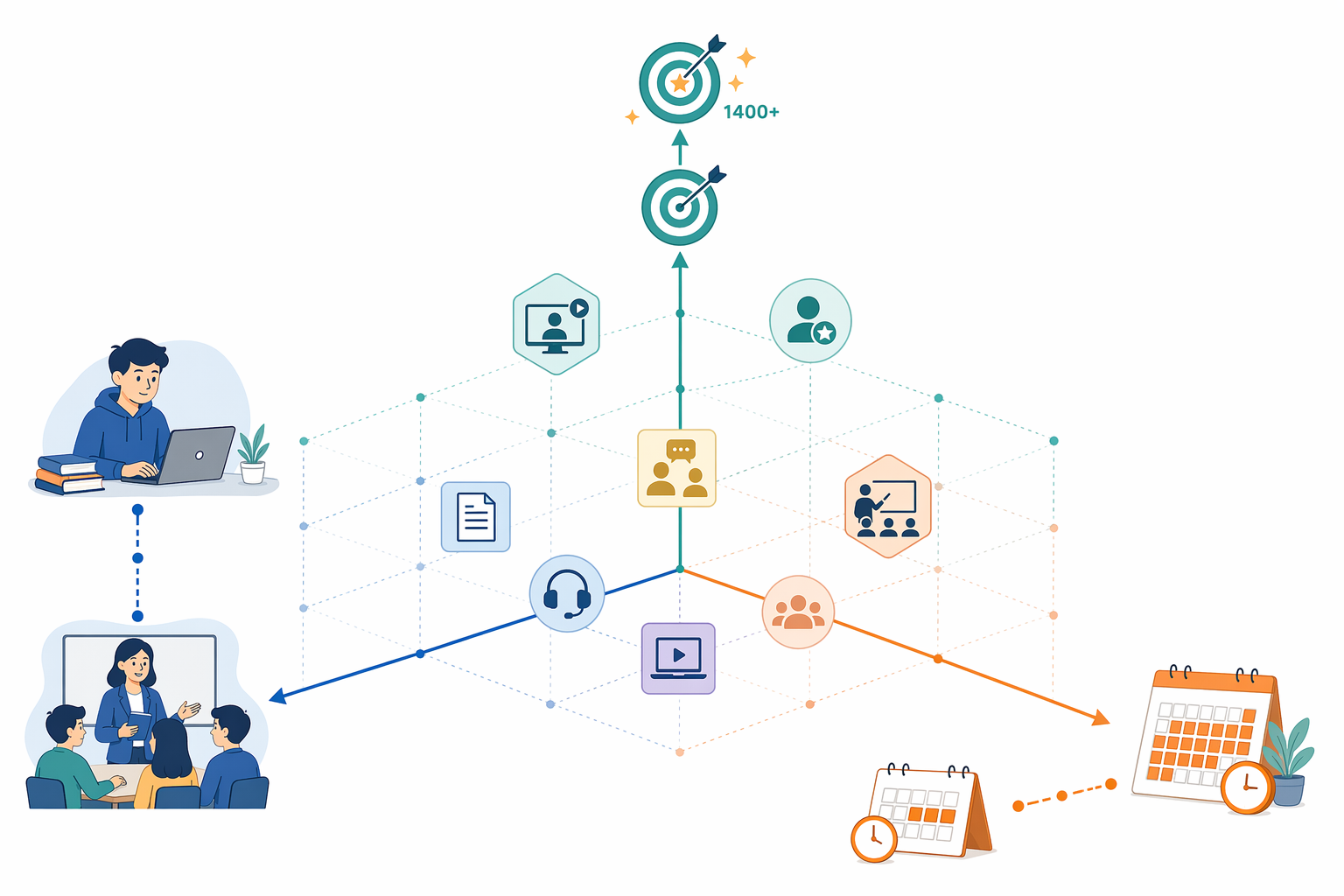
A student trying to move from a shaky baseline to a solid, usable score does not need the same plan as a student trying to cross 1400. That sounds obvious until a family pays for a prestige package because the number on the sales page feels reassuring.
For moderate improvement, the course should expose weak areas quickly and create enough repetition to fix them. A student missing core algebra, grammar rules, or data-analysis questions may benefit more from consistent practice and review than from an elite-labeled program. UWorld, Magoosh, Kaplan, Princeton Review’s standard live options, free official practice, or a hybrid of those can all be reasonable depending on the student’s independence and budget.
Average score-gain numbers are useful only if they are treated carefully. College Board research cited in prep discussions found that 6 to 8 hours of official SAT practice was associated with an average 90-point increase, while 20 hours was associated with an average 115-point increase.[5] That does not mean every student who studies 20 hours gains 115 points, and it does not prove that a particular commercial course will cause that result. Baseline score, study quality, missed-question review, and consistency all matter.
For 1400+ goals, slow down before buying the course with the boldest guarantee. Princeton Review’s SAT 1400+ program is listed at about $1,849, and Prep Expert’s Capstone course is listed around $1,699, with both positioned around high-score threshold outcomes.[3][6] These programs may fit a student who is already close enough that advanced strategy, targeted repair, and sustained pressure can realistically matter.
They are much less convincing as a magic upgrade for a student far below the threshold. A student starting hundreds of points away may need a longer foundation-building plan first: content review, repeated practice tests, error logs, and enough weeks for habits to change. Guarantee terms also deserve careful reading. Score guarantees usually have conditions, and those conditions can include attendance, homework completion, baseline documentation, or starting-score requirements.
The cleanest question is this: is the student close enough to 1400 that a threshold-specific course is solving the next problem, or is the family paying for a label before the student has the foundation to use it?
Then Check The Timeline, Because Time Changes The Right Answer
A four-month plan and a three-week plan should not look like the same course compressed. With months available, students can take a diagnostic, repair major content gaps, build pacing, sit for full practice tests, and use mistakes to shape the next week. With only a few weeks left, the plan has to become narrower: high-yield weaknesses, test timing, digital format familiarity, and fewer illusions about complete reinvention.
Kaplan’s Unlimited Prep is one of the more flexible long-run options, listed around $1,999 and described as including classes through senior year plus PSAT, ACT, and AP coverage.[3] That price is not automatically unreasonable. For a student with a crowded schedule, multiple test dates, and a real need for flexibility across exams, the plan may buy breathing room. For a student who mainly needs one focused SAT push, it may be more structure than the situation calls for.
Shorter timelines point toward different formats. Kaplan Bootcamp is described as a 2- to 3-week option, and Princeton Review’s Summer Camp is another compressed route for students who need concentrated prep.[3] A bootcamp can help when a student has the time and stamina to treat prep like a short-term project. It is a poor fit when the student is already overloaded, has major content gaps, or cannot review between sessions.
Practice tests matter in both timelines, but they should not be dumped randomly into the calendar. A full test too early can diagnose; a full test too late can only confirm what has not been fixed. Students who need help spacing tests and turning results into a study plan can use this guide on how to use SAT practice tests before choosing a course schedule.
A Practical Shortlist By Student Type
Once the student’s learning environment, score goal, and timeline are clear, the shortlist gets much smaller.
- Self-paced question-bank student: Start with UWorld, especially if the student will review explanations and use analytics to find patterns.
- Affordable video learner: Consider Magoosh, then pair the videos with timed practice so studying does not become passive.
- Budget-constrained independent student: Begin with Khan Academy and official practice tests, then pay only for the missing piece — explanations, questions, accountability, or tutoring.
- Live-class accountability student: Compare Kaplan, Princeton Review, and PrepMaven by live hours, class size, teacher consistency, and schedule fit.
- 1400+ threshold chaser: Look at Princeton Review 1400+ or Prep Expert Capstone only after confirming the student is close enough for that level of program to make sense.
- Flexible long-run planner: Consider Kaplan Unlimited Prep if the student genuinely benefits from extended access across SAT, PSAT, ACT, or AP needs.
- Short-timeline cram student: Look at bootcamps or summer intensives, but keep the plan narrow and realistic.
Families hesitating over whether a paid class is worth it should pause before they buy, not after. The better question is not whether SAT classes are worth the cost in general, but whether this student will get something from the class that they will not create alone. The guide on whether SAT prep classes are worth it is a useful side door for that decision.
The right SAT course should make the next six to sixteen weeks more concrete: what to study, when to show up, which mistakes to review, and how to tell whether the plan is working. If a student can name their category — question-bank learner, video learner, classroom learner, high-score threshold student, long-run planner, or short-timeline crammer — the course list is no longer a popularity contest. It is a fit problem.
References
- SAT Suite Changes and Important Dates, College Board
- 6 College Admission Trends to Watch in 2026, CollegeData
- Best SAT Prep Courses and Classes, Test Prep Insight
- Best SAT Prep Courses, PrepMaven
- Average Increase in SAT Scores with Prep, Prep Expert
- Best SAT Prep Courses and Programs, Efficient Learning
Supporting Resources
- What Khan Academy SAT Prep Does and Doesn't Give You →
This article reviews Khan Academy's free SAT prep offering in 2026, covering its course structure, effectiveness, limitations, and which students it serves best — helping you decide if it's enough for your target score.
- Google Gemini Free SAT Practice Test: What to Expect and How to Use It →
Google Gemini now offers free full-length SAT practice tests powered by Princeton Review content. This guide explains how to access it, what it does well, and where documented accuracy issues mean you should treat it as a supplementary tool — not a replacement for official College Board materials.
- What's a Good SAT or ACT Score in 2026? →
Wondering if your SAT or ACT score is strong enough for college? This guide shows how to find your personal target score using real Common Data Set data, so you can set a clear goal based on your specific reach and match schools.
Comments
Join the discussion with an anonymous comment.