
SAT
This article compares score improvement data from free resources like Khan Academy with paid SAT prep programs to help students and parents decide when the investment makes sense based on starting scores, goals, and budget.
Updated:
The hard question about sat prep classes is not whether SAT prep can raise scores. Practice can help, and the best free option already has public score-gain data behind it. The harder question is whether paying hundreds or thousands of dollars buys something your student would not produce with a free plan: completed hours, faster diagnosis, better feedback, fewer skipped assignments, or a score increase large enough to matter financially.
That distinction matters because free prep is no longer a few worksheets and good intentions. College Board reported that students who used Official SAT Practice on Khan Academy for 6 to 8 hours saw an average gain of about 90 points, and students who completed 20 hours of personalized practice gained an average of 115 points compared with students who did not use the platform.[1] That is the baseline every paid class has to beat.

Start With the Free Baseline
A 115-point average gain from 20 hours of personalized practice is not a promise. The College Board/Khan Academy analysis was not a controlled trial, and students who voluntarily completed practice may have been more motivated than students who did not. That caveat is real. It means the number should not be treated as proof that any teenager can casually log in and gain 115 points.
Still, the number is useful because it ties improvement to a concrete behavior: roughly 20 hours of targeted practice. For a student who can sit down four days a week, complete assignments, review missed questions, and take practice tests without a parent turning every evening into a negotiation, free prep deserves to be taken seriously. A paid class has to offer more than the same worksheets in a more expensive wrapper.
For a deeper look at how far that free route can realistically go, see How Far Can Khan Academy SAT Prep Take You?. The short version is simple: if a student’s target gain is moderate and their study habits are already solid, the cheapest serious option is to begin with Khan Academy and official practice before buying anything.
Where Paid Prep Starts to Earn Its Price
Structured prep becomes more defensible when the student’s problem is not access to material but follow-through. A class can create a weekly schedule, assign homework, force review, and make missed practice visible to someone other than a parent. For some families, that is not a bonus feature. It is the product.
Commercial prep sources report average gains in the 60- to 120-point range for structured prep, with one-on-one tutoring sometimes advertised at 100 to 200+ points.[2][3] Those ranges line up with what many families hope to buy, but they need careful reading. Prep companies benefit when improvement numbers sound broad and impressive. A 200-point result may happen for some students, especially when the starting score leaves many fixable gaps, but it should not be treated as the normal outcome for every student who pays.
The useful comparison is not “paid prep works” versus “free prep works.” Both can. The useful comparison is this: if free practice can plausibly produce a 90- to 115-point improvement when completed seriously, what extra obstacle does the paid class remove?
| Student situation | Most cost-effective first move | Why |
|---|---|---|
| Needs 50–80 points and already studies consistently | Free official practice first | The target may be within reach through completed self-study hours. |
| Needs about 100+ points but avoids independent practice | Structured class or hybrid plan | The paid value is accountability and pacing, not just content access. |
| Has repeated weak areas after practice tests | Targeted class, tutor, or AI-supported review | The bottleneck is diagnosis and correction, not more random questions. |
| Is close to a scholarship or admissions threshold | Consider paid support sooner | A modest score change may have financial consequences. |
| Needs a very large jump and has limited time | Private tutoring may be justified, but only with clear milestones | The family is paying for customization and urgency. |
Starting Score Changes the Math
A student starting far below their target often has more visible content gaps: algebra skills that never became automatic, grammar rules that were guessed through, or reading timing that collapses halfway through a section. For that student, the first 50 or 100 points may come from fixing patterns that a good practice platform can expose. If they will actually use the platform, starting free is not a weak choice.
A student already scoring high is in a different position. The easier points may be gone. Their mistakes may be less frequent, more timing-sensitive, or tied to a few stubborn question types. A general class can still help, but the family should be careful about paying for broad coverage if the student only needs precision work. At that level, a shorter targeted plan can make more sense than a long course that re-teaches material the student already knows.
The target score matters just as much as the starting score. A student trying to move from “not my best” to “a little stronger” does not need the same plan as a student trying to cross a scholarship cutoff. If the score threshold could change aid eligibility, the cost of prep should be compared with the value of the possible award, not just with the family’s monthly budget.
What the Price Usually Buys
SAT prep pricing stretches from $0 for Khan Academy to $5,000+ for elite private tutoring, while many families spend somewhere around $300 to $1,000.[4] Online classes are often cheaper than in-person equivalents; EducationData.org reports that online SAT prep courses cost 10% to 25% less than comparable in-person options.[5]
Those numbers are less useful as a shopping catalog than as a way to ask what the student is actually missing. A $300 class that gets a student to complete 20 focused hours may be a better purchase than a more expensive package full of features the student will not use. A $1,500 program can be reasonable if it gives frequent feedback, separates math and reading weaknesses, and keeps the student moving. A $5,000 tutoring plan needs a narrower justification: a large score gap, limited time, a highly specific weakness, or a financial threshold that makes the risk worth considering.
- If the bottleneck is practice volume, buy the cheapest structure that makes practice happen.
- If the bottleneck is content knowledge, look for instruction tied to diagnosed weak areas.
- If the bottleneck is careless errors or timing, prioritize review routines and full-length practice.
- If the bottleneck is motivation, do not pretend a free login will fix it by itself.
- If the bottleneck is a parent-student standoff, accountability may be worth paying for even when the content is not unique.
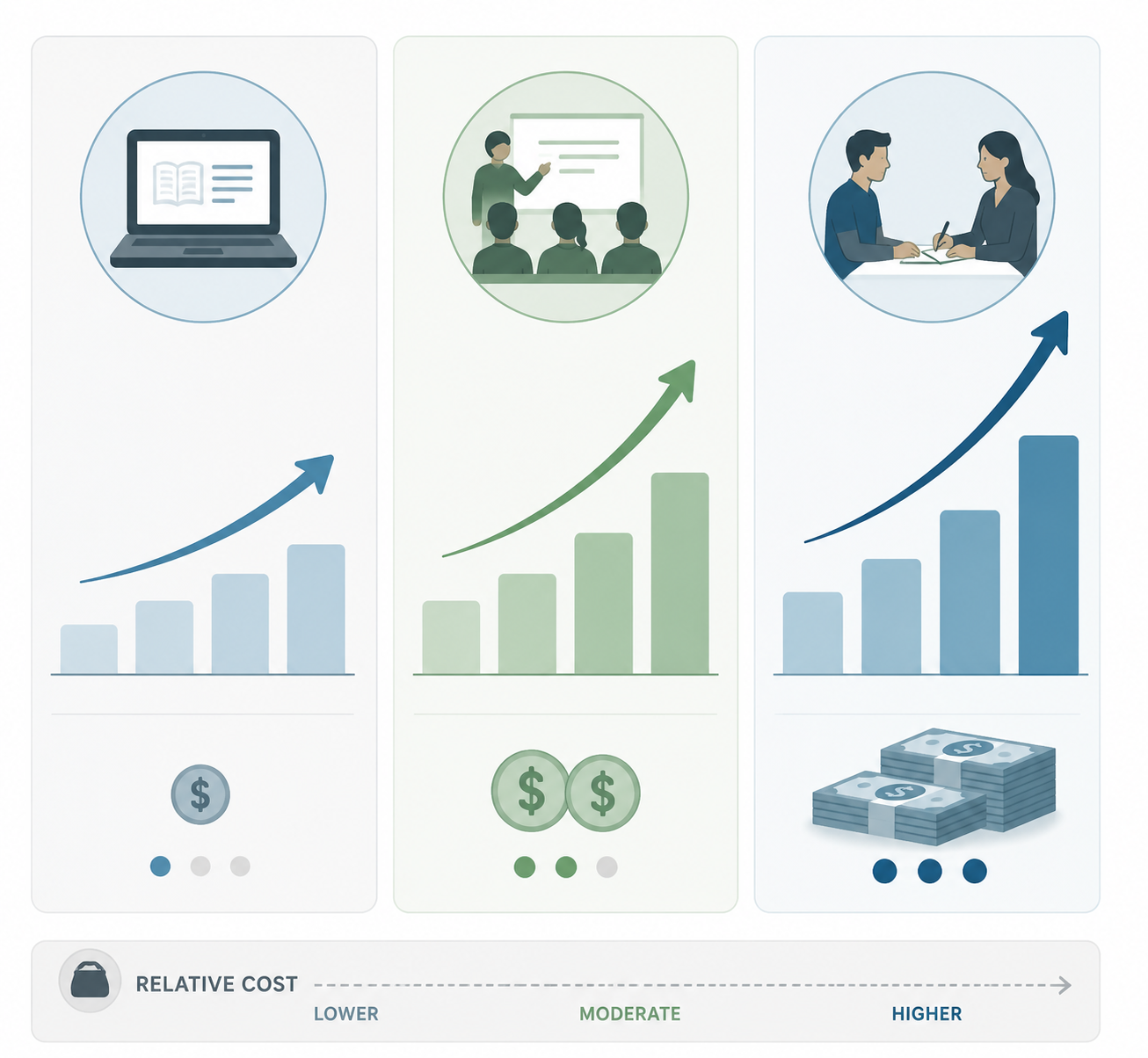
The Hybrid Route Is Often the Sensible Middle
A family does not have to choose between doing everything alone and buying the most expensive package. A strong hybrid plan starts with official practice, uses a full-length test to identify weak areas, and only pays for the part the student cannot solve independently.
For example, a student might begin with Khan Academy practice, take an official-style digital practice test, and then use the results to decide whether they need a class, a short tutoring block, or simply a stricter calendar. The SAT Practice Tests with Bluebook and Khan Academy guide is the right next stop for building that evidence before paying.
This is also where AI tutoring tools can fit, especially for students who need more explanation than Khan Academy gives but do not need a weekly private tutor. The comparison in Khan Academy vs AI SAT Tutors can help separate “I need more feedback” from “I need a full paid course.”
When a Paid Class Is Probably Worth It
A paid SAT class becomes easier to justify when three things are true: the student has a meaningful score gap, the free plan is unlikely to be completed consistently, and the class offers more than generic lectures. The family should be able to point to what the course changes in the student’s week.
- The student needs a score increase of around 100 points or more and has not shown the discipline to complete independent practice.
- The student has already used free practice but keeps missing the same question types.
- The student needs outside accountability because parent reminders are not working.
- The target score is tied to a scholarship, honors program, or admissions threshold.
- The provider can explain how it diagnoses weaknesses, assigns practice, reviews missed questions, and tracks progress.
If those conditions fit, provider choice matters. A nearby class is not automatically better for the digital SAT, and an online class is not automatically weaker. Families comparing local options can use Does SAT Prep Near Me Really Matter for the Digital SAT? and How to Find the Best SAT Prep Classes Near You in 2026 to evaluate schedule, instructor quality, practice-test policy, and refund terms before signing up.
When Free Prep Is the Better First Move
Free prep should come first when the student can follow a plan, the target gain is moderate, and there is enough time before test day to see whether the plan is working. In that situation, paying immediately may solve a problem the student does not actually have.
A reasonable free trial is not “study when you feel like it.” It should include scheduled practice blocks, official question review, at least one full-length practice test, and a decision date. After two or three weeks, the family should know whether the student is completing the work and whether the missed-question patterns are improving.
If the student completes the plan and scores are moving, keep the cost at $0 for as long as the progress continues. If the student does not complete the plan, the family has learned something just as important: the missing ingredient is structure, not another free resource.
A Practical Decision Rule
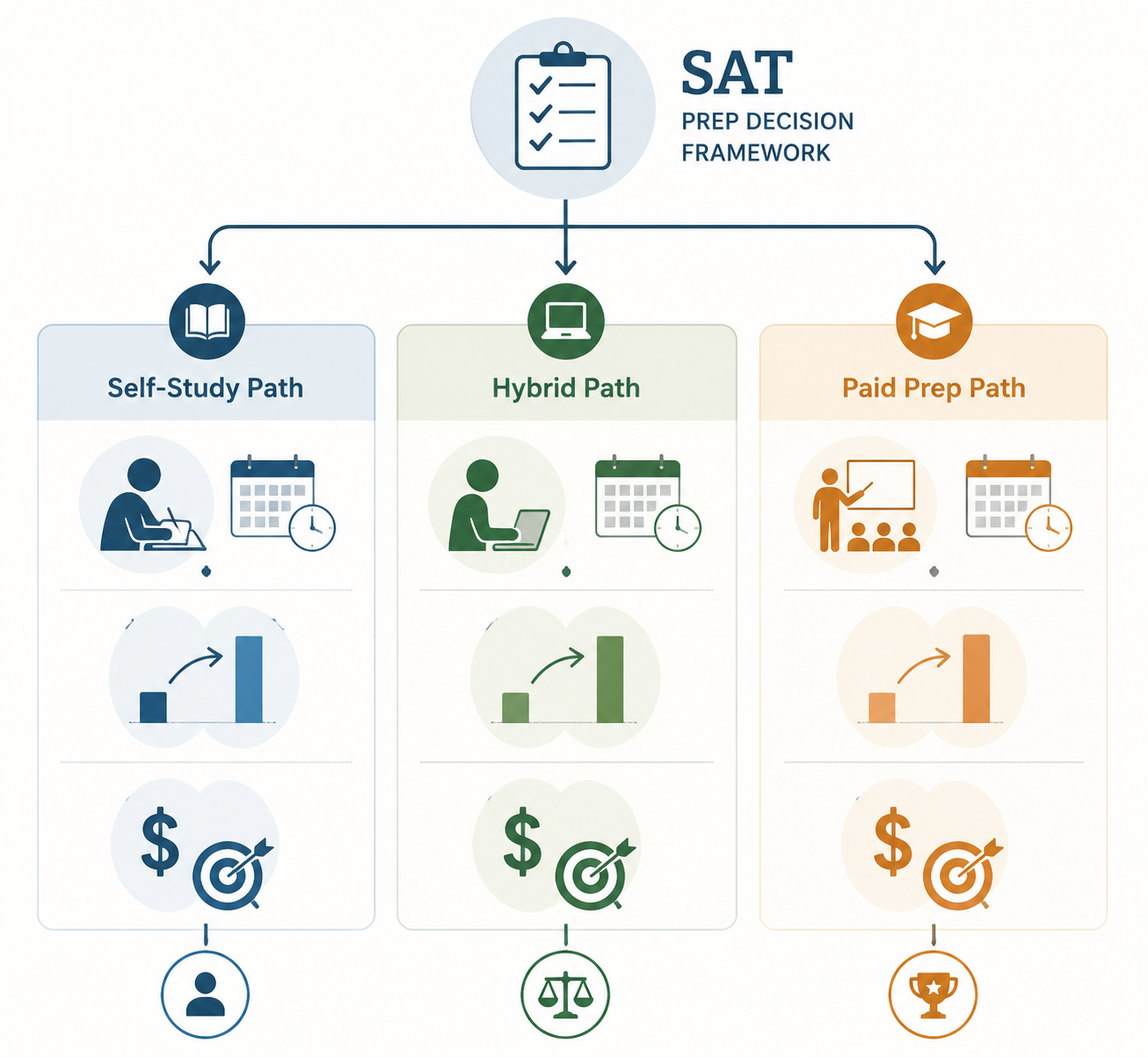
Pay for SAT prep when the student needs structure, when the target score is far enough away that unguided practice is unlikely to close the gap, or when a score threshold has real financial consequences. Start with free or hybrid prep when the student can complete regular practice and the needed gain is modest enough to test with official materials first.
The cheapest good choice is the one that fixes the actual bottleneck. For one student, that is Khan Academy and a calendar. For another, it is a $500 class that turns intention into completed hours. For a smaller group, it is targeted tutoring because the score goal is urgent, specific, and valuable enough to justify the price.
References
- New Data Links 20 Hours of Personalized Official SAT Practice on Khan Academy to 115-Point Average Score Gains, College Board Newsroom
- Average Increase in SAT Scores with Prep, Prep Expert
- Do SAT Prep Courses Really Work?, 4SATPrep
- How Much Does SAT Tutoring Cost? 2026 Pricing Guide, Private Prep, 2026
- Best Online SAT Prep Courses & Classes, EducationData.org
Supporting Resources
- How to Build a Daily Bible Study Habit Using an App: A Science-Backed Guide for Students →
This guide shows Christian students how to apply habit-science principles—cues, routines, and rewards—to build a consistent daily Bible reading habit using apps like YouVersion, Olive Tree, and Dwell. Learn four app-powered hacks, a 7-day starter challenge, and how to connect spiritual discipline with academic study habits.
- MCAT Study Prep Guide: Best Tools, Timelines, and a Phase-by-Phase Plan →
A comprehensive hub for pre-med students planning MCAT preparation — covers how the exam is structured, how to set a realistic study timeline based on your content baseline, and which free and paid tools to use at each phase of prep from content review through full-length simulation.
- How to Use ASVAB Study Apps Effectively: A Study Plan Framework for Scoring 50+ on the AFQT →
Most recruits download an ASVAB app but don't use it systematically. This guide provides a step-by-step study plan framework — from diagnostic testing to timed simulations — to help you turn app access into a competitive AFQT score of 50 or higher.
Comments
Join the discussion with an anonymous comment.