
What Khan Academy SAT Prep Does and Doesn't Give You
This article reviews Khan Academy's free SAT prep offering in 2026, covering its course structure, effectiveness, limitations, and which students it serves best — helping you decide if it's enough for your target score.
Updated:
Khan Academy SAT prep is still one of the best free ways to study for the SAT in 2026. The more useful question is whether it is enough for your score goal. For many students, especially those trying to build fundamentals or move from a shaky score into a solid one, Khan Academy plus Bluebook can absolutely carry the main load. For students already near the top of the range and trying to push past 1400, it is better treated as the official foundation than as the whole plan.
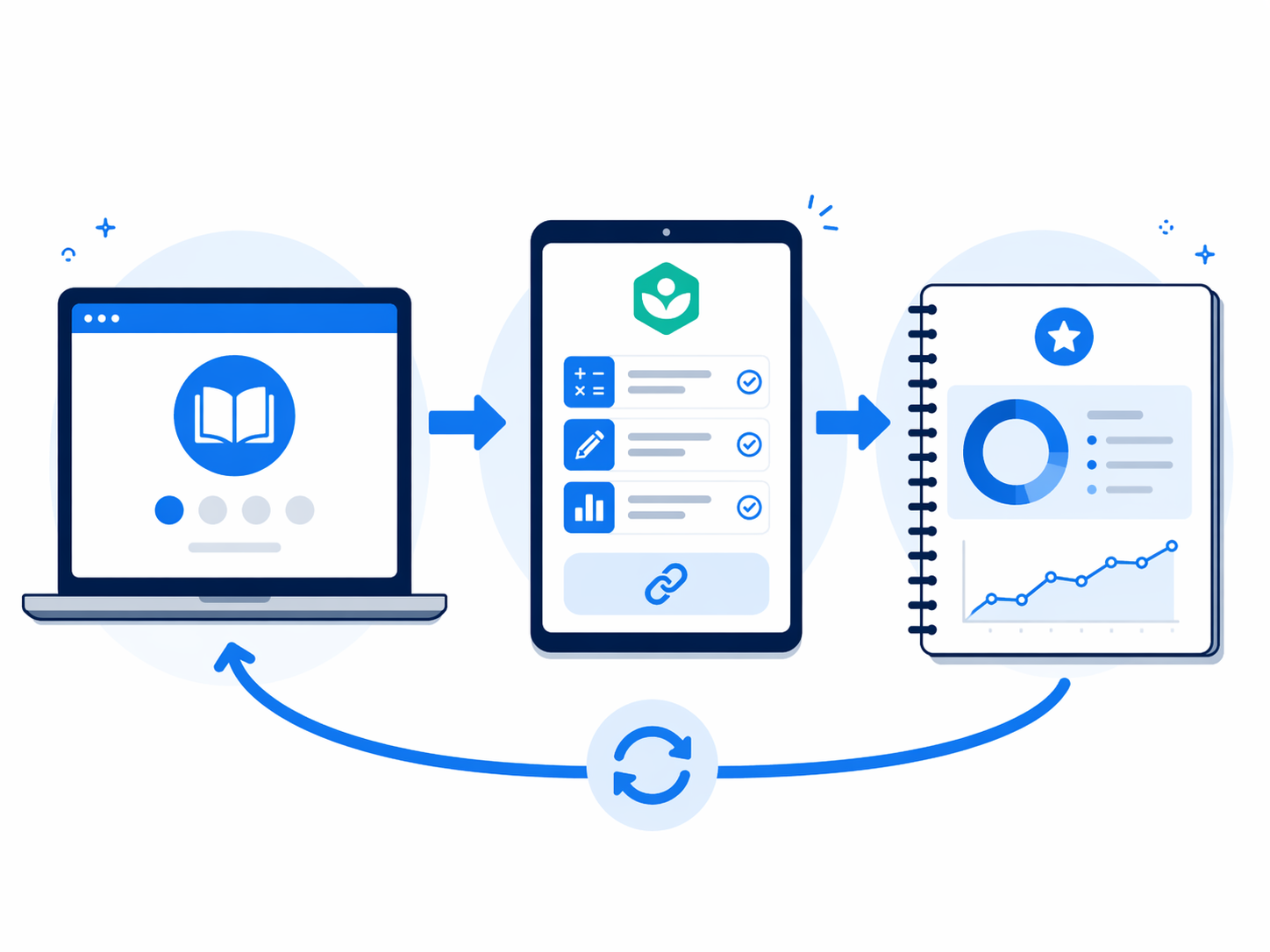
That distinction matters because the current Digital SAT setup is no longer “do everything inside Khan Academy.” Full-length practice tests live in Bluebook. Khan Academy provides lessons, drills, and targeted practice. After a Bluebook test, students can use post-test “Practice on Khan Academy” links to work on areas connected to their results, while the older account-linking setup has been deprecated.[1][2]
What Khan Academy SAT Prep Actually Is in 2026
Khan Academy is the official free SAT practice partner for College Board, but “official” does not mean it replaces every part of a serious prep plan. It gives students concept lessons, worked examples, practice questions, and skill practice aligned to the Digital SAT. It does not give students a full proctored testing environment inside Khan Academy anymore; that role belongs to Bluebook.
A normal study week should therefore move between two tools: Khan Academy for learning and drilling, Bluebook for full-length practice, then Khan Academy again for targeted follow-up. A student who simply opens Khan Academy and clicks around for twenty hours may be busy without getting the same value as a student who studies, tests, reviews, and then drills the specific weak skills that showed up under timed conditions.
| Part of prep | Where it happens | What the student gets |
|---|---|---|
| Concept learning | Khan Academy | Short lessons, examples, and skill practice |
| Targeted drills | Khan Academy | Practice by math or Reading and Writing skill |
| Full-length test simulation | Bluebook | Digital SAT practice tests in the official testing app |
| Post-test follow-up | Bluebook to Khan Academy | Practice links connected to performance after a Bluebook test |
This two-platform setup is not a minor detail. Strong self-studiers can turn it into a clean loop. Less organized students can mistake scattered practice for a plan. If a student is asking, “Did I do enough Khan Academy?” the better question is usually, “Did I use Khan Academy to fix what my Bluebook test exposed?”
The Score-Gain Evidence Is Real, but It Needs a Caveat
The most quoted number for Khan Academy SAT prep is a strong one: College Board reported that students from the class of 2017 who spent 20 hours on personalized Official SAT Practice on Khan Academy saw an average score gain of 115 points, based on a study of nearly 250,000 students.[3]
The same College Board report also found that students who spent 6 hours using the platform gained an average of 90 points, and that more than 16,000 students gained 200 points or more.[3]
Those numbers are worth taking seriously. They are also not a promise. The study predates the Digital SAT transition, and the same large-scale result has not been revalidated for the current format in the materials available here. It also reports averages, which means it smooths over the student who barely improved, the student who jumped dramatically, and the student who used Khan Academy alongside other help.
For planning purposes, the evidence supports a practical expectation: consistent Khan Academy practice can produce meaningful gains, especially when a student has clear content gaps. It does not support the idea that logging a certain number of hours automatically buys a certain score increase.
What You Get in Math and Reading and Writing
The Digital SAT Math course is organized into 12 units and three difficulty tiers. That matters because a student can work through foundations before jumping into harder material instead of treating every missed math question as the same kind of problem.[4]
The Reading and Writing side has also been expanded for the Digital SAT. Khan Academy described the course as moving from 5 units to 11 units and adding more than 100 new practice questions, giving students more room to practice the shorter, more targeted question types used on the current test.[4]
The strongest part of Khan Academy is concept repair. If a student keeps missing linear equations, transitions, punctuation boundaries, central ideas, or command-of-evidence questions, the platform gives them a place to slow down and rebuild the skill. That is different from just taking practice test after practice test and hoping the pattern fixes itself.
The weaker part is high-end test strategy. Khan Academy can show why an answer is correct and give more practice with the underlying skill, but it is not built like a private tutor sitting beside a student and saying, “You keep losing time here because you are choosing the long route,” or “At your score level, this question type is not the best use of your next two weeks.”

The Study Cycle That Makes Khan Academy Work
The student who gets the most from Khan Academy is not necessarily the one who spends the most time on it. It is the one who uses it after noticing something specific. A clean cycle looks like this:
- Take a full-length Bluebook practice test under realistic timing.
- Review the score report and write down the skills, not just the section scores.
- Use the Bluebook-to-Khan Academy practice links when available.
- Spend several study sessions repairing the highest-value weak areas.
- Retest later, then repeat with a smaller and more precise target list.
That is also why a generic “20 hours on Khan Academy” goal can be misleading. Twenty hours of random mixed practice and twenty hours of targeted work after a timed Bluebook test are not the same thing. One fills a calendar. The other changes what happens on the next test.
If you decide to use Khan Academy as your main plan, the natural next step is a schedule that forces this loop instead of relying on motivation. A week-by-week approach like How to Structure Your SAT Prep with Khan Academy and Bluebook is more useful than a vague promise to “practice more.” For the testing side specifically, How to Take SAT Practice Tests with Bluebook and Khan Academy can help keep the full-length tests from becoming isolated events.
Where Khan Academy Starts to Feel Thin
Several independent prep-review sites point to the same broad limitations: Khan Academy does not function like a full commercial course with a built-in diagnostic test, a complete personalized study plan, a score guarantee, or a very large proprietary question bank. Test Prep Insight, PrepMaven, and PrepScholar have each framed some version of those gaps in their reviews or comparisons.[5][6][7]
Those critiques should be read with a little caution because prep-review sites often operate in a commercial ecosystem where paid programs benefit from looking more complete than free tools. Still, the limitations are not imaginary. If a student needs someone else to diagnose, schedule, assign, monitor, and adjust the plan, Khan Academy will not do all of that on its own.
The question bank issue also matters more for some students than others. A student who is still learning core algebra or grammar rules may not need thousands of fresh questions yet. A student scoring in the high 1300s who has already burned through the obvious weaknesses may need harder problems, more nuanced explanations, and more practice distinguishing between nearly-right answers under pressure.
Who Can Probably Rely on Khan Academy
Khan Academy is strongest for students who are willing to self-study and still have visible content gaps. If the missed questions come from concepts the student never fully learned, forgot, or learned in a different format, Khan Academy is exactly the kind of tool that can make progress feel normal instead of expensive.
- A student starting with uneven math foundations can use Khan Academy to rebuild specific skills before chasing harder strategy.
- A student aiming for a moderate-to-strong score gain can pair Khan Academy practice with Bluebook tests and get a serious free plan.
- A student with a tight budget can avoid paying for a course before proving that free official practice is not enough.
- A student who already knows how to follow a schedule can turn the platform into a repeatable weekly system.
For these students, buying a course too early can be wasteful. If the main problem is that the student never mastered systems of equations or keeps missing punctuation questions, the first fix does not have to cost hundreds of dollars.
Who Should Supplement It
Students aiming above 1400 should be more careful. At that level, the remaining points are often not sitting in obvious content gaps. They may come from pacing decisions, question selection, careless error patterns, advanced grammar distinctions, calculator strategy, or the ability to recognize the trap answer before it eats a minute.
Khan Academy can still be part of that plan. It should be. But it may not be enough by itself. A high-scoring student may need harder third-party practice, an advanced strategy course, tutoring targeted to a specific weakness, or a larger set of full-length review materials. The right supplement depends less on prestige and more on the actual bottleneck.
For a more score-range-specific decision, Is Khan Academy SAT Prep Free Enough for Your Target Score? goes deeper into when the free route is likely sufficient and when it starts to become risky. If the answer is “I need more than Khan Academy,” a broader comparison like Which SAT Prep Course Fits Your Learning Style, Score, and Schedule? is the more honest next stop than buying the first famous course a parent recognizes.
What About Khanmigo and Other Free Help?
Khanmigo, Khan Academy’s AI tutor, is worth watching but not worth treating as proven SAT magic. The available evidence points to a low monthly price in mid-2026 and mixed SAT-specific student reactions, including comments about basic-level explanations and reliability concerns.[8][9]
That does not mean students should ignore AI help. It means they should test it against a real need. If an AI tutor helps explain why a grammar answer is wrong or walks through a missed algebra problem clearly, it can save time. If it gives vague reassurance or inconsistent explanations, it is not a substitute for a real review process. For students comparing AI options, Khan Academy vs AI SAT Tutors is the better place to separate useful support from novelty.
There are also free human-support options in the SAT ecosystem. Schoolhouse.world offers free SAT bootcamps in a 4-week, peer-tutor-led format, with eligibility described for students scoring 400–690 per section.[10]
That kind of structure can help the student who does not need a luxury prep course but does need another human being expecting them to show up. It is not the same product as Khan Academy, and it is not aimed at every score range, but it fills a gap Khan Academy leaves open: accountability.
The Practical Verdict
Khan Academy SAT prep gives students a serious free foundation: official-aligned lessons, structured math and Reading and Writing practice, and a workable connection to Bluebook testing. The score-gain evidence is encouraging, especially for students who put in consistent time, but it comes from the pre-Digital SAT era and should be treated as a useful benchmark rather than a guaranteed outcome.
If your goal is to learn the test, repair weak skills, and make a meaningful score jump without paying for prep, Khan Academy plus Bluebook is one of the fairest starting points available. If your goal is a 1400+ score and you are already close enough that each missed question is expensive, use Khan Academy as the official base and add the missing layer: harder practice, sharper strategy, or coaching that matches the exact reason your score has stopped moving.
For the broader tool landscape, SAT Study Tools Guide 2026 and the SAT Exam Prep Guide can help place Khan Academy inside a full prep decision instead of treating one free platform as the whole universe.
References
- Can students still practice using Khan Academy? — College Board Help Center.
- Helping your students prepare for the Digital SAT on Khan Academy — Khan Academy Support.
- New Data Links 20 Hours of Personalized Official SAT Practice on Khan Academy to 115-Point Average Score Gains — College Board Newsroom.
- Introducing Khan Academy's Expanded Digital SAT Reading & Writing Course — Khan Academy Blog.
- Khan Academy SAT Prep Review — Test Prep Insight.
- Khan Academy SAT Prep Review — PrepMaven.
- Best SAT Prep Courses — PrepScholar.
- Khanmigo Statistics — Skillademia.
- What we've learned from building AI tools for learning — Khan Academy Blog.
- SAT Bootcamp — Schoolhouse.world.
Comments
Join the discussion with an anonymous comment.