
SAT
Compare Kaplan SAT prep against Princeton Review, PrepScholar, Magoosh, and Khan Academy based on practice volume, adaptivity, live instruction, and price. Learn which provider best fits your budget, timeline, and learning style in 2026.
Updated:
Kaplan SAT test prep is a credible, polished choice in 2026, especially for students who want live structure and clean explanations. It is not the strongest default for a student who plans to study mostly alone, needs a large practice bank, or wants the most precise adaptive remediation. That distinction matters because many families do not buy SAT prep in the abstract; they buy it after a disappointing practice score, a crowded junior-year schedule, and the feeling that a familiar brand might reduce the risk.
The evidence on Kaplan is also unusually split. Test Prep Insight gives Kaplan a 9.5/10 Editor’s Choice rating, while PrepMaven rates Kaplan 5/10, a gap wide enough that shoppers should look past the star rating and inspect what each review rewards: lesson polish, live class structure, question supply, adaptive depth, access time, and fit for the student sitting down after school on a Tuesday night.[1][2]

| Provider | Best fit | Practice volume | Adaptivity | Live instruction | Price sensitivity |
|---|---|---|---|---|---|
| Kaplan | Students who want a structured class and polished lessons | 500+ practice questions and 4 practice tests in the cited comparison | More limited, tied to modules and four practice tests | A central strength for students who need accountability | Discounts can change the value calculation |
| Princeton Review | Students prioritizing more practice at a comparable spend | 2,000+ questions and 9 practice tests in the cited comparison | Less central than practice volume in this comparison | Strong paid-course competitor | Most relevant when priced near Kaplan |
| PrepScholar | Students who need targeted remediation | Less important here than how practice is assigned | Question-by-question adaptive engine | Not the main reason to choose it in this comparison | Worth weighing when wasted practice is the bigger problem |
| Magoosh | Budget-conscious self-paced students | A self-study reference point rather than the volume leader here | Useful for independent learners, but not the main adaptive benchmark | Not a live-class substitute | Most appealing when cost is the constraint |
| Khan Academy | Students starting with free official practice or using outside accountability | Free College Board-official baseline | Useful practice path, but not a live coached course | No live instruction | Free changes the paid-prep question |
If the immediate question is whether Kaplan is “good,” the answer is yes, with conditions. If the question is whether Kaplan is the best value against Princeton Review, PrepScholar, Magoosh, and Khan Academy, the answer depends heavily on whether the student needs teaching, practice volume, adaptive diagnosis, or simply a plan they will actually follow.
Where Kaplan Actually Earns Its Place
Kaplan’s strongest case is not that it overwhelms the student with practice. Its case is order. A student gets a familiar course sequence, clear video explanations, recognizable branding, and paid tiers that can include live instruction. For a nervous junior who has already tried “just do practice problems” and stalled, that structure can be a real advantage.
That is why Kaplan can still be a sensible buy even when another provider offers more questions. Some students do not need a bigger pile; they need someone to tell them which assignment is due before the next class, what to review after a missed question, and when to stop rewatching explanations and take another timed section.
The caution is that structure should not be mistaken for unlimited substance. Families comparing Kaplan plans should look closely at access length, practice test count, and how much the student will actually practice outside class. Readers who want the plan-by-plan version can use A Complete Guide to Kaplan SAT Prep Plans for 2026 rather than treating every Kaplan tier as interchangeable.
Kaplan vs. Princeton Review: Similar Spend, Very Different Practice Supply
The Kaplan-Princeton Review comparison is the one most families should slow down for, because the trade-off is concrete. In Test Prep Insight’s head-to-head comparison, Kaplan is listed with 500+ practice questions and 4 practice tests, while Princeton Review is listed with 2,000+ questions and 9 practice tests at a similar price point.[3]
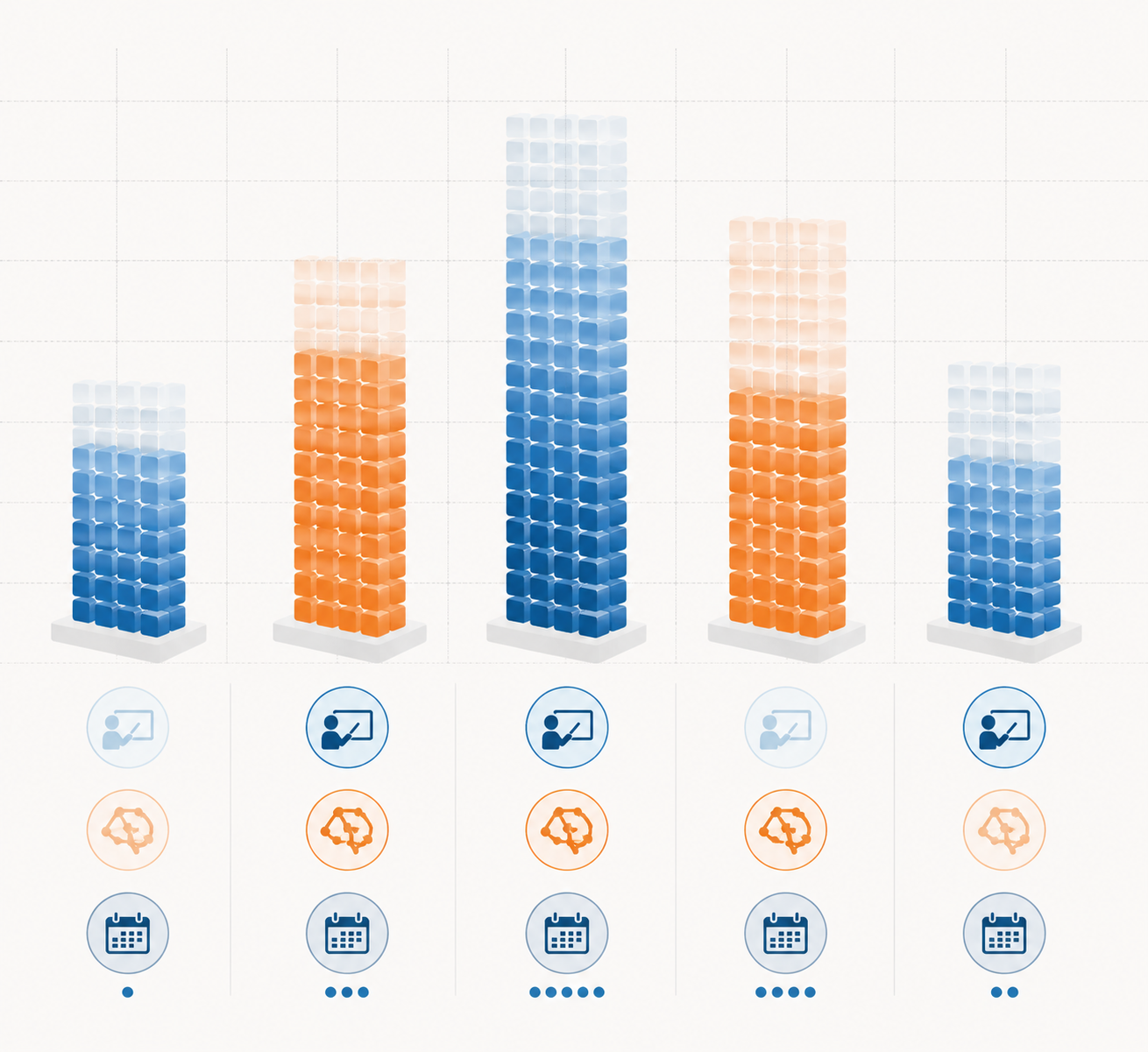
That difference changes the weekly experience. A student using Kaplan may get a smoother instructional path, but a student who needs repeated exposure to digital SAT question types can run into the limits of the question bank sooner. Princeton Review’s larger practice supply gives more room for full-length test cycles, retakes, review days, and targeted drilling before the next official exam date.
More questions do not automatically mean better prep. A student can burn through 2,000 questions badly, skip review, and learn very little. But when two paid options sit in a similar price neighborhood, practice volume deserves serious weight. SAT improvement usually requires repeated timed work, not just understanding a lesson the first time it is explained.
This is where the parent’s instinct to buy the safer-looking brand can backfire. If the student already understands lessons quickly and mostly needs reps, endurance, and test-day pacing, Princeton Review may be the more practical paid choice. If the student is easily overwhelmed and needs a cleaner classroom path, Kaplan may still fit better even with fewer questions.
For a deeper look at the rival course structure, see Your Guide to Princeton Review SAT Prep Courses in 2026. For students comparing practice resources more broadly, the Free SAT Practice Tests Guide is the more direct next stop.
Kaplan vs. PrepScholar: The Important Difference Is How Remediation Happens
PrepScholar’s strongest contrast with Kaplan is not brand style. It is the level at which the system adapts. PrepScholar describes a question-by-question adaptive engine, while Kaplan’s adaptivity is more limited and tied to module-level work from four practice tests.[4]
That mechanism matters for a student with uneven skills. Imagine a hypothetical student who is fine on algebra, inconsistent on transitions, and slow on advanced math. A broad module can point that student toward a general area. A question-by-question system can, in principle, keep narrowing the assignment as the student proves what they can and cannot do. The difference is not cosmetic; it affects how much study time gets spent on material the student already knows.
Kaplan’s polished lessons can still be better for a student who needs concepts taught calmly before they practice. PrepScholar looks more compelling when the student is already willing to work independently and the main problem is inefficient remediation. A student who keeps saying, “I studied for hours, but my score did not move,” may need better targeting more than another standard lesson sequence.
This is also why adaptivity claims should be read carefully. A course can be adaptive in a light way, by recommending a broad module after a test, or in a more granular way, by changing the next assignment after individual answers. Those are not the same student experience.
Magoosh Belongs in the Budget Conversation, Not the Live-Class One
Magoosh is best treated as a budget-conscious self-paced alternative in this comparison. It belongs on the shortlist for a student who can watch lessons, follow a study schedule, and hold themselves accountable without a weekly class. It is less persuasive for the student whose main obstacle is follow-through.
That does not make Magoosh weaker in every case. A motivated student with a clear test date, a school-year calendar, and a parent or counselor checking progress may get enough structure from a lower-cost self-paced tool. The same student might not benefit much from paying more for live instruction if they rarely ask questions or already learn well from recorded explanations.
For families trying to decide whether live instruction itself is worth the premium, Are SAT Prep Classes Worth the Cost? is the better frame than a brand-by-brand feature list.
Khan Academy Changes the Paid-Prep Question
Khan Academy is the option every paid provider has to be compared against because it is free and College Board-official. Sources evaluating SAT prep consistently treat it as a strong baseline alternative, with the major caveat that it does not provide live instruction.[5][6]
That baseline should make families more specific about what they are buying. If the student only needs official practice and can stick to a schedule, starting with Khan Academy is hard to argue against. If the student has tried free prep and keeps drifting, the missing feature is not another free problem set. It is accountability, diagnosis, or instruction.
The mistake is treating “free” and “paid” as the whole decision. A student using Khan Academy with a teacher, tutor, parent, or disciplined study group may have enough external structure. A student using Kaplan without doing assigned practice may still underperform. The tool matters, but the week-to-week system around the tool matters too.
For a fuller free-prep discussion, see How Far Can Khan Academy SAT Prep Take You?. Students building a wider study setup can also use the SAT Study Tools Guide 2026 or the broader SAT Exam Prep Guide.
Be Careful With Guarantees, Instructor Claims, and Discounts
Some comparison points look cleaner than they are. Instructor qualification claims are one example. Kaplan says its instructors are 99th-percentile scorers, while PrepMaven reports a 90th-percentile minimum in its review, so families should avoid treating the instructor claim as a settled apples-to-apples measure.[2]
Score guarantees also need careful reading. Kaplan’s guarantee can require only some improvement over a prior attempt, while other providers may frame guarantees around larger 100- to 160-point targets. Those are different promises, not just different marketing language.
Pricing is similarly unstable. Kaplan’s frequent 10% to 20% discounts can make one week’s comparison look different from the next, so the real question is not the list price alone. It is what the student receives for the actual checkout price: access time, practice tests, question volume, feedback, and the kind of structure the student will use.
Which SAT Prep Provider Should You Choose?

- Choose Kaplan if the student needs structured live classes, likes polished explanations, and is more likely to study when a course schedule creates accountability.
- Choose Princeton Review if practice volume and full-length tests are the priority at a comparable spend, especially for a student who needs repeated timed work.
- Choose PrepScholar if adaptive remediation matters most and the student needs assignments that respond more precisely to missed questions.
- Choose Magoosh if budget self-study is the main constraint and the student can follow a plan without live-class accountability.
- Choose Khan Academy if free official practice is the starting point, or if the student already has outside accountability from a parent, teacher, tutor, or study group.
Kaplan remains a solid, safe-feeling SAT prep option in 2026. It just should not be the automatic winner once question volume, adaptive depth, access window, and free official alternatives are placed side by side.
References
- Kaplan SAT Prep Review, Test Prep Insight
- Kaplan SAT Prep Review, PrepMaven
- Kaplan vs Princeton Review SAT, Test Prep Insight
- PrepScholar vs Kaplan SAT Prep, PrepScholar
- Kaplan SAT Prep, Sojourning Scholar
- Best SAT Prep Courses, Achievable
Supporting Resources
- The Trap of Anki for the MCAT: When Flashcards Hurt More Than Help (and How to Avoid It) →
For premed students already using Anki who feel stuck or burnt out, this critical guide exposes when Anki can become a productivity trap — replacing deeper learning with pattern recognition — and provides evidence-backed guardrails to use it effectively without wasting time.
- Which SAT Prep Course Fits Your Budget and Learning Style? →
Compare the top SAT prep courses for 2026 — from free Khan Academy to premium tutoring — and find the best fit based on your budget, learning style, and target score.
- ASVAB Exam Prep Guide: How to Study Smarter by Subtest Priority →
Most ASVAB guides treat all 10 subtests equally — but the AFQT formula double-weights Verbal Expression, meaning Word Knowledge and Paragraph Comprehension deliver twice the score return per hour studied. This hub walks prospective military recruits through the AFQT scoring formula, a subtest priority strategy, a week-by-week study plan, and the right study tools matched to each section type.
Comments
Join the discussion with an anonymous comment.