
SAT
Deciding between free Khan Academy SAT prep and paid AI tutoring? This comparison breaks down when each option makes sense — from the 115-point gain and $4/month Khanmigo to AI platforms with thousands of practice questions, personalized explanations, and deeper analytics.
Updated:
If your SAT score is roughly 1000–1200 and your budget is tight, start with Khan Academy and official Bluebook practice. It is free, it is tied to College Board’s official SAT practice ecosystem, and it is still the safest first stop for building the algebra, grammar, and reading habits that most midrange scores are missing.
If you are already in the 1200–1400 range, especially if you are aiming for 1300+ and have stopped improving after using Khan Academy seriously, a paid AI SAT tutor can make sense. Not because “AI” magically teaches better, but because some platforms give you more question volume, more direct answer explanations, sharper weak-spot tracking, and sometimes ACT coverage if you are deciding between tests.
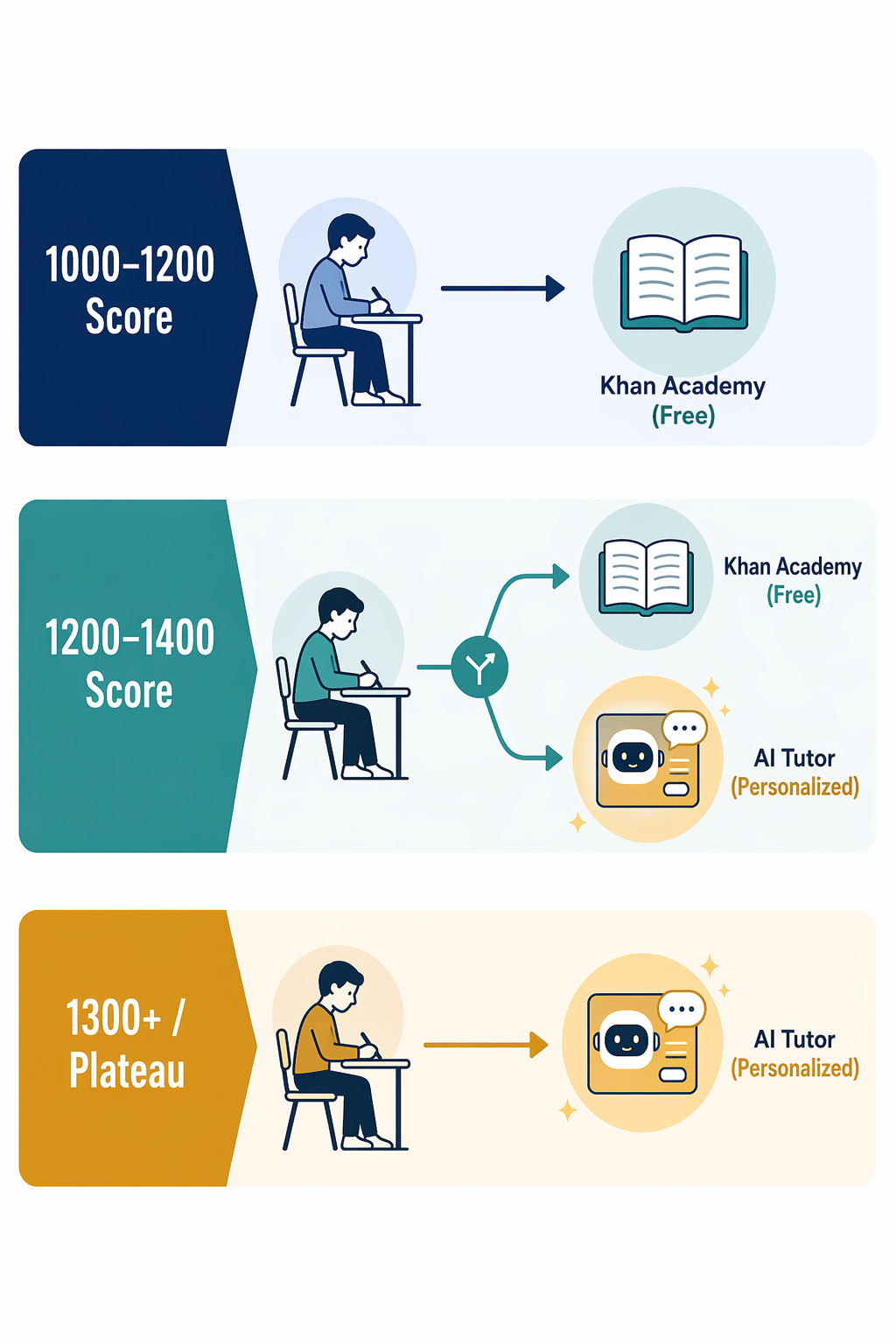
That is the short answer to the Khan Academy vs AI tutor for SAT decision. The longer answer depends on what is actually blocking the score: missing foundations, not enough official-style practice, careless repetition of the same mistake, weak analytics, lack of motivation, or simply running out of useful questions.
The Best First Move Is Usually Khan Academy
Khan Academy has one piece of evidence that still matters: College Board reported in 2017 that students who completed 20 hours of personalized Official SAT Practice on Khan Academy saw an average 115-point score gain, and about 16,000 of roughly 250,000 students gained 200 points or more.[1] That is a concrete, parent-understandable result.
It also needs the caveat right beside it: that finding came from the paper SAT era, not the current Digital SAT. It should not be treated as proof that every student using Khan Academy in 2026 will gain 115 points on the Digital SAT. What it does support is a narrower and still useful conclusion: sustained, personalized practice on Khan Academy has been associated with meaningful SAT gains, and the platform remains a strong no-cost starting point.
The free part matters. Families do not need to pay just to find out whether a student has been skipping linear equations, punctuation rules, or function notation. Khan Academy’s SAT prep can expose those gaps without turning the first month of studying into a subscription decision. For students who need a fuller plan around it, a Digital SAT practice schedule is often more valuable than adding another app immediately.
| Student situation | Most sensible starting point | Why |
|---|---|---|
| Around 1000–1200 | Khan Academy + Bluebook practice | Foundations usually matter more than question-bank size. |
| 1200–1300 and still improving | Stay with Khan Academy, add structure | The student may not have exhausted the free gains yet. |
| 1300+ or plateaued after serious practice | Khan Academy + paid AI tutor | More targeted drilling and analytics may matter. |
| Studying for both SAT and ACT | Consider an AI platform with ACT coverage | Khan Academy SAT prep does not solve ACT prep. |
| Needs direct explanations fast | Compare Khanmigo with explanation-first tools | Socratic guidance and direct worked explanations feel very different. |
Where Khan Academy Can Stall
The problem with free official prep is not that it is weak. The problem is that some students eventually need more than it gives. LearnQ’s comparison says Khan Academy offers about 250+ SAT prep questions, while LearnQ claims 5,000+ questions and Acely claims 9,000 questions.[2][3] Those larger numbers are vendor-reported, so they do not automatically prove better prep. A large bank can include uneven questions, repeated patterns, or AI-generated items that do not match the real test well enough.
Still, question volume becomes a real issue for certain students. A student trying to move from 1040 to 1180 may need clearer instruction and steadier practice. A student trying to move from 1320 to 1450 may need repeated exposure to harder traps, alternate solution paths, and the exact pattern behind missed high-difficulty questions. Those are different jobs.
PrepMaven’s Khan Academy SAT review gives the digital SAT practice a 6/10 and notes that the interface can limit students to four questions per concept before moving them forward.[4] That kind of design may be fine for survey-style review. It is less satisfying when a student has missed the same punctuation question type three times and needs ten more carefully chosen examples before it sticks.
Sharp makes a related argument: Khan Academy can plateau above about 1300 because it emphasizes foundational concepts more than advanced pattern recognition.[5] Since that comes from a competing prep platform, it deserves some caution. But the underlying distinction is familiar to anyone who has watched high-scoring students miss the same “almost right” answer again and again. At that level, knowing the rule is not always enough; the student has to recognize how the test disguises the rule.
Khanmigo Is Cheap, but Its Teaching Style Matters
Khanmigo changes the Khan Academy decision because it adds AI guidance at a very low price: $4 per month or $44 per year, according to Khan Academy’s Khanmigo pricing page.[6] For a family comparing that with private tutoring or a $49-per-month platform, the price is hard to ignore.
The important question is not whether Khanmigo is “better” or “worse” than a paid AI SAT tutor. It is whether its teaching style fits the student. Khanmigo is designed to guide students Socratically rather than simply hand over direct answers. That can be excellent for a student who gives up too quickly, guesses without reasoning, or needs to learn how to think through a problem step by step.
It can also be irritating for a student who is two weeks from test day, already understands the main concept, and just needs to know why answer choice C is wrong. That frustration is not proof that Khanmigo is badly designed. It is a mismatch between a guided teaching style and a test-prep moment that calls for direct correction.
What Paid AI SAT Tutors Actually Add
The best argument for paid AI SAT tutors is not novelty. It is coverage. Platforms such as Acely, LearnQ, Whiz, UWorld, Sharp, and similar tools try to fill the gaps that show up after a student has used the obvious free resources: more questions, more targeted drilling, more explanation styles, more analytics, and in some cases ACT prep in the same system.
Acely describes its AI tutor as purpose-built for SAT and ACT prep and says it stays strictly on topic.[3] That matters for students who are splitting time between tests or who get distracted in general-purpose AI chats. But Acely’s own comparison page is still a vendor source, so its claims should be read as product positioning, not independent proof that it raises scores more than Khan Academy.
UWorld’s value is different. PrepGraph highlights UWorld’s detailed, illustrated answer explanations that show why each answer choice is right or wrong.[2] That style can be especially useful for students who learn by dissecting mistakes. A vague “review grammar” recommendation does not change much; a clear explanation of why the comma splice trap worked this time often does.
Analytics are another reason to pay, but only if the student will use them. A dashboard that says “advanced algebra: weak” is not enough. A useful system should help the student decide what to do next: retry missed quadratic questions, separate conceptual errors from careless errors, revisit a lesson, or move to mixed timed practice. The value is not the chart. It is the next corrected practice block.
| Need | Khan Academy | Khanmigo | Paid AI SAT tutors |
|---|---|---|---|
| Foundations | Strong free starting point | Can guide reasoning step by step | Varies by platform; some focus more on drilling than teaching |
| Official SAT alignment | Best connection to official practice ecosystem | Built on Khan Academy’s learning environment | May be useful, but quality depends on question design |
| Question volume | More limited; LearnQ cites about 250+ questions | Does not by itself solve volume limits | Often much larger, but counts are often self-reported |
| Explanation style | Clear lessons and practice review | Socratic guidance | Often more direct, especially tools built around answer explanations |
| Advanced plateau support | Can be less sufficient for 1300+ targeting | Helpful if the student responds well to guided prompts | Often stronger for repeated weak-spot drilling and analytics |
| ACT coverage | Not a full ACT prep solution | Not the main reason to choose it | Some platforms include SAT and ACT |
| Cost | Free | $4/month or $44/year | Approx. $18–$250/month or course, depending on platform |
Cost Changes the Comparison
Paid AI tutors can look expensive next to Khan Academy because Khan Academy is free. They look different next to private tutoring. PrepGraph and The Hill describe private SAT tutoring as commonly costing about $50–$200 per hour, while larger prep packages can run from about $1,600 to more than $10,000.[2][7] Against that backdrop, an AI tutor is not just an app fee; it is a lower-cost substitute for some of the repetition, explanation, and tracking that families used to buy by the hour.
The mid-2026 price spread is wide. Khan Academy is free, Khanmigo is listed at $4 per month or $44 per year, Sharp Pro is described at $18 per month, Whiz Pro at about $20 per month, LearnQ premium around $20–$30 per month, Acely at $49 per month on an annual plan, and UWorld around $250 per course.[2][3][5][6] Test-prep prices change often, and promotions can make a monthly comparison messy, but the basic pattern is clear: AI prep usually sits far below private tutoring and above free official practice.
That does not mean every family should pay. A student who has not completed a full Bluebook practice test, has not reviewed missed questions carefully, and has not used Khan Academy consistently does not yet know whether the free option is insufficient. Paying before that point can simply add another login to avoid.
What to Use by Score Band
If You Are Around 1000–1200
Use Khan Academy first. At this score level, the biggest gains often come from fixing repeatable foundations: linear equations, functions, percentages, transitions, punctuation, evidence questions, and timing habits. A huge question bank is less important if the student is still missing the lesson underneath the question.
The practical plan is simple: take a Bluebook practice test, study missed skills on Khan Academy, redo similar problems until the error pattern is clear, then take another timed section or full test. If the student needs a complete roadmap, use the site’s broader SAT Exam Prep Guide before shopping for paid tools.
If You Are Around 1200–1300
Do not rush to pay just because the score feels stuck for one week. First check whether the student has actually reviewed mistakes in a way that changes behavior. A student who writes “careless” beside every missed math question has not reviewed; they have labeled the discomfort and moved on.
- Stay with Khan Academy if missed questions still point to clear content gaps.
- Add Khanmigo if the student benefits from being prompted through reasoning instead of being shown the answer immediately.
- Consider a paid AI tutor if the student has completed the obvious Khan Academy practice and needs more targeted repetition.
- Do not pay for analytics unless someone will check them weekly and turn them into assignments.
If You Are Targeting 1300+
This is where the paid AI tutor argument gets stronger. At 1300+, the student may not need another general lesson on commas or systems of equations. They may need harder mixed practice, faster recognition of traps, better review of wrong answer choices, and a system that keeps serving the weak pattern until it is no longer weak.
A paid platform is most defensible here when it gives the student something specific that Khan Academy is no longer giving: a larger pool of high-difficulty questions, direct explanations, ACT coverage, fine-grained analytics, or an easier way to drill one recurring mistake. If the student only wants a sleeker interface, the case is weaker.
If Budget Is the Main Constraint
Use the free official resources without apology. Khan Academy plus Bluebook can carry a serious prep plan, especially when the student has a schedule and reviews mistakes honestly. Khanmigo is the lowest-cost add-on if the student wants AI help but the family does not want to commit to a larger subscription.
If money is available for only one paid month, do not spend it at the beginning. Spend it after the student has a baseline score, a list of recurring weaknesses, and enough Khan Academy work completed to know what is still missing. That makes the paid tool solve a known problem instead of becoming a vague promise.
A Practical Hybrid Plan
The strongest setup for many students is not Khan Academy or an AI tutor. It is Khan Academy and official Bluebook practice for the spine of the plan, plus an AI tutor only where the free system is no longer enough.
- Take a full Bluebook practice test before choosing tools.
- Use Khan Academy to repair the clearest content gaps.
- Track missed questions by reason: concept gap, trap answer, time pressure, or careless execution.
- Add Khanmigo if guided questioning helps the student slow down and reason.
- Add a paid AI tutor if the student needs more volume, more direct explanations, stronger analytics, ACT prep, or a way past a 1300-range plateau.
Families still building the whole system can use a diagnostic-first SAT prep toolkit to decide what belongs in the plan and what is just extra.
That is the cleanest decision: start with Khan Academy and official practice, add Khanmigo only if its Socratic style fits the student, and consider Acely, LearnQ, Whiz, UWorld, Sharp, or a similar AI SAT tutor when the student needs more practice volume, direct answer explanations, deeper analytics, ACT coverage, or a serious push beyond the free-resource plateau.
References
- New Data Links 20 Hours of Personalized Official SAT Practice on Khan Academy to 115-Point Average Score Gains — College Board Newsroom, 2017.
- Best AI SAT Tutor in 2026: An Honest Comparison — PrepGraph.
- Acely vs Khan Academy | SAT & ACT Prep Comparison — Acely.
- Khan Academy Review: Is It The Best SAT Prep Service? — PrepMaven.
- How Sharp compares to other SAT prep platforms — Sharp.
- Khanmigo Alternatives for SAT & ACT Prep (2026) — PrepGraph.
- SAT test prep industry faces sink-or-swim moment with AI — The Hill.
Supporting Resources
- Is Anki Actually Evidence-Based for the MCAT? What the Research Says About Spaced Repetition and Score Improvement →
Skeptical about the time investment Anki requires for MCAT prep? This article examines the peer-reviewed evidence — including a 2023 cohort study showing 6.2–12.9% higher exam scores for Anki users — alongside the valid critiques about the 'Anki trap,' so you can make an informed decision about whether and how to use it.
- MCAT Study Prep Guide: Best Tools, Timelines, and a Phase-by-Phase Plan →
A comprehensive hub for pre-med students planning MCAT preparation — covers how the exam is structured, how to set a realistic study timeline based on your content baseline, and which free and paid tools to use at each phase of prep from content review through full-length simulation.
- How to Build a Daily GRE Vocabulary Flashcard Habit That Actually Works →
A practical guide for GRE test-takers who struggle with consistency. Learn the daily system that 160+ Verbal scorers use: a structured blend of spaced-repetition flashcards, contextual reading, and active recall testing that compounds over 6–8 weeks.
Comments
Join the discussion with an anonymous comment.