

MCAT Study Tools in 2026: Courses, Question Banks, and Flashcard Apps Compared
A practical comparison of the top MCAT prep courses, question banks, and flashcard apps for 2026, with decision frameworks to help you build the right study stack for your budget and score target.
Updated:
The hardest MCAT purchase is rarely the most expensive one. It is the tool that looks comprehensive enough to trust, then quietly leaves a gap: not enough AAMC-style practice, weak review workflow, no spaced repetition, or too much content watching and not enough score-facing work. A useful MCAT study tools comparison in 2026 has to separate the jobs these tools actually do.
A full course, a question bank, AAMC official material, and a flashcard app are not interchangeable. One teaches. One pressures your reasoning. One calibrates you to the exam writer. One keeps biochemistry, psych/soc terms, equations, and missed-question lessons from evaporating three weeks later. The buying decision is not “Which one is best?” It is “Which stack covers the whole prep cycle without wasting my budget?”
Prices also deserve to appear early, because 2026 MCAT prep pricing is not stable. UWorld, Kaplan, Blueprint, and Princeton Review commonly run discounts in the 12–30% range, and the figures in this article should be treated as mid-2026 comparison prices rather than permanent rates. Kaplan full-course options are listed around $1,599–$2,699, UWorld Comprehensive around $1,199–$1,549, Magoosh around $399, and Altius above $3,000 in the available course comparisons.[1][2]
| Tool category | Best at | Weakest at | What to check before paying |
|---|---|---|---|
| Full MCAT course | Structured content learning, schedule support, live or recorded instruction | May not provide enough independent practice volume or the review system you need | Instruction quality, QBank size, full-length exams, accountability, refund or guarantee terms |
| Standalone QBank | High-volume practice, explanations, weak-area diagnosis | Usually not enough by itself for students who lack content foundation | Question style, explanation depth, filtering, analytics, review workflow |
| AAMC official materials | Official exam calibration and AAMC logic | Limited volume compared with commercial QBanks | Whether you are saving enough official material for timed, score-facing practice |
| Flashcard and spaced-repetition app | Retention, missed-question repair, equations, terms, pathways | Does not teach reasoning by itself | Algorithm behavior, card quality, sync cost, ability to edit and tag cards |
| Free resources | Lowering the cost floor, content review, daily CARS exposure | Patchy structure and fewer realistic full-test conditions | Whether the free material fits into a deliberate schedule rather than becoming endless browsing |
Start With the Workflow, Not the Brand List
A workable MCAT stack has to move through five phases: content learning, practice questions, review and explanation work, spaced repetition, and official exam calibration. Students get into trouble when they buy heavily in one phase and assume the rest will take care of itself.
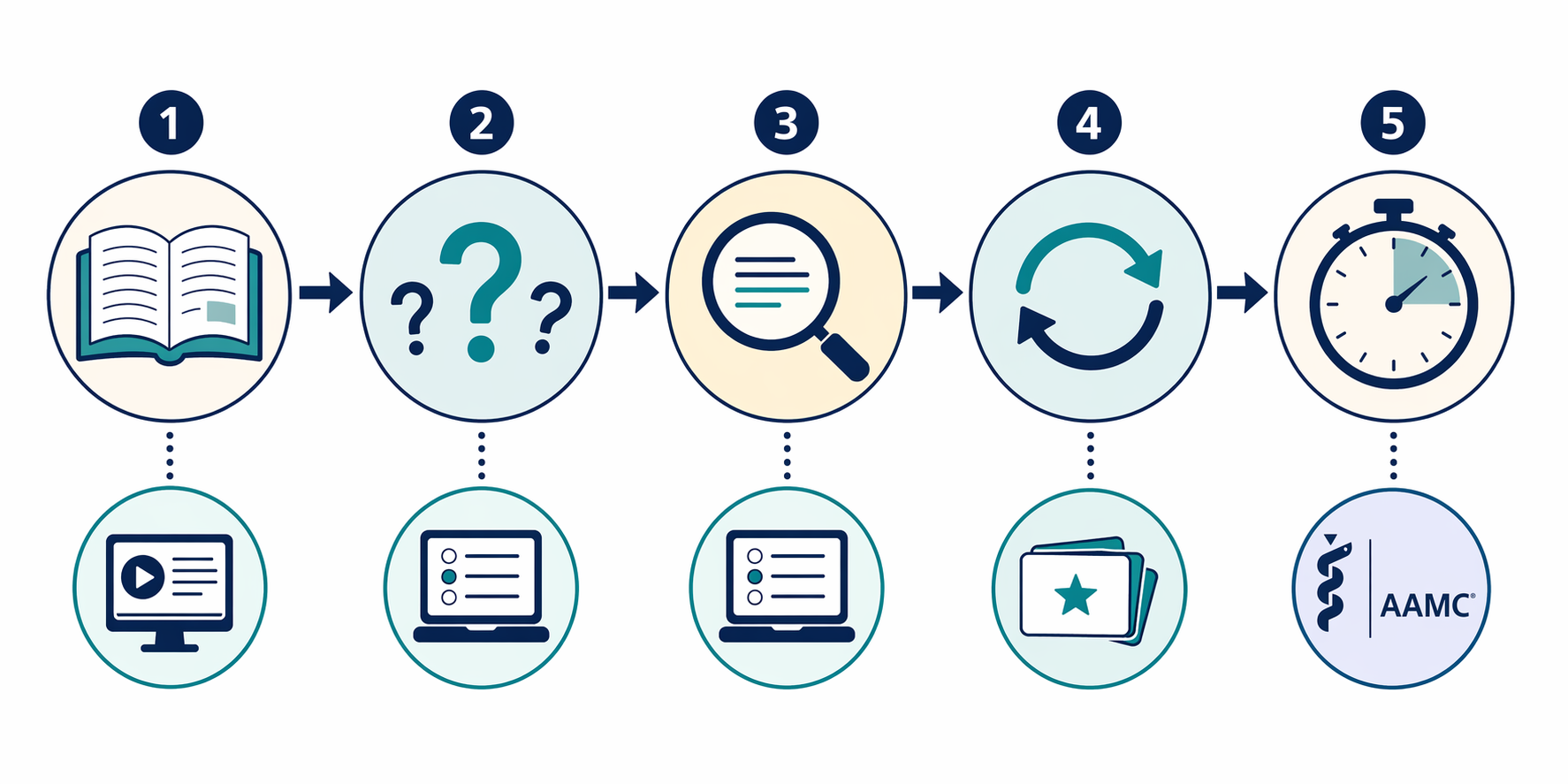
The common bad version looks familiar: a student buys a large course, watches the lessons, feels productive, then discovers in month two that passage timing and AAMC-style answer elimination still feel foreign. The opposite mistake is also common: buying only a brutal QBank while the content foundation is too thin to learn efficiently from misses. Neither mistake means the tool is bad. It means the tool is being asked to do the wrong job.
The stack should answer five plain questions before money changes hands: How will I learn content I genuinely do not know? Where will I get enough hard practice? How will I review missed questions without rereading explanations passively? What system will bring facts back before I forget them? When will I switch from third-party difficulty to official AAMC calibration?
Full Courses: Useful Structure, Uneven Practice Depth
A full MCAT course is easiest to justify when the student needs structure as much as content. If your diagnostic is low because you never built a stable physics or biochem base, or if you know you will drift without a calendar and instructor accountability, a course can be more than polish. It can reduce decision fatigue during the months when you are most likely to waste time deciding what to do next.
That does not make full courses automatic. Paying four figures for instruction does not remove the need for a separate review process, official AAMC material, and usually a serious question bank phase. The course is the spine of the schedule, not proof that every other study tool is optional.
| Provider | Mid-2026 price signal | Notable strengths | Main buying caution |
|---|---|---|---|
| Kaplan | $1,599–$2,699 | Highest course rating in the cited comparison at 9.7/10; praised for live instruction quality and updated 2025 course structure | Includes 3,000+ QBank questions, which is smaller than Blueprint’s 5,000+ in the same comparison |
| UWorld Comprehensive | $1,199–$1,549 | 3,000+ AAMC-style questions, 1,300+ bite-sized videos, 4,000+ prebuilt flashcards, FSRS-based spaced repetition | Looks close to an integrated stack, but students still need to plan official AAMC calibration carefully |
| Magoosh | About $399 | Much lower price; 380+ video lessons and 740+ practice questions | May be better as a budget content platform than as the only serious practice source |
| Altius | $3,000+ | Premium instruction model; self-reported average score of 516 and a 90th-percentile score guarantee | The 516 average is company-reported in the cited course review, not independently verified |
Kaplan is the course that will make the most sense to students who want live instruction and a recognizable, structured path. Test Prep Insight gives Kaplan the highest rating in its reviewed group, 9.7/10, and points to live instruction quality and a refreshed 2025 course structure as major strengths.[1] That matters if you are the kind of student who learns faster when someone else sequences the work and explains hard topics in real time.
The caution is practice volume. Kaplan’s 3,000+ QBank questions are substantial, but the same comparison notes Blueprint at 5,000+ questions.[1] A smaller QBank is not automatically a dealbreaker, especially if explanations and instruction are strong. But if your main need is thousands of difficult passages after content review, do not buy a live course and assume the QBank side is the strongest part of the package.
UWorld Comprehensive is different because it starts to look like a stack inside one product. UWorld lists 3,000+ AAMC-style questions, 1,300+ bite-sized videos, 4,000+ prebuilt flashcards, and FSRS-based spaced repetition in its comprehensive MCAT offering.[2] For a student who wants fewer separate subscriptions and already trusts UWorld explanations, that integration is genuinely attractive.
Still, “integrated” is not the same as “complete for every student.” A student who needs live accountability may not get the same benefit from a video-and-platform model as from a scheduled course. A student who already has strong content and only needs practice may not need the full comprehensive version at all. UWorld’s strength is not that it replaces all judgment; it is that its questions, explanations, videos, and flashcards sit close to the daily work of improving from misses.
Magoosh deserves more respect than it sometimes gets in high-spend prep conversations. At about $399, it is roughly one-fifth the cost of many full courses in the cited comparison, with 380+ video lessons and 740+ practice questions.[1] That is not the same category as a premium live course, and it should not be judged as if it were. For a budget-constrained student who can self-schedule and supplement with AAMC, Anki, and free practice, Magoosh can serve as a lower-cost content layer.
Altius sits at the other end of the decision. Its $3,000+ price and tutoring-style premium positioning are hard to justify unless instruction and accountability are major needs. Test Prep Insight reports Altius’s self-reported average score of 516 and a 90th-percentile score guarantee.[1] Those claims are worth noticing, but they should be read as provider-reported outcomes and guarantee terms, not as neutral proof that paying more causes a 516.
A QBank-Centered Stack Is Not the Cheap Version of a Course
Self-study built around a QBank is often described as the budget route, but that undersells what it actually does. A strong QBank-centered plan can be more direct than a course for students who already know enough content to learn from mistakes. The work is uncomfortable: timed passages, missed questions, explanation review, error logging, targeted content repair, and Anki cards made from the mistakes that keep repeating.
UWorld’s standalone QBank pricing in mid-2026 listings sits around $329–$380 depending on 90-day versus 180-day access.[3] That is much less than a full course, but it is not a full prep plan by itself. It gives practice volume and explanations; you still need content sources for topics you do not understand, AAMC material for official calibration, and a retention system so the same amino acid, optics, endocrine, or psych/soc miss does not come back under a different disguise.
This is where the student’s starting point matters. If you miss a passage because the reasoning was subtle, a good explanation can teach you how the test punished your assumption. If you miss it because you never learned the content, the explanation may become a patch instead of a foundation. A QBank-heavy plan works best when the student can tell the difference and route the miss correctly.
What AAMC Official Material Does That Third-Party Tools Cannot
AAMC material is not just another practice source. It is the closest available view of how the exam writer phrases passages, weights distractors, and makes answers feel tempting. The AAMC Online-Only Bundle is listed at $323.70 and includes seven full-length exams, including the newer Practice Exam 6, plus Section Banks and Question Packs.[3]
AAMC also offers two free full-length exams, the Unscored Sample Test and Practice Exam 1, along with 120 free practice questions.[3] That lowers the entry cost for students who cannot buy everything at once. It does not mean official practice is unlimited. Because AAMC volume is finite, it should be placed deliberately: early enough to correct your direction, late enough that you are not burning official exams while still learning basic content.
A practical split is to use third-party questions for volume and skill-building, then use AAMC material for calibration. If your UWorld percentage rises but AAMC logic still feels strange, that is a signal, not a contradiction. Third-party practice can make you stronger; official material tells you whether that strength is translating into the exam’s language.
Flashcards Matter Most After the Missed Question
Flashcards are easy to treat as a side app: something to do on the bus, a way to feel productive between real study blocks. For the MCAT, their better use is more specific. They turn missed questions into future retrieval. They make you confront the same weakness before the exam does.
Anki remains the default serious option because it is flexible, free on desktop, and built around spaced repetition. Its iOS app is listed at $24.99 as a one-time purchase, while desktop use is free.[7] The FSRS algorithm, added to Anki in late 2023, is cited by MintDeck as reducing unnecessary reviews by about 15%, though the actual effect depends on card load, settings, and memory patterns.[7]
The deck choice is less important than students want it to be, but it is not irrelevant. MileDown has 2,888 free cards and links to Khan Academy videos; Jacksparrow2048 has 5,978 cards; AnKing’s MCAT Hub is listed at $66 per year; and the Abdullah deck is described at 16,000 cards in the available deck comparisons.[5][6] Those numbers should change your expectations. A 16,000-card deck is not “more complete” in a vacuum if it crowds out practice review. A smaller deck is not “too light” if you are actively adding cards from your own misses.
MileDown is popular partly because it grew out of familiar MCAT review materials: the 90-page MCAT Review Sheets and the 300-page Khan Academy psych/soc document.[5] That makes it approachable for broad review. Jacksparrow-style larger decks may fit students who want more detail and can tolerate a heavier daily review load. Paid hubs may be worth it if tagging, updates, and organization save enough time to matter. The trap is downloading a famous deck and never converting your own QBank and AAMC mistakes into cards.
Other apps can work, especially for students who will not maintain Anki. AceNotes’ 2026 app comparison includes MintDeck, Quizlet, Brainscape, and RemNote among MCAT study app options.[8] The question is not whether an app has a clean interface. It is whether it schedules retrieval reliably, lets you edit cards quickly, and fits the way you review missed questions. For a broader app-level comparison, the guide Quizlet vs. Knowt vs. Anki vs. RemNote is the better next stop.
Free Resources Lower the Floor, but They Do Not Remove the Need for a Plan
Free MCAT resources are not filler. For some students, they are the difference between starting now and delaying the exam because the ideal stack is unaffordable. Khan Academy’s MCAT material is available free through 2026 through its AAMC partnership, with 1,100+ videos and 3,000+ review questions.[3] That is a real content base, especially for students rebuilding sciences before heavier practice.
Jack Westin’s free daily CARS passages also have a clear role: they make CARS a daily habit instead of a crisis section saved for the end. That supports daily CARS practice year-round, but it is not a claim that Jack Westin perfectly replicates AAMC CARS or replaces official practice. The distinction matters because CARS improvement depends heavily on timing, passage discipline, and answer-choice logic under official conditions.
A low-cost stack can be legitimate if it is built intentionally: Khan Academy for content, free AAMC exams and questions for early calibration, Jack Westin for CARS rhythm, Anki for retention, and paid AAMC material when the budget allows. What free resources cannot do is automatically sequence your weeks, force review discipline, or create unlimited official-style full-length practice.
Sample MCAT Tool Stacks by Budget and Need
Student Doctor Network’s 3-month MCAT schedule estimates total tool costs from about $310 to $1,170 depending on the stack, while noting that prices are indicative and change periodically.[4] That range is useful because it shows how much the decision changes once you stop asking for one winner and start assembling roles.
| Student situation | Core stack | What this stack protects | What it may lack |
|---|---|---|---|
| Lowest workable budget | Khan Academy, free AAMC exams and questions, Jack Westin CARS, Anki with a free deck | Content access, basic official exposure, daily retention | High-volume paid explanations, more official material, structured accountability |
| Budget self-study with serious practice | AAMC Online-Only Bundle, UWorld QBank, Anki, Khan Academy as needed | Official calibration, hard practice, repeatable missed-question review | Live instruction and external schedule pressure |
| Needs structure but has limited cash | Magoosh, AAMC bundle, Anki, selected free resources | Lower-cost content structure plus official practice | Large QBank volume unless supplemented |
| Wants integrated digital prep | UWorld Comprehensive, AAMC official material, Anki or UWorld flashcards | Questions, videos, flashcards, and review tools in one ecosystem | May still lack live accountability |
| Needs premium instruction and accountability | Kaplan or Altius, AAMC official material, Anki, possible UWorld supplement | Instructor support, structure, schedule pressure | High cost; QBank depth and independent review still need checking |
If You Have Under $500
Do not spend the whole budget on a course just because courses feel official. Start with what must be covered: AAMC exposure, content review, CARS habit, and retention. Khan Academy gives a free content base through 2026, AAMC provides two free full-lengths and 120 free questions, Jack Westin can keep CARS active, and Anki can handle retention if you actually review daily.[3][7]
The first paid upgrade should usually be official AAMC material, not a random pile of extra content. If another $329–$380 becomes available, UWorld’s standalone QBank is the obvious practice-volume upgrade among the tools compared here.[3] This kind of stack is demanding because no instructor is watching your calendar. But it is not unserious. It just puts more burden on scheduling and review discipline.
If You Can Spend Around $700–$1,200
This is where the AAMC plus UWorld plus Anki stack becomes hard to beat for independent students. The AAMC bundle supplies official exams, Section Banks, and Question Packs; UWorld supplies difficult practice with explanations; Anki supplies retention and missed-question repair.[3][7] Khan Academy fills content gaps without adding another paid subscription.
The workflow matters more than the shopping cart. A missed UWorld question should produce one of three actions: reread the explanation and note the reasoning error, review the underlying content if the gap is foundational, or make a targeted flashcard if the fact or rule needs retrieval. A missed AAMC question gets even more respect because it may reveal how the exam writer wants you to think, not just what you forgot.
For a detailed version of that system, use the guide MCAT Study Prep Hub: How to Integrate Anki, UWorld, and AAMC Into One Workflow after choosing the stack.
If You Are Considering a Full Course
Buy the course for the reason it is actually good. Kaplan makes sense if live instruction, structure, and polished course delivery are the missing pieces.[1] UWorld Comprehensive makes sense if you want a more integrated platform with questions, videos, prebuilt flashcards, and FSRS-based repetition.[2] Magoosh makes sense if you need affordable content structure and can supplement practice.[1] Altius makes sense only if premium instruction and accountability are worth a much larger bill to you, with the company-reported outcome claims read cautiously.[1]
Before buying, ask what you will still need to add. Many course students still benefit from AAMC official material, an Anki workflow, and sometimes a separate QBank. If the course already exhausts the budget, look closely at whether its question volume, explanations, and full-length strategy are enough for your target score and timeline.
If Your Target Score Is High and Your Content Is Already Solid
High-score chasing usually shifts the value toward practice quality, error analysis, and official calibration. Social evidence from high-scorer study stacks commonly centers on AAMC material, UWorld, and Anki, but that should be treated as pattern evidence rather than proof that every student should copy the same setup. The pattern is still useful: high scorers tend to spend a lot of time correcting how they think after questions, not just collecting more videos.
At that level, the dangerous purchase is the one that lets you avoid your error log. Another course module may feel safer than reviewing why you keep choosing answers that are too extreme, too content-heavy, or not passage-supported. If your content base is strong, the tool that improves your score is often the one that makes your misses impossible to ignore.
How to Choose Without Pretending There Is One Winner
A simple decision rule works better than ranking every product from best to worst. First, secure AAMC official practice somewhere in the plan. Second, decide whether you need a course for structure and instruction or whether you can learn content through lower-cost resources. Third, choose a serious practice source if your course does not already give enough high-quality questions. Fourth, commit to a spaced-repetition system before your first major QBank block, not after your misses pile up.
- Buy a full course if your biggest risk is lack of structure, weak content foundation, or low accountability.
- Skip the full course and build around AAMC, UWorld, and Anki if you are self-directed and mainly need practice, review, and calibration.
- Use a lower-cost stack if money is tight, but protect official practice and daily review before paying for polish.
- Consider premium instruction only when live teaching, tutoring, or accountability clearly solves a problem you have already identified.
- Treat score guarantees and reported averages as terms to inspect, not outcomes to assume.
The best MCAT study setup in 2026 is not the biggest bundle. It is the stack that covers official practice, high-quality explanations, spaced repetition, and a repeatable review workflow without draining money from the parts you still need.
Once the stack is chosen, the next problem is execution. If Anki is part of the plan, start with How to Use Anki for the MCAT. If you are turning practice misses into cards, use The MCAT Anki Workflow. If your reviews are growing but your score is stuck, check 8 Anki MCAT Mistakes That Keep Your Score in the Low 500s before buying another subscription.
References
- Best MCAT Prep Courses (Top 5 Reviewed & Ranked), Test Prep Insight
- Best MCAT Prep Courses 2026–2027: Ranked & Compared, UWorld
- Prepare for the MCAT Exam; AAMC MCAT Official Prep Updates, AAMC
- 3-Month MCAT Study Schedule (2026–2027 Cycle), Student Doctor Network
- Best MCAT Anki Decks Compared, Elite Medical Prep
- Best Anki MCAT Decks in 2026, StudyRemote
- Best Flashcard App for MCAT Prep in 2026, MintDeck
- Top 12 MCAT Study Apps (2026), AceNotes
Comments
Join the discussion with an anonymous comment.