
Free US High School Exam Revision Timetable Template with Study Hour Guide
Download a free revision timetable template tailored for US high school students preparing for finals, AP exams, and the SAT. Includes research-backed study hour guidelines and step-by-step instructions to build a consistent study schedule.
Available Formats
Access links are provided in the guide below.
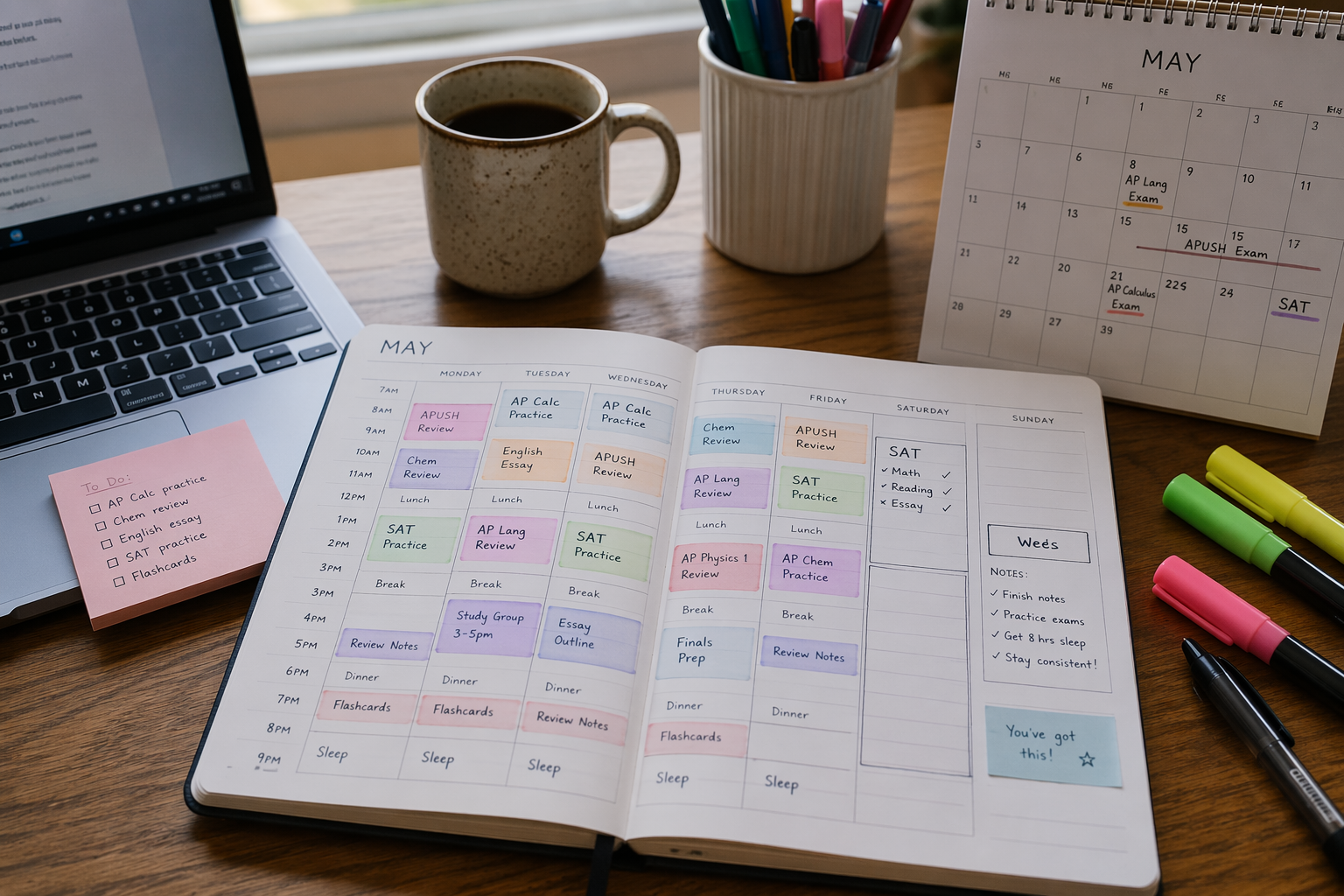
If you searched for a high school exam revision timetable template and keep finding GCSE or A-level planners, this one is built for US finals, AP exams, and the SAT. A useful US revision timetable needs room for semester finals, teacher-made unit tests, AP exam weeks, SAT dates, sports practices, late homework, and the ordinary school nights when a student has about 90 useful minutes left.
The free template comes in Google Sheets and printable PDF formats, with three versions: a weekly revision planner, an exam countdown planner, and a subject-by-topic breakdown sheet. Use the weekly planner when tests are part of normal school life. Use the countdown planner when finals, AP exams, or the SAT are close enough to need backward planning. Use the subject-by-topic sheet when “study biology” is too vague to be useful.
What the Template Includes
The template is not one giant calendar pretending every student has the same problem. It separates the planning jobs that usually get tangled together: deciding when to study, deciding what to study, and deciding how much review is reasonable before an exam.
| Template page | Best for | Use it when |
|---|---|---|
| Weekly revision planner | Regular school weeks | You have quizzes, chapter tests, homework, practices, and a normal class schedule to protect |
| Exam countdown planner | 2-week, 1-month, or 3-month exam windows | Finals, AP exams, or the SAT are close enough that each week needs a job |
| Subject-by-topic breakdown sheet | Turning a course into specific study tasks | You need to move from “study math” to “quadratic functions, trig identities, and calculator-free practice” |
For a short runway, the 2-week countdown version helps triage: weak topics, high-value practice, and the exams arriving first. For a 1-month build-up, the planner can spread topics across four weeks without making every night a cram session. For a 3-month runway, it becomes a steadier routine: weekly review, targeted practice, and occasional full-length or cumulative checks.
If the exam window is exactly 30 days away and you want a narrower plan, the 30-day countdown study planner can work as a companion. This timetable is broader: it gives you the weekly routine, the countdown view, and the topic inventory in one place.
How Many Hours Should a High School Student Schedule?
Parents often ask for a clean number. Students often want one too, because a number feels easier than a judgment call. The research and study-skills guidance available here do not support one universal target. They support a working range that changes with grade level, course difficulty, and how close the exams are.
| Source | What it suggests | How to use it in the timetable |
|---|---|---|
| SchoolHabits | 45–60 minutes per day of focused revision during regular test weeks | A practical baseline for students who need consistency without turning every night into finals week |
| Study Work Grow | 30 minutes to 3 hours, depending on grade level and goals | A wide range that fits the difference between a freshman with one quiz and a junior carrying AP courses |
| Exam Study Expert | A 40,000+ student revision census found 1–2 hours per night as the most common effective range | A useful middle band for many students, especially when several exams are approaching |
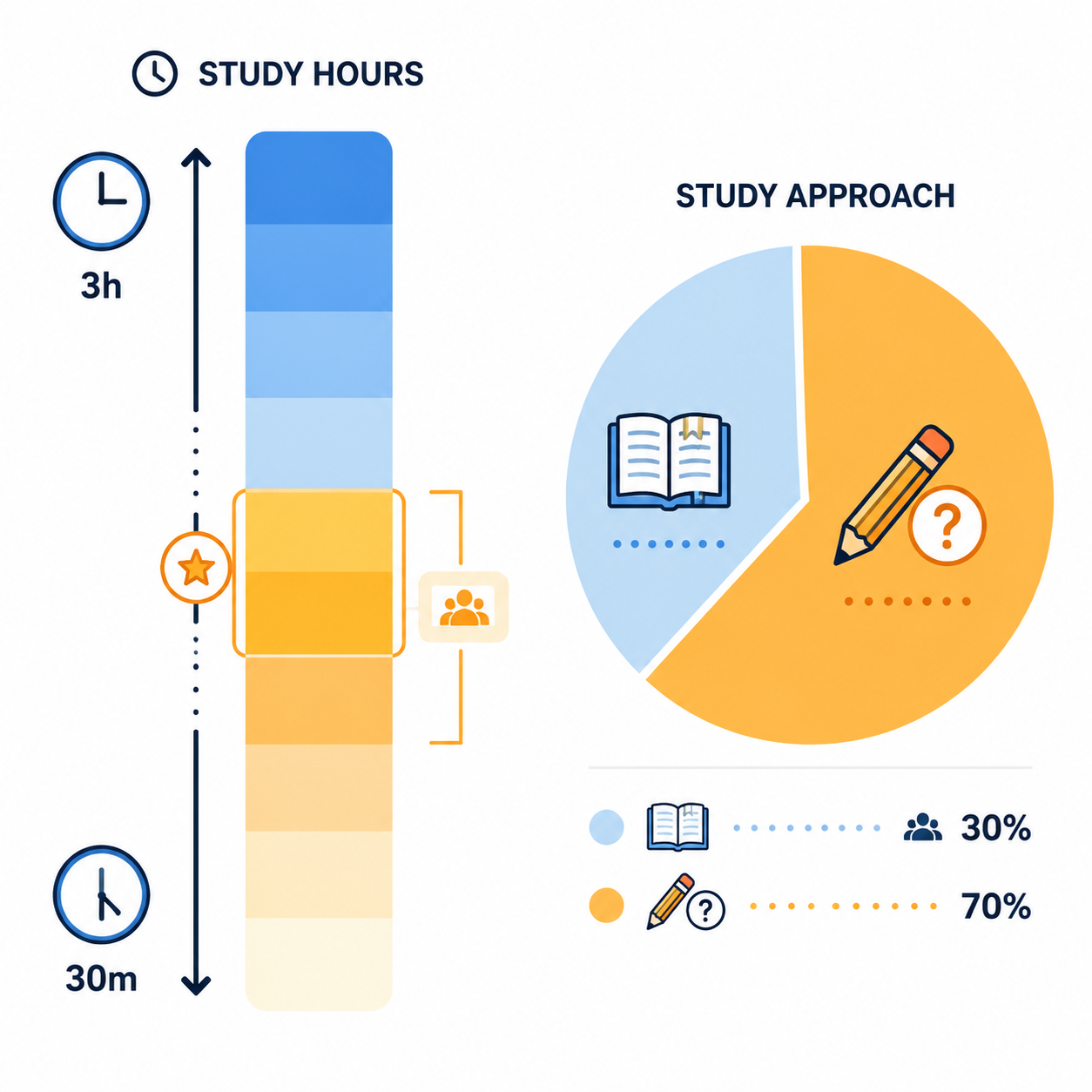
SchoolHabits gives a 45–60 minute daily baseline for focused revision during regular test weeks.[1] Study Work Grow gives a broader 30-minute to 3-hour range by grade level and goals.[2] Exam Study Expert reports that, in its Revision Census of more than 40,000 students, 1–2 hours per night was the most common effective range.[3]
That means the template should not begin with “study three hours every night.” It should begin with the student’s actual exam pressure. A ninth grader with one biology test and regular homework may only need a few focused blocks across the week. A junior with AP U.S. History, precalculus, chemistry, and an SAT date on the calendar needs a different plan. A senior in a lighter final semester may need consistency more than volume.
A realistic starting range
For ordinary test weeks, start with 45–60 minutes of focused revision on school nights, then adjust for homework load. For heavier exam periods, many students land closer to 1–2 hours per night, especially if the time is split across two subjects. For AP-heavy or SAT-plus-finals stretches, some days may reach the upper end of the 30-minute to 3-hour range, but that should be planned around sleep, sports, work, family obligations, and existing assignments.
A good timetable also leaves some nights lighter on purpose. If every box is filled, the first late practice, group project, migraine, or surprise English essay wrecks the plan. Open space is not laziness; it is what keeps the plan usable past Thursday.
Why the Timetable Spreads Work Across Days
The template spreads subjects across multiple days because spacing usually gives students a better chance to remember and use the material. The University of Pittsburgh Study Lab explains that 10 hours of study spread over 5 days is more effective than 10 hours crammed into 2 days.[4] That point matters on a real high school calendar. A student who waits until Sunday night to “do chemistry” may technically log time, but the plan leaves no room to notice what is still confusing.
Spacing also changes the kind of studying a student can do. On day one, they can identify weak topics. On day two, they can practice them. On day three, they can return without the answer key open. That sequence is hard to create when the whole subject is pushed into one long block.
How to Fill In the Revision Timetable
Start with dates, not intentions. A timetable that begins with “study more” usually turns into decoration. A timetable that begins with the actual AP Biology date, the algebra final, the English essay deadline, and the Saturday SAT has a fighting chance.
1. List every exam date first
Put all known exam dates into the countdown planner before assigning a single study block. Include semester finals, midterms, AP exams, SAT dates, unit tests, major papers, and project deadlines. If a teacher has only said “finals week,” write that week in pencil or mark it as tentative until the school posts the exact schedule.
For AP students, the 2026 main AP exam window is listed as May 4–8 and May 11–15 by Save My Exams, citing the College Board.[6] Before building an AP calendar around those dates, verify them directly with the official College Board schedule and your school, especially if late testing or local administration details may apply.
2. Break each class into topics
Use the subject-by-topic sheet before the weekly calendar. This is the step students most often skip, and it is the reason their planners end up with blocks that say “study history” for six nights in a row. That phrase does not tell a tired student what to do at 8:15 p.m.
- For math: list units, problem types, formulas, calculator skills, and teacher-emphasized review topics.
- For science: list chapters, labs, diagrams, equations, vocabulary, and free-response skills.
- For English: list texts, themes, essay formats, quotations, grammar skills, and timed-writing practice.
- For history or social science: list periods, people, causes and effects, documents, maps, and comparison questions.
- For world language: list grammar structures, vocabulary sets, listening practice, speaking prompts, and writing tasks.
The topic sheet should be messy at first. That is fine. Its job is to reveal the actual work hiding behind the course name.
3. Mark weak areas and high-value areas
Next, label each topic. Keep the labels simple: strong, okay, weak, or unknown. Then add a priority mark for topics that are likely to matter more on the exam because the teacher emphasized them, they appear often in practice questions, or they connect to multiple units.
Weak does not automatically mean “spend all night here.” A weak topic that barely appears on the final may need one short repair block. A shaky skill that shows up in every math unit deserves repeated practice. The timetable should reflect both difficulty and exam value.
4. Assign study blocks across the week
Now move to the weekly planner. Place fixed commitments first: school, practice, work shifts, rehearsals, appointments, family obligations, and sleep. Then add homework time. Only after that should revision blocks go into the open spaces.
A workable school-night block is usually specific and limited: “Chemistry: stoichiometry practice problems,” “APUSH: Period 6 short-answer questions,” or “SAT Math: linear equations review.” If a block needs more than one line to explain, it may be too big for one night.
Students who do not yet have a reliable homework routine may need to stabilize that first with a homework tracker in Google Sheets or a weekly assignment planner. Exam revision works better when daily assignments are not constantly ambushing the calendar.
5. Shape each block with the 30/70 rule
The UPenn Weingarten Center recommends spending about 30% of a study session reviewing material and 70% actively practicing through retrieval practice, self-testing, and practice questions.[5] That ratio is one of the easiest ways to make a timetable more useful without adding more hours.
For a 60-minute block, that might mean about 15–20 minutes reviewing notes, formulas, examples, or vocabulary, followed by 40–45 minutes solving problems, answering questions, writing from memory, or checking what can be done without looking. The exact minutes do not need to be perfect. The point is to stop letting the whole session become rereading.
| Study block | Review portion | Active practice portion |
|---|---|---|
| 30 minutes | Quick notes check, formula review, or flashcard warm-up | Practice questions, short self-test, or one timed response |
| 60 minutes | Review examples, missed homework, or teacher guide | Problem set, retrieval practice, free-response work, or essay outline |
| 90 minutes | Review priority topics and error log | Longer mixed practice, timed section, or cumulative exam review |
Using It for Finals, AP Exams, and the SAT
Finals week usually creates a pile-up problem. Several classes end at once, and the student cannot give every subject the same amount of attention. In the countdown planner, put the earliest final and the hardest final where they are impossible to miss. Then give each course a few topic-level blocks before its exam date, rather than waiting for the night before.
AP exams need a slightly longer runway because the course exam may not line up neatly with the school’s own final calendar. The revision timetable can handle the day-to-day work, while a longer 16-week AP study plan can help with the full arc of AP preparation. The practical issue is overlap: AP review, class homework, spring sports, prom season, and final projects often occupy the same weeks.
SAT prep belongs on the same calendar, not in a separate mental folder. If the SAT is on a weekend, the week before should not be packed with brand-new material every night. It should include targeted practice, review of missed question types, and enough space that the student is not exhausted before Saturday morning.
Google Sheets or Printable PDF?
Choose the format the student will actually touch. Google Sheets is better for students who need to move blocks around, color-code subjects, duplicate weeks, or share the plan with a parent, tutor, or teacher. Printable PDF is better for students who focus more easily on paper, want the plan visible on a desk, or get distracted when every planning session starts on a device.
There is no prize for using both. If choosing between paper and digital is already becoming its own project, use this paper planner vs. digital app comparison once, make the choice, and move on. A simple spreadsheet used for two weeks beats a beautiful system abandoned after one Sunday setup session.
A Two-Week Test Before You Change the System
Template collecting can feel productive, especially when exams are close. It is not the same as studying. Pick one format, fill it in honestly, and use it for two school weeks before redesigning it. During those two weeks, pay attention to where the plan breaks: too many blocks, vague topics, no catch-up space, sessions that are all review and no practice, or study times that collide with real life.
After two weeks, adjust the template rather than starting over. Shorten blocks that keep getting skipped. Add more active practice if the student is rereading but still missing questions. Move demanding subjects away from the worst energy points of the week. Keep the parts that survived ordinary school friction.
A successful revision timetable is not a perfect calendar. It is a plan that fits US exam structures, uses realistic study-hour ranges, spreads work across days, and tells a tired student exactly what to do next.
References
- How Long Should High School Students Study? — SchoolHabits
- How Much Should I Study in High School? — Study Work Grow
- How Many Hours Should You Study a Day? — Exam Study Expert
- The Seven-Day Test Prep Plan — University of Pittsburgh Study Lab
- How to Create a Finals Week Study Plan — UPenn Weingarten Center
- How to Make an AP Study Schedule That Works — Save My Exams
Related Guides & Templates
- How to Build a Weekly Study Schedule That Actually Sticks (Evidence-Based Guide) →
Most study schedule templates fail within a week. This evidence-based guide walks you through the foundational steps — auditing your real week, mapping subjects to energy windows, and building in buffer time — so your schedule works with your brain, not against it. Includes a free downloadable template.
- Why Most Homework Trackers Fail for ADHD Students — and What Actually Works →
Traditional homework trackers often fail students with ADHD within weeks because they rely on the executive functions that ADHD impairs. This article explains the five specific failure points, why standard systems break down, and what an ADHD-friendly tracker actually needs to work.
- Best Online Assignment Planner Tools Compared — Which Student Planner App Actually Works? →
A head-to-head comparison of the top online assignment planners for high school and college students. We compare MyStudyLife, myHomework, Power Planner, Google Calendar, and Notion across features, pricing, and best-fit student profiles to help you choose the right tool for your semester.
Comments
Join the discussion with an anonymous comment.