
SAT
Searching 'sat prep near me'? Learn how to choose the right SAT prep format in 2026 by matching your budget, learning style, and goals — not just geography.
Updated:
The family who searches sat prep near me is usually not asking for a map. They are asking for a safer decision: someone reputable, a plan that does not waste the next three months, and a price that will not quietly double after the first consultation.
Nearby can still matter. Some students do better when a real person expects them in a room at 4 p.m. Some families have unreliable internet or a student who will not engage through a screen. But in 2026, location is a weak first filter for SAT prep. The digital SAT is shorter, adaptive, and taken in Bluebook; a strong online program may now look more like the real test than a local class still handing out paper packets.
So the better first question is not “Who is closest?” It is “Which format gives this student the right mix of digital practice, accountability, cost control, and score-growth support?” Once that answer is clear, local search becomes useful instead of panicked.
The Price Spread Is Too Wide for ZIP Code to Decide
SAT prep pricing in 2026 is not one market. It is several markets stacked on top of each other: free practice, subscription-style self-paced courses, live online classes, local group classes, boutique tutoring, and high-end in-home tutoring. Private Prep’s 2026 pricing guide puts SAT tutoring broadly at $45 to $500+ per hour depending on tutor tier, with online tutoring often 10% to 25% cheaper than in-home support.[1]
Geography adds another layer. Private Prep’s 2026 data lists New York City at about $50 to $300+ per hour, Los Angeles at $45 to $250+ per hour, Dallas at $45 to $200+ per hour, and Minneapolis at $40 to $150+ per hour.[1] That does not mean a New York tutor is automatically better than a Minneapolis tutor. It means rent, local demand, and household income can show up inside the hourly rate.
| Prep format | Typical 2026 price snapshot | What the price usually buys |
|---|---|---|
| Free or low-cost self-paced | $0 to about $500 | Practice problems, videos, explanations, study plans, limited human accountability |
| Commercial self-paced course | Examples in 2026 include Magoosh at $129, PrepScholar around $397-$495, and Kaplan self-paced at $799 | Structured curriculum, digital lessons, score dashboards, sometimes guarantees or support |
| Live online class | Commonly around $600-$2,000; examples include Kaplan at $799 for 18 hours, Princeton Review at $949 for 18 hours, and Prep Expert at $1,199 for 36 hours | Scheduled instruction, peer pacing, online practice, some instructor access |
| In-person class | Often about $700-$1,800 | Scheduled local sessions, classroom accountability, quality that depends heavily on center and instructor |
| Private tutoring | $45-$500+ per hour; full programs can run from hundreds to $10,000+ | Individual diagnosis, customized pacing, high accountability, potentially high cost |
That table is not meant to crown a winner. It is meant to slow down the assumption that the closest option is the safest option. A family could spend less than $500 and get enough structure for a self-directed student, or spend several thousand dollars on a local tutor who never gives a digital diagnostic. Both can happen.
The Digital SAT Changed What “Good Prep” Looks Like
The SAT is no longer a long paper test that students can simulate well enough with a thick workbook and a kitchen timer. The 2026 digital SAT runs 2 hours and 14 minutes, uses adaptive modules within sections, and is delivered in Bluebook with Desmos available for math.[4] Those details should shape how families judge prep.
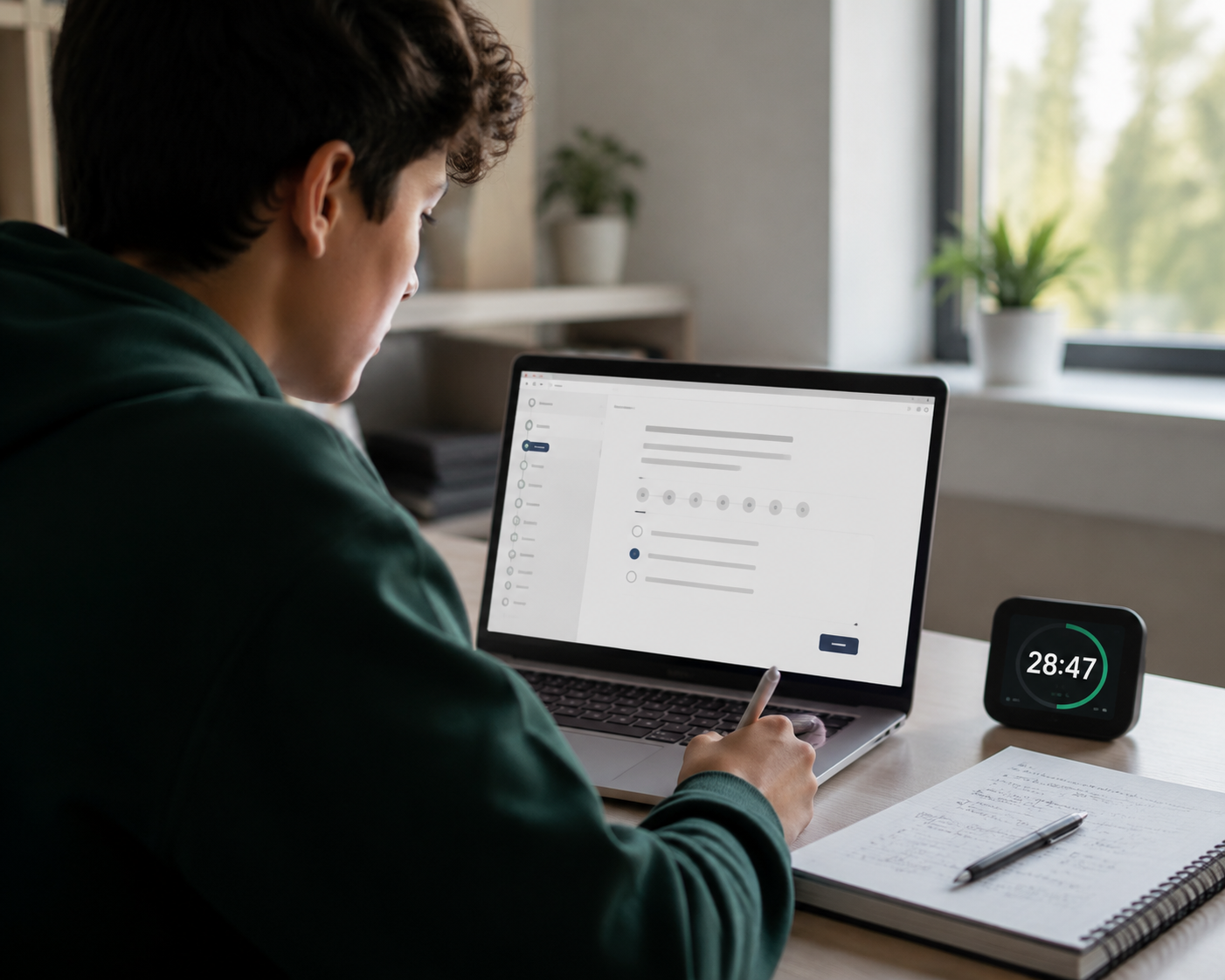
A student does not only need to know comma rules, linear equations, and reading strategy. The student needs to know what it feels like when Module 2 changes after Module 1. They need to practice moving through a shorter, denser test without treating it like the old SAT. They need to use Desmos as a decision tool, not as a panic button. They need to know Bluebook’s rhythm well enough that test-day energy goes toward the questions, not the interface.
This is where online prep deserves a fairer hearing than it used to get. A live online class or self-paced digital course is not automatically a compromise if it puts the student in a test-like environment, tracks performance by question type, and assigns practice inside a digital setting. By contrast, an in-person class can feel reassuring while still being poorly matched to the actual exam if its practice is mostly printed worksheets.
For families already comparing tools, the broader SAT exam prep guide can help organize section strategy and study resources. Students who are specifically struggling with digital-test execution may also need targeted work on Bluebook practice mistakes, Desmos strategy, or adaptive Module 2 decisions.
Match the Prep Format to the Student, Not the Search Results
A defensible SAT prep decision usually comes down to five factors: budget, learning style, timeline, baseline score, and target score. The format should follow those facts.
- Budget: Decide the ceiling before consultation calls. Otherwise, every option can be made to sound necessary.
- Learning style: Separate “needs help” from “needs a person physically present.” Those are not always the same problem.
- Timeline: A student testing in four weeks needs triage; a student testing in four months can build skill and stamina more gradually.
- Baseline score: A diagnostic score should come before package selection, not after payment.
- Target score: A modest score lift and a highly selective-college target may require very different levels of intensity.
Score-gain claims can help families calibrate ambition, but they should not be treated as promises. Industry-facing materials commonly describe dedicated prep gains around 140 to 150+ points, while commercial guarantees include PrepScholar’s 160-point guarantee and Magoosh’s 100-point guarantee for students at 1350 or below.[2][5] Those figures are useful as expectation-setting, not proof that a particular student will gain that amount from a particular tutor.
When in-person tutoring or classes make sense
Local prep earns its price when the physical appointment solves a real problem. If the student avoids independent work, shuts down in large online sessions, needs a relationship with one adult, or has a home environment that makes focused study hard, “near me” is not a silly filter. It is part of the intervention.
The expensive version of local prep is easiest to justify when there is a large gap between the baseline and target score, the timeline is short, or the student has uneven skills that a generic class will not catch quickly. A strong tutor can look at a diagnostic and say, for example, that the student is losing math points not because algebra is weak across the board, but because they are choosing slow methods on questions where Desmos would be faster. That kind of diagnosis can be worth paying for.
But families overpay for local prep when they buy proximity without evidence. A familiar storefront does not guarantee a digital SAT curriculum. A pleasant tutor does not guarantee adaptive-test expertise. A small group class can still move at the wrong pace for nearly everyone in the room.
If in-person prep is clearly the right fit, use a local search strategy after the format decision, not before it. This guide to finding SAT prep classes near you is the better next step once the family has decided that face-to-face accountability is worth prioritizing.
When live online prep is the better middle ground
Live online prep is often the most practical compromise: scheduled enough to create accountability, digital enough to match the test environment, and usually less expensive than in-home tutoring. Private Prep’s pricing guide notes that online tutoring is often 10% to 25% cheaper than in-home tutoring, and course comparisons show many live online classes clustered well below the cost of extensive private tutoring.[1][2]
This format fits students who will show up when a class is scheduled but do not need a tutor sitting beside them. It also works for families outside major metro areas, where the best local option may be whoever happens to be within driving distance. C2 Education notes that major providers such as Kaplan and Princeton Review have shifted primarily online, while in-person options are often limited to select major cities and local-center curriculum quality can vary widely.[6]
The risk is passivity. A student can attend a live online class, keep the camera off, and quietly do very little. Before paying, ask how the instructor checks homework, whether practice happens in a digital SAT-like setting, how missed classes are handled, and whether parents receive progress information that is more specific than “doing fine.”

When self-paced or free prep is enough
Self-paced prep is not the consolation prize. For a student who is organized, honest about mistakes, and already close to the target score, free or low-cost tools may be the rational choice. The money saved can go toward official test fees, college application costs, or a short burst of tutoring later if the diagnostic data shows a stubborn problem.
This format works best when the student has a written schedule, uses full-length digital practice at planned intervals, reviews missed questions, and knows when to change tactics. A student who simply watches videos and hopes familiarity turns into points is not really preparing. They are consuming prep content.
Families choosing this route should be honest about accountability. If the student has needed reminders for every major school deadline, a self-paced SAT plan may fail for behavioral reasons even if the curriculum is solid. For families comparing no-cost practice with paid adaptive support, the Khan Academy vs. AI SAT tutors comparison can help clarify what the student actually gains by paying.
A Simple Decision Framework Before You Pay
The easiest way to avoid the wrong purchase is to make the first decision without provider names. Start with the student profile, then choose the format, then compare specific programs or tutors.
| Student situation | Most likely fit | Why |
|---|---|---|
| Self-directed student, modest score goal, several months available | Free or low-cost self-paced prep | The student can convert structure into action without much outside pressure |
| Motivated student who needs schedule and instruction, but not one-on-one support | Live online class | The family gets accountability and digital practice without private-tutor pricing |
| Student avoids work unless someone is expecting them | In-person class or recurring live tutoring | The appointment itself is part of the solution |
| Large baseline-to-target gap or uneven diagnostic profile | Private tutoring, online or local | The student needs diagnosis, prioritization, and faster feedback |
| Unreliable internet or distracting home environment | In-person prep | The physical setting may remove obstacles that online prep cannot fix |
| High target score with limited time | Targeted private tutoring plus digital practice | The plan needs to focus only on the highest-value score opportunities |
Notice that “local” appears only when it solves a specific problem. It is not a default mark of quality. A student with a 90-day runway, a realistic target, and good study habits may be better served by a structured digital plan than by driving across town twice a week. A student with the same score goal but no follow-through may need the drive.
Once the format is chosen, build the calendar. A program does not become effective because it has a polished dashboard or a cheerful tutor; it becomes effective when practice, review, and retesting happen on schedule. Families who need a concrete timeline after selecting a format can use a 90-day digital SAT practice schedule to turn the purchase into weekly work.
How to Vet a Local SAT Tutor or Class
If the student truly needs in-person support, the vetting call matters more than the driving distance. Tutoring guides from Northside Tutoring and Amikka Learning both emphasize asking about diagnostics, digital SAT expertise, average score improvements, and warning signs such as vague guarantees or generic curriculum.[7][8]
- Ask what diagnostic test they use before building the plan. A tutor who starts with a package before seeing a baseline score is guessing.
- Ask how their curriculum reflects the digital SAT, including adaptive modules, Bluebook-style practice, and Desmos use.
- Ask what score-improvement data they track and how they define it. Average gains are less useful if they exclude students who dropped out or started very high.
- Ask who teaches the sessions. A center’s reputation may not tell you much about the specific instructor your student will see.
- Ask whether there is a trial session, short initial package, or off-ramp before committing to a large bundle.
- Be cautious with vague guarantees, one-size-fits-all lessons, pressure to buy immediately, or confidence that is not tied to diagnostic evidence.
One more question is worth asking directly: “How will you turn this baseline score into this target score?” A good answer does not need to be flashy. It should name the highest-value skill gaps, the practice format, the review routine, and the checkpoints when the plan will change.
What Families Tend to Overpay For
The first overpayment is buying hours before buying diagnosis. A 30-hour package can be reasonable for one student and excessive for another. Without a baseline score and a target, the family is not evaluating a plan; it is evaluating confidence.
The second is paying a local premium for ordinary curriculum. If the tutor’s main material is the same generic problem set a student could access online, the added value has to come from diagnosis, pacing, feedback, and accountability. If those are weak, proximity is doing too much of the sales work.
The third is confusing a score guarantee with a score plan. Guarantees can be reassuring, but they often depend on eligibility rules, homework completion, attendance, and retake conditions. The more useful question is how the program responds when practice scores do not move after the first few weeks.
The fourth is choosing the most intensive format because the parent is anxious. Anxiety is understandable; junior year compresses testing, grades, activities, and college lists into one household calendar. But the most expensive option is not automatically the most respectful one. A student who can thrive with a structured online class does not need a boutique tutor simply because the stakes feel high.
So, Does SAT Prep Near Me Matter?
It matters when location solves a real constraint: the student needs face-to-face accountability, the home setup makes online learning unreliable, internet access is a problem, or a specific local tutor has proven fit with this student’s needs. In those cases, local prep is not old-fashioned. It is practical.
It matters much less when the family is using geography as a shortcut for trust. The digital SAT rewards practice in the digital environment, careful review, and a plan tied to the student’s baseline and target. Those can come from a local tutor, a live online class, or a self-paced program. The format should earn its place.
If the search started with “sat prep near me,” the next step is to pause before calling the closest center. Set the budget ceiling, get a diagnostic, name the target score, decide how much accountability the student actually needs, and then choose the format. Nearby is useful only after the real problem has been identified.
References
- How Much Does SAT Tutoring Cost? 2026 Pricing Guide, Private Prep
- Best SAT Prep Courses (Reviewed & Ranked), Test Prep Insight
- 12 Best SAT Prep Courses for 2026, PrepMaven
- Digital SAT Changes: What Families Need to Know in 2026, Test Prep Scout
- Average SAT Test Prep Cost: 2026 Data, Private Prep
- Should You Prepare for the SAT In-Person or Online?, C2 Education
- How to Find the Right SAT Tutor Near Me, Northside Tutoring
- SAT Tutoring Near Me: How to Find the Right Tutor in 2026, Amikka Learning
Supporting Resources
- Are SAT Prep Classes Worth the Cost? →
This article compares score improvement data from free resources like Khan Academy with paid SAT prep programs to help students and parents decide when the investment makes sense based on starting scores, goals, and budget.
- GRE Prep by the Numbers: Cost, Time & Score Data to Build Your Personal Prep Plan →
Break down GRE prep with hard numbers: costs from free to premium, required study hours per score band, score improvement guarantees, practice test benchmarks, and cost-per-point analysis. Make an informed, math-backed decision on your prep path.
- How to Use SAT English Practice Tests to Boost Your Score →
A practical guide to the digital SAT Reading & Writing section — covering the adaptive format, the best official and third-party practice resources, and a structured review method that turns practice tests into real score improvements.
Comments
Join the discussion with an anonymous comment.