
GRE Exam Hub
A Study Guide for Climate Change and Wildfires on Every Exam
This guide maps how major standardized tests (GRE, SAT, ACT, MCAT, AP Environmental Science) cover the climate–wildfire connection, providing verified facts and exam-specific passage strategies so you study the right material for your test.
- gre
- mcat
- asvab
- sat
- act
- digital-adaptive
- official-material
- section-strategy
- test-date-timeline
If you searched for a climate change and wildfires study guide, the problem is probably not that you need another long climate explainer. You need to know which parts of the science survive contact with a timed exam. This guide is scoped to GRE verbal and AWA, SAT reading-style evidence questions, ACT Science, MCAT CARS, and adjacent AP Environmental Science free-response work. It is not meaningfully an ASVAB topic.
The efficient path is one verified fact core, then exam-specific practice. ETS has an official GRE diagnostic reading passage built around fossil-fuel carbon dioxide and carbon sequestration, which is a useful reminder that environmental science usually enters the GRE as passage reasoning rather than recall.[1] College Board’s 2024 AP Environmental Science Set 2 materials include a free-response item asking students to explain how prescribed burning can reduce the severity and spread of forest fires.[2] ACT Science preparation is framed around reading variables, tables, and graphs under time pressure, not memorizing a documentary’s worth of background.[3]

The fact core worth carrying into the test room
A strong exam answer does not start with “climate change causes wildfires” as a loose slogan. It starts with mechanism. Fires need heat, oxygen, and fuel; once a fire exists, its behavior is shaped by fuels, weather, and topography. The National Park Service identifies fuel moisture as the most important fuel characteristic because dry fuel ignites and burns more readily.[4]
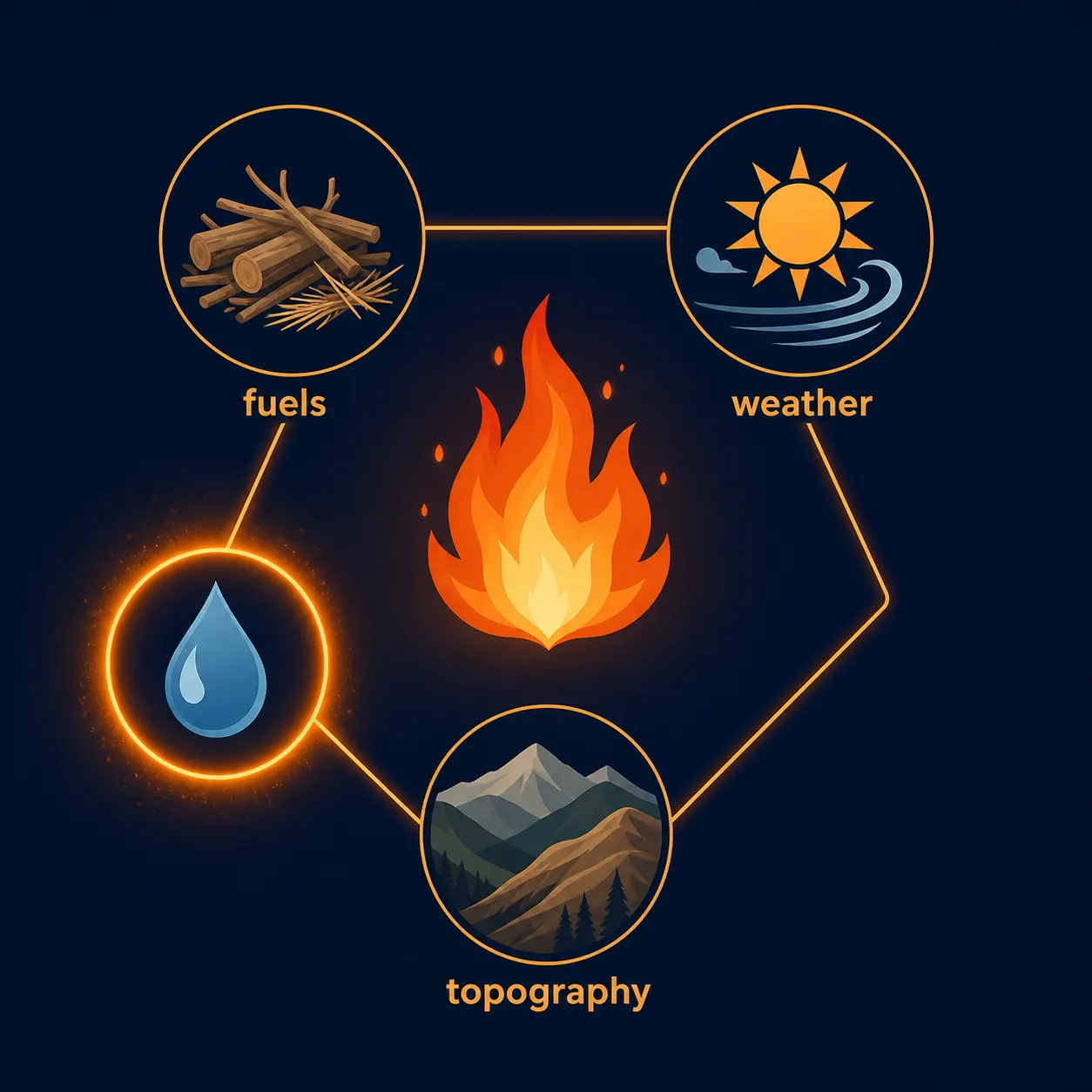
That mechanism is what lets you read an unfamiliar passage or graph without panicking. If a prompt mentions drought, wind, high temperature, or a “thirstier” atmosphere, translate it into fuel moisture and fire weather. If a graph gives a fire-weather index, do not treat it as a mysterious climate score. ClimateData.ca describes the Canadian Fire Weather Index system as six linked components: FFMC, DMC, DC, BUI, ISI, and FWI.[5] On an exam, those abbreviations matter less as vocabulary to recite than as variables to track.
The climate connection is narrower and more useful than the slogan version. NASA describes climate change as contributing to hotter temperatures, drought, lower fuel moisture, and conditions that can make some fires larger or more intense.[6] NOAA similarly emphasizes the wildfire-climate connection through hotter, drier conditions and reports that fire seasons in parts of the western United States are more than a month longer than they were 35 years ago.[7]
Keep ignition separate from fire weather. C2ES reports that more than 80% of U.S. wildfires are caused by people.[8] That does not cancel the climate signal. It means a good answer distinguishes who or what starts a fire from the conditions that affect how readily fuels burn and how severe the fire can become.
Dated statistics you can actually use
Memorize only a small set of numbers, and carry their scope labels with them. The mistake that costs points is not forgetting a dramatic statistic; it is using a statistic outside its domain.
| Fact | Exam-safe use | Scope label |
|---|---|---|
| A 2016 PNAS attribution study found that human-caused climate change doubled cumulative western U.S. forest fire area since 1984 and drove more than half of the fuel-aridity increase since the 1970s.[9] | Use as evidence that climate can affect fire-conducive conditions, especially fuel aridity. | Western U.S. forests; attribution study; dated 2016. |
| A 2025 Nature Communications study found that 1-in-15-year fire-weather extremes were 88% to 152% more likely under contemporary 2011–2040 climate than under quasi-preindustrial 1851–1900 climate across forested ecoregions.[10] | Use when a passage asks about changing probability of extreme fire weather. | Forested ecoregions only; do not generalize to all landscapes or global burned area. |
| World Weather Attribution’s January 2025 Los Angeles analysis estimated that climate change made the wildfire disaster about 35% more likely, about 6% more intense, and lengthened the dry season by about 23 days.[11] | Use as a case-specific attribution example with uncertainty and location attached. | Highly exposed Los Angeles area; January 2025 event analysis. |
| NASA measured about 640 million metric tons of carbon from Canada’s 2023 fires.[6] | Use for emissions passages, especially when a question links fire, carbon, and feedbacks. | Canada’s 2023 fire season; carbon emissions. |
| The WCRP State of Wildfires 2024–25 report put 2024–25 fire emissions at 2.2 Pg C, 9% above average despite below-average burned area.[12] | Use to avoid assuming burned area and emissions always move together. | 2024–25 global fire-emissions reporting. |
| UNEP projected that extreme fires could increase by up to 14% by 2030, 30% by 2050, and 50% by 2100, and described a Fire Ready Formula that puts about two-thirds of spending into planning, prevention, preparedness, and recovery, with one-third for response.[13] | Use for policy or preparedness prompts, not as proof about every individual fire. | UNEP 2022 projection and policy framing. |
| NASA notes a counterintuitive global pattern: burned area has declined in some shrublands, grasslands, and savannas while forest burned area and emissions have risen.[6] | Use to answer graph or passage questions that separate land-cover types. | Do not flatten global burned-area trends into one simple climate story. |
How the same wildfire material changes by exam
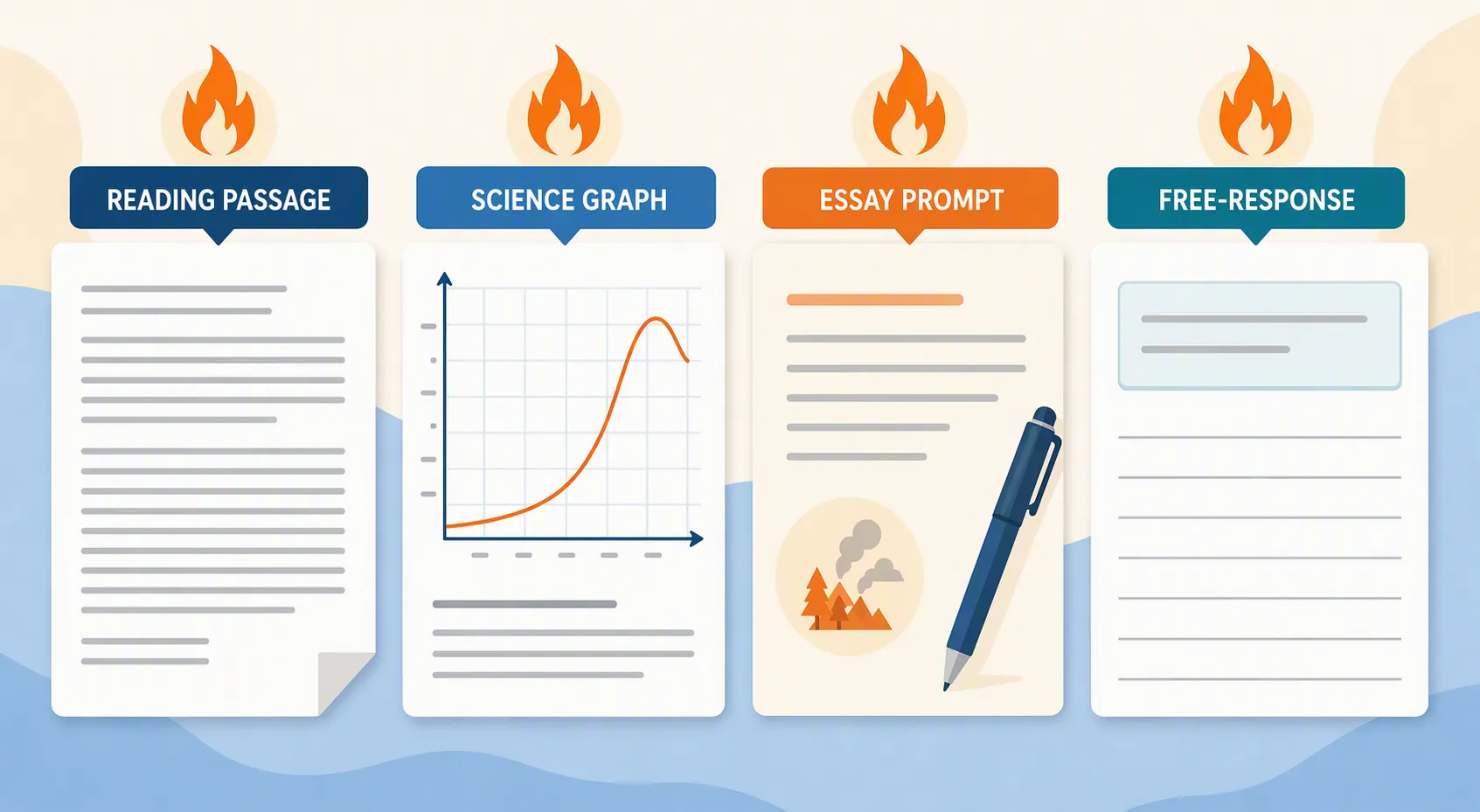
GRE verbal, SAT reading, and MCAT CARS: read the argument, not the topic
On reading-heavy exams, the topic is bait only if you treat it like a content quiz. A GRE passage about carbon sequestration may ask what the author implies, which claim a paragraph supports, or why a qualification appears where it does.[1] A wildfire passage can do the same with fuel moisture, Indigenous burning practices, satellite emissions estimates, or attribution models.
For GRE and SAT-style reading, mark three things as you read: the main causal claim, the evidence offered for it, and the author’s limitation. A passage might argue that warming increases fire weather in forested ecoregions while also saying the same result should not be transferred to non-forested landscapes. The correct answer will often preserve that boundary.
MCAT CARS is even stricter about not importing outside science. If the passage says a community reduced fuel loads through prescribed burning, use that claim only as far as the passage supports it. Do not add a lecture about carbon feedbacks unless the author made that move. For more practice with that kind of passage discipline, the same habit appears in the Lake Erie whitefish MCAT case study.
A useful reading drill is to take one verified wildfire statistic and write two sentences: one that states it correctly, and one that overgeneralizes it. For example, “climate change increased 1-in-15-year fire-weather extremes across forested ecoregions” stays inside the cited scope; “climate change increased all global fire activity by the same amount” does not. That is exactly the distinction many evidence questions are built to test.
ACT Science: treat wildfire as a variables problem
ACT Science is the least interested in whether you can narrate a wildfire documentary. It rewards fast interpretation of variables, axes, units, and relationships. If a table lists fuel moisture, wind speed, temperature, and an index value, your job is to see what changes together and what stays controlled.
A hypothetical ACT-style graph might show fuel moisture decreasing across several days while a fire-weather index rises. You do not need to know the full Canadian Fire Weather Index system to answer the likely question. You need to notice that lower fuel moisture is associated with more fire-conducive conditions in the data shown, then choose the answer that matches the graph rather than the answer that sounds most dramatic.
Watch for three ACT traps: switching from temperature to drought without evidence, confusing ignition frequency with fire spread, and treating a regional dataset as global. The wildfire topic is a good match for ACT Science because it naturally produces tables of weather, fuels, and indices. For a non-wildfire version of the same graph-reading skill, use the Curiosity rover polygons ACT Science practice guide.
AP Environmental Science and GRE AWA: turn evidence into a causal answer
AP Environmental Science is where the wildfire content most visibly becomes an answer you have to produce. The 2024 APES Set 2 scoring materials include an item asking students to describe how a prescribed burn would reduce forest-fire severity and spread.[2] A concise answer should connect prescribed burning to reduced fuel load: burning some leaf litter, dead wood, or underbrush under controlled conditions can leave less readily available fuel for a later wildfire.
Do not write that prescribed burning “stops” wildfires. That is too absolute. It is safer to say it can reduce available fuel and therefore reduce potential intensity, severity, or rate of spread under certain conditions. The National Weather Service glossary is useful for functional vocabulary here: red flag warning, prescribed fire, crown fire, spotting, firebrands, and wildland-urban interface are terms that often help decode prompts and answer choices.[14]
GRE AWA uses the same evidence differently. You are not trying to prove that you know wildfire science. You are trying to support a claim with bounded evidence. If an issue essay asks about government responsibility, climate adaptation, or risk management, the UNEP prevention-versus-response framing can help, but only if you attach the date and avoid treating it as a universal budget law. For more on using evidence without letting it take over the essay, see the Colin Gray 180-year sentence GRE case study.
What to memorize lightly, verify carefully, and practice by exam
Do not build a giant wildfire notebook. Build one source-labeled fact card and then spend most of your time in the question format your exam rewards.
- Memorize lightly: fire triangle; fire behavior triangle; fuel moisture; drought; aridity; fire weather; prescribed burn; red flag warning; wildland-urban interface.
- Verify carefully: any statistic with a year, region, land-cover type, or attribution claim. Keep “forested ecoregions,” “western U.S. forests,” “Canada 2023,” and “Los Angeles January 2025” attached to the numbers they came with.
- Practice by exam: GRE/SAT/MCAT students should drill claim, evidence, qualification, and inference; ACT students should drill variables, axes, and data trends; APES students should drill concise causal responses; GRE AWA students should practice bounded evidence use.
| Exam | Best use of the wildfire fact core | Main mistake to avoid |
|---|---|---|
| GRE verbal | Track claims, concessions, and evidence in dense passages. | Answering from outside knowledge instead of the passage. |
| SAT reading | Use wildfire facts to understand evidence and scope. | Choosing the broad answer when the text supports a narrower one. |
| MCAT CARS | Treat wildfire as passage content, not science recall. | Importing mechanisms the author did not use. |
| ACT Science | Read fuel moisture, weather, index values, units, and graph trends. | Confusing correlation in a figure with a causal claim not shown. |
| AP Environmental Science | Explain mechanisms such as fuel-load reduction and fire severity. | Writing vague answers such as “prescribed burns are good for forests.” |
| GRE AWA | Use dated, scoped evidence to support broader reasoning. | Dropping an impressive statistic without explaining what it proves. |
The companion astronomy version of this study method is the meteor-shower study guide for ACT, SAT, and GRE. For broader passage habits, the same claim-versus-evidence discipline is also modeled in the orcas vs. great whites test-passage guide and the GRE verbal strategy guide built around Amani na Umoja.
Climate change and wildfires is not one more topic to “learn” in the abstract. It is a recurring exam passage ecosystem. Carry a compact, source-labeled fact base, then practice the reasoning format your test actually scores.
References
- Shorter Passage — ETS GRE Diagnostic Service
- AP Environmental Science 2024 Free-Response Questions: Set 2 Scoring Guidelines — College Board, 2024
- 9 ACT Science Practice Questions with Explanations — Magoosh
- Wildland Fire Behavior — National Park Service
- Understanding Fire Weather and Climate Change Basics — ClimateData.ca
- Wildfires and Climate Change — NASA Science
- Wildfire climate connection — NOAA
- Wildfires and Climate Change — Center for Climate and Energy Solutions
- Impact of anthropogenic climate change on wildfire across western US forests — Proceedings of the National Academy of Sciences, 2016
- Climate change increases fire weather risk across forested ecoregions — Nature Communications, 2025
- Climate change increased the likelihood of wildfire disaster in highly exposed Los Angeles area — World Weather Attribution, 2025
- The State of Wildfires 2024–2025 — World Climate Research Programme
- Number of wildfires to rise by 50% by 2100 and governments are not prepared, experts warn — United Nations Environment Programme, 2022
- Fire Weather Glossary — National Weather Service
Related exhibits & inventory
Verified outcomes
Planners
No planner filed for this exam yet
A downloadable timeline template for this exam hasn't been published yet.
Tool verdicts
AI-tool cautions
No AI tools tested for this exam yet
No hands-on AI-accuracy logs have been filed for this exam.
Questions about this plan
Ask a question about a specific section, timeline, or citation in this plan — or flag something that needs correcting.
Comments
Join the discussion with an anonymous comment.