
GRE Exam Hub
The Colin Gray 180-Year Sentence as a GRE Case Study
This case study compares the Colin Gray and Crumbley prosecutions to give GRE and MCAT test-takers a real, citation-backed example for Issue essays and CARS passages on parental versus systemic responsibility.
- gre
- mcat
- asvab
- sat
- act
- digital-adaptive
- official-material
- section-strategy
- test-date-timeline
A GRE Issue prompt or MCAT CARS passage will not ask you to relitigate a Georgia criminal trial. It might ask whether society should hold individuals responsible for preventable harms when schools, families, laws, and institutions all share part of the background. That is where the Colin Gray case becomes useful: not as a headline to repeat, but as a disciplined example of how responsibility changes when warning signs become specific.
As of July 30, 2026, the important exam-safe wording is this: Colin Gray had been convicted on 27 counts, including two counts of second-degree murder, two counts of involuntary manslaughter, 18 counts of cruelty to children, and five counts of reckless conduct; the jury reached its verdict in under two hours; and prosecutors said the convictions exposed him to a maximum of 180 years in prison.[1] That last phrase matters. “180 years” is the maximum exposure, not a confirmed imposed sentence unless the sentencing result has been separately verified.

Also keep the proceedings separate. Colt Gray, the shooter, pleaded guilty to 55 counts and received life without parole on July 28, 2026.[2] Colin Gray’s case concerns the father’s alleged choices before the shooting: access, notice, and failure to act. For timed writing, that distinction prevents the most common weak move: turning one person’s criminal sentence into a vague statement that “the family was punished.”
Why This Case Is Stronger Than a Generic Responsibility Example
Many current-events examples collapse under exam pressure because they are either too broad or too emotionally loaded. “Parents should be responsible for their children” is too broad. “School shootings are caused by bad parenting” is worse: it asserts causation without proving it and ignores institutional context. The Colin Gray case is more usable because the alleged warning chain is concrete.
The key legal escalation is not simply that a parent was prosecuted. It is that Gray became the first parent of a school shooter convicted of murder, rather than only manslaughter, after a record that prosecutors framed around notice and access.[3] CNN’s legal sources treated the conviction as significant but carefully bounded: one expert called it “fact-specific,” while another warned that the implications for parents could be “troubling.”[3] Both ideas can be true at once, and that is exactly why the case works for GRE and MCAT reasoning.
The prosecution’s theory did not depend on clairvoyance. It depended on whether a reasonable adult had enough information to understand that ordinary household gun access had become dangerous. The reported facts included an FBI-flagged online threat in May 2023, signs of the son’s mental deterioration, a bedroom shrine to Parkland shooter Nikolas Cruz, a mother’s Google search about the Crumbley case, and the father’s decision to give the teenager an AR-15 despite those warning indicators.[3] For an exam essay, that is the difference between blaming a parent for unforeseeable violence and arguing that criminal liability may become plausible when warnings are repeated, legible, and ignored.

The Crumbley Comparison: Same Category, Different Escalation
The natural comparison is James and Jennifer Crumbley, the Michigan parents convicted of involuntary manslaughter after their son killed four students at Oxford High School in 2021. Their sentences were 10 to 15 years.[4] The Crumbley case showed that parents could face criminal consequences for grossly negligent conduct connected to a child’s school shooting. The Gray case pushed that logic further because the conviction included second-degree murder counts.
| Case | Conviction Level | Exam-Relevant Point |
|---|---|---|
| Crumbley parents | Involuntary manslaughter | A precedent for parental accountability when warning signs and gun access intersect |
| Colin Gray | Second-degree murder, involuntary manslaughter, cruelty to children, and reckless conduct counts | An escalation based on prosecutors’ argument that notice was unusually specific and ignored |
A useful comparison does not mean the cases are identical. In the Crumbley case, the parents were punished for conduct a jury accepted as criminally negligent. In Gray’s case, prosecutors had to persuade jurors that the father’s conduct supported more severe liability. The under-two-hour verdict suggests the jury did not treat the evidence as a close factual call, but a fast verdict should not be converted into a universal rule about all parents of violent children.[1]
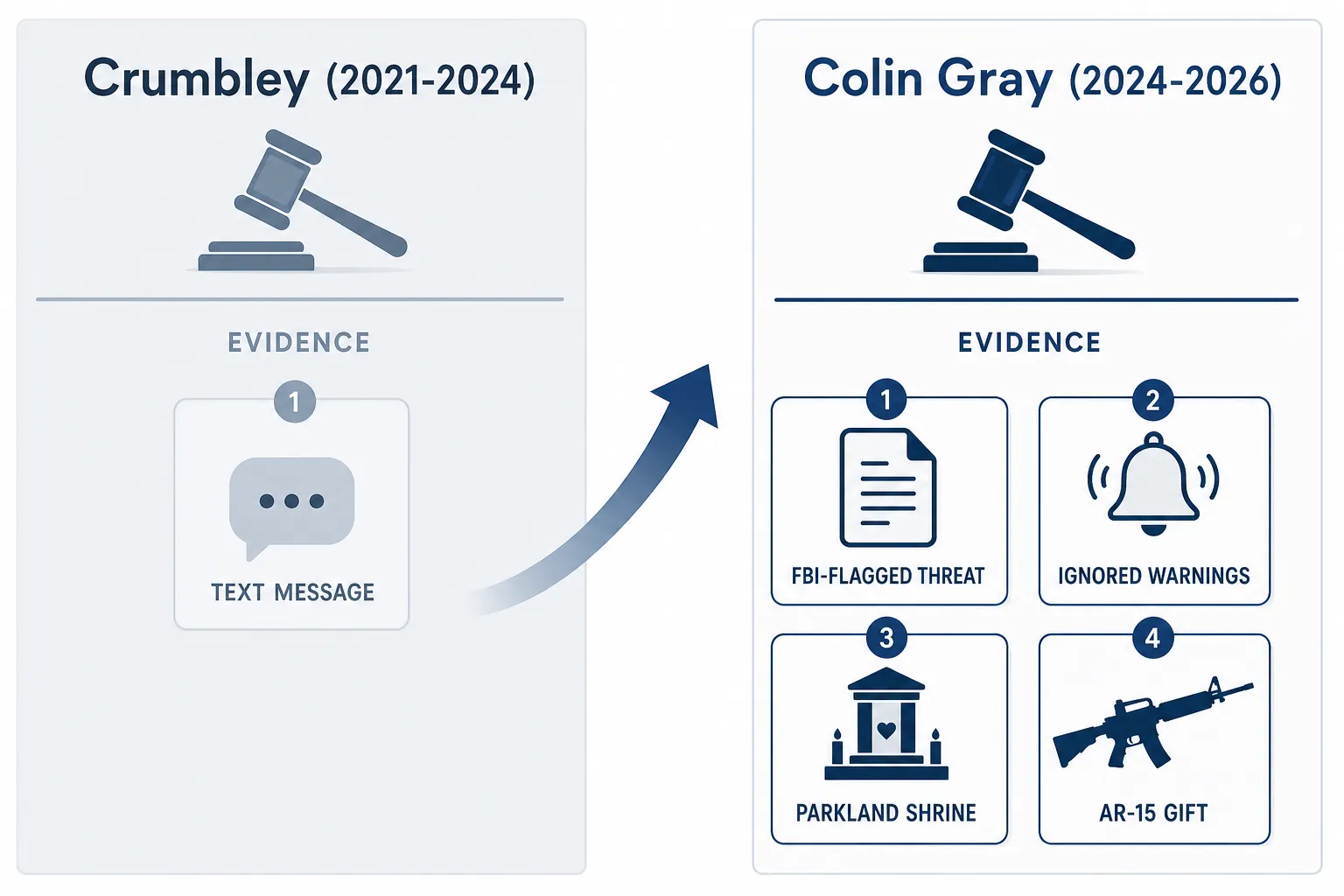
This is the formulation worth carrying into an exam: the Crumbley prosecutions established that parental accountability could reach criminal court; the Gray conviction showed that, under a more severe warning record, that accountability could escalate from manslaughter to murder. That formulation is narrower than “parents are now liable for school shootings,” and narrower is stronger.
What the Evidence Lets You Argue
The best use of the Gray case is foreseeability. In ordinary language, foreseeability asks whether the harm was reasonably predictable. In legal writing, the standard is more technical; in GRE and MCAT contexts, the concept still helps you separate moral hindsight from evidence available before the harm occurred.
A weak essay says, “After the shooting, everyone could see the father should have known.” A stronger essay says, “The father’s liability became more plausible because prosecutors pointed to warnings that existed before the shooting: a flagged threat, deteriorating behavior, an apparent fixation on a prior school shooter, and the father’s decision to provide access to an AR-15.” The second version respects timing. It does not use tragedy as proof by itself.
That distinction matters in CARS, too. A passage might present the case to test whether the reader confuses moral blame, civil responsibility, and criminal liability. Moral blame can be broad. Civil systems can allocate risk and compensation differently. Criminal liability usually requires a tighter showing of mental state, causation, and statutory fit. If a passage emphasizes the “fact-specific” nature of the case, the safe inference is not that courts will now punish parents broadly; it is that prosecutors may pursue severe charges when repeated warnings and weapon access are unusually clear.[3]
What the Case Does Not Prove
The case does not prove that prosecution is a common response to school shootings. Everytown’s discussion of the case notes that only three parents had been prosecuted across more than 400 school shootings since Columbine.[4] That number cuts two ways. It weakens alarmist claims that every parent is suddenly at criminal risk, because prosecutions remain exceptionally rare. It also weakens confident deterrence claims, because a response used so rarely is hard to measure as a broad preventive force.
Everytown also cites the U.S. Secret Service finding that 76% of targeted school shooters under 18 obtained the firearm from home.[4] That statistic supports an access argument, not a complete causation argument. It can justify writing about household storage and adult responsibility, but it does not prove that every shooting would be prevented by parental prosecution or that home access is the only relevant variable.
Giffords cites research finding that states with child access prevention laws had 72% fewer unintentional shootings of children than states without those laws, and it discusses estimates that 4.6 million children live in homes with loaded, unlocked firearms.[5] Those figures belong in the context paragraph of an essay, not in a sweeping claim that one criminal verdict will change national behavior. They show why storage policy is a serious systemic issue. They do not show that Gray’s conviction, by itself, will deter future parents.
That caution is not fence-sitting. It is the core test-prep skill: matching the conclusion to the evidence. Advocacy organizations such as Everytown and Giffords provide useful data and legal-policy summaries, but their interpretation favors stronger gun-safety policy. A careful essay can use the cited statistics while separating the data from the policy frame.
How to Use Colin Gray in a GRE Issue Essay
If the prompt asks whether individuals should be held responsible for harms that also have systemic causes, the Gray case gives you a balanced structure. Start with the individual-responsibility side, because the facts are unusually concrete. Then qualify it with the broader access data and the rarity of prosecutions.
- Use it for foreseeability: repeated warning signs make liability more defensible than hindsight alone.
- Use it for proportionality: Gray’s murder conviction escalated beyond the Crumbley manslaughter precedent.
- Use it for limits: three parent prosecutions across more than 400 school shootings shows how rare this response remains.
- Use it for systemic context: firearm access from home and storage-law data suggest prevention cannot rely only on punishment after tragedy.
A compact GRE paragraph could look like this: “The Colin Gray conviction shows why individual liability can be justified when a preventable harm is preceded by specific warnings. Unlike a case in which a parent had no reason to anticipate violence, prosecutors pointed to a flagged threat, deteriorating behavior, fixation on a prior school shooter, and the father’s decision to provide weapon access. Yet the rarity of parent prosecutions after school shootings suggests that criminal law is a narrow tool, not a full substitute for storage policy, school intervention, or mental-health systems.”
Notice what that paragraph does not do. It does not say the conviction caused safer behavior. It does not say all parents should be criminally liable. It does not treat a maximum sentencing exposure as the actual sentence. Those omissions make the example more credible, not less forceful.
How It Might Appear in MCAT CARS Reasoning
CARS will usually care less about the legal facts than about the author’s logic. A passage might use the Gray case to ask whether law should punish individual negligence, reshape social norms, or leave prevention to regulation. The trap answer would be the one that makes the case stand for more than the passage supports.
| If the passage says | A careful inference is | An overread is |
|---|---|---|
| The conviction was fact-specific | The outcome depended on unusual evidence of notice and access | All parents of school shooters now face murder liability |
| Home firearm access is common in youth school shootings | Storage and supervision are relevant prevention issues | Home access alone explains every shooting |
| Parent prosecutions are rare | Criminal liability is selective and difficult to generalize | The law has no role in prevention |
The most exam-relevant tension is between precedent and anomaly. The Guardian framed the Gray conviction as part of a “new frontier” in parental accountability.[6] That phrase may be useful in an essay introduction, but it needs immediate narrowing. A frontier is not the same as a settled rule. It means legal actors are testing boundaries under unusual facts.
A Less Obvious Angle: Liability Beyond Criminal Court
One strong essay move is to show that criminal prosecution is not the only legal consequence of unsafe gun access. Marcia Zug argued in The Conversation that irresponsible parental gun ownership could become relevant in custody disputes after cases like Gray’s.[7] That angle is useful because it expands the discussion without exaggerating the criminal precedent.
For example, a student could argue that courts may be reluctant to impose murder liability except in extreme cases, while family-law systems may respond earlier by treating unsafe firearm storage as evidence relevant to a child’s welfare. That is a cleaner distinction than saying “the law should punish parents more.” It separates punishment after harm from risk assessment before harm.
The Exam-Safe Bottom Line
The Colin Gray case is a powerful example because it is specific: 27 counts, a murder conviction rather than only manslaughter, a jury verdict reached in under two hours, and a maximum exposure reported at 180 years.[1] It is powerful for the same reason it must be handled carefully. The case supports an argument about fact-specific parental criminal liability when warning signs and weapon access converge. It does not prove a broad deterrence shift, and it does not replace systemic explanations involving storage law, school intervention, firearm access, and mental-health response.
In a timed essay, that is enough. Use Gray to show escalation beyond Crumbley. Use the access and prosecution data to show limits. Then stop before the example turns into a claim the evidence cannot carry.
References
- CNN — Colin Gray trial overview
- AP News — Sentencing coverage
- CNN — What conviction means for parents
- Everytown — What You Need to Know About the Colin Gray Trial
- Giffords — A Tale of Two School Shootings
- The Guardian — New frontier
- The Conversation — Irresponsible parental gun ownership could become a factor in custody disputes
Related exhibits & inventory
Verified outcomes
Planners
No planner filed for this exam yet
A downloadable timeline template for this exam hasn't been published yet.
Tool verdicts
AI-tool cautions
No AI tools tested for this exam yet
No hands-on AI-accuracy logs have been filed for this exam.
Questions about this plan
Ask a question about a specific section, timeline, or citation in this plan — or flag something that needs correcting.
Comments
Join the discussion with an anonymous comment.