
ACT, SAT, GRE Exam Hub
Meteor Shower Astronomy Study Guide for ACT, SAT and GRE
A compact, source-verified fact core and passage-reading strategies for meteor-shower passages on the ACT Science, digital SAT Reading & Writing, and GRE Verbal — including why MCAT CARS does not test this content.
- gre
- mcat
- asvab
- sat
- act
- digital-adaptive
- official-material
- section-strategy
- test-date-timeline
This meteor shower astronomy study guide is filed under exam-hubs and was last reviewed in Q3 2026. It is built from labeled sources: official ACT and College Board test descriptions, GRE prep guidance, NASA and American Meteor Society astronomy references, and clearly marked third-party passage examples. The first thing to notice is calming: the ACT Science page says advanced knowledge is not required, even though Earth and space sciences are in scope; the College Board describes digital SAT Reading and Writing passages as short passages across domains including science; and GRE prep sources warn that science Reading Comprehension is answered from the passage rather than from outside expertise.[1][2][3][4]
That does not make astronomy vocabulary useless. It makes the goal smaller. You are not trying to become the student who knows the most about meteors. You are trying to become the student who does not spend four timed minutes decoding words that the question only needs you to hold in working memory.
The fact core worth keeping small
A useful meteor-shower fact core should feel more like the northern-lights 4-step chain than like a chapter from an astronomy textbook. The point is to reduce friction before the passage starts asking about graphs, models, and cautious conclusions.
| Term or idea | Hold this much |
|---|---|
| Meteoroid → meteor → meteorite | A meteoroid is the object in space; a meteor is the streak of light as it enters the atmosphere; a meteorite is what reaches the ground.[5] |
| Meteor shower | Earth passes through debris left along an orbit; many streaks seem to arrive from the same region of the sky.[6] |
| Parent body | Many showers are associated with comet debris, but parent bodies can also be asteroidal. Do not force every passage into a comet-only story.[6] |
| Radiant and naming | The radiant is the point in the sky from which the meteors appear to come; showers are usually named for the constellation near that radiant.[7] |
| ZHR | Zenithal hourly rate is a standardized ideal rate, not what every observer actually sees. The AMS example contrasts a Perseid ZHR of 100 with about 10 meteors per hour in a city and about 50 in a moonless rural sky.[7] |
| Altitude and speed | Most visible meteors occur around 80–120 km altitude, and entry speeds range from about 11–72 km/s.[7] |
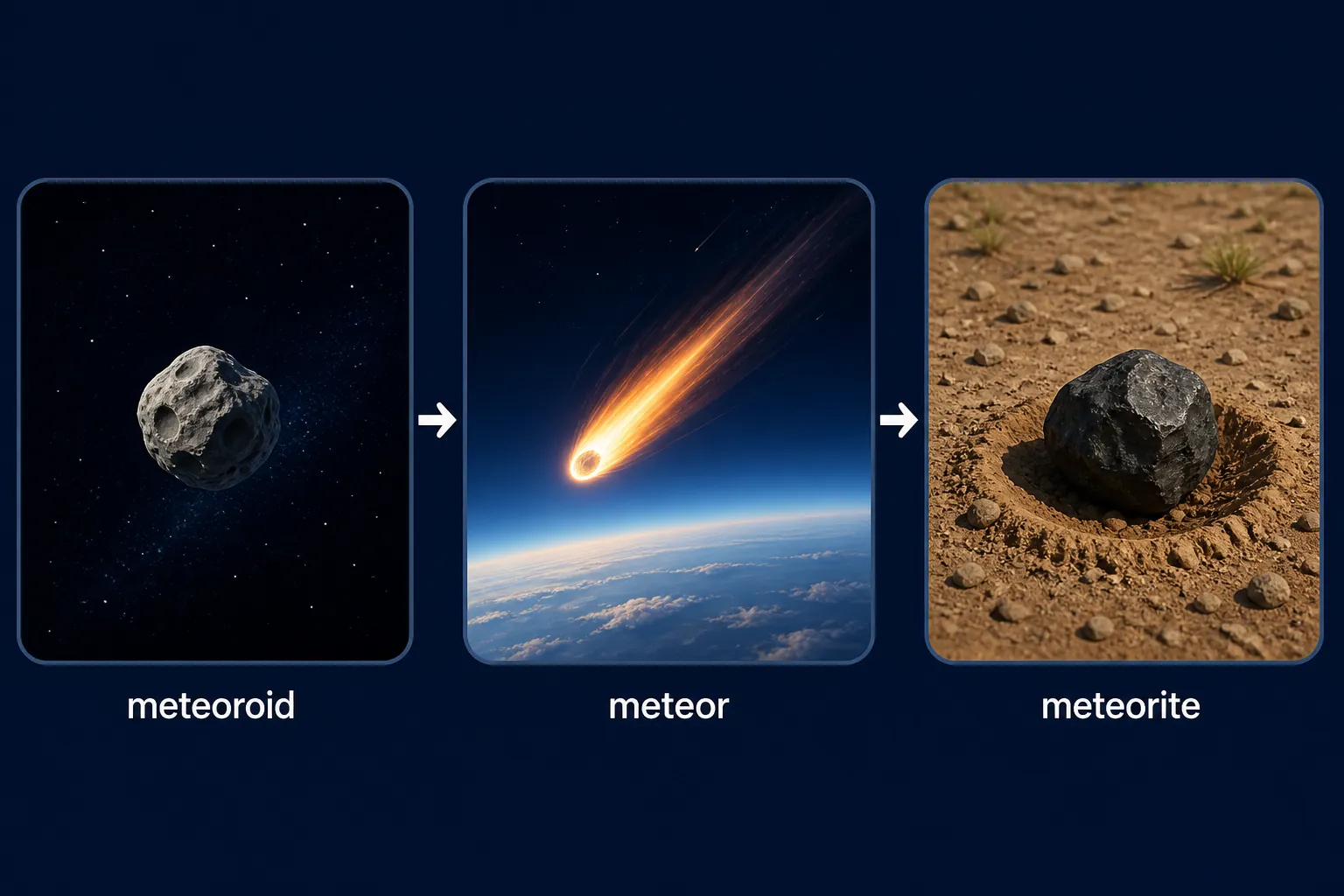
The chain matters because test passages often use all three labels without caring whether you admire the sky. If the question asks what would happen if more fragments reached the ground, the answer is about meteorites, not the glowing streaks. If a graph compares apparent directions in the sky, the answer is about the radiant, not the rock on the ground. One clean distinction prevents several wrong answer choices from sounding plausible.
Calendar facts are lower value for exam reading. Peak dates, moonlight, weather, and observing location matter to skywatchers, but a standardized-test passage will normally give the timing it wants you to use. If a question hinges on an exact date or a rate, take it from the passage or graph, not from memory.
How a meteor-shower passage actually works
The most useful example here is a Geminid meteor-stream passage reproduced by Cetking. Its original official attribution is unclear, so it should be treated as a representative standardized-test science passage, not as an official ETS, ACT, College Board, or GMAC item. It is still valuable because it has the structure that slow readers often miss: a hypothesis, a computer model, a prediction, and later observational evidence.[8]
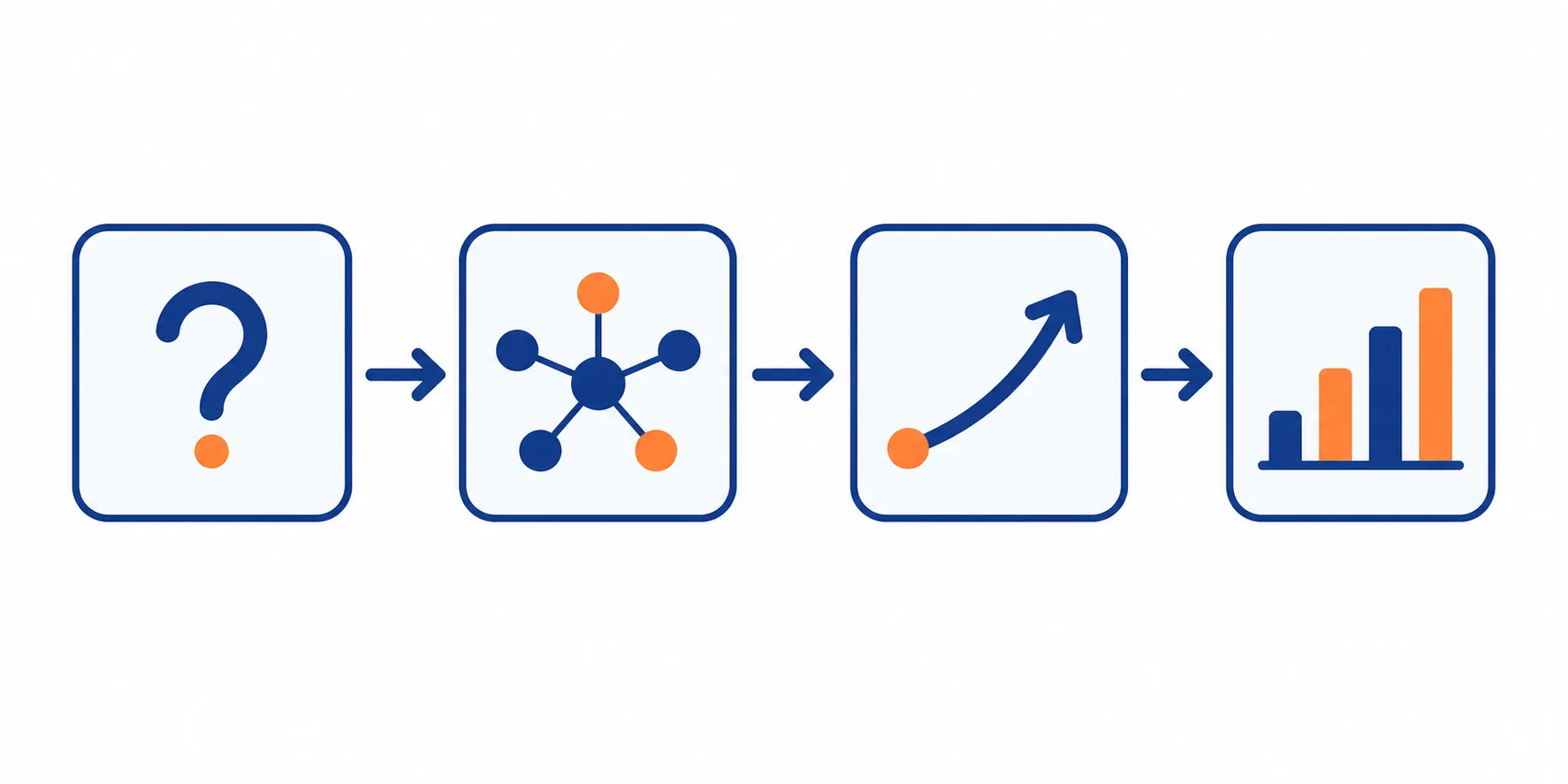
The passage describes a computer model of the Geminid meteor stream. In that model, the stream is not a simple uniform band. It includes a dust shroud along a cometary orbit, and the model predicts twin-peaked Geminid activity. Later, observations from 1970–1979 are described as showing a bifurcation, with a secondary burst about 19 hours after the first.[8]
That paragraph is not asking you to learn the Geminids. It is asking you to keep the evidence levels separate. A model predicts. Later observations support, weaken, complicate, or fail to match that prediction. A cautious answer choice will preserve that order. A trap answer choice often makes the observation sound like it was already built into the model, or makes the model sound proven because later data partly matched it.
| Passage move | What to mark while reading | Likely test trap |
|---|---|---|
| Hypothesis | What the scientists think the stream may be like | An answer says the hypothesis is already established fact |
| Model | What assumptions the computer model uses | An answer imports outside astronomy instead of using the stated assumptions |
| Prediction | What the model says should be observed, such as twin-peaked activity | An answer changes “may” or “could” into “will” |
| Data | What the later observations actually showed, including the 1970–1979 bifurcation and the secondary burst about 19 hours later | An answer treats one confirming pattern as proof of every part of the model |
The verb work is where many points disappear. “May produce a secondary burst” is not the same as “must produce a secondary burst.” A model that “accounts for” a pattern is not automatically the only possible explanation. Evidence from 1970–1979 is evidence from that time window, not a guarantee about every year. Those are small words, but on a timed test they are often the whole question.
This is the same general science-passage blueprint as the Dyson-sphere passage-analysis method: do not treat the topic as the task. Track claim, test, revision, and limit. Meteor showers just make the vocabulary unfamiliar enough that students start reading like hobbyists instead of test-takers.
ACT Science: meteor showers fit the official skill categories cleanly
The ACT is the exam where a meteor-shower passage is most at home. The official ACT Science description includes Earth and space sciences, naming geology, astronomy, and meteorology among the content areas. It also says advanced knowledge is not required; the tested work is reading, analyzing, evaluating, reasoning, and problem solving with the provided scientific information.[1]
The official reporting categories explain why the Geminid example is so useful. Interpretation of Data accounts for 38–50% of the ACT Science score, Scientific Investigation for 18–32%, and Evaluation of Models, Inferences, and Experimental Results for 24–38%.[1] A meteor-stream passage can touch all three without ever asking, “What is the parent body of the Geminids?”
| ACT reporting category | Meteor-shower version of the task |
|---|---|
| Interpretation of Data | Read a graph of activity over time, compare peaks, distinguish ZHR from observed rate, or identify the time gap between bursts. |
| Scientific Investigation | Notice what was observed, what was modeled, and what time window the observations covered. |
| Evaluation of Models, Inferences, and Experimental Results | Decide whether later bifurcation data supports, contradicts, or only partly supports the proposed stream model. |
For ACT timing, the practical move is to read for labels before details. Circle, underline, or mentally tag words such as model, predicted, observed, may, approximately, and during 1970–1979. If you are already running out of time on ACT Science, the useful question is not whether you can learn more astronomy tonight. It is whether you can stop rereading the same sentence because you never marked what job it was doing. That timing problem is closer to the approach discussed in this ACT Science exam-strategy piece than to a skywatching guide.
Digital SAT Reading and Writing: shorter passage, same precision problem
The digital SAT does not give you ACT-style long science data passages in the same way. College Board describes Reading and Writing passages as 25–150 words, drawn from literature, history/social studies, humanities, and science.[2] That changes the pressure. You may get a compact astronomy paragraph, but the test is still asking for reading precision, not a meteor-shower lecture.
A SAT version of the Geminid idea might compress the whole setup into one paragraph: researchers proposed a model, the model predicted a second peak, later observations showed a delayed burst. The question might ask which finding would best support the model, which choice most accurately describes the data, or which completion follows from the paragraph. In that setting, the dangerous habit is over-reading. If the passage says the observations are consistent with a model, do not pick an answer saying the model has been conclusively proven.
For SAT practice, keep the astronomy chain tiny and spend more effort on the answer-choice verbs. “Suggests,” “supports,” “establishes,” and “rules out” are not interchangeable. If your broader SAT issue is uneven performance by question type, connect this passage habit to a SAT score-gap study method, then practice with targeted sets rather than rereading astronomy notes. The same applies when you are deciding how to use SAT practice questions or pairing Khan Academy SAT practice with Bluebook.
GRE Verbal: do not argue with the passage
GRE science Reading Comprehension rewards restraint. Dummies’ GRE science RC guidance says the questions do not require outside scientific knowledge.[3] AnvayaPrep similarly frames scientific passages as passage-based and warns against relying on outside knowledge; it also makes claims that science passages may represent about 30–40% of GRE Reading Comprehension and that test-takers may score 10–15% lower on them, but those figures should be treated as prep-site claims, not verified ETS statistics.[4]
That distinction matters. A GRE passage about a meteor stream can be wrong-footed by a reader who knows some astronomy and starts correcting the passage. If the passage’s model treats a dust shroud along a cometary orbit as the relevant explanation, answer within that model unless the question explicitly asks you to evaluate a weakness. Outside knowledge may be true in the world and still useless for the question in front of you.
The GRE version of the trap often appears in inference language. If the passage says later data showed a secondary burst about 19 hours after the first, a safe inference may be that the data were consistent with a twin-peaked prediction. It is not safe to infer that every future Geminid display will show the same timing, or that no competing model could explain the pattern. The answer has to fit the passage’s evidence boundary, not your confidence.
MCAT CARS: this is mostly a boundary, not another astronomy assignment
MCAT CARS is not where meteor-shower facts are tested. UWorld describes CARS as 9 passages, 53 questions, and 90 minutes, split 50% humanities and 50% social sciences.[9] That source is AAMC-aligned prep guidance rather than the primary AAMC page, so the modest conclusion is the right one: do not study radiant, ZHR, or meteorite terminology for CARS content.
This article is not making a claim about whether astronomy can appear anywhere in MCAT science sections. That was not verified against a primary AAMC source here. The narrow CARS point is enough: if you are preparing for CARS, the transferable skill is reading the author’s logic and limits, not memorizing meteor-shower mechanics.
A practical reading playbook for meteor-shower passages
When a meteor-shower passage appears, give it one fast structural pass before you let the nouns intimidate you.
- Translate the vocabulary chain first: object in space, streak in atmosphere, fragment on ground.
- Mark whether each sentence is giving a hypothesis, a model assumption, a prediction, an observation, or an interpretation.
- Separate ideal rates from observed rates. ZHR is not the same as what one city observer sees.
- Watch time windows. Data from a particular decade or observation period does not automatically describe all years.
- Preserve qualifiers. May, could, approximately, consistent with, and suggests are answer-choice governors.
- Do not import outside astronomy unless the question explicitly asks for a general scientific principle and gives you room to use it.
The compact astronomy helps because it keeps you from staring at the wrong word. The score-relevant work is still passage control: identifying what was claimed, what was modeled, what was observed, and how far the evidence can honestly go. That is not astronomy mastery, and it does not promise a score jump. It is simply a faster, cleaner way to read the passage you were already going to have to answer.
References
- Description of Science Test — ACT
- What’s on the SAT: Reading and Writing — College Board
- Reading Comprehension on the GRE: Science Questions — Dummies
- Scientific Passages — AnvayaPrep
- Meteors and Meteorites: Facts — NASA Science
- Meteor Showers — NASA Science
- Meteor FAQ — American Meteor Society
- Reading Comprehension Science Passages — Cetking
- MCAT CARS — UWorld
Related exhibits & inventory
Verified outcomes
No verified outcomes on file for this exam yet
See Methodology for how outcome evidence is disclosed once logged.
Planners
No planner filed for this exam yet
A downloadable timeline template for this exam hasn't been published yet.
Tool verdicts
AI-tool cautions
No AI tools tested for this exam yet
No hands-on AI-accuracy logs have been filed for this exam.
Questions about this plan
Ask a question about a specific section, timeline, or citation in this plan — or flag something that needs correcting.
Comments
Join the discussion with an anonymous comment.