
SAT, ACT, GRE, ASVAB Exam Hub
Why Orcas vs. Great Whites Is a Model Test Passage
The orca vs. great white shark story is a model test passage because it rewards claim-vs-evidence reading — the core skill behind SAT, ACT, GRE, and ASVAB science questions. Use the real studies to practice separating what researchers proved from what they only claimed.
- gre
- mcat
- asvab
- sat
- act
- digital-adaptive
- official-material
- section-strategy
- test-date-timeline
A science passage about orcas and great white sharks looks easy until the answer choices arrive. One choice says killer whales make great whites flee. Another says killer whales always make great whites flee. A third says the studies prove great whites are a regular prey item for orcas everywhere. The topic is exciting, but the test skill is dull in the best possible way: match each claim to the evidence that actually supports it.
That is why this topic should not become a predator scoreboard. The useful version asks three smaller questions: what did researchers observe, what did they infer from it, and what did they not prove? The orca-versus-great-white story is almost built for SAT, ACT, GRE, and ASVAB science reading because the studies partly agree and partly complicate one another.
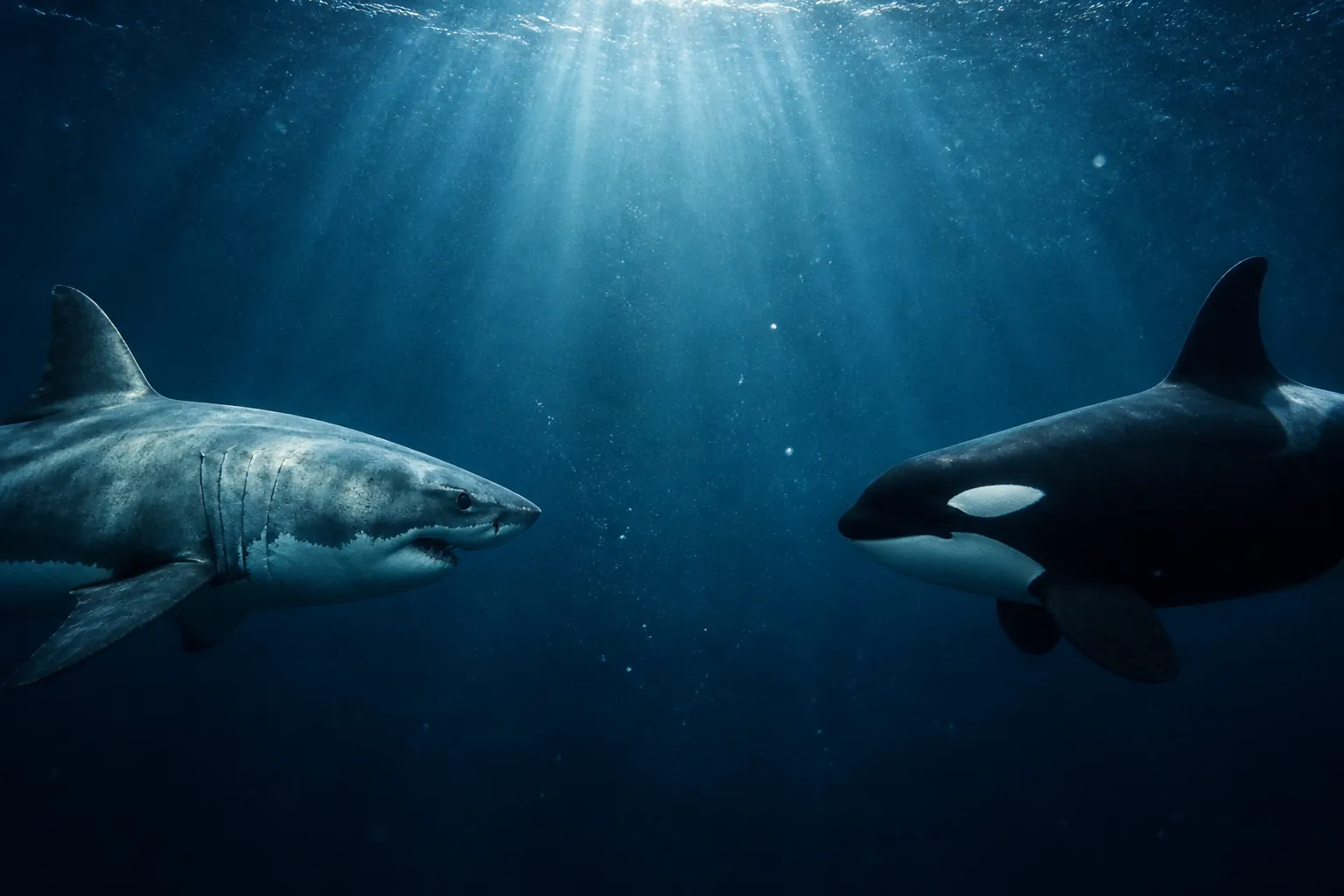
Start with the cleanest evidence: the Farallon displacement study
The strongest main claim comes from a 2019 Scientific Reports study on white sharks, killer whales, and elephant seals at Southeast Farallon Island. On Nov. 2, 2009, two killer whale pods passed the island for about 2.5 hours. All 17 tagged great white sharks left within about eight hours, and most did not return until the following season.[1]

That is a wonderfully testable sentence because every part matters. “All 17 tagged great white sharks” is not the same as “all great white sharks.” “Within about eight hours” is not the same as “instantly.” “Most did not return until the following season” is not the same as “great whites permanently abandoned the area.” A test question can hide inside any one of those differences.
The seal data make the passage more interesting. The study found that shark predation on elephant seals fell in years when killer whales appeared. The long-term average was 6.02 predation events per 100 hours, while three killer-whale years showed 1.73, 1.29, and 0.84 predations per 100 hours — a 3.5- to 7-fold drop.[1]
Notice what the number measures. It does not measure shark fear directly. It does not count battles between adult orcas and adult sharks. It measures elephant seal predation pressure at a particular site during observation time. The researchers’ broader claim is that killer whales can redistribute white shark foraging pressure on seals, not that every shark in every ocean follows the same rule.
| Evidence from the Farallon study | Careful claim it supports | Answer choice that would be too broad |
|---|---|---|
| Two killer whale pods passed Southeast Farallon for about 2.5 hours on Nov. 2, 2009.[1] | A brief killer whale presence was followed by shark departure at this site. | Killer whales always force great whites away wherever they appear. |
| All 17 tagged great whites left within about eight hours.[1] | The tagged sharks in that study displaced quickly after the killer whale visit. | All great whites instantly flee all orcas. |
| Most tagged sharks did not return until the following season.[1] | The absence was long enough to affect seasonal foraging patterns. | Great whites never return to areas visited by killer whales. |
| Elephant seal predation fell from a long-term average of 6.02 per 100 hours to 1.73, 1.29, and 0.84 in killer-whale years.[1] | Seal predation pressure dropped substantially during those years. | The study proves orcas protected seals intentionally. |
That last overreach is common. If seals benefit after sharks leave, it is tempting to say orcas “helped” seals. But the passage evidence supports a different sentence: when killer whales were present in those years, shark predation on elephant seals dropped. The seals were the beneficiaries; the study does not require the orcas to have that goal.
Hunting evidence answers a different question
The Farallon data mainly help with displacement: do great whites leave an area after killer whales appear? A second kind of evidence deals with mechanism: do orcas hunt great whites, and how? Those questions overlap, but they are not interchangeable.
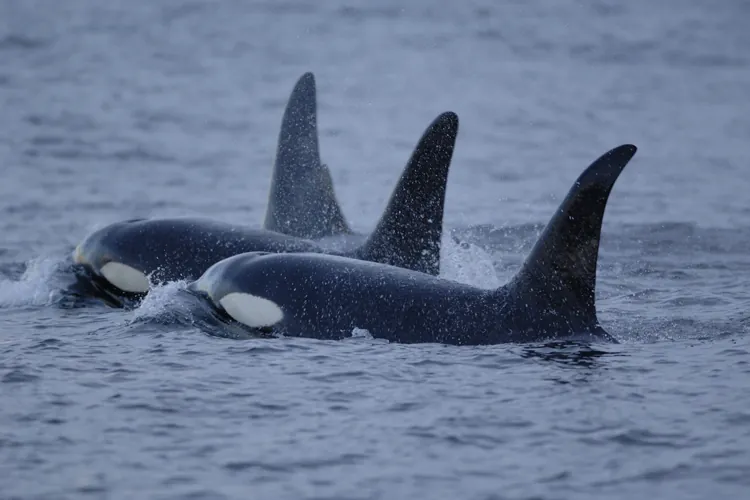
A 2025 Frontiers in Marine Science study reported three juvenile great white shark kills by Moctezuma’s pod in the Gulf of California, with events in August 2020 and August 2022. The reported technique involved flipping the sharks upside down, a position associated with tonic immobility, and feeding on the liver.[2]
Tonic immobility is a temporary state in which a shark becomes still after being inverted. Shark Trust describes it as a reflex-like state that can occur when some sharks are turned upside down.[3] For a predator with the size, coordination, and handling ability of an orca, flipping a shark is not a decorative detail. It is the mechanism that makes the hunting claim biologically plausible.
The liver detail is also worth reading carefully. White shark livers are energy-rich, which helps explain why reports focus on them. But liver-size figures should not be blended into one confident number. The Atlantic has described the great white liver as about a quarter of the shark’s body weight, while Nature Africa described it as up to a third in its coverage of South African orca predation.[4][5] A precise reader keeps those as attributed descriptions, not a single universal statistic.
The Gulf of California study supports a real hunting claim, but a narrow one: this named pod was observed killing juvenile great whites in a small number of documented events. The researchers also warned that limited observations do not prove white sharks are a regular prey item and that broader diet evidence is needed before making that stronger claim.[2]
South African cases add texture, not a universal rule
South African reports show similar behavior in a different setting. Nature Africa reported first aerial drone footage of a killer whale killing a great white off Mossel Bay in May 2022 and noted 11 documented great white deaths in that context.[5] A later report described the orca Starboard killing a 2.5-meter juvenile great white shark alone in under two minutes in June 2023.[6]
Those cases matter because they show that liver-targeting and shark-killing behavior is not confined to one Gulf of California report. They still do not license the headline version: “orcas beat sharks.” A single solo kill, drone footage from one region, and a few documented carcasses are strong observations, but they are still observations with scope.
Then comes the study that ruins the easy answer
If the passage ended with the Farallon and Gulf of California evidence, a rushed reader might choose the neat answer: killer whales appear, great whites leave, and sometimes orcas hunt them. But a 2026 Neptune Islands study complicates that version. Based on 12 years of sighting data at Australia’s Neptune Islands, researchers recorded six prolonged white shark absences lasting more than 42 days, yet only one coincided with killer whale presence.[7]
That finding does not erase the Farallon study. It does something more exam-relevant: it narrows the claim. The Farallon evidence supports displacement after killer whale presence at Southeast Farallon. The Neptune Islands evidence challenges the idea that killer whales are always, or solely, responsible for long white shark disappearances.
This is exactly where standardized-test questions get their wrong answers. One answer choice may sound scientific because it includes real vocabulary — predation, displacement, apex predator, trophic cascade — while quietly replacing “in this study” with “in all ecosystems.” Another may take a correlation in sighting data and turn it into a single proven cause. The vocabulary is not the trap. The scope is.
| Study or report | What it can support | What it cannot support by itself |
|---|---|---|
| 2019 Southeast Farallon study | Tagged great whites left after killer whale pods passed, and elephant seal predation dropped in killer-whale years.[1] | All great whites everywhere flee all orcas, or orcas intentionally protect seals. |
| 2025 Gulf of California study | Moctezuma’s pod was observed killing juvenile great whites by flipping them and feeding on livers.[2] | White sharks are a regular prey item for all orcas. |
| South African reports | Some orcas have been documented killing great whites, including a solo juvenile kill by Starboard.[5][6] | Pack hunting is always required, or every orca population uses the same strategy. |
| 2026 Neptune Islands study | Most prolonged absences in that 12-year dataset did not coincide with killer whale presence.[7] | Killer whales never affect white shark movement. |
How a test-taker should read the whole case
For SAT and ACT science-style reading, the main move is not memorizing marine biology. It is refusing to let a vivid passage outrun its evidence. For GRE reading, the same case trains scope, qualification, and author attitude. For the ASVAB General Science subtest, it is a reminder that a biological explanation can be correct in one setting and still too broad as a general rule.
- Name the study before naming the conclusion. “The Farallon study found…” is safer than “Scientists found…,” because it keeps the claim attached to place, method, and sample.
- State the exact evidence. In this case: 17 tagged sharks, about eight hours, most absent until the following season, and a 3.5- to 7-fold drop in seal predation during killer-whale years.
- Separate behavior from mechanism. Leaving an area after orcas appear is displacement evidence. Flipping juvenile sharks into tonic immobility is hunting-mechanism evidence.
- Mark the limitation as information, not as fine print. “Limited observations” in the Gulf of California study is not a weakness to ignore; it tells you which answer choices are too broad.
- Use conflicting evidence to narrow, not panic. The Neptune Islands study does not make the Farallon result false. It prevents the universal claim.
Here are the answer-choice words that should slow you down: always, never, proves, causes, solely, all populations, and regular prey item. Sometimes those words are correct. In this passage, most of them would need more evidence than the studies provide.
A supported answer might say: “At Southeast Farallon, killer whale presence was associated with the departure of tagged great whites and reduced elephant seal predation.” A tempting but overbroad answer would say: “Killer whales cause great whites to abandon hunting grounds whenever they appear.” The first sentence sounds less dramatic because it is doing the work.
Use the predator story as a passage-reading drill
If you are preparing for the SAT or ACT, practice this with the same habits you would use in the SAT exam prep guide: underline the study’s actual finding, circle the qualifier, and reject answers that make the claim larger than the data. If you are preparing for GRE Verbal, compare this to the evidence-control work in Translate and Study Amani na Umoja for GRE Verbal Success. If you are studying for ASVAB science, use the same method you would use in Hurricane Science Study Tips for the ASVAB General Science Subtest: explain the mechanism, then stop where the evidence stops.
The repeatable routine is simple: identify the study, state its exact claim, list the evidence, mark what it does not prove, and check whether the answer choice stayed inside those lines. That is the transferable skill hiding inside the orca-versus-great-white headline.
References
- Killer whales redistribute white shark foraging pressure on seals, Scientific Reports, 2019.
- Novel evidence of interaction between killer whales and white sharks in the Gulf of California, Frontiers in Marine Science, 2025.
- Tonic Immobility, Shark Trust.
- Great White Sharks Are Scared of Killer Whales, The Atlantic, 2019.
- Killer whales hunt, kill great white shark, Nature Africa, 2022.
- Orcas demonstrating they no longer need to hunt in packs to take down the great white shark, Taylor & Francis Newsroom, 2024.
- White shark response to killer whales, Discover Wildlife, February 2026.
Related exhibits & inventory
Verified outcomes
No verified outcomes on file for this exam yet
See Methodology for how outcome evidence is disclosed once logged.
Planners
No planner filed for this exam yet
A downloadable timeline template for this exam hasn't been published yet.
Tool verdicts
AI-tool cautions
No AI tools tested for this exam yet
No hands-on AI-accuracy logs have been filed for this exam.
Questions about this plan
Ask a question about a specific section, timeline, or citation in this plan — or flag something that needs correcting.
Comments
Join the discussion with an anonymous comment.