
GRE Exam Hub
Translate and Study Amani na Umoja for GRE Verbal Success
Learn how to systematically decode intimidating GRE Verbal Reading Comprehension passages on geopolitics and international relations using the Amani na Umoja military exercise as a concrete case study, transforming unfamiliar proper nouns and strategic analysis into predictable structural patterns.
- gre
- mcat
- asvab
- sat
- act
- digital-adaptive
- official-material
- section-strategy
- test-date-timeline
“Amani na Umoja” translates to “Peace and Unity,” and in this case, it names a 2024 China-Tanzania-Mozambique joint military exercise.[1] That is enough translation. For GRE Verbal Reading Comprehension, the useful move is not to linger over the Swahili. It is to notice that the phrase is a proper noun doing a job inside a passage.
That distinction matters for anyone searching for “amani na umoja translation english study” because the translation is the easy part. The test-like problem is what happens next: the passage starts stacking unfamiliar items — PLA, TPDF, FOCAC, BRICS Plus, Y-20, Type 071, Tanzania, Mozambique — and a capable reader suddenly behaves as if the sentence has become a password screen.
Do not turn this into a prediction. There is no evidence that Amani na Umoja itself will appear on the GRE. It is a training case: dense, real, source-backed, and structurally similar to the kind of geopolitical prose that makes students lose time. If you want the broader exam setting, start with the GRE exam hub; here, we are staying inside one RC skill: turning an intimidating topic into a readable structure.
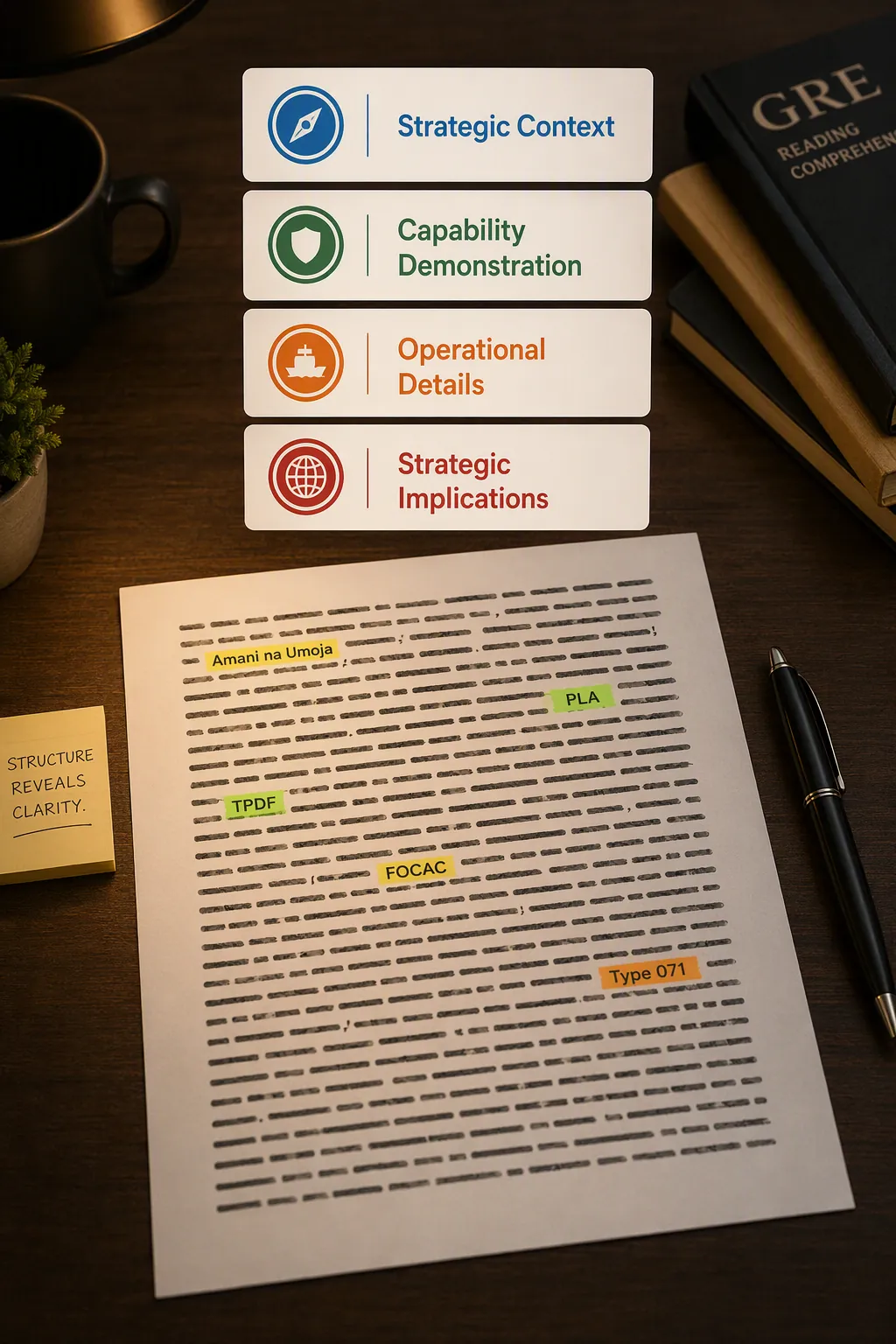
The Four-Part Shape Behind the Proper Nouns
A GRE-style passage on geopolitics rarely asks whether you know the subject in advance. It asks whether you can track the author’s organization while the subject looks unfamiliar. For cases like Amani na Umoja, the structure usually reduces to four parts:
| Passage Element | What You Should Ask | GRE Use |
|---|---|---|
| Strategic context | Why is this event being framed as part of something larger? | Main idea and inference |
| Capability demonstration | What capacity is the actor showing it can now perform? | Main idea and function |
| Operational details | Which facts are evidence, not the argument itself? | Function and detail |
| Strategic implications and reactions | What follows if the framing is accepted? | Inference and author attitude |
This template is not a shortcut around reading. It is a way to stop treating every unfamiliar acronym as equally important. In a real passage, “Y-20” and “Type 071” may look like traps. They are usually not vocabulary questions. They are detail-level evidence for a larger claim about reach, logistics, or military coordination.
Apply the Template to Amani na Umoja
Start with the facts only as far as they help the structure. Amani na Umoja ran from July 29 to August 11, 2024, and involved Chinese, Tanzanian, and Mozambican forces.[1] China deployed a battalion-sized combined-arms force from the PLA 82nd Group Army, with elements from the Joint Logistics Support Force and Information Support Force.[1] The same account describes it as the largest-ever PLA deployment to Sub-Saharan Africa.[1]
Those facts are not there to make you memorize an order of battle. In a passage, they would probably support a broader point: China was not merely attending a ceremonial exchange; it was demonstrating the ability to move, sustain, and coordinate a substantial force far from home.
1. Strategic Context: Why This Event Is Not Treated as Isolated
A passage writer needs context because otherwise Amani na Umoja is just an event listing. The strategic context is the reason the exercise is interpreted as meaningful. The US Army War College SSI account situates the exercise in a longer China-Tanzania relationship, including 60 years of diplomatic relations, and in a broader pattern of Chinese security engagement in Africa.[1]
That is the part to mark, not over-study. If a sentence mentions FOCAC, BRICS Plus, China’s Djibouti base, or Gulf of Aden anti-piracy deployments, your job is not to become an Africa security analyst in the middle of the GRE. Your job is to label the sentence: context. The author is widening the frame so the reader interprets one exercise as part of a larger pattern.[1][2]
A main idea answer will often include that wider frame. A wrong answer will often collapse the passage into the narrow event: “The passage describes a military exercise held in Tanzania and Mozambique.” That may be true, but it is too small if the passage is actually about what the exercise suggests.
2. Capability Demonstration: What the Details Prove
Now the scary equipment names become useful. The exercise included Y-20 strategic transport aircraft and Type 071 amphibious landing docks.[1] Janes also reported that China deployed a significant force to Tanzania for the exercise, corroborating the scale and operational seriousness of the deployment.[3]
On the GRE, a sentence like that is rarely asking you to admire hardware. It is answering a capability question: what can the actor now show it can do? Here, the aircraft and ships point toward power projection — moving forces, equipment, and support across distance and across domains. If you mark those terms as “capability evidence,” you do not need to know the technical specifications.
This is where many strong quant-heavy students waste time. They see a label with numbers in it — Type 071, Y-20 — and treat it like a hidden formula. In RC, the question is more often functional: why did the author include this label? Because the label helps establish the scale, sophistication, or logistical reach of the operation.
3. Operational Details: Evidence, Not the Whole Argument
The exercise had a land phase at the Mapinga Combat Training Center in Tanzania and a naval phase off the coast of Mozambique.[1] These are the kinds of details that look important because they are concrete. They are important, but usually not because a GRE question will ask you to recall the location.
Their more likely role is argumentative. Land and naval phases show the operation was multi-domain. Tanzania and Mozambique show that the exercise was not confined to a single bilateral setting. A land training center and offshore naval activity give the author evidence for saying the exercise had operational breadth.
When annotating, keep the label plain: “land phase = operational evidence,” “naval phase = operational evidence,” “two countries = scope.” You are not building a study guide to East African geography. You are preventing details from flooding working memory.
4. Strategic Implications: What the Passage Lets You Infer
Once the passage has given context, capability, and operations, it can move to implication. The Africa Center has described China’s military activity in Africa as deepening through formats such as BRICS naval drills, while the SSI account treats Amani na Umoja as part of China’s growing military footprint in Tanzania and the region.[1][2]
A careful inference should stay inside those bounds. You can infer that the exercise would be read by analysts as evidence of expanded Chinese military reach and partnership activity in Africa. You cannot infer, from these materials alone, that China is certain to establish a new base in Tanzania, that African states uniformly welcome the activity, or that the exercise directly caused a specific policy change.
That restraint is not politeness; it is GRE discipline. Inference questions reward what follows from the passage, not what sounds geopolitically plausible.
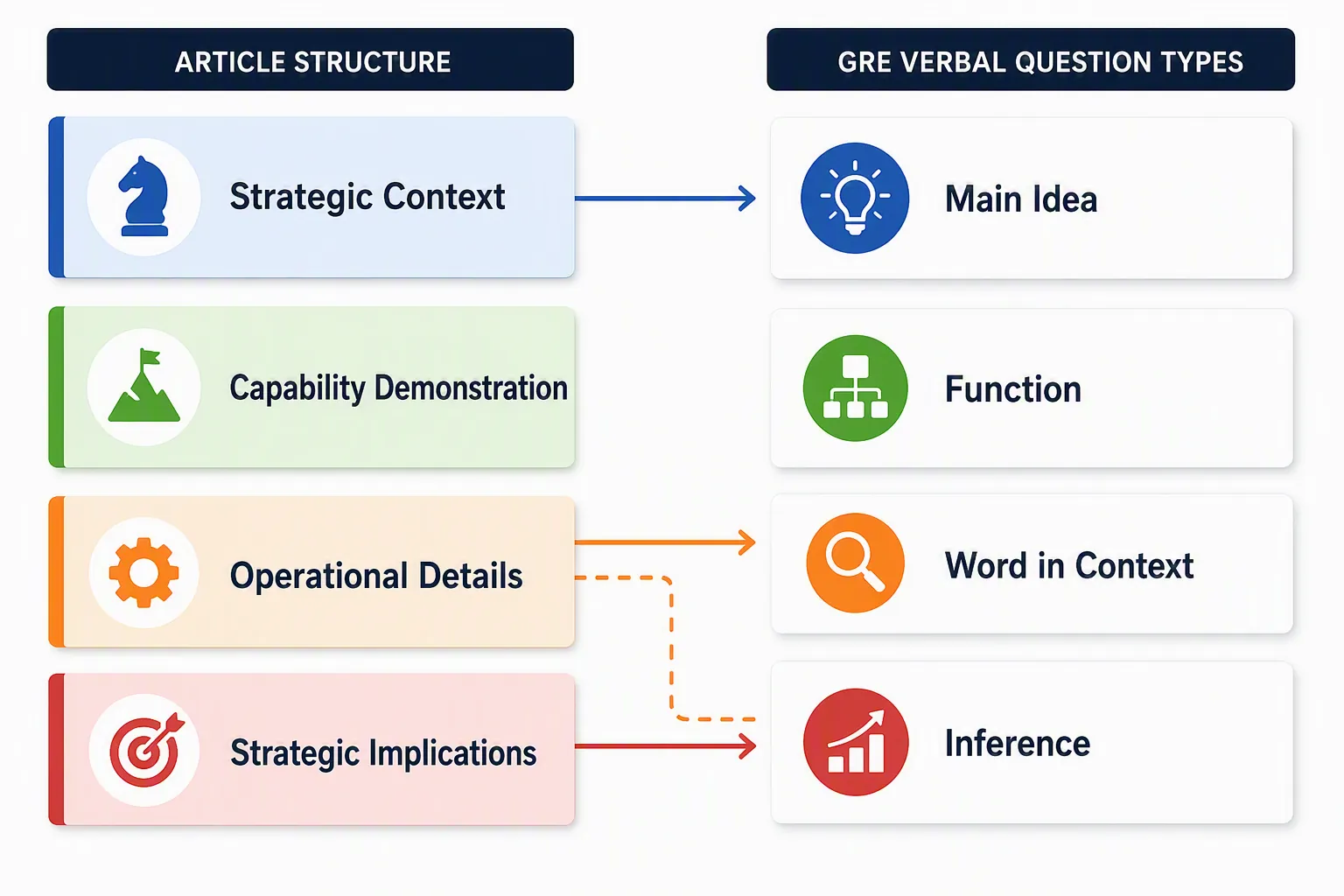
How the Same Markings Answer GRE Questions
The point of the template is not prettier notes. It is faster answer selection. Once you have marked the four elements, the common RC question types become less mysterious.
Main Idea
A main idea question asks for the whole structure, not the most vivid noun. For an Amani na Umoja-style passage, the best answer would likely say that a particular joint exercise illustrates or signals a broader development in China’s military engagement in Africa. It would include the event but not stop at the event.
Weak answer choices usually fail in predictable ways. One choice may be too narrow, focusing only on the translation of “Amani na Umoja” or the exercise schedule. Another may be too broad, claiming to explain all China-Africa relations. Another may be too extreme, treating one deployment as proof of a settled long-term outcome.
Function
A function question asks why a detail appears. If the passage mentions Y-20 aircraft and Type 071 amphibious ships, do not answer as if the author’s purpose is to catalog equipment. The better function is to show the logistical and maritime capabilities involved in the deployment.[1]
If the passage mentions the land phase in Tanzania and the naval phase off Mozambique, the detail likely supports the claim that the exercise had geographic and operational scope.[1] The correct answer may sound abstract compared with the sentence itself. That is normal. Function answers often translate a concrete detail into its argumentative role.
Inference
Inference questions are where background knowledge most often betrays students. If you know a little geopolitics, you may overreach. If you know none, you may freeze. The template gives you a middle path: infer from the passage’s movement.
If the author links Amani na Umoja to a longer diplomatic relationship, a large PLA deployment, strategic airlift, amphibious ships, and multi-country operations, then a fair inference is that the exercise is being presented as more than symbolic.[1] A less fair inference would add a motive, outcome, or policy consequence that the passage never establishes.
Word in Context
Word-in-context questions do not only test ornate vocabulary. In geopolitical prose, ordinary words can carry technical force: “footprint,” “projection,” “engagement,” “presence,” “interoperability,” “signal.” The answer depends on what the word is doing in the paragraph.
Take “footprint.” In a passage about China’s growing military footprint in Tanzania, the word would not mean a literal mark on the ground. It would mean the extent or visibility of military presence and activity. You get that meaning from the surrounding structure: context plus capability plus operations.
A Short Practice Passage
Use this as a hypothetical GRE-style passage built from the sourced facts above, not as an official GRE item:
Amani na Umoja, or “Peace and Unity,” was a 2024 joint exercise involving Chinese, Tanzanian, and Mozambican forces. Although the exercise coincided with a long history of China-Tanzania diplomatic relations, analysts paid particular attention to the scale and composition of the Chinese deployment. The PLA sent a battalion-sized combined-arms force and used assets such as Y-20 transport aircraft and Type 071 amphibious landing docks. The exercise included a land phase in Tanzania and a naval phase off Mozambique, suggesting that its significance lay not merely in bilateral symbolism but in the demonstration of China’s ability to conduct more complex operations in Sub-Saharan Africa.
Before answering anything, mark the structure:
- Strategic context: long China-Tanzania relationship.
- Capability demonstration: battalion-sized force, Y-20 aircraft, Type 071 ships.
- Operational details: land phase in Tanzania, naval phase off Mozambique.
- Strategic implication: the exercise suggests more complex Chinese military operations in Sub-Saharan Africa.
Now a main idea answer has to mention both the exercise and what it demonstrates. A function answer about Y-20 aircraft should say they illustrate transport or projection capability. An inference answer should stay close to the claim that the exercise was operationally and strategically significant. A word-in-context answer for “symbolism” should contrast ceremonial meaning with practical demonstration.
What Not to Memorize
Do not memorize Amani na Umoja as “GRE content.” Do not make flashcards for every acronym in the case. Do not assume that a foreign-language title, a military unit, or a platform number is automatically the key to the passage.
Memorize the reading behavior instead. When a passage begins with an unfamiliar name, ask what role it plays. When the author adds dates and participants, decide whether they establish context or scope. When equipment appears, ask what capability it supports. When the final sentences broaden toward regional influence, reaction, or strategic change, prepare for inference.
Amani na Umoja is useful precisely because it looks like the sort of passage that makes students flinch. Once translated, it is just a title. Once structured, it becomes predictable.
References
- Peace and Unity: China's Growing Military Footprint in Tanzania — US Army War College SSI, 2025
- China Deepens Military Footprint in Africa with BRICS Naval Drills — Africa Center for Strategic Studies
- China deploys significant force to Tanzania for exercise — Janes Defence, 2024
Related exhibits & inventory
Verified outcomes
Planners
No planner filed for this exam yet
A downloadable timeline template for this exam hasn't been published yet.
Tool verdicts
AI-tool cautions
No AI tools tested for this exam yet
No hands-on AI-accuracy logs have been filed for this exam.
Questions about this plan
Ask a question about a specific section, timeline, or citation in this plan — or flag something that needs correcting.
Comments
Join the discussion with an anonymous comment.