
How to Compare World Cup and Super Bowl Viewership Data
A practical guide to understanding the methodology behind World Cup and Super Bowl viewership numbers, so you can compare them responsibly and avoid common misinterpretations.
Updated:
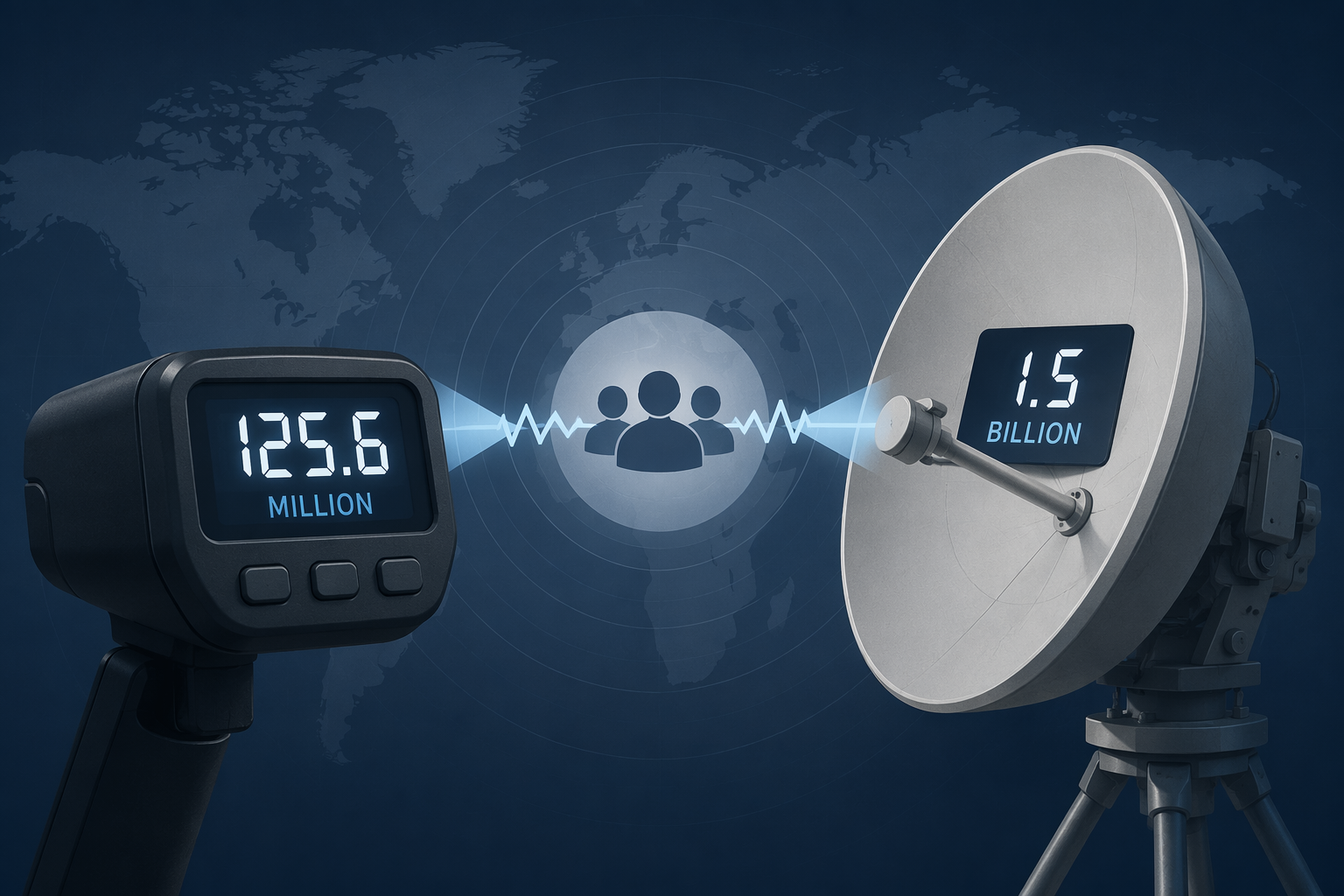
The tempting version of a World Cup vs Super Bowl viewership study is one sentence long: Super Bowl LX averaged 125.6 million U.S. viewers, while the 2022 World Cup final is associated with 1.5 billion global viewers.[1][2] Put that way, the World Cup looks about twelve times larger.
That sentence is also where the comparison starts to wobble. The Super Bowl number is an average audience for a single U.S. broadcast. The World Cup number is a global reach figure for a final. Those are not the same kind of measurement, not the same geographic scope, and not always the same viewing window. A careful comparison has to slow down before it decides what the numbers mean.
Start By Asking What The Number Counts
Viewership statistics usually sound cleaner than they are. A number may count the average number of people watching during a program, the total number who watched at least some part of it, or the number who engaged with any related coverage across TV and digital platforms. All three can be legitimate. They just cannot be swapped into the same sentence as if they measure the same thing.
For Super Bowl LX, Nielsen reported 125.6 million average U.S. viewers. Nielsen also noted that this was the first Super Bowl reported using its Big Data + Panel methodology, and that the figure was revised upward from 124.9 million after a data collection issue was corrected.[1] That correction does not make the number useless; it makes the citation more specific. If a measurement system changes, the method note belongs near the number.
The 2022 World Cup final gives a useful warning because one event produced more than one defensible number. FIFA reported 1.5 billion viewers globally for Argentina vs. France, but the same audience report also lists 571 million as the average live audience.[2] If a student quotes only the larger figure, the reader may assume it is an average audience unless the metric is named.
| Figure | Event | What It Measures | Scope | Timeframe |
|---|---|---|---|---|
| 125.6 million | Super Bowl LX | Average viewers | United States | Single game broadcast |
| 1.5 billion | 2022 World Cup final | Global viewers / reach for the final | Global | Single match |
| 571 million | 2022 World Cup final | Average live audience | Global | Single match |
| 5 billion | 2022 World Cup tournament | People engaged across linear TV and digital | Global | Entire tournament |
The Three Checks: Metric, Scope, Timeframe
A responsible comparison does not begin by choosing the bigger number. It begins by putting each claim through three checks.
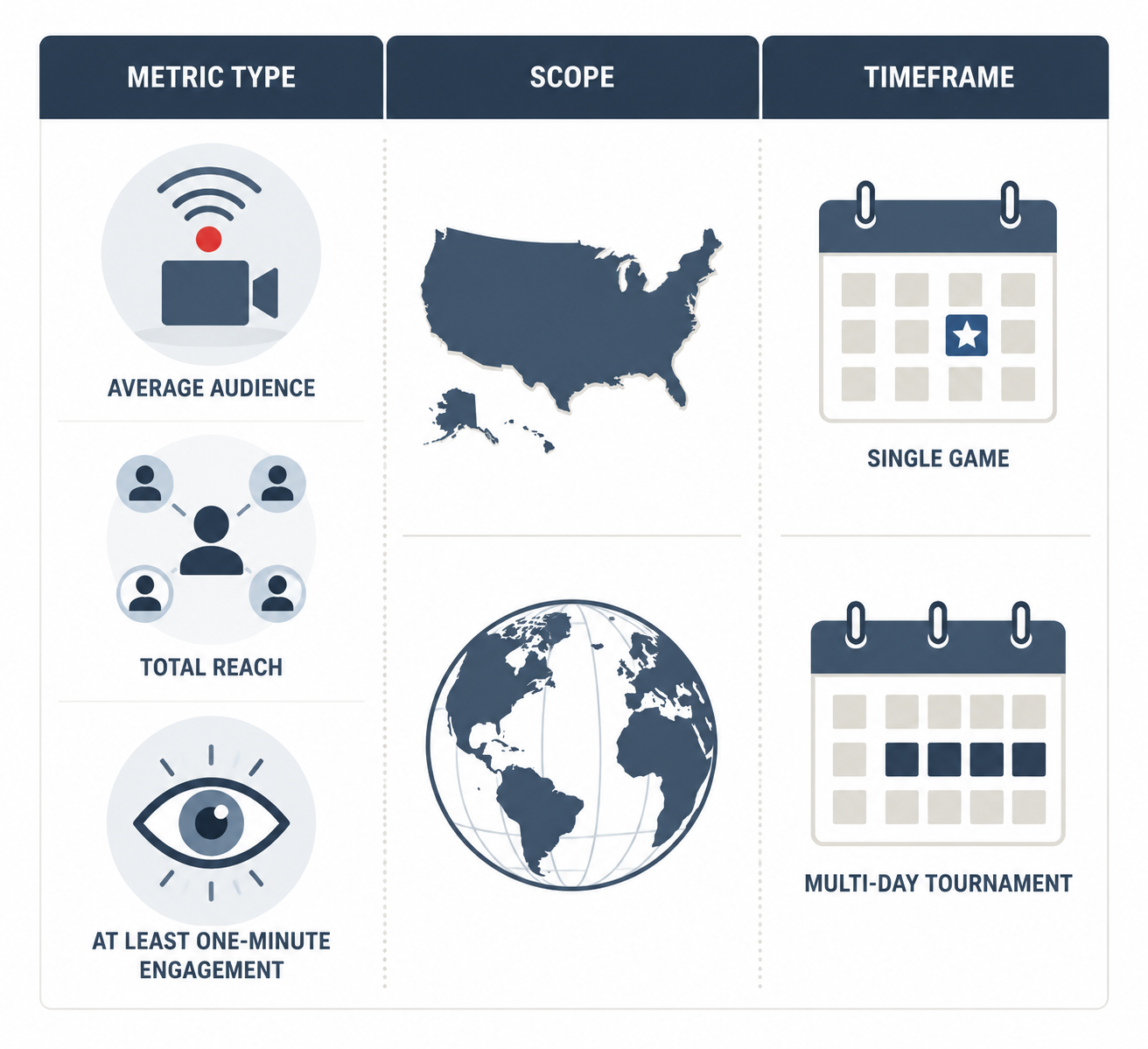
- Metric type: Is the number an average audience, total reach, peak audience, or at-least-one-minute engagement?
- Scope: Is the number U.S.-only, international-only, or global?
- Timeframe: Is the number for one game, one match, one broadcast window, or a full tournament?
- Source and method: Who produced the number, and did the measurement method change or get corrected?
Those checks may feel fussy, but they prevent the most common citation error: treating a large reach figure as if it were an average audience. Reach is usually easier to inflate because a person can count after watching briefly. Average audience is stricter because it estimates how many people were watching during the average minute.
Average Audience Is Not Total Reach
Average audience answers a question like this: during the program, how many people were watching at a typical moment? That is why the Super Bowl LX figure of 125.6 million is powerful but narrow. It describes average U.S. viewing for that broadcast, not every person worldwide who saw any part of the event.[1]
Total reach answers a looser question: how many people watched at least some part? FIFA's 1.5 billion figure for the 2022 World Cup final is a global figure, and it sits beside the more restrictive 571 million average live audience figure in FIFA's own report.[2] The contrast is the lesson. Even before the Super Bowl enters the comparison, the World Cup final changes size depending on which metric is being cited.
Peak audience is another separate category. Nielsen reported that the Bad Bunny halftime show during Super Bowl LX peaked at 128.2 million viewers, higher than the game's average audience.[1] That does not mean the halftime show had a larger full-event audience than the game. It means the highest measured moment exceeded the average across the broadcast.
U.S.-Only Is Not Global
The Super Bowl is often reported first through U.S. television measurement. The World Cup is usually discussed as a global event. If the comparison uses a U.S. Super Bowl number against a global World Cup number, the result may still be interesting, but it is not a same-scope comparison.
When the scope is narrowed to the United States, the answer changes. The Athletic's analysis cites about 25 million U.S. viewers for the 2022 World Cup final, compared with Super Bowl audiences well above 100 million in recent years.[4] That version of the comparison favors the Super Bowl because it is comparing U.S. audience to U.S. audience.
When the scope becomes global, the World Cup final is the larger object. But then a U.S.-only Super Bowl number is no longer the right comparison partner. The Athletic reported NFL figures placing Super Bowl LVIII's international audience at 62.5 million and its total global audience, including the United States, at about 264.9 million.[4] That still does not make the Super Bowl equal to the World Cup final globally, but it is closer to comparing one global figure with another global figure.
A Single Game Is Not A Tournament
The World Cup also creates a timeframe problem because it is both a final and a month-long tournament. FIFA reported that 5 billion people engaged with the 2022 World Cup across linear TV and digital platforms.[3] That number is not a final audience, and it is not an average audience for one broadcast. It is a tournament-wide engagement figure.
Using that 5 billion figure against one Super Bowl broadcast would combine three mismatches at once: engagement versus average audience, global versus usually U.S.-reported, and tournament versus single game. The mistake is not that FIFA's number is automatically wrong. The mistake is putting it in a role it was not built to play.
How The Answer Changes When You Control The Comparison
The fairest answer depends on which comparison you are actually making. A paper that says "the World Cup gets more viewers than the Super Bowl" needs to specify whether it means globally, in the United States, for the final, for the whole tournament, by average audience, or by reach.
| Question | Better Comparison | What The Evidence Supports |
|---|---|---|
| Which event had the larger U.S. audience? | U.S. World Cup final audience vs. U.S. Super Bowl audience | The Super Bowl is larger in the available cited comparison: about 25 million U.S. viewers for the 2022 World Cup final versus 125.6 million average U.S. viewers for Super Bowl LX.[1][4] |
| Which final/game had the larger global audience? | Global World Cup final audience vs. global Super Bowl audience | The World Cup final is larger in the cited figures, but the cleanest comparison should use global figures on both sides.[2][4] |
| Which sports property reached more people across an entire event period? | Entire World Cup tournament engagement vs. some broader Super Bowl/NFL event measure | FIFA's 5 billion tournament engagement figure shows enormous reach, but it should not be described as an average audience for one match.[3] |
| Can 1.5 billion and 125.6 million go in the same sentence? | Yes, if the sentence names the mismatch | They can be contrasted as global World Cup final reach versus average U.S. Super Bowl audience, not as identical measures.[1][2] |
That last row matters because students often think the only choices are "compare" or "do not compare." There is a third option: compare while naming the limits. For example, a careful sentence could say that the 2022 World Cup final reached 1.5 billion viewers globally, while Super Bowl LX averaged 125.6 million viewers in the United States; because these figures differ by metric and scope, they show the scale of each event but should not be treated as a direct ratings comparison.[1][2]
Why Impressive Ratios Need Extra Checking
Big sports comparisons attract rhetorical math. The Athletic examined FIFA president Gianni Infantino's claim that the 2026 World Cup would be like "104 Super Bowls" and found that the actual math behind the comparison was closer to about 47, depending on the assumptions used.[4] The useful part of that example is not the exact corrected ratio. It is the reminder that a ratio can sound precise while hiding a denominator problem.
A ratio should make the units more visible, not less visible. If one side is tournament attendance, another is television audience, or one is total matches while another is one championship game, the ratio may be doing more persuasion than measurement.
What To Do With 2026 World Cup Numbers
As of July 20, 2026, the 2026 World Cup final is too fresh for the safest full official audience comparison. That does not mean there is no evidence from the tournament. FIFA reported that the 2026 group stage set new viewership benchmarks, and NPR reported that Americans were showing up for the World Cup in record-breaking numbers.[5][6] Those are useful signals about attention and growth. They are not a substitute for final, method-documented audience figures for the championship match.
For a paper written now, the 2022 World Cup remains the safer complete reference point for a final because FIFA's audience report provides both the 1.5 billion global viewer figure and the 571 million average live audience figure.[2] A current article can mention 2026 group-stage momentum, but it should mark final viewership numbers as pending if official final data has not yet been released.
A Citation Workflow For Viewership Claims
Before using any World Cup or Super Bowl viewership statistic, rewrite the number in a fuller form. If the full form sounds awkward, that is usually a sign the original statistic was doing too much work.
- Name the event: Super Bowl LX, the 2022 World Cup final, or the full 2022 World Cup tournament.
- Name the metric: average audience, total reach, peak audience, or engagement.
- Name the scope: U.S., international, or global.
- Name the timeframe: one broadcast, one match, one halftime segment, or the full tournament.
- Name the source and note method changes or corrections when they affect interpretation.
Here is the difference in practice: "The World Cup had 1.5 billion viewers and the Super Bowl had 125.6 million" is under-labeled. "FIFA reported 1.5 billion global viewers for the 2022 World Cup final, while Nielsen reported 125.6 million average U.S. viewers for Super Bowl LX under its Big Data + Panel methodology" is longer, but it lets the reader see the comparison's limits.[1][2]
The same habit works outside sports. A chart about income, climate, polling, AI, or public health can also mix average, total, peak, national, global, annual, and one-day measurements. If you want more practice with evidence problems that look simple until the method appears, the same approach shows up in historical evidence evaluation, scientific convergence, and source verification for schoolwork.
The usable rule is simple: never cite a viewership number without naming the metric, scope, timeframe, source, and date or methodology note when relevant. Without those labels, the number may still be real, but the comparison is not ready.
References
- Super Bowl LX Delivers 125.6 Million Viewers — Nielsen
- FIFA World Cup Qatar 2022 — Global Engagement & Audience Report — FIFA
- FIFA World Cup Qatar 2022 In Numbers — FIFA
- Is the World Cup really the equivalent of 104 Super Bowls? — The Athletic
- Records tumble as FIFA World Cup 2026 Group Stage sets new benchmark — FIFA
- Americans are showing up for the World Cup in record-breaking numbers — NPR
Comments
Join the discussion with an anonymous comment.