
How do wind-powered cargo ships reduce fuel consumption?
Learn how rotor sails, wing sails, suction sails, and kite systems use wind to generate thrust and cut fuel consumption on cargo ships, with verified savings of 5–30% from real-world installations.
Updated:
Wind-powered cargo ships reduce fuel consumption by adding thrust from the wind so the main engine does less work. The ship is still usually burning fuel. The important change is the workload: part of the forward push comes from aerodynamic devices mounted on the vessel, and the engine can be throttled back while maintaining speed, or the same fuel burn can move the ship faster under favorable conditions.
That is the clean version of the answer. The less tidy, more useful version is that verified savings depend heavily on the device, vessel, route, wind direction, control system, and whether the ship was retrofitted or designed around wind from the start. DNV reports delivered savings from current wind-assisted propulsion installations in the 4.5% to 9% range, while individual trials and vendor-backed demonstrations show higher daily results under good conditions.[1]
The missing middle: wind becomes thrust, then lower engine load
A cargo ship needs thrust to overcome water resistance, wind resistance, and the energy losses in its propeller and hull. On a conventional vessel, nearly all useful thrust comes from the main engine turning the propeller. Wind-assisted propulsion adds a second source of thrust above deck. If the wind device produces a forward component of force, the propeller does not have to supply as much of it.
The device does not need to push exactly from behind like a square sail in an old painting. Modern systems often use lift, not simple drag. Air moves faster over one side of a wing, spinning cylinder, or suction-controlled surface than the other. That pressure difference creates a force. The control problem is to angle, spin, trim, or deploy the device so part of that force points in the ship’s direction of travel.
Once that forward force exists, the ship operator has choices. The engine can be reduced to hold the same arrival schedule with less fuel. The ship can maintain power and gain speed. Or, on some voyages, operators can adjust routing to spend more time in useful wind. Fuel savings appear when those operational choices turn aerodynamic help into lower engine demand rather than just extra speed.
Four systems, four ways to borrow force from the air
The word “sail” hides too much. A spinning cylinder, a rigid wing, a suction-assisted tower, and a kite are not interchangeable. They all reduce fuel in the same broad way — by supplementing the engine — but the physics and operating limits differ.
| Technology | How it creates useful force | What changes on the ship |
|---|---|---|
| Rotor sails | A powered cylinder spins in the wind and uses the Magnus effect to create a pressure difference. | The control system changes spin speed and operating status so the side force includes forward thrust. |
| Wing sails | A rigid aerofoil works more like an aircraft wing than a cloth sail, producing lift as air flows around it. | The wing angle is adjusted so part of the lift helps propel the vessel. |
| Suction sails | Fans draw air through slots or perforations to keep airflow attached to the surface. | Controlled airflow delays separation and can increase useful lift from a compact structure. |
| Kites | A large kite flies above the ship, reaching stronger and steadier winds than deck-mounted equipment. | The kite pulls through a tow line, adding forward force when launch, retrieval, and route conditions allow. |
Rotor sails: spinning cylinders and the Magnus effect
Rotor sails look almost suspiciously plain: tall cylinders standing on deck. Their trick is rotation. When a cylinder spins in moving air, one side of the cylinder moves with the airflow and the other moves against it. That changes air speed and pressure around the cylinder, producing a sideways lift force known as the Magnus effect.
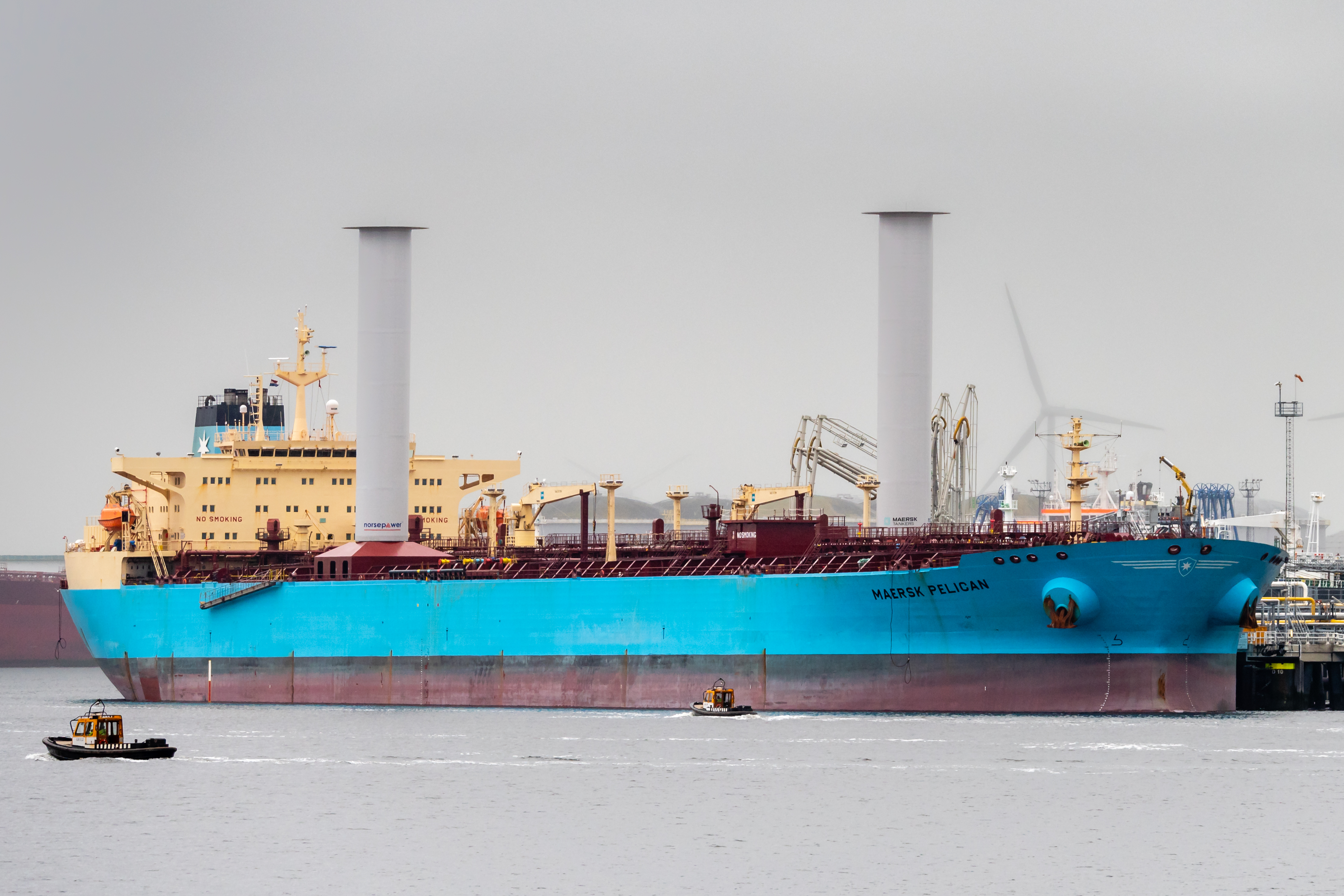
Sideways force is not automatically useful. The rotor has to be placed on a moving ship with a specific wind angle, and the vessel’s control system has to decide when the force helps. In favorable apparent wind, a component of the lift points forward. Then the engine can back off. In poor wind, the rotor may offer little benefit or may be stopped to avoid wasting power.
That small electric demand for spinning the cylinder is one reason the measured result matters more than the visual drama. A rotor sail is useful only if the extra propulsion it creates is greater than the energy it consumes and the operational complications it adds.
Wing sails: rigid aerofoils on cargo decks
Wing sails are easier to picture if they are treated as vertical aircraft wings rather than revived canvas. A rigid wing creates lift when air flows around its shaped surface. On a ship, that lift is managed so it contributes forward thrust instead of merely pushing the vessel sideways.
The wing can be large, which makes deck integration harder. Cargo operations, port clearance, visibility, bridge equipment, and stability all matter. But the size is also why wing-sail trials are interesting: a large rigid surface can capture enough wind energy for daily savings that become visible in fuel logs, not just in simulations.
Suction sails: keeping airflow attached
Suction sails add a more engineered wrinkle. Airflow over a lifting surface can separate, which reduces lift and increases drag. A suction sail uses controlled airflow, often by drawing air through openings, to keep the boundary layer attached for longer. The goal is not romance; it is a better lift-to-drag result from a structure compact enough to mount on a working ship.
Because fans and control systems are involved, the same practical test applies as with rotor sails: the net result matters. A suction sail has to create enough extra useful thrust to justify its own energy use, maintenance, weight, and deck footprint.
Kites: stronger wind above the deck
Kites attack a different limitation. Wind near the deck can be blocked, turbulent, or simply weaker. A kite flies higher, where wind can be stronger, and pulls the ship through a tow line. The fuel-saving mechanism is direct: the kite adds forward pull, and the engine can supply less thrust.
The complication is handling. Launch, retrieval, crew workload, automation, restricted waters, and changing weather all affect whether the kite can be used during enough of a voyage to matter. A kite can be elegant physics and still be a difficult commercial object.
What has actually been verified?
The most useful fuel-saving claims are tied to named vessels, measured voyages, or independent verification. This is where wind-assisted propulsion becomes less like a concept image and more like machinery.
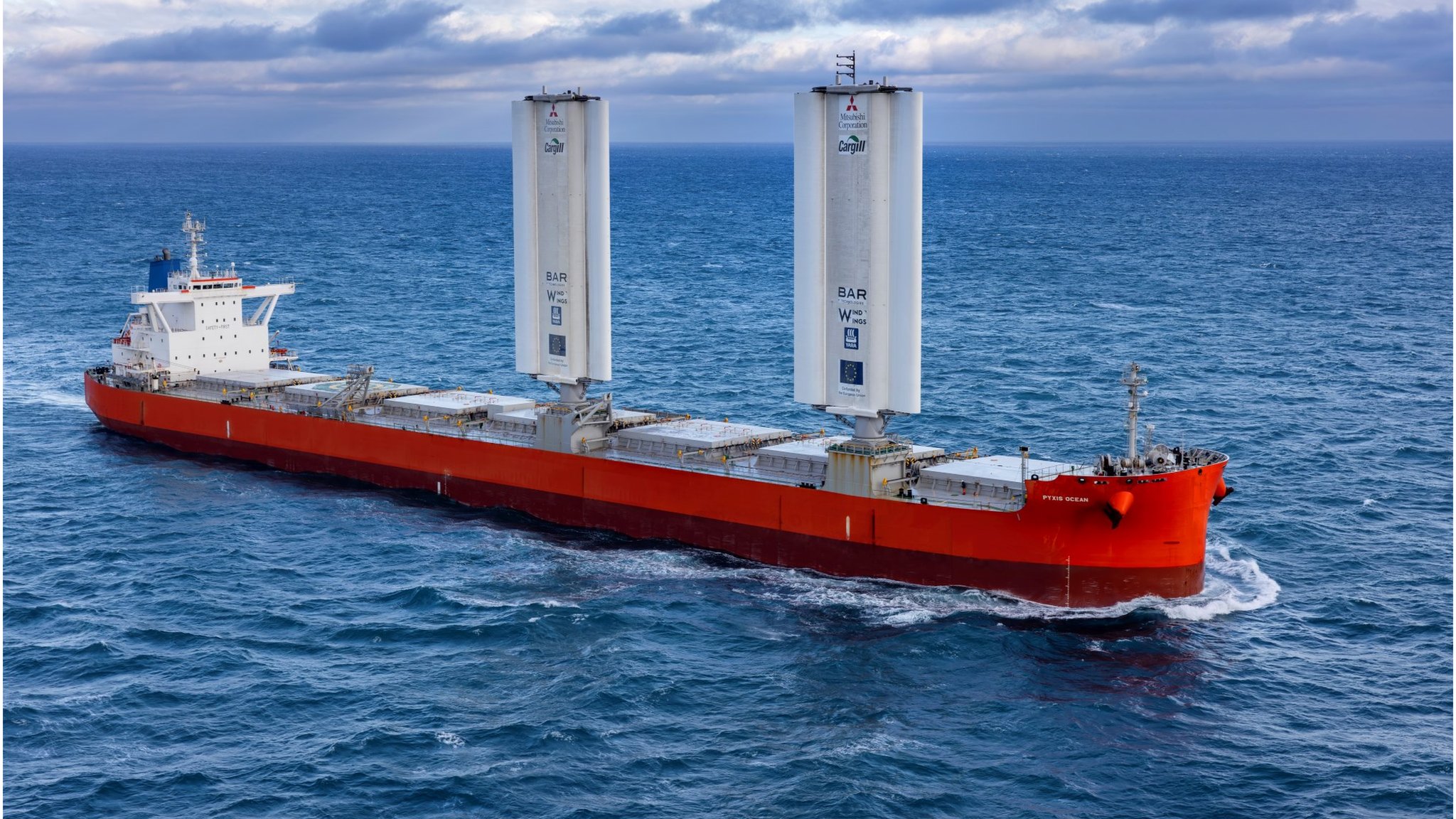
The cleanest example is the Pyxis Ocean, a bulk carrier fitted with two WindWings. During its trial period, the vessel achieved average fuel savings of 3.3 tons per day and peak savings of 12 tons per day. The same reporting described a daily CO₂ reduction of about 20 tons.[2][3]
Those numbers are useful because they connect the entire causal chain. The wings did not make the ship “zero-emission.” They supplied enough aerodynamic thrust on certain parts of the route for the engine to burn less fuel. The average and peak figures also show why a single percentage can be misleading: wind assistance is lumpy. On one day, the system may be doing modest work. On another, the wind angle and speed may let it carry a much larger share of the propulsion load.
Rotor sails have their own measured example. The Maersk Pelican, later known as Timberwolf, achieved 8% fuel savings in its first year after rotor sails were installed, according to BBC reporting in 2025.[4] That is not a cinematic number, but it is commercially meaningful. For a ship that operates many days a year, an 8% reduction changes fuel bills and emissions without asking the vessel to stop being a cargo ship.
Another rotor-sail case, the Sohar Max ore carrier fitted with Anemoi rotor sails, has been reported with an expected fuel reduction of 6%.[4] The wording matters. “Expected” is not the same as a completed, independently verified annual result. It is still relevant because it sits near the DNV delivered-savings range, not because it proves that every similar vessel will save exactly that amount.
DNV’s range of 4.5% to 9% delivered savings from current installations is a useful guardrail precisely because it is less glamorous than the biggest demonstration figures.[1] It says: yes, these systems can reduce fuel burn on working ships; no, a high projected percentage should not be treated as normal until measured on the water.
Why the same sail does not save the same fuel on every ship
Wind savings vary because the ship is moving through two fluids at once: water and air. The propeller and hull determine how much engine power is needed. The wind device determines how much useful force can be added above deck. The route decides how often the weather cooperates.
- Route: A vessel that regularly meets favorable crosswinds has more usable wind energy than one on routes with calm air, headwinds, or restricted operating windows.
- Vessel type: Bulk carriers, tankers, ro-ro ships, and container ships have different deck space, stability limits, cargo-handling needs, and speed profiles.
- Retrofit versus newbuild: A retrofit must work around the ship that already exists. A newbuild can place equipment, structure, controls, and cargo systems around wind assistance from the beginning.
- Operating strategy: A device saves more fuel when voyage planning and engine control actually convert wind thrust into lower fuel burn.
- Automation: Control software decides when to deploy, rotate, feather, spin, or shut down equipment so that the device helps rather than interferes.
Automation deserves attention, but not mysticism. Norsepower says its AI-driven Sentient Control system can improve savings by 10% to 20% on top of base rotor-sail performance.[5] That is a claim about optimizing an existing wind device — choosing better operating points, reducing missed opportunities, and reacting to changing conditions. It should not be read as a magic multiplier that turns every rotor installation into a high-savings case.
Newbuild claims need the same discipline. Companies developing purpose-built sailing cargo ships have publicized very high projected reductions, including claims of 80% for Neoliner Origin and 96% for Vela. Those figures may describe design ambition, but they are not the same kind of evidence as Pyxis Ocean’s measured daily fuel savings or DNV’s delivered-savings range. Until independently verified in service, they belong in the projection column, not the proof column.
Momentum is real, but forecasts are not fuel logs
The industry is no longer at the stage of one-off sketches. The International Windship Association has projected 5,000 to 10,000 wind-assisted propulsion installations by 2032, and an early-2025 snapshot counted 52 vessels with systems installed and 97 on order.[6] By mid-2026, that snapshot is likely conservative, but it is still a snapshot from an industry association, not a verified savings result for each installation.
This distinction matters for student research. Adoption tells you that shipowners, charterers, and technology suppliers see enough value to install equipment. Effectiveness tells you how much fuel was saved after the ship sailed. A serious explanation of how wind-powered cargo ships reduce fuel consumption can use adoption data for context, but it should use measured savings to support the main claim.
Why fuel savings matter more in 2026
Fuel has always been a cost. In 2026, fuel reduction also interacts more directly with compliance. The EU Emissions Trading System is fully covering shipping by 2026, which means emissions from covered voyages can carry a carbon-cost exposure, not just an environmental label.[7] FuelEU Maritime also includes a wind reward factor that can recognize wind-assisted propulsion in compliance calculations.[7]
The International Maritime Organization’s Carbon Intensity Indicator adds another administrative pressure by rating ships on operational carbon intensity.[8] A wind device that cuts fuel burn can therefore help in three linked ways: it reduces bunker fuel use, lowers associated CO₂ emissions, and can improve the vessel’s position under rules that increasingly attach money or ratings to carbon performance.
The regulation does not change the physics. A rotor still needs useful apparent wind. A wing still needs the right angle of attack. A kite still needs launchable conditions. What regulation changes is the value of each ton of fuel not burned. A moderate verified saving can become more attractive when it also reduces carbon costs and compliance pressure.
A usable answer for research papers
Wind-powered cargo ships reduce fuel consumption by shifting part of the propulsion workload from the engine to aerodynamic devices. Rotor sails use the Magnus effect, wing sails use aerofoil lift, suction sails use controlled airflow attachment, and kites use stronger winds above the vessel. In each case, the device has to create forward thrust that the operator converts into lower engine power.
The technology is proven, but conditional. Current delivered savings reported by DNV sit at 4.5% to 9%, while named trials such as Pyxis Ocean show that larger daily reductions are possible under favorable conditions.[1][2][3] The strongest claims are tied to measured ships, stated time periods, and clear operating contexts. The weakest claims ask readers to treat a design target as if it were already a fuel log.
So the careful conclusion is not that sails have replaced engines. They have not, at least not for most present commercial cargo operations. The better conclusion is that wind-assisted propulsion can supply part of a ship’s thrust, reduce engine load, and cut fuel burn when the route, vessel, equipment, and control strategy line up.
References
- Wind assisted propulsion systems, DNV,
- This cargo ship is using wind power to cut down on fuel use, NPR, 2023/10/05,
- Cargo ship fitted with WindWings sets sail, EU CINEA, 2023/08/22,
- Can ships go back to using sails?, BBC News, 2025,
- Norsepower Sentient Control, Norsepower,
- Market intelligence, International Windship Association,
- EU ETS and FuelEU Maritime: what ship owners need to know, Wärtsilä,
- Shipping’s Carbon Rules Are Getting Tougher, Forbes, 2025/02/21,
Comments
Join the discussion with an anonymous comment.