
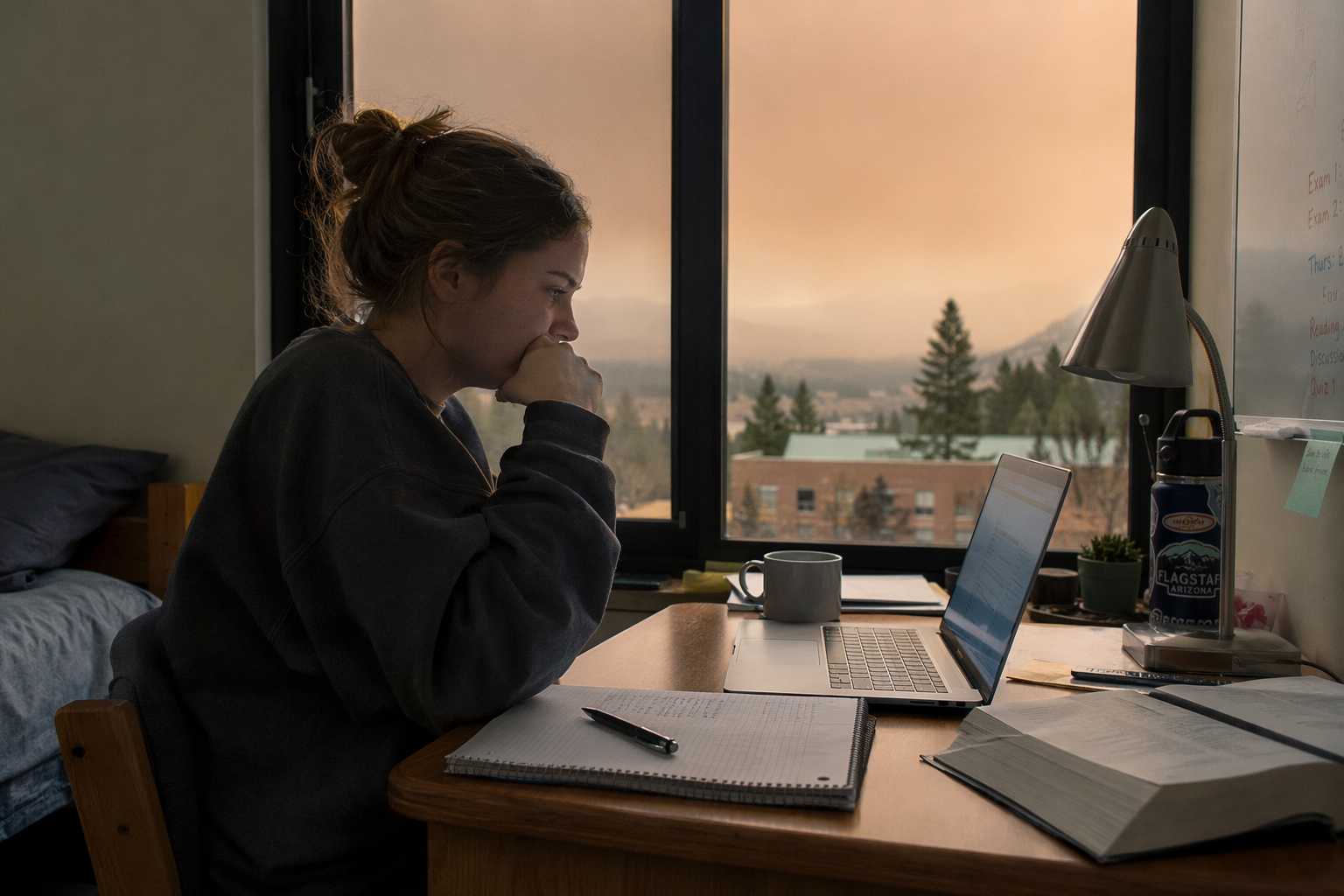
How Wildfire Smoke Impairs Your Studying and Concentration
Wildfire smoke can measurably impair concentration, memory, and cognitive performance within hours through PM2.5-triggered neuroinflammation. This article explains the biological mechanisms behind the brain fog and recommends evidence-backed strategies to protect your study focus during smoke events.
Updated:
Wildfire smoke can make studying harder within the same afternoon it arrives. In one large analysis of 10,228 adults using a brain-training task, each 10 μg/m³ increase in PM2.5 during the three hours before the task was associated with a 21-point lower attention score; heavy smoke density the previous day was associated with a 117-point lower score.[1] The EPA describes the same short window plainly: fine particulate matter can reduce attention in adults within hours of exposure.[2]
That matters for students because studying is mostly attention under pressure: holding a definition in mind, comparing two formulas, reading a paragraph without losing the thread, noticing the one word that changes a test question. When smoke moves in and those tasks suddenly feel heavier, the first useful correction is not moral. It is biological.
The academic signal shows up outside lab-style cognitive tasks too. Stanford researchers reported that wildfire smoke exposure lowered test scores across 11,700 U.S. school districts, with measurable declines even at low smoke levels; the effect nearly doubled when exposure happened during school hours rather than on weekends.[3] That timing is hard to ignore. It points toward the air in the learning space, not just the general stress of fire season.
The Problem Is PM2.5, Not Weak Discipline
Wildfire smoke is a mixture, but the study-focus problem centers on fine particulate matter, especially PM2.5. These particles are small enough to travel deep into the lungs. From there, evidence reviewed by wildfire and brain-health researchers indicates that PM2.5 can cross the blood-brain barrier and trigger inflammation in the hippocampus, a brain region involved in learning and memory.[4]
A 2024 review in JAMA Neurology also describes another route: PM2.5 may bypass the blood-brain barrier through axonal transport along sinus nerves.[5] The practical meaning is not that every smoky day causes the same amount of harm, or that one exposure explains every bad study session. It means smoke has biologically plausible, near-term pathways into systems students rely on for concentration, memory, and flexible thinking.
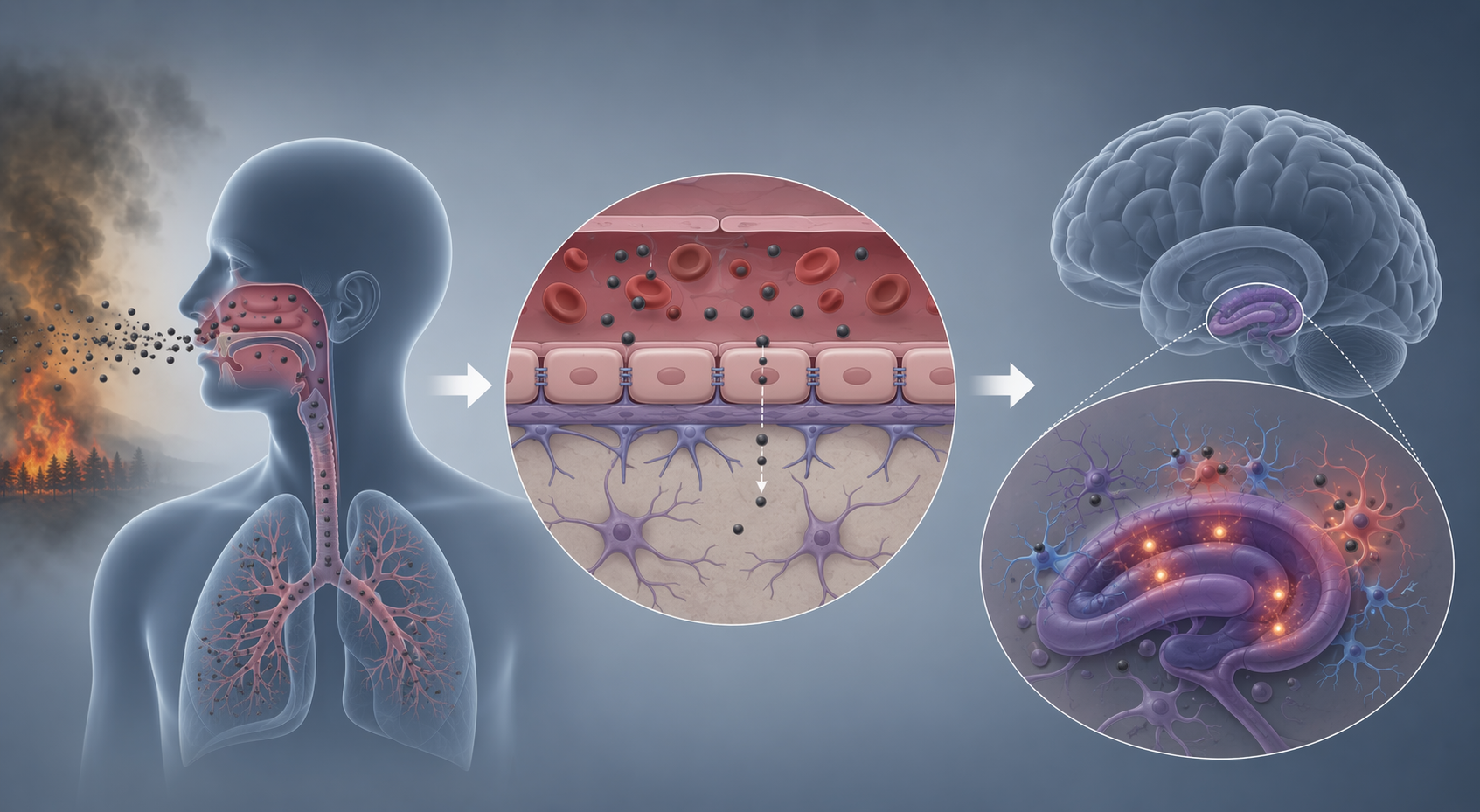
The hippocampus piece is especially relevant to studying. A student can still look busy while the system underneath is less efficient. Notes get copied, tabs stay open, a timer runs, but encoding is poorer and review takes longer. That is different from laziness. It is what happens when the brain is asked to do high-precision work while an inflammatory exposure is active.
The evidence is strongest when kept narrow. Cleland and colleagues measured attention through Lumosity, a commercial brain-training platform, not a full clinical neuropsychological exam.[1] The school-district findings are about K-12 academic outcomes, not college midterms or graduate qualifying exams.[3] Direct research on college-age students studying during wildfire events is still thinner than anyone working with students would like. But the pattern across short-term attention findings, school performance, and plausible brain mechanisms is strong enough to change how a smoky study day should be handled.
What Usually Changes During a Smoky Study Session
Smoke does not need to make a student feel dramatically ill to interfere with work. The first losses are often ordinary-looking: rereading the same paragraph, forgetting what the problem asked, losing place in a multi-step proof, or needing more time to switch from lecture notes to practice questions.
| Study Function | What Smoke Can Make Harder | What That Looks Like |
|---|---|---|
| Attention | Staying on the same task long enough to complete it | More rereading, more tab-switching, more unfinished problem sets |
| Working memory | Holding several pieces of information at once | Losing the first part of a sentence, formula, or argument before reaching the end |
| Learning and recall | Encoding new material cleanly enough to use later | Studying for an hour but remembering less than expected the next day |
| Executive function | Planning, shifting, and correcting errors | Taking longer to choose what to do next or missing obvious mistakes |
These are exactly the kinds of losses that students tend to personalize. They decide they are behind, undisciplined, or suddenly bad at a subject. Sometimes they are simply studying in dirty air.
The Most Defensible Fix Is Cleaner Study Air
If smoke is affecting concentration through inhaled fine particles, the first intervention should be environmental. Not a better mantra. Not a more punishing schedule. Cleaner air.
Harvard Health recommends creating a clean room during wildfire smoke events by closing doors and windows and using a properly sized HEPA air purifier.[6] For studying, that room should be treated as the high-value workspace: the place for reading dense material, writing, problem solving, memorization, and exams if they must be taken remotely.
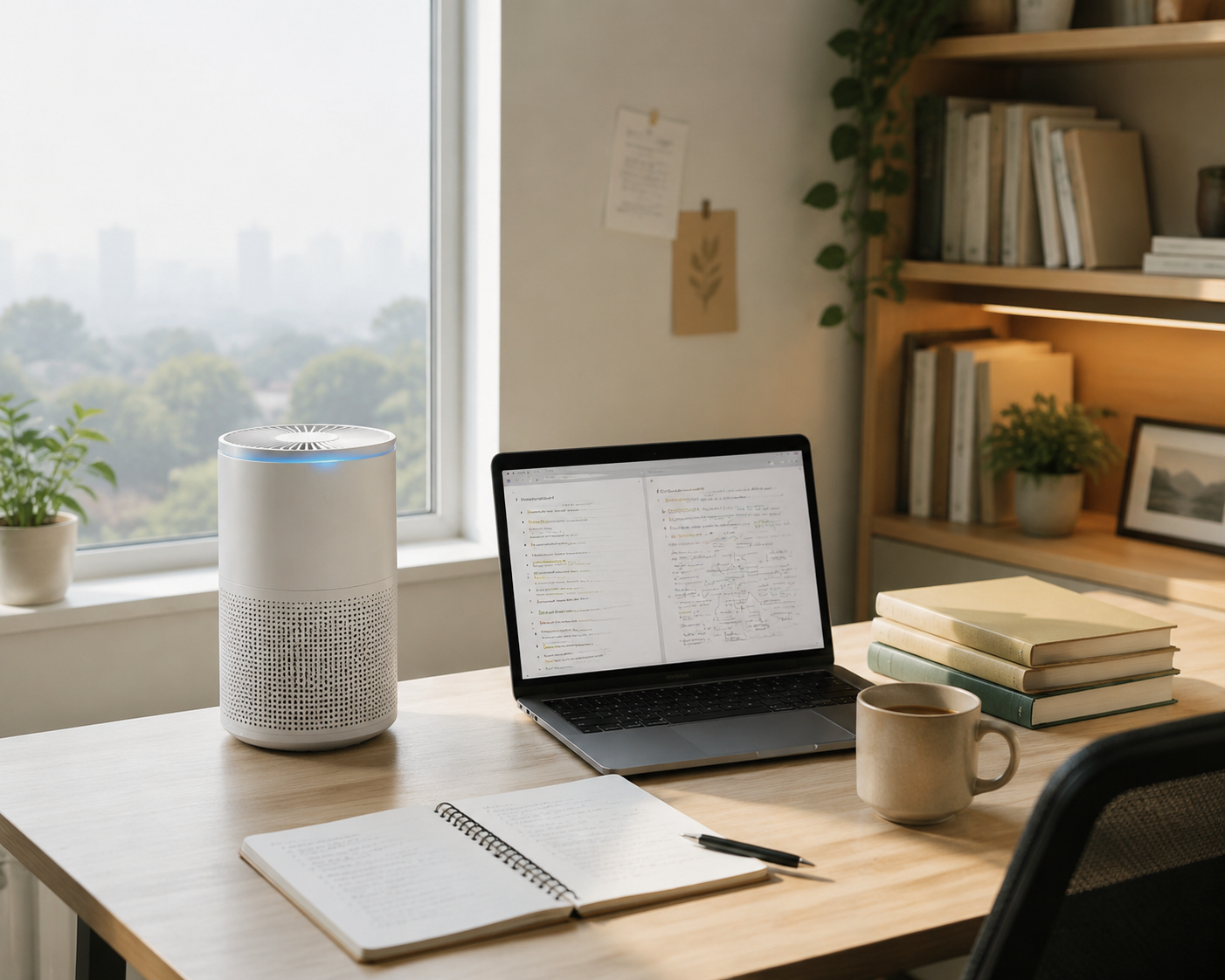
HEPA evidence is not perfect for the exact student-and-wildfire question, but it is useful. In a 2026 randomized crossover trial of adults aged 40 and older living near highways, HEPA filtration reduced indoor PM2.5 by 52% and improved cognitive performance, including executive function and mental flexibility, by 12%.[7] That study involved traffic pollution, not wildfire smoke, and older adults, not undergraduates. Still, the mechanism is relevant: lower indoor PM2.5, then measure cognition.
Another indoor-air-quality study reported that cognitive test scores were 61% higher on days with better air quality and 101% higher when better air quality was paired with improved ventilation.[8] This does not mean a student can buy their way out of every smoke event. It does mean the air around the desk is part of the study setup, just like light, noise, and internet access.
A clean study room does not need to be elaborate. The point is to reduce the particle load where the hardest thinking happens.
- Choose one room for serious study during smoke events, preferably a smaller room where doors and windows can stay closed.
- Use a HEPA purifier sized for that room rather than expecting one small unit to clean an entire apartment or dorm suite.
- Keep the cleanest-air tasks there: exams, problem sets, close reading, writing, coding, and memorization.
- Move lower-cognitive-load tasks, such as organizing files or formatting notes, to times or places where the air is less controlled.
- If noise is also stealing attention, treat sound control as part of the same environment design; a quieter setup or the right study headphones can reduce one more avoidable load.
For the noise piece, a guide to headphones for studying and focus can help, but sound control is secondary on a smoke day. The air comes first because the exposure is not just distracting. It is physiologically active.
Adjust the Workload Instead of Pretending the Day Is Normal
Once the air is as controlled as possible, the next move is to lower the cognitive load. That does not mean giving up. It means matching the work to the conditions instead of demanding smoke-day performance from a brain under particle exposure.
On a worse-air day, the highest-risk tasks are the ones that require sustained attention and new encoding: learning a brand-new chapter, writing an argument from scratch, taking a timed practice test, or solving unfamiliar problems. If those tasks cannot be moved, put them in the cleanest room and give them the best hours available. If they can be moved, shift them.
| If the Air Is Worse | Prefer | Avoid When Possible |
|---|---|---|
| You still need to study | Reviewing already-learned material, making flashcards, checking solutions, organizing notes | Starting the hardest new concept of the week in uncontrolled air |
| You have an exam soon | Shorter focused blocks in the cleanest room, with error review after each block | Long, uninterrupted cramming that treats fatigue as a discipline problem |
| You feel unusually foggy | Tasks with visible checkpoints: five problems, one outline, one page of recall | Open-ended reading with no stopping point |
| You share housing | Scheduling clean-room study time around roommates or family needs | Assuming the whole home has the same air quality |
This is also where instructors, advisors, and parents can either help or make things worse. A student asking to move a remote exam out of a smoke-heavy afternoon is not asking for comfort theater. They may be asking to avoid taking a high-stakes cognitive task during the exact exposure window where attention has been shown to drop.[1][2]
Food Can Support the System, But It Cannot Clean the Air
Diet belongs in this conversation only if it stays in its lane. The 2024 JAMA Neurology review notes that omega-3s, vitamin C, and Mediterranean dietary patterns may help blunt inflammatory responses related to PM2.5 exposure.[5] That is a support strategy, not a shield.
For a student, the reasonable version is modest: eat normally, include anti-inflammatory foods when available, and avoid turning a smoke event into a week of skipped meals and caffeine-only studying. A meal with fish or another omega-3 source, fruit or vegetables with vitamin C, whole grains, beans, nuts, or olive oil fits the evidence direction better than a supplement panic-buy. But none of that substitutes for reducing PM2.5 in the room where the studying happens.
What the Evidence Does Not Yet Prove
The honest version has limits. Much of the direct cognitive evidence uses adult samples or K-12 academic data rather than college students sitting through a smoke-season finals week. Some filtration evidence comes from traffic-pollution settings, where PM2.5 is important but the source mixture differs from wildfire smoke.[7] Neurological research on wildfire smoke is still relatively young, and long-term dose-response patterns are not settled.
Those limits should prevent overclaiming, not inaction. The question for a student is not whether every pathway has been mapped perfectly. It is whether the available evidence is strong enough to change the plan on a smoky day. For attention, learning, and test performance, it is.
A Practical Rule for Smoke Days
If the air is worse, expect cognition to be worse. That expectation is not defeatist; it is protective. It keeps students from interpreting particle exposure as a personality flaw.
Protect the study space first. Put the hardest work in the cleanest air you can access. Reduce the number of decisions the session requires. Use shorter blocks with clearer endpoints. Eat in a way that supports inflammation control if you can, but do not pretend food can do the work of filtration.
Wildfire smoke does not make studying impossible for everyone every time. It does make concentration more biologically expensive. The fix is partial protection and clearer expectations: change the air, lower the load, and stop treating smoke-day brain fog as a failure of willpower.
References
- Associations of Wildfire Smoke PM2.5 Exposure with Attention in a Cognitive Task: A Longitudinal Study of U.S. Adults, Environmental Health Perspectives
- Fighting Haze: The Effects of Wildfire Smoke and Particulate Matter on Brain Function, EPA Science Matters
- Wildfire smoke exposure hurts learning outcomes, Stanford Report, September 2022
- How does wildfire smoke affect the brain?, International Association of Wildland Fire
- Air Pollution and Brain Health: An Emerging Issue, JAMA Neurology, 2024
- Wildfires: How to cope when smoke affects air quality and health, Harvard Health Publishing, June 23, 2023
- Portable air filtration and cognitive function in adults exposed to traffic-related air pollution: a randomized crossover trial, Scientific Reports, 2026
- How Does Air Quality Impact Learning and Productivity in Schools? Air Pollution and Productivity Explained, Camfil
Comments
Join the discussion with an anonymous comment.