
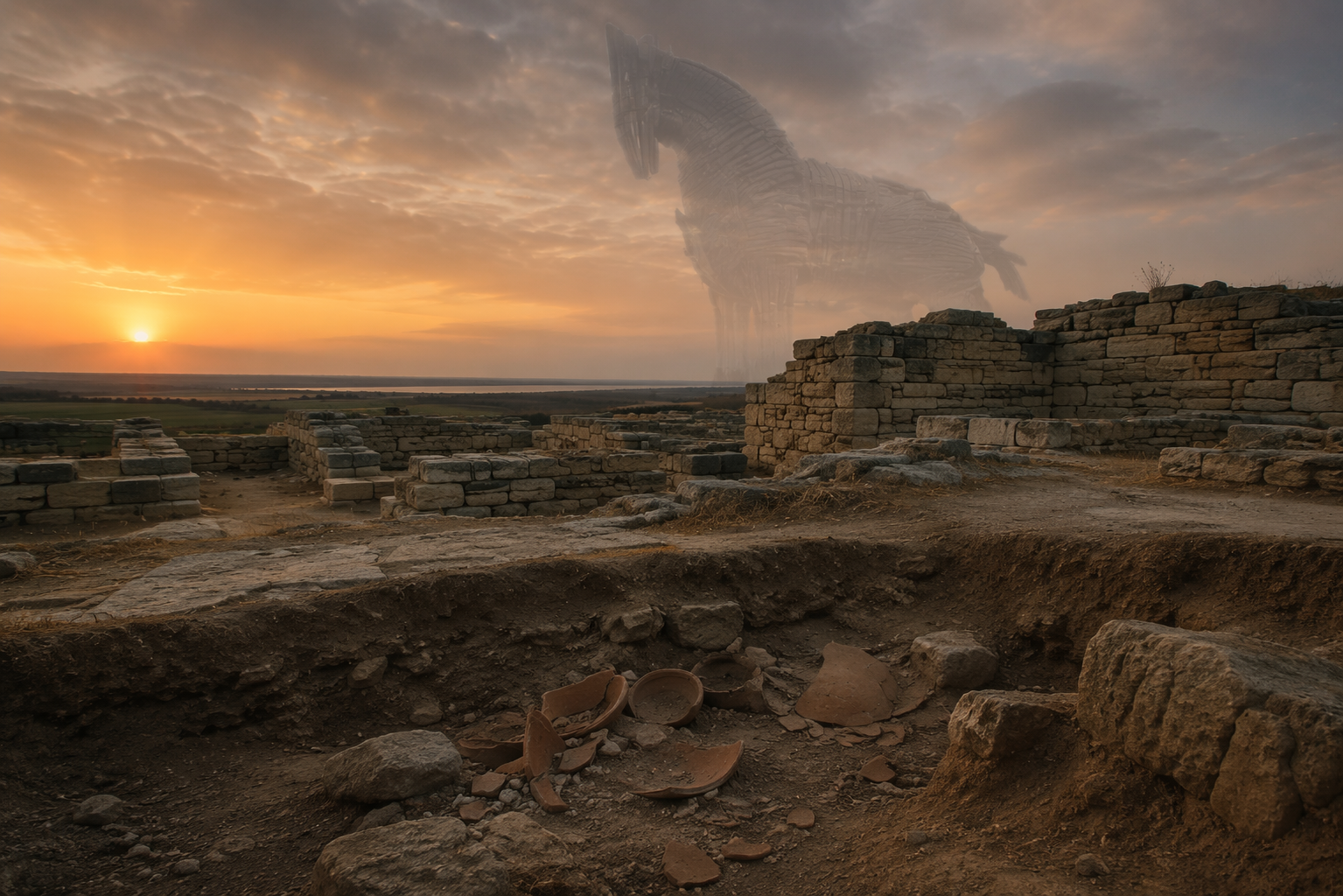
Was the Trojan Horse Real? A Study in Historical Evidence Evaluation
Learn how historians evaluate ancient claims by using the Trojan Horse as a case study. This guide presents a five-evidence-type methodology to understand why most scholars consider the horse mythological, and how that critical thinking applies to any historical question.
Updated:
The newest evidence from Troy does not give us a wooden horse. It gives us something less cinematic and more useful: signs of fighting. In 2025, Archaeology Magazine reported that excavations led by Rüstem Aslan uncovered caches of sling stones at Troy, strengthening the case for military conflict in Troy VIIa, a destruction level often dated around 1180 BC.[1] That matters because the question “was the Trojan Horse real?” is too blunt. A real war, a remembered siege, a poetic tradition, and a famous trick are not the same claim.
A student can get into trouble by collapsing those claims into one answer. If there was conflict at Troy, that does not prove that Greek soldiers hid inside a horse. If the horse is mythological, that does not prove that Troy itself was imaginary. The better question is: what kind of evidence would each part of the story require, and what kind of evidence do we actually have?
Start with the ground, but do not ask it to speak in poetry
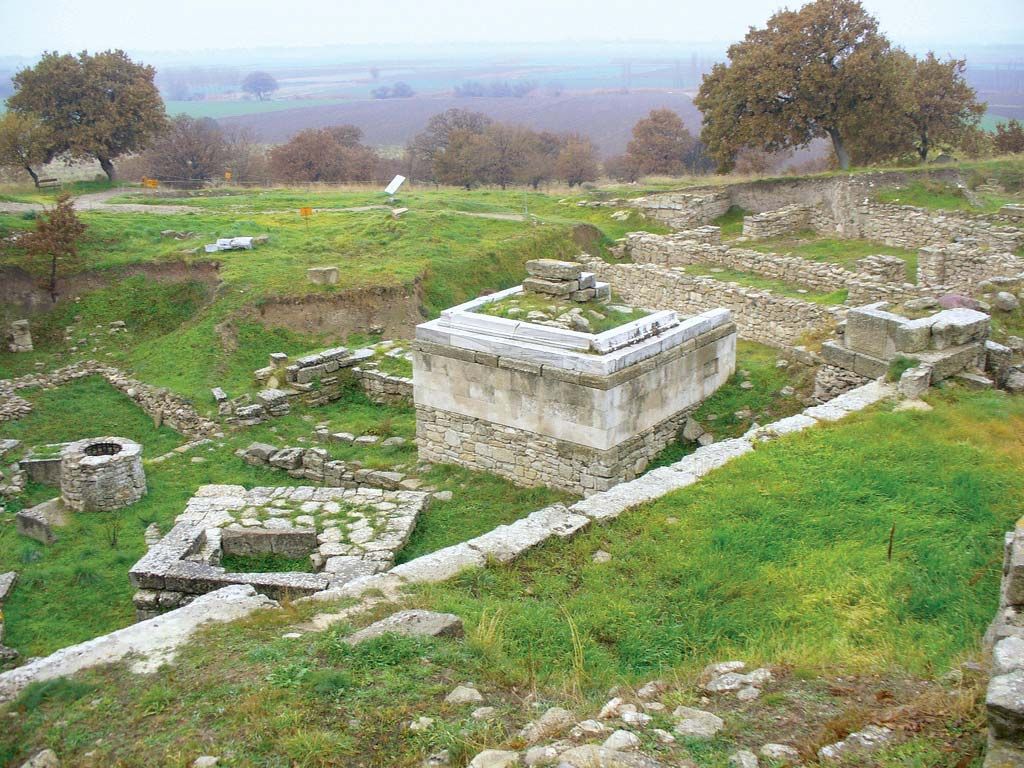
Archaeology is usually the safest place to begin because it can fix attention on material traces: walls, burned layers, weapons, pottery, human remains, settlement changes. It is also the easiest evidence to overread. A cache of sling stones can point toward preparation for violence or an episode of conflict. It cannot identify Achilles, confirm a ten-year war, or reconstruct a wooden horse being pulled through a gate.
The 2025 sling-stone finds are important precisely because they narrow the question responsibly. They strengthen the case that Troy VIIa was not merely a literary backdrop but a place where violence may have occurred in the Late Bronze Age.[1] They do not turn the later epic story into a transcript. Ongoing excavations may sharpen or revise the interpretation, and a single category of find should not be made to carry the whole Trojan War tradition.
The site itself is complicated enough without adding certainty that the evidence cannot bear. Hisarlik, the mound identified with Troy, contains multiple settlement layers, and scholars have long debated which layer, if any, best corresponds to a historical conflict remembered in Greek epic. World Archaeology’s discussion of the site emphasizes that the “Trojan War” is not something archaeology uncovers as one neat object; it is a story later readers try to connect to destruction levels, fortifications, and patterns of occupation.[2]
This is the first rule for studying the Trojan Horse as a historical deception claim: match the conclusion to the evidence type. Archaeology can make a historical conflict more plausible. It can show destruction, repair, weapons, or stress at a site. Unless something much more direct appeared, it cannot prove the particular deception described in later tradition.
The Iliad is not where many readers expect the horse to be
The literary evidence is powerful, but it is not simple. Many modern readers meet the Trojan Horse as if it belonged naturally to Homer’s Iliad. It does not. The Iliad focuses on a short span near the end of the war and does not narrate the fall of Troy through the horse. The Odyssey refers to the horse story, but that is a different poem, with a different narrative purpose and its own problems of dating and transmission.[3]
That absence matters, but it has to be handled carefully. It would be too easy to say, “The Iliad leaves it out, so the horse was invented later.” The Homeric poems stand at the end of a long oral tradition, and the dating of their composition remains bound up with the Homeric question: whether one thinks in terms of composition around the eighth century BC, centuries of oral development, or some combination of performance, stabilization, and later textual form. A story can be old and still absent from a particular poem; a story can also become famous later and be retrofitted into a larger legendary cycle.
The later textual tradition is full of variation. Ancient sources differ on details such as how many warriors were hidden inside the horse, with reported numbers ranging from 23 to 3,000.[3] That range is not a small footnote. It shows that the tradition was not preserving one stable operational account of a military trick. It was transmitting a memorable story whose details could expand, contract, and change according to genre, audience, and purpose.
Julia Kindt, writing in History Today, argues that the horse is best understood as a cultural symbol rather than a recoverable historical event.[4] That judgment fits the evidence better than either extreme. The story clearly mattered in Greek and later imagination. It became a way to think about deception, victory, divine favor, and the collapse of a city from within. But cultural importance is not the same as factual reporting.
A useful paper separates claims before judging them
One reason essays on this topic go wrong is that they treat “real” as if it had only one meaning. It is better to split the question into smaller claims and ask what would count as evidence for each one.
| Claim | What the evidence can reasonably support | What it cannot prove |
|---|---|---|
| Troy was a real place | Archaeology at Hisarlik supports a real ancient settlement with multiple occupation layers. | It does not prove every event in epic tradition. |
| Troy experienced violent conflict | Sling-stone caches and destruction evidence can strengthen the case for fighting in or around Troy VIIa. | They do not identify the attackers or confirm the full legendary war. |
| A Trojan War tradition preserved historical memory | Oral poetry may preserve traces of past conflict while reshaping them over time. | It cannot be treated as a modern eyewitness report. |
| Greek soldiers hid inside a wooden horse | Literary and artistic sources show that the story became famous. | No physical or contemporary evidence currently verifies the event as described. |
This separation is not a way of dodging the answer. It is the answer-producing method. The more specific and dramatic the claim becomes, the more direct the evidence must be. A city can be real, a conflict can be plausible, a memory can be old, and a particular episode can still be mythological.
The Mykonos Vase shows reception, not verification
Visual evidence adds another layer, and the Mykonos Vase is the object students should know. Usually dated to around 675 BC, it is widely identified as the oldest known visual depiction of the Trojan Horse. The vase shows warriors inside the body of the horse and scenes associated with the sack of Troy.[5]

The vase is vivid enough to tempt a bad argument: people were picturing the horse by the seventh century BC, so the event must have happened. That does not follow. The object proves that the story had entered visual culture by that period. It helps date the reception and circulation of the motif. It does not reach back across centuries and certify a Late Bronze Age deception.
Still, the vase is not trivial. It shows that the horse was not just a passing line in a text. By the early Archaic period, artists and audiences could recognize the image. The story had become narratable in clay, not only in song. For historical evaluation, that is evidence of tradition, not evidence of the original event.
Why scholars keep proposing other explanations
Because the literal horse is poorly supported, scholars and popular writers have tried to explain what may lie behind it. The main alternatives usually include a siege engine, an earthquake, a ship-related misunderstanding of the word or image of the horse, or a literary invention shaped by the needs of the story.[6] These theories are not equal to proof. They are attempts to account for why this particular symbol, rather than some other image, became attached to Troy’s fall.
The siege-engine theory has an obvious attraction: ancient warfare did involve devices used against walls, and later readers might have misunderstood or dramatized such a machine as a wooden horse. The earthquake theory points in another direction, since Poseidon was associated both with horses and earthquakes, making the horse a possible symbolic trace of a natural disaster rather than a military trick. The ship theory depends on language and maritime association. The literary-invention theory asks whether the horse functions best as narrative architecture: a compact, unforgettable way to make Troy fall through deception after direct force has failed.
None of these explanations should be crowned simply because they sound clever. A siege engine, an earthquake, a ship, and a poetic symbol belong to different kinds of argument. Each would need different supporting evidence. At present, the safest conclusion is narrower: the literal hidden-warrior horse is not well supported, while several explanations remain possible for how the tradition formed.
Consensus has shifted because the question has improved
Modern scholarship on Troy has not moved in a straight line from belief to debunking. The more interesting change is methodological. Earlier arguments often asked whether Homer was true. Better arguments ask which parts of the tradition might preserve historical memory, which parts belong to poetic elaboration, and how far any specific claim can be traced through evidence.
BBC Culture’s discussion of the Trojan War historicity question reflects that wider caution: scholars may take the possibility of conflict around Troy seriously while remaining careful about the epic details.[7] That distinction is the center of the problem. “The Trojan War happened” can mean anything from “a Late Bronze Age conflict helped inspire later stories” to “the events of epic poetry occurred as narrated.” Those are not interchangeable.
Accessible summaries often reach the same practical endpoint. Mental Floss, for example, presents the general conclusion that historians do not treat the Trojan Horse as a verified historical device, even though Troy and a background of conflict remain serious subjects of inquiry.[8] HISTORY.com likewise treats the familiar horse story as part of a larger debate about deception, gullibility, and tradition, not as settled military history.[9]
The disagreement among experts is not an embarrassment to hide from the reader. It is part of the evidence story. Ancient history often works with late texts, partial material remains, and traditions that were not designed to satisfy modern evidentiary standards. A responsible answer keeps those limits visible instead of sanding them down into confidence.
So, was the Trojan Horse real?
As a literal wooden horse that carried Greek soldiers into Troy exactly as later tradition tells it, the Trojan Horse is almost certainly mythological. There is no physical trace of such an object at Troy, no contemporary Late Bronze Age account of the deception, and no stable early textual record that lets us reconstruct the event as history. That is not the same as saying the story is worthless or that nothing historical lies behind the Trojan tradition.
The stronger answer is layered. Archaeology supports a real place and may support violent conflict at Troy VIIa. Epic poetry preserves a powerful tradition shaped by oral performance and later composition. Visual art shows that the horse story was established by the early Archaic period. Comparative theories offer possible explanations for how the motif developed. Historiography shows why scholars now speak more carefully about memory, myth, and evidence than about simple truth or falsehood.
That method travels well beyond Troy. For any ancient claim, first date the source. Then name its type: material object, poem, inscription, later history, image, or modern interpretation. Ask what the source can show directly, what it can only suggest, and what later readers have added to it. A vivid story may preserve memory, but it does not get to skip the ordinary rules of evidence because it is famous.
References
- New Evidence Alludes to Military Conflict at Ancient Troy, Archaeology Magazine, July 10, 2025.
- Trojan War: The archaeology of a story, World Archaeology.
- Trojan Horse, Wikipedia.
- Was the Trojan Horse Real?, History Today.
- Mykonos Vase, History Skills.
- Unraveling the Myth of the Trojan Horse: Historical Theories Behind the Legendary Tale, The Archaeologist.
- Did the Trojan War actually happen?, BBC Culture.
- Was the Trojan Horse Real?, Mental Floss.
- Trojan Horse: Myth or Military Strategy?, HISTORY.com.
Comments
Join the discussion with an anonymous comment.