
How to Compare WWII Films for History Class
A four-dimension framework for comparing WWII films in a history class assignment, covering historical accuracy, narrative perspective, thematic focus, and filmmaker intent. Students learn to move beyond simple accuracy checks to critical analysis of how films shape historical understanding.
Updated:
Comparing WWII films for history class usually starts with a tempting question: which movie is more accurate? That question matters, but it is too small for a strong paper. A film can get uniforms, weapons, or a battle sequence right and still narrow the war into one nation’s memory, one soldier’s experience, or one dramatic myth. Another film can invent a scene and still reveal something useful about how later generations wanted to remember the war.
That is why comparing WWII films is not just a fact-checking exercise. It is a study of how films build historical understanding. In a 2009 Washington University study, students who saw film clips that matched assigned historical reading improved correct recall by about 50 percent; when the clips contradicted the reading, false recall also reached about 50 percent. The same report found that specific warnings before viewing could reduce the misleading effect, while general warnings were not enough.[1]
One study should not be treated as the last word on how students learn from film, especially because research continues to develop. But the classroom warning is practical: images stick. If a film shows a fictional rescue mission, a nationalized version of an intelligence breakthrough, or a duel that did not happen, many viewers remember it as if it belongs to the historical record unless they have a way to label what they are seeing.
Start With Four Questions, Not One Accuracy Score
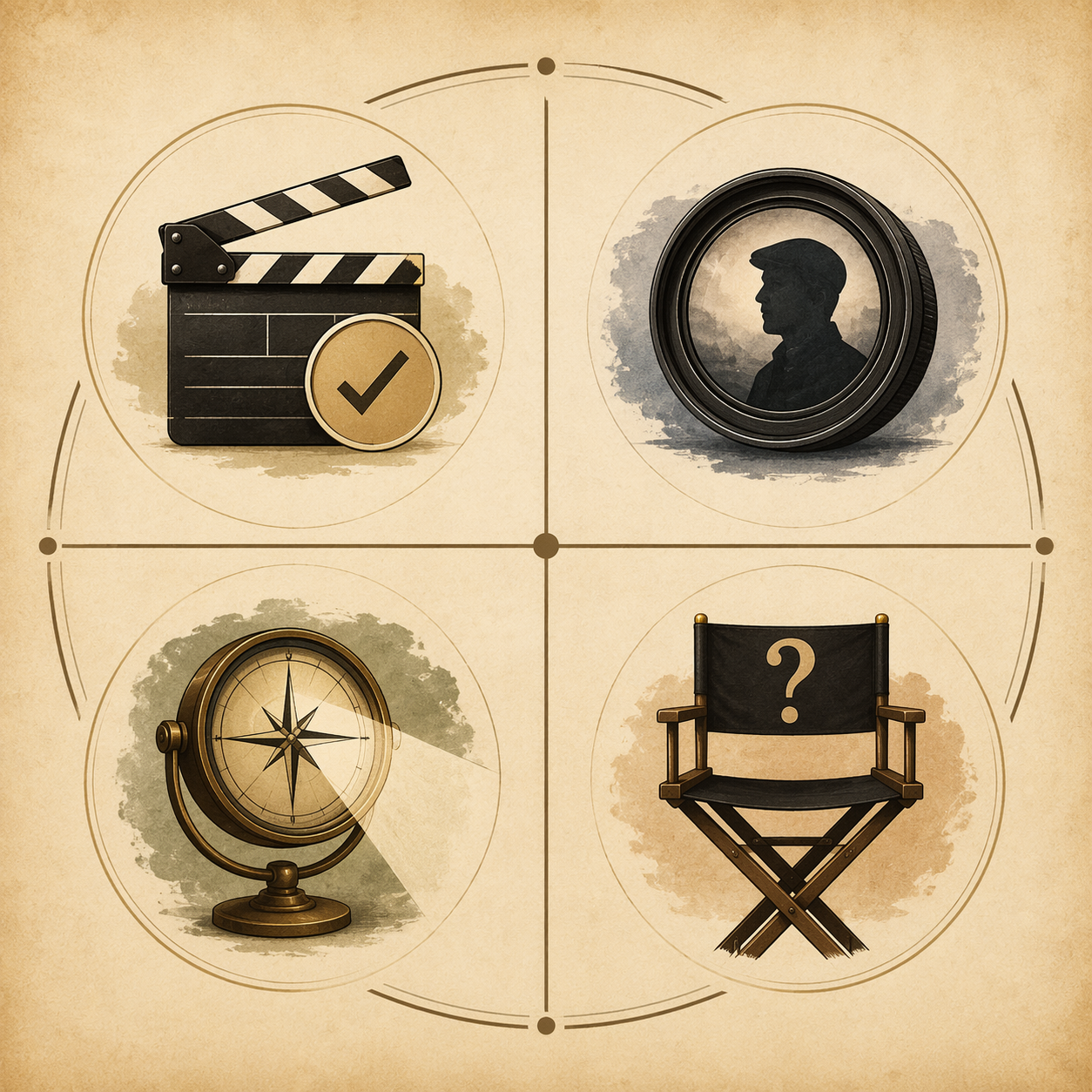
A useful comparison needs four dimensions: historical accuracy, narrative perspective, thematic focus, and filmmaker intent. These dimensions overlap, but they ask different questions. Accuracy asks what the film gets right or wrong. Perspective asks whose experience the film turns into the center of the war. Theme asks what part of WWII the film thinks matters most. Intent asks why the filmmakers made the choices they made.
| Dimension | What To Compare | Paper-Ready Question |
|---|---|---|
| Historical accuracy | Events, people, hardware, settings, chronology, compression, inventions | What does each film preserve, alter, simplify, or invent? |
| Narrative perspective | The viewpoint, nationality, group, or character experience placed at the center | Whose war does each film ask the viewer to experience? |
| Thematic focus | Combat, occupation, genocide, resistance, home front, aftermath, enemy experience, memory | What does each film make WWII seem to be mainly about? |
| Filmmaker intent | Dramatization, commemoration, critique, education, entertainment, audience age, genre | Why might the film make these choices, and what effect do they have? |
This framework keeps the paper from becoming a list of mistakes. It also protects you from the opposite problem: praising a moving scene as historically meaningful before asking what kind of evidence it actually is.
Historical Accuracy: Separate the Battle From the Story Built Around It
Accuracy is still the first dimension to check. A Tides of History analysis suggests looking at war film accuracy through four categories: events, people, hardware, and settings. It also argues that no film scores perfectly across all four, which is a useful warning against treating accuracy as a single grade.[2]
Events are the large historical actions: invasions, evacuations, battles, intelligence operations, deportations, surrenders. People are the real historical figures, composite characters, invented soldiers, or civilians who carry the story. Hardware includes weapons, vehicles, ships, aircraft, codes, equipment, and uniforms. Settings include geography, weather, architecture, trenches, camps, ships, cities, and the physical conditions of the war.
The important move is to identify the layer being judged. For example, Saving Private Ryan is often praised for the force and detail of its D-Day sequence, and History vs Hollywood reports that historians have described that sequence as among cinema’s most accurate depictions of the Omaha Beach landing. But the central rescue mission to find Private Ryan and the final battle at Ramelle are fictional.[3]
That does not make the film useless for a history paper. It means the comparison sentence has to be precise: Saving Private Ryan can be discussed as a film that uses a historically grounded combat opening to support a fictional narrative about sacrifice, duty, and the value of one soldier’s life. A weaker paper says, “Saving Private Ryan is accurate.” A stronger paper says which part is accurate, which part is invented, and what the invention does.
Other films create different accuracy problems. BBC Bitesize notes that U-571 wrongly gives Americans credit for capturing an Enigma machine, when the Royal Navy did so, and that Enemy at the Gates invents the sniper duel at the center of its story.[4]
Those examples are useful because they are not small costume errors. They change ownership, memory, and meaning. U-571 turns an Allied intelligence achievement into a different national story. Enemy at the Gates turns the Battle of Stalingrad into a personalized duel, which may help a viewer follow the drama but can shrink a vast urban catastrophe into a contest between two symbolic marksmen.
How To Use Accuracy Without Letting It Take Over
- Identify the real event or historical setting each film claims to depict.
- Mark what is confirmed, compressed, composite, invented, or disputed.
- Separate major distortions from minor production choices.
- Ask whether the change affects historical meaning, not just factual neatness.
- Cross-check specific claims with academic, museum, primary-source, or historian-reviewed material.
Enthusiast sites and film-history explainers can be good starting points, especially when you are trying to identify what to verify. They should not be the final authority for a history-class paper. If a claim will carry your argument, check it against stronger historical sources.
Narrative Perspective: Ask Whose War You Are Watching
Perspective is where many student papers become more interesting. WWII was not one experience. It was fought and endured by soldiers, occupied civilians, prisoners, resistance workers, factory laborers, children, political leaders, refugees, nurses, intelligence officers, sailors, pilots, perpetrators, liberators, and survivors. A film must choose.
When comparing two films, ask who gets interiority. Which characters are allowed to be afraid, conflicted, brave, mistaken, funny, or morally complicated? Which people appear mainly as victims, enemies, background bodies, symbols, or obstacles? A film’s camera often tells you this before the dialogue does. It lingers on some faces and rushes past others.
A U.S.-centered combat film, for instance, may make WWII feel like a story of American sacrifice and battlefield brotherhood. A film about occupation may make the war feel like a daily problem of collaboration, survival, fear, and compromise. A Holocaust film may frame the war through genocide and memory rather than battlefield victory. A German submarine film such as Das Boot, if assigned with appropriate context, asks a different question again: how should viewers analyze enemy experience without confusing humanization with absolution?
The comparison should not stop at “Film A is American and Film B is German” or “Film A is about soldiers and Film B is about civilians.” The sharper question is what those choices make visible. A combat film may show fear, loyalty, tactical confusion, injury, and the chaos of command. It may also leave out occupation policy, racial ideology, forced labor, civilian hunger, or the long aftermath of trauma. A civilian-centered film may reveal moral pressure and social fracture while giving little attention to military strategy. Both can be historically serious; neither is complete.
Comparison Sentences That Actually Compare
Instead of writing, “Both films show that war is terrible,” make the viewpoint do some work. A stronger sentence might read: “While Film A presents WWII through soldiers who experience history as immediate battlefield danger, Film B presents the war through civilians who experience it as surveillance, scarcity, and impossible moral choices.”
That sentence does not require the two films to cover the same event. In fact, comparisons often improve when the films do not match too neatly. The assignment is not to prove that one movie “wins.” It is to explain how each one turns a vast war into a human-scale story.
Thematic Focus: Notice What Each Film Makes the War Mean
Theme is different from topic. Two films can both be about WWII combat and still make different arguments about courage, obedience, sacrifice, leadership, trauma, nationalism, or survival. Two films can both concern the Holocaust and still differ in how they represent victims, perpetrators, bystanders, rescue, memory, and moral responsibility.
To find a film’s thematic focus, watch what the film spends time on. Does it slow down for tactical decisions, personal grief, rescue, betrayal, family separation, bureaucratic cruelty, religious identity, battlefield injury, liberation, guilt, or remembrance? Does it treat WWII mainly as a test of courage, a warning about fascism, a national origin story, a moral catastrophe, a survival story, or a tragedy with no clean ending?
This is where a film list can help with selection, though not with analysis by itself. Video Librarian organizes WWII teaching films into narrative and documentary categories, which is a useful reminder that a comparison can pair different kinds of evidence: a feature film with a documentary, two fictional films from different national perspectives, or two films that treat different parts of the war.[5]
For a class paper, it is usually better to choose films that differ in a meaningful way. Two Normandy combat films may produce a good paper if you compare style, memory, and historical choices carefully. But a combat film paired with a home-front film, a Holocaust film, an occupation story, or a documentary often gives you more to analyze because the films are asking viewers to care about different historical problems.
| If One Film Emphasizes | And Another Emphasizes | Your Comparison Can Ask |
|---|---|---|
| Front-line combat | Civilian occupation | How does each film define danger and courage? |
| Military victory | Genocide and survival | What does each film make central to remembering WWII? |
| National sacrifice | Enemy experience | How does perspective shape sympathy and judgment? |
| Heroic rescue | Bureaucratic violence | Does the film make history feel like individual action or systemic force? |
| Immediate battle | Postwar aftermath | Where does each film suggest the war’s consequences end? |
Be careful with films that are emotionally powerful but historically controversial. The Boy in the Striped Pajamas, for example, has been criticized by historians for inaccuracies in its representation of Auschwitz. If a teacher assigns it, the controversy can become part of the analysis, but the film should not be used as a straightforward source on camp history without strong correction from historical scholarship.
Filmmaker Intent: Explain the Choice Before You Condemn It
Filmmaker intent does not mean guessing what was in a director’s private mind. It means analyzing the visible purpose of the film: its genre, audience, structure, emotional design, release context when known, and relationship to historical evidence. A documentary, a battlefield epic, a classroom-friendly older film, and an R-rated trauma narrative are not trying to do the same job.
This matters because dramatization is not automatically a flaw. Films compress timelines because a full historical process may take years. They create composite characters because a single fictional figure can represent a pattern. They invent dialogue because cameras were not present for private conversations. The question is whether those choices clarify a historical issue, distort it, sentimentalize it, or move credit and blame to the wrong place.
Age and classroom context also shape intent. Lesson Plan Guru’s film guidance lists The Longest Day as PG-13 and Tora! Tora! Tora! as G for younger viewers, while Schindler’s List and Das Boot are rated R and require more mature high school handling.[6]
Those ratings do not tell you which films are historically better. They tell you something about audience, intensity, and classroom use. A film made or selected for younger viewers may avoid graphic violence or sexual violence. An R-rated film may confront brutality more directly but require more preparation. In a comparison paper, that becomes part of the argument: what can the film show, what does it avoid, and how do those limits affect the version of WWII the viewer receives?
A Working Method for Watching and Writing
The best comparison work begins before the first scene. Edutopia recommends a three-phase approach to using historically inaccurate films: prepare with background before viewing, ask after viewing what editorial choices the filmmakers made, and bring in outside sources such as historian reviews.[7]
For a student paper, that approach can become a simple set of steps.
- Before viewing, write down the real event, time period, or historical issue each film covers. Read enough background to know the basic chronology and major people involved.
- While viewing, take notes in four columns: accuracy, perspective, theme, and intent. Do not try to write full paragraphs yet.
- After viewing, mark scenes that need verification. These are usually scenes that make strong factual claims, assign credit or blame, show a famous event, or seem too dramatically neat.
- Check those scenes against outside sources. Use film explainers to locate the issue, then verify important claims with stronger historical material when possible.
- Turn the comparison into an argument about construction: how each film builds a version of WWII and what that version helps or harms.
A note-taking grid keeps the assignment from blurring into general reaction. It also helps when the two films are very different, because you are not looking for identical scenes. You are looking for comparable choices.
| Scene or Choice | Film A | Film B | What To Verify or Analyze |
|---|---|---|---|
| Opening sequence | What historical world does the viewer enter first? | What historical world does the viewer enter first? | Does the opening frame the war as combat, persecution, occupation, strategy, memory, or aftermath? |
| Main characters | Who carries the emotional burden of the story? | Who carries the emotional burden of the story? | Whose experience becomes representative of WWII? |
| Major historical event | What event is shown, compressed, or invented? | What event is shown, compressed, or invented? | Does the film alter chronology, agency, location, or outcome? |
| Enemy portrayal | Are enemies individualized, faceless, ideological, sympathetic, or monstrous? | Are enemies individualized, faceless, ideological, sympathetic, or monstrous? | Does the portrayal help historical understanding or flatten responsibility? |
| Ending | What feeling or judgment does the film leave? | What feeling or judgment does the film leave? | Does the ending emphasize victory, loss, rescue, guilt, survival, or unresolved consequence? |
Turning Notes Into a Thesis
A comparison paper needs a claim that can be argued, not just a topic. “This paper compares Saving Private Ryan and U-571” is a topic. “Both films dramatize WWII through small groups of Allied servicemen, but Saving Private Ryan anchors its fiction in a historically praised combat reconstruction while U-571’s central distortion changes national credit for a major intelligence achievement” is a claim.
The claim should name the difference and explain why it matters. Use verbs such as centers, compresses, invents, redirects, humanizes, simplifies, memorializes, nationalizes, questions, or sentimentalizes. Those verbs force you to analyze filmmaking choices rather than merely announce whether you liked the movie.
- Weak: “Film A is more accurate than Film B.”
- Stronger: “Film A is more accurate in its depiction of the battle’s physical setting, while Film B takes greater liberties with chronology to create a clearer individual hero narrative.”
- Weak: “Both movies show sacrifice.”
- Stronger: “Both films value sacrifice, but one defines sacrifice as battlefield duty while the other defines it as civilian endurance under occupation.”
- Weak: “The movie was inaccurate, so it was bad for history.”
- Stronger: “The film’s invented scene is not reliable as a record of the event, but it is useful evidence of how the filmmakers wanted viewers to understand courage, loyalty, and national memory.”
That last distinction is often the difference between a fact-check and historical analysis. A fictional scene cannot prove that an event happened. It can help you analyze what a later film culture wanted the event to mean.
Choosing Films Without Letting the List Do the Thinking
If your teacher lets you choose the films, pick a pair that creates a real comparison. The easiest pair is not always the best pair. Two films about the same battle can work if you are ready to compare accuracy, tone, and memory closely. Two films from different fronts, genres, or national perspectives may make the argument easier to see.
Use recommendation lists as maps, not as arguments. A list can help you find a documentary, a combat film, an occupation story, or a film suitable for your grade level. It cannot decide what the film means historically. That work begins when you ask what the film centers, what it changes, and what kind of WWII it leaves in the viewer’s memory.
A good final judgment does not have to declare one film the winner. It can say that one film is stronger for studying combat realism, another for studying national mythmaking, another for understanding civilian fear, and another for examining how later generations remember atrocity. No WWII film captures the war’s totality. The strongest comparison explains how each film constructs a different version of the past, why those differences exist, and what a careful viewer should do with them.
References
- Historical movies help students learn, but separating fact from fiction can be challenge, Washington University in St. Louis, 2009, https://source.washu.edu/2009/08/historical-movies-help-students-learn-but-separating-fact-from-fiction-can-be-challenge/
- Drama vs Facts: Historical Accuracy in War Films, Tides of History, 2020, https://thetidesofhistory.com/2020/03/29/drama-vs-facts-historical-accuracy-in-war-films/
- Saving Private Ryan, History vs Hollywood, https://www.historyvshollywood.com/reelfaces/saving-private-ryan/
- Six times films got World War Two wrong, BBC Bitesize, https://www.bbc.co.uk/bitesize/articles/znnxqfr
- Teaching WWII with Film, Video Librarian, https://videolibrarian.com/articles/lists/teaching-wwii-with-film/
- Top 13 Best World War II Movies to Watch in History Class, Lesson Plan Guru, https://www.lessonplanguru.com/blog/top-13-best-world-war-ii-movies-to-watch-in-history-class
- Using Inaccurate Films to Understand History, Edutopia, https://www.edutopia.org/article/using-inaccurate-films-understand-history
Comments
Join the discussion with an anonymous comment.