

How the Dinosaur Extinction Meteorite Study Proves Science
This case study traces the four-decade investigation of the dinosaur extinction meteorite impact, showing how scientists use converging evidence from multiple fields to build and refine hypotheses about events 66 million years ago—making the scientific method concrete for students.
Updated:
The dinosaur extinction meteorite study is useful because it answers a student question in a way a textbook diagram rarely does: how do scientists know what happened so long ago when nobody was there to watch it? The answer did not arrive as a single dramatic proof. It grew from a strange chemical clue, then from predictions, then from multiple tests that kept pointing toward the same explanation.
A strange layer started the investigation
The first clue was a thin, unusual iridium-rich layer at the boundary between rocks from the age of dinosaurs and the rocks above it. In the Alvarez hypothesis, that anomaly mattered because iridium was measurable, unusually concentrated, and later found at many K-Pg boundary sites worldwide. A good observation is not the same thing as a finished explanation; it is the thing that makes an explanation worth testing.
Once the impact idea was proposed, it became a set of expectations. If an asteroid really caused the extinction, scientists should be able to find shocked minerals, impact ejecta, a crater of the right age, and a chemical fingerprint that linked the boundary layer to extraterrestrial material.
Evidence had to agree from different directions
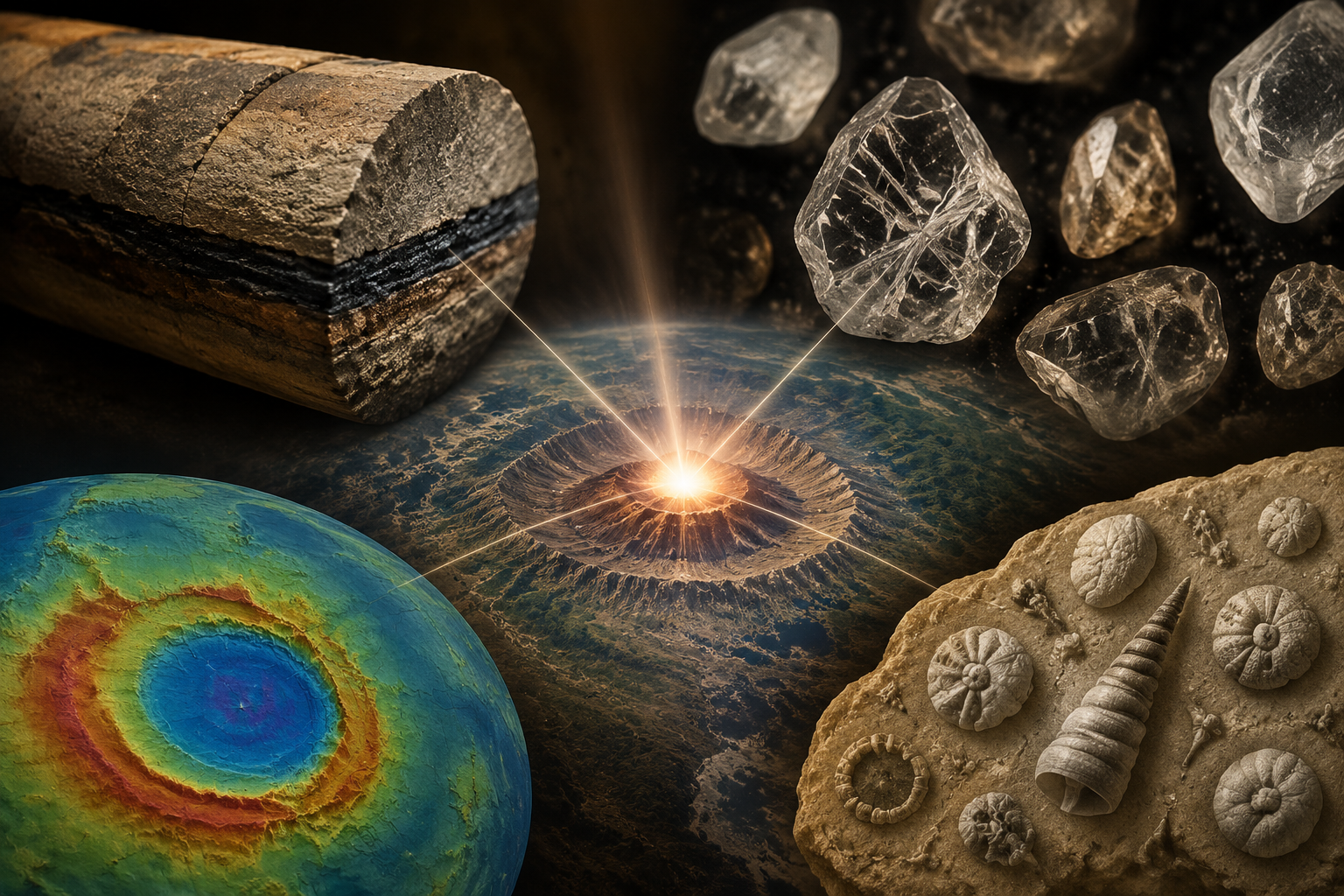
That is where the case became strong. Boundary rocks preserved shocked quartz and microtektites, both signs of extreme impact pressure, and later work identified the 180 km Chicxulub crater under the Yucatán Peninsula, dated to about 66 million years ago. In 2016, an IODP drilling expedition pulled nearly 3,000 feet of core from the crater, giving researchers direct access to impact rock and evidence for sulfur release rather than forcing them to infer everything from the surface.
In 2021, UT Austin researchers reported asteroid dust with a matching chemical fingerprint inside the crater at the exact layer marking the extinction, with iridium measured in parts per billion within a 5 cm section of core [1]. That detail matters because it ties three separate pieces together: the crater, the boundary layer, and the extraterrestrial material.
This is the part of the scientific method students often miss. Scientists did not keep repeating the same clue in different words. They looked for independent evidence that would have been hard to fake if the impact idea were wrong.
Refinement did not erase the impact
Recent work has changed the surrounding story, not the core explanation. A 2026 UT Austin study used Helium-3 isotope dating from six K-Pg boundary sites in Europe, North Africa, and the Gulf of Mexico and found new plankton species appearing between 3,500 and 11,000 years after impact, with some in under 2,000 years [2]. On geological timescales, that is fast; on human timescales, it is still a long recovery.
Another 2026 Baylor-led study dated Naashoibito Member fossils to 66.4 to 66 million years old and argued that thriving dinosaur communities were still present right up to the boundary [3]. That does not weaken the impact case. It narrows the before-and-after picture and keeps the extinction from being turned into a vague story about slow decline.
A separate 2026 Johns Hopkins-led study reported fungal microfossils that point to ecological stress 30,000 to 10,000 years before impact, around the Poladpur phase of Deccan Traps eruptions [4]. If that interpretation holds, the planet was already under pressure when the asteroid arrived. The impact still matters, but it landed in a stressed system rather than a blank slate.
What this case teaches about science
The dinosaur extinction meteorite study shows why science is stronger when different methods converge. Chemistry raised the first suspicion, geology looked for the crater, paleontology checked what ecosystems were doing, drilling recovered direct samples, and later isotope and microfossil studies refined the timeline. Each line of evidence had its own limits, but together they made one explanation increasingly hard to replace.
That is the useful classroom lesson. Science is not instant certainty, and it is not endless doubt. A good hypothesis keeps generating predictions that can be checked against independent evidence, and when those checks keep working across decades, the result is not a slogan. It is the best explanation available so far.
References
- Asteroid Dust Found in Crater Closes Case of Dinosaur Extinction - University of Texas at Austin - 2021-02-24
- Evidence of lightning-fast evolution found after dino-killing asteroid impact - Jackson School of Geosciences, The University of Texas at Austin - 2026-01
- New Baylor-led research rewrites story of dinosaur extinction - Baylor Mayborn School - 2026
- The asteroid that wiped out the dinosaurs may have struck a planet that was already in serious trouble - SpaceDaily - 2026
Comments
Join the discussion with an anonymous comment.