
The Odyssey Film Adaptation Comparison Guide for Students
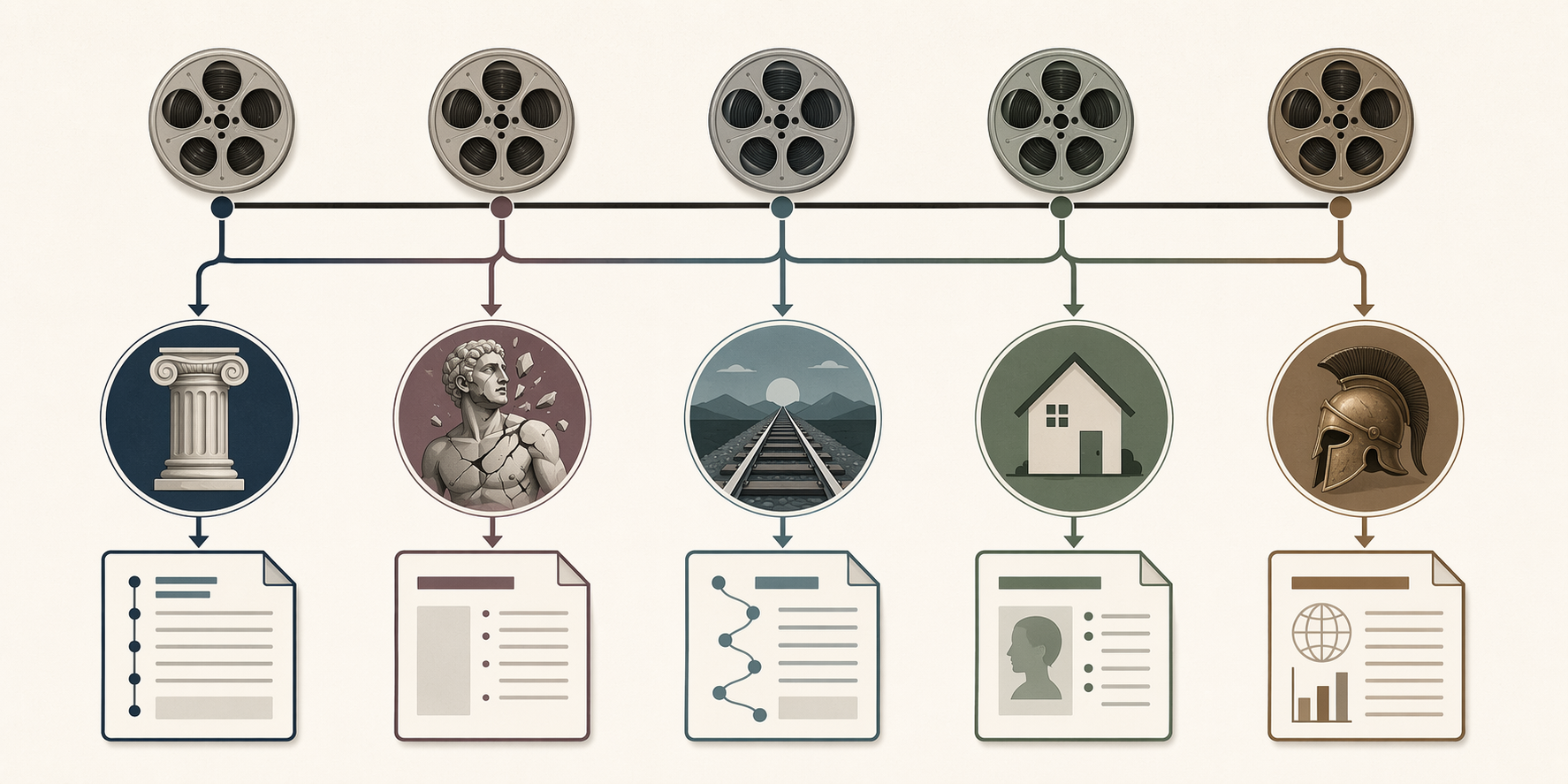
Not sure which film adaptation of The Odyssey to watch for your literature assignment? This guide compares major versions—from the 1997 miniseries to Nolan's 2026 epic—and maps each to the essay types it best supports, so you can choose wisely and use it correctly.
Updated:
If you are choosing an Odyssey film adaptation for a paper, the first question is not which one is the most famous, most faithful, or highest rated. The useful question is narrower: which version helps you answer the assignment you actually have, and where might it quietly lead you away from Homer’s poem?
Film can be a legitimate way into ancient material. BBC News reported in June 2026 that university students said films “often played a key role in sparking their interest” in Classics.[1] That does not make a movie a replacement for the poem. It means a film can give you a first map: names, places, conflicts, emotional stakes. The mistake comes when that map gets mistaken for the territory.
The Quick Choice: Match the Film to the Paper
| If your assignment asks for... | Start with... | Use it for... | Watch out for... |
|---|---|---|---|
| Plot tracking, episode comparison, or a first pass through the story | The Odyssey miniseries, 1997 | Following major episodes in order and checking how scenes are visualized | Treating its faithfulness as permission to cite the film instead of the poem |
| Adaptation analysis, medium comparison, or a paper on reinterpretation | Christopher Nolan’s The Odyssey, 2026 | Explaining what changes when gods, guilt, Argos, revenge, and homecoming are reframed | Writing Nolan’s inventions as if they are Homer’s |
| Archetypes, hero’s journey, or thematic transposition | O Brother, Where Art Thou?, 2000 | Showing how Odyssey patterns survive in a radically different setting | Expecting one-to-one character and episode matches |
| Character study, trauma, homecoming, or minimalist adaptation | The Return, 2024 | Studying Odysseus after the journey rather than during the whole journey | Forgetting how much of the poem’s wandering world has been stripped away |
| Historical reception or adaptation timeline work | Ulysses, 1954 | Comparing a mid-20th-century sword-and-sandal version with later retellings | Using it as your main comprehension aid for the poem |
That table is more important than any ranking. Rotten Tomatoes and Metacritic numbers can provide quick context, but they do not know your prompt. A teacher asking about narrative structure needs different evidence from one asking about modern mythmaking, trauma, or reception history.
Use the 1997 Miniseries When You Need the Poem’s Shape
The 1997 Odyssey miniseries, directed by Andrei Konchalovsky, is the safest first viewing when your immediate problem is orientation. SparkNotes lists it among movie adaptations of The Odyssey, and the reason students keep ending up there is practical: it gives you a relatively complete screen path through the poem’s major adventures.[2]
That matters if your draft currently has sentences like “Odysseus faces many obstacles” and nothing more specific behind them. A fuller adaptation helps you separate the Cyclops episode from Circe, the Sirens from Scylla and Charybdis, Ithaca from the wandering books. It gives you a sequence to attach to your notes, which is often what a student needs before a thesis can become more than a mood.
The miniseries also has a small but telling academic afterlife. UNC Classics professor Al Duncan credited the 1997 version with helping spark his lifelong interest in Classics, a useful reminder that “accessible” is not the same thing as shallow.[3] If a film gets you to notice the poem’s architecture, it has done real study work.
For an episode-by-episode comparison paper, this is where the 1997 version earns its place. You can choose one episode, reread the relevant passage in Homer, then ask concrete comparison questions: What does the film make visible? What does it simplify? Which speeches, disguises, or delays disappear? Does the scene turn a test of intelligence into an action beat, or preserve the slow pressure of recognition?
The danger is exactly the reason it feels useful. Because the miniseries stays close enough to be reassuring, students can forget that it is still making choices. Costumes, pacing, facial expressions, scene order, and omitted lines are interpretive decisions. If your paragraph says Homer emphasizes something, your evidence still needs to come from Homer. If your paragraph says the miniseries emphasizes something, then cite the adaptation as the adaptation.
If you need a poem refresher before or after watching, use The Odyssey Summary and Analysis for Students to check the relevant books rather than relying on memory from the screen version.
Use Nolan’s 2026 Film When the Assignment Is About Adaptation Choices
Christopher Nolan’s The Odyssey is the opposite kind of study tool. It is not mainly useful because it quietly escorts you through Homer. It is useful because its changes are big enough to analyze. The film was released on July 17, 2026, and July 2026 listings put it at 96% on Rotten Tomatoes and 88 on Metacritic, but those numbers should be handled lightly this close to release.[4] Early consensus can move; your essay should not lean on it as proof of literary significance.
The changes themselves are much better evidence. Vanity Fair’s July 2026 account identifies major departures from Homer, including the removal of the gods as physical characters and a reworked ending; Time’s May 2026 coverage and MovieWeb’s explanation also foreground Nolan’s reinterpretive approach.[5][6][7] For a student, that is where the paper begins.
The gods are absent as bodies, but not as a problem
In Homer, divine action is not decorative background. Athena, Poseidon, Zeus, Hermes, and other gods shape what mortals can do, know, suffer, and escape. A film that removes the gods as physical characters changes the grammar of responsibility. Events can feel psychological, political, accidental, or morally self-generated instead of openly divine.
That gives you a strong adaptation thesis if you keep the boundary clean. A weak claim says, “The Odyssey is really about survivor’s guilt and not the gods.” A stronger claim says, “Nolan’s adaptation shifts pressure away from visible divine intervention and toward Odysseus’s interior burden, changing how viewers assign responsibility for suffering and return.” The first claim misreports Homer. The second analyzes the adaptation.
Survivor’s guilt turns wandering into aftermath
Nolan’s Odysseus is reported as being reimagined through survivor’s guilt.[5][6] That matters because Homer’s Odysseus is many things at once: tactician, liar, veteran, husband, king, storyteller, favorite of Athena, enemy of Poseidon. A guilt-centered version narrows the beam. It can make the journey feel less like a contest among forces and more like the long consequence of having lived when others did not.
For a character essay, that is fertile ground, but only if you compare it to specific passages. Look at where Homer’s Odysseus weeps, conceals his identity, tests others, narrates his own suffering, or responds to dead companions. Then ask what the film intensifies. Does guilt explain what the poem leaves more distributed among fate, divine hostility, pride, longing, and tactical necessity?
Argos becomes more than a recognition scene
Nolan’s film reportedly elevates Argos, Odysseus’s dog, into a supporting character.[5][7] In the poem, Argos is devastating partly because his scene is brief. He recognizes Odysseus when the household has not, and his death compresses years of absence into one domestic body. Expanding him changes the scale of that recognition.
This is a good place for a paragraph about medium. Film can return to a dog’s body, movement, waiting, and attachment without needing a long speech. If Argos appears across more of the story, the adaptation may turn a single moment of recognition into a continuing emotional thread. That is not “more faithful” just because it feels moving. It is a different technique for making home visible.
Atonement changes the meaning of the ending
The most dangerous place to confuse film with poem is the ending. Nolan’s version is reported to replace the poem’s revenge ending with atonement and departure.[5][7] That is not a small adjustment. Homer’s return to Ithaca involves recognition, testing, household restoration, violence against the suitors, and the question of how social order resumes after bloodshed.
If your essay is about justice, vengeance, or homecoming, you cannot treat Nolan’s ending as a neutral modernization. You should name the change directly: the film redirects the emotional endpoint from punishment and restoration toward moral reckoning and leaving. That can support a sharp argument about contemporary discomfort with heroic revenge, but it cannot stand in for what Homer’s ending does.
For a deeper breakdown of the 2026 version’s changes, use 10 Ways Nolan’s The Odyssey Diverges from Homer’s Epic. If your teacher wants you to work back and forth between film and poem, Study Homer’s Odyssey Through Christopher Nolan’s Film is the better companion.
Use O Brother, Where Art Thou? for Transposition, Not Plot Review
O Brother, Where Art Thou? is often the film that surprises students into writing better. It does not look like an Odyssey adaptation if what you are hunting for is bronze armor and island monsters. Mental Floss identifies the 2000 film as an Odyssey adaptation and lists it with a 78% Rotten Tomatoes score.[8] The useful part for class is not the score. It is the relocation.
The film transposes the pattern of wandering, temptation, performance, disguise, and return into 1930s Mississippi. Monsters become human obstacles. Epic danger becomes social, comic, musical, racialized, economic, and legal pressure. That makes it a strong choice for an essay about how myths travel: not by preserving every surface detail, but by carrying a recognizable structure into another world.
Use it when your prompt includes words like archetype, hero’s journey, allusion, adaptation, or theme. Do not use it as your main plot guide. A good O Brother paragraph usually sounds like this in shape: the film does not recreate the Cyclops episode literally; it translates the function of an encounter into a new cultural and comic register. That kind of sentence keeps you from forcing one-to-one matches where the adaptation is doing something looser.
Use The Return for Homecoming, Trauma, and Narrow Focus
The Return, released in 2024 and starring Ralph Fiennes, is a narrower study choice. It focuses on the homecoming in Ithaca and strips away much of the fantasy material for psychological realism; Mental Floss lists it with a 78% Rotten Tomatoes score.[8] That makes it a poor first map of the whole epic but a strong lens for one cluster of questions.
Choose it if your paper is about what return does to a person, not simply whether Odysseus gets home. A minimalist adaptation can make silence, bodily exhaustion, suspicion, and domestic estrangement carry more weight than spectacle. It can also sharpen Penelope and Telemachus as people living with the consequences of absence rather than as figures waiting for the adventure plot to finish.
The limitation is built into the premise. Because the wandering episodes are largely outside its frame, The Return should not be your only film if the assignment asks about Odysseus’s full journey, hospitality across foreign lands, monsters, storytelling, or divine conflict. It is best for close character work around Ithaca.
Use Ulysses for Reception History
Ulysses, the 1954 feature starring Kirk Douglas, belongs in a different kind of paper. Collider identifies it among notable Odyssey adaptations, and its value for students is historical more than practical.[9] It shows how a mid-20th-century sword-and-sandal film tradition imagined Homer for popular audiences.
That makes it useful if your assignment asks how adaptations change across time. Pairing Ulysses with the 1997 miniseries, O Brother, The Return, or Nolan’s 2026 film lets you compare not only plot choices but also assumptions about heroism, masculinity, spectacle, pacing, and what ancient epic is supposed to look like on screen.
It is not the version I would choose the night before a quiz on the poem. For reception history, though, its age is the point. You are studying how The Odyssey has been received and repackaged, not simply trying to remember who gets home and how.
How to Use Any Odyssey Film Without Getting the Paper Wrong
Before you write, separate three things in your notes: what Homer’s poem says, what the film shows, and what you think the change means. Most bad adaptation paragraphs collapse those into one confident blur.
- If you are summarizing the poem, verify the episode in Homer or a reliable study guide before trusting the film.
- If you are analyzing the film, name the adaptation choice instead of pretending it was already in the poem.
- If you use review scores, treat them as reception context, not as evidence that an interpretation is correct.
- If your assignment is comparative, build the paragraph around a difference that changes meaning, not a random missing detail.
- If your teacher expects textual evidence, quote or cite the poem for claims about Homer and use the film for claims about the adaptation.
A simple working sentence can keep you honest: “In Homer, this moment does X; in the film, it becomes Y; that change matters because Z.” You can use that structure for the 1997 miniseries, Nolan’s 2026 film, O Brother, The Return, or Ulysses. The content will change; the discipline stays the same.
Advanced readers working specifically on Nolan’s version may also want A Student Analysis of Christopher Nolan’s The Odyssey, especially if the assignment asks for a more developed argument about the 2026 film’s interpretation.
So choose the adaptation by task. Use the 1997 miniseries to get your bearings. Use Nolan when your paper is about transformation. Use O Brother when you need mythic structure in a new setting. Use The Return when the question is homecoming and damage. Use Ulysses when the subject is reception history. Then go back to the poem at the points where your essay makes its claims.
References
- How The Odyssey film is highlighting shrinking access for pupils to the Classics, BBC News, June 2026.
- The Odyssey: Movie Adaptations, SparkNotes.
- Classics professor shares thoughts on the film The Odyssey, UNC College of Arts and Sciences, July 2026.
- The Odyssey (2026 film), Wikipedia.
- The Odyssey: 10 Major Changes From Book to Screen, Vanity Fair, July 2026.
- Inside The Odyssey, Christopher Nolan's Most Epic Movie Yet, Time, May 2026.
- 5 Changes Christopher Nolan Has Made To The Odyssey Explained, MovieWeb.
- 5 Adaptations of The Odyssey, Ranked By Rotten Tomatoes, Mental Floss.
- 6 Amazing Adaptations of The Odyssey To Watch Before Christopher Nolan's New Movie, Collider.
Comments
Join the discussion with an anonymous comment.