

Enlicitide Eligibility Criteria: What the CORALreef Trials Require
A structured breakdown of the inclusion and exclusion criteria across the CORALreef clinical trials for enlicitide decanoate, explaining how eligibility varied by trial and what that means for the enrolled population and generalizability of results.
Updated:
The first question when reading enlicitide eligibility criteria is not whether the LDL-C curve moved. It is who was allowed to stand under that curve. In CORALreef Lipids, enlicitide decanoate reduced LDL-C by 56% versus placebo at 24 weeks in a phase 3 population of 2,912 adults; after removing biologically impossible values, the reported reduction was 60%.[1] Those numbers are clinically attention-grabbing, but they come from a population filtered before randomization: adults on stable lipid-lowering therapy, with LDL-C still above trial thresholds, and with several common high-risk comorbidities or recent events excluded.
That enrollment frame matters because enlicitide is being studied and now discussed as a once-daily oral PCSK9 inhibitor, a format that changes the practical conversation around PCSK9 therapy. Merck announced FDA approval of enlicitide decanoate, marketed as Lipfendra, on July 16, 2026.[2] Approval status, however, does not make every clinic patient resemble the CORALreef denominator. The trials mostly answer a narrower question: what happens when selected high-risk patients, already stabilized on background therapy or documented as statin intolerant, add oral PCSK9 inhibition?
The CORALreef Program Starts With a Shared Enrollment Pattern
Across the CORALreef program, the common entry logic was add-on therapy in a high-risk lipid population. Adults generally needed elevated LDL-C despite stable moderate- or high-intensity statin therapy, or documented statin intolerance, for at least 30 days before screening. That design is important: the main adult efficacy evidence is not monotherapy evidence. It is evidence for enlicitide layered onto an existing lipid-lowering baseline.
The same pattern also means that trial eligibility did a lot of clinical sorting before the first dose. The recurring exclusions included homozygous or compound heterozygous familial hypercholesterolemia, NYHA Class IV heart failure, left ventricular ejection fraction of 25% or lower, estimated glomerular filtration rate below 30 mL/min/1.73 m², fasting triglycerides of 400 mg/dL or higher, recent PCSK9 inhibitor exposure without adequate washout, and a recent major ASCVD event or planned revascularization within 3 months.[3]
| Eligibility Feature | How It Shaped The Trial Population |
|---|---|
| Adults, generally age 18 or older | The main CORALreef adult data do not directly answer pediatric use questions. |
| Stable moderate- or high-intensity statin therapy, or documented statin intolerance, for at least 30 days | Efficacy results reflect add-on therapy rather than de novo lipid management. |
| Elevated LDL-C despite background treatment | Patients already at LDL-C goal were not the target population. |
| ASCVD, high ASCVD risk, or risk equivalents | The program emphasized high-risk prevention rather than low-risk primary prevention. |
| Exclusion of severe renal impairment, advanced heart failure, very high triglycerides, recent events, and inadequate PCSK9 inhibitor washout | Several common clinic scenarios were systematically kept outside the randomized denominator. |
This is the basic map to keep in view before reading any single CORALreef result. The program was not enrolling everyone with hypercholesterolemia. It was enrolling patients whose LDL-C remained high enough despite a stable treatment background, while excluding several conditions that would make interpretation harder or alter risk.
CORALreef Lipids: The Pivotal Population Behind the 24-Week LDL-C Result
CORALreef Lipids carries the most weight for interpreting the adult lipid-lowering claim because it was the large pivotal phase 3 lipid endpoint trial. It enrolled 2,912 adults across 14 countries; the mean age was 63 years, 39% of participants were women, and 98% were taking moderate- or high-intensity statins.[1] That statin background is not a side note. It tells the reader that the reported LDL-C reduction came from a population already treated in a way that resembles guideline-directed baseline lipid management for many high-risk patients.
The LDL-C entry thresholds separated secondary prevention from primary prevention. Adults with ASCVD needed LDL-C of at least 70 mg/dL. Adults without established ASCVD but with high-risk features entered at a higher LDL-C threshold of at least 90 mg/dL.[3] That split matters for generalizability: the trial was not simply asking whether enlicitide lowers LDL-C in anyone with mild elevation. It was selecting patients whose residual LDL-C remained above a risk-stratified threshold after stable therapy.
Within that frame, the LDL-C effect was large. Enlicitide reduced LDL-C by 56% versus placebo at 24 weeks, and the analysis excluding biologically impossible values reported a 60% reduction.[1] The point is not to diminish the effect size. It is to attach the effect size to its denominator: mostly statin-treated, high-risk adults who cleared trial exclusions and whose LDL-C remained high enough to qualify.
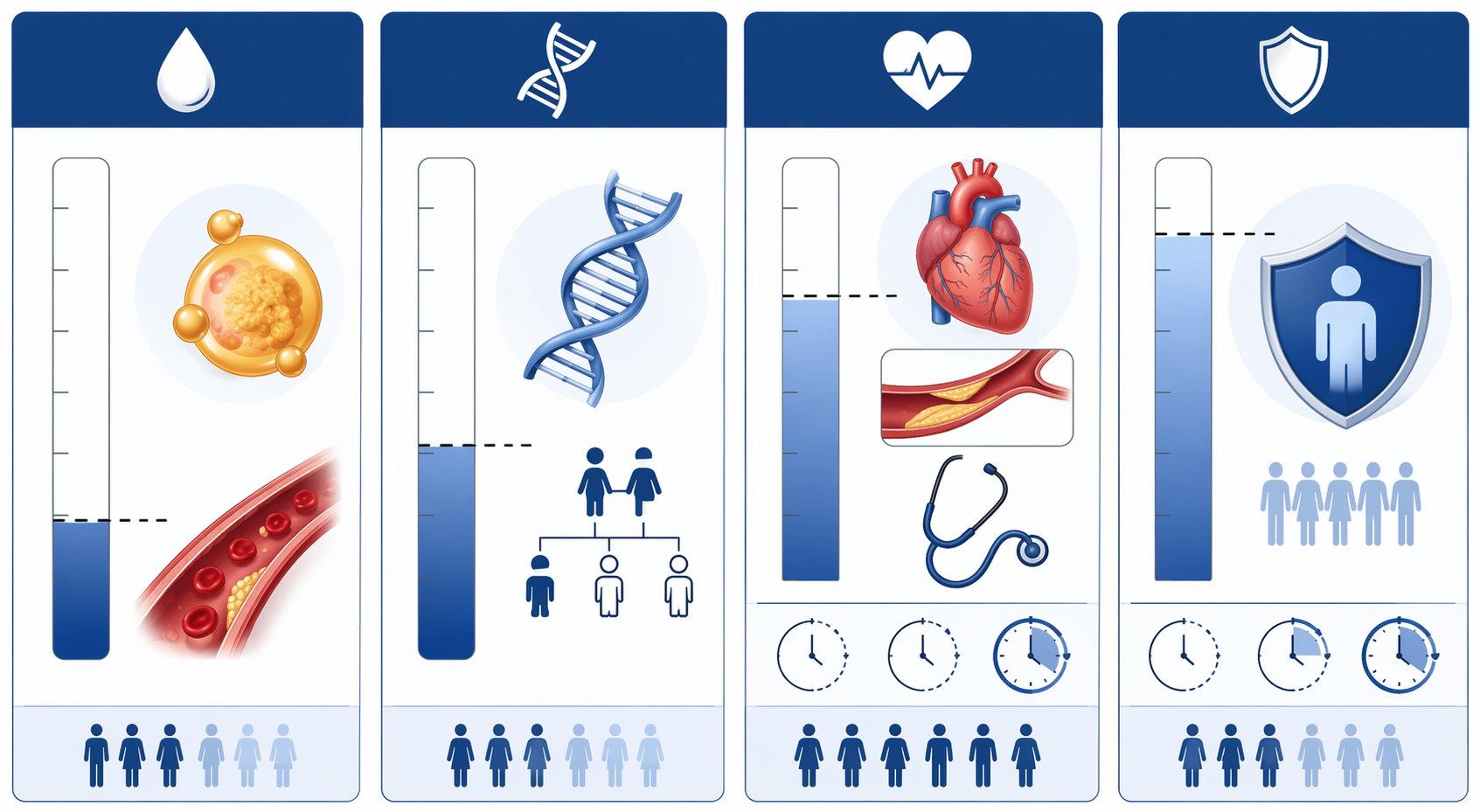
The trial also leaves predictable blind spots. A patient with eGFR below 30 mL/min/1.73 m², fasting triglycerides of 400 mg/dL or higher, NYHA Class IV heart failure, LVEF of 25% or lower, very recent major ASCVD event, planned revascularization, or insufficient washout from a prior PCSK9 inhibitor was not the same kind of patient the trial was designed to represent.[3] In clinic, these are not rare abstractions; they are often the patients whose medication decisions feel least clean.
CORALreef HeFH Adds a Familial Hypercholesterolemia Gate
CORALreef HeFH narrowed the entry question around heterozygous familial hypercholesterolemia. The trial enrolled 303 adults and required a diagnosis of heterozygous FH by clinical criteria or genotyping.[2] That requirement is the defining eligibility difference: patients were not included merely because their LDL-C was high; they had to fit a heterozygous FH category.
Merck reported a mean baseline LDL-C of approximately 92 mg/dL on background statins in the HeFH trial.[2] The same sponsor release also reported selected adverse events, including diarrhea in 7% of enlicitide-treated participants versus 2% of placebo participants, and dizziness in 9% versus 4%.[2] Those are sponsor-disclosed trial results, useful for orientation but not a substitute for full protocol-level eligibility review.
One boundary should stay explicit: the available material did not provide full protocol-level inclusion and exclusion criteria for CORALreef HeFH. The safest interpretation is therefore narrower than a full trial manual. The trial supports conclusions about adults with heterozygous FH meeting its diagnostic and background-treatment requirements; it should not be stretched to homozygous FH or compound heterozygous FH, which were part of the recurring exclusion pattern across the adult program.[3]
CORALreef Outcomes Uses Broader Risk Entry, But It Has Not Yet Proven MACE Reduction
CORALreef Outcomes is the program’s broadest clinical test because it is built around cardiovascular events rather than only lipid endpoints. The trial lists 14,550 participants and follows a high cardiovascular risk population for major adverse cardiovascular events over approximately 4.5 years.[4] That makes its eligibility criteria especially important: if positive, the trial could define the population in which LDL-C lowering with enlicitide is tied to outcomes rather than laboratory response.
The entry routes are broader than the lipid endpoint trial in a clinically meaningful way. In addition to established high-risk cardiovascular disease pathways, CORALreef Outcomes includes risk criteria such as age 60 years or older with diabetes plus microvascular disease or long insulin use.[4] That kind of criterion makes a different group visible: older patients with diabetes and complications who may not fit a simple recent-event frame but still carry substantial cardiovascular risk.
The caution is just as important as the expansion. As of July 2026, CORALreef Outcomes has not reported evidence that enlicitide reduces MACE. The trial is designed to answer that question; it has not yet answered it.[4] Until those results exist, the adult CORALreef evidence can support LDL-C lowering within selected populations, but it cannot be used as proof of event reduction.
CORALreef AddOn Shows How Many Patients Eligibility Can Remove
Eligibility criteria can look tidy in a table and still behave messily at screening. CORALreef AddOn makes that visible. In the JACC report, 435 adults were screened and 134 did not meet eligibility, a screening failure rate of 30.8%.[5] The most common reasons were LDL-C outside the required range, uncontrolled diabetes defined by HbA1c of 9% or higher, and disqualifying medications.[5]

That 30.8% figure should not be automatically imported into every CORALreef trial, because comparable screening failure rates were not published for each study. Its value is more practical than statistical: it shows that the eligibility frame was active, not decorative. Nearly one in three screened adults in that trial did not reach randomization.[5]
The reasons for screen failure also show why generalizability is not only about rare exclusions. LDL-C outside range can remove patients whose cholesterol is either too low for the trial question or not in the defined enrollment window. HbA1c of 9% or higher can remove patients with uncontrolled diabetes, a group clinicians frequently see when cardiovascular risk is high. Disqualifying medications can exclude patients because of interaction, confounding, or protocol rules rather than because they are clinically unimportant.
Pediatric and Renal Trials Need a Narrower Reading
The CORALreef program also includes pediatric and renal-focused work, but the available material supports only cautious description. The pediatric trial is identified as NCT07058077, and the renal trial has additional age- or kidney-function-specific criteria.[3] Full protocol-level criteria were not available in the material reviewed here, so these studies should not be treated as if their eligibility details are fully mapped.
That limitation is not just a documentation problem. Pediatric lipid trials and renal impairment trials often define populations differently from broad adult ASCVD trials. Without the full criteria, the responsible conclusion is limited: these studies may extend the program into groups not fully represented by CORALreef Lipids, but their eligibility boundaries cannot be reconstructed from the available sources with the same confidence.
What the Eligibility Criteria Mean for Applying the Evidence
The CORALreef evidence is strongest for high-risk adults who look like the enrolled trial populations: stabilized on moderate- or high-intensity statins or documented as statin intolerant, still above LDL-C thresholds, and not carrying the exclusions that would have kept them out of the trials. For CORALreef Lipids, that means the 24-week LDL-C result belongs to a largely statin-treated, high-risk adult cohort, not to an unrestricted lipid clinic population.[1]
The evidence is weaker for the patients who appear constantly in practice but less clearly in the denominator: severe renal impairment, very high triglycerides, advanced heart failure, recent major ASCVD events, planned revascularization, uncontrolled diabetes in AddOn-style screening, inadequate prior PCSK9 inhibitor washout, and familial hypercholesterolemia forms outside heterozygous FH. These patients are not automatically poor candidates for any therapy; they are simply not the patients from whom the main CORALreef estimates were cleanly derived.
That is the most useful way to read the program as of Q3 2026. Enlicitide’s LDL-C lowering is impressive within a carefully selected high-risk population. The eligibility criteria define how far that evidence can travel.
References
- Efficacy and Safety of Enlicitide, an Oral PCSK9 Inhibitor, for Lowering LDL Cholesterol in Adults With or at Risk for ASCVD: The Phase 3 CORALreef Lipids Trial, UT Southwestern Medical Center.
- Merck’s Investigational Oral PCSK9 Inhibitor Enlicitide Decanoate Met All Primary and Key Secondary Endpoints in Adults With Hypercholesterolemia in Pivotal CORALreef Lipids Study, Merck.
- Core CORALreef trial eligibility records summarized across the program, UCSD Clinical Trials.
- A Study to Evaluate the Effect of MK-0616 on Major Cardiovascular Events in Adults at High Cardiovascular Risk, UCSD Clinical Trials.
- CORALreef AddOn JACC publication, Journal of the American College of Cardiology, 2026.
Comments
Join the discussion with an anonymous comment.