
What 'Mushroom' Teaches About NYT Connections Wordplay
By tracing how the word 'mushroom' has been used across more than a dozen NYT Connections puzzles, this guide reveals six core wordplay strategies that players can apply to solve future puzzles faster and more confidently.
Updated:
The funniest thing about trying to get better at NYT Connections is that sometimes the useful lesson is not “learn more facts.” Sometimes it is “stop trusting the very clean mushroom category sitting right in front of you.”
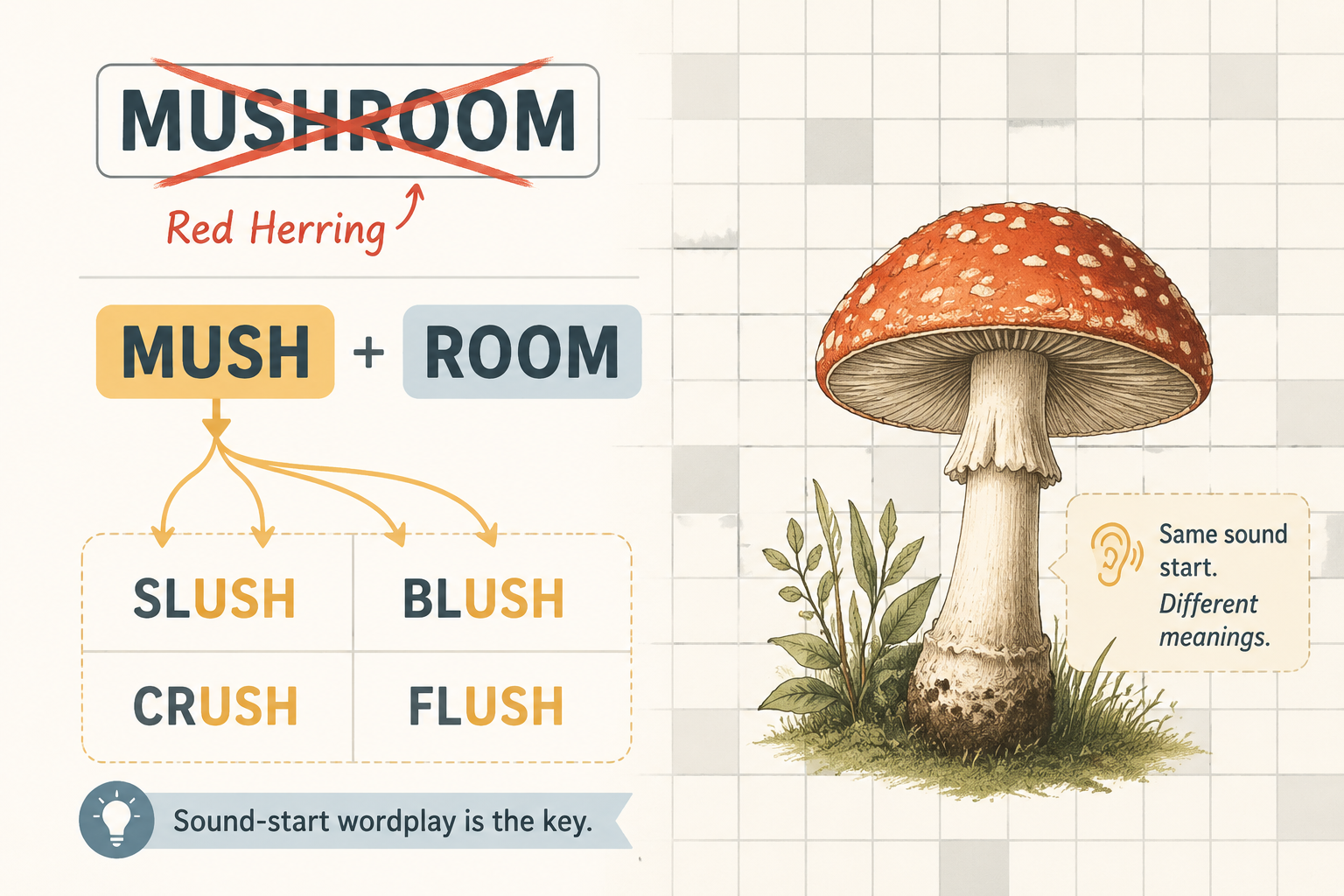
On April 13, 2026, puzzle #1037 put MUSHROOM on the board, and the trap looked almost polite. A solver could reasonably start hunting for OYSTER, BUTTON, SHIITAKE, PORTOBELLO, or some other edible-fungus friend. Instead, MUSHROOM mattered because of its opening sound/string: MUSH. The actual category grouped SLUSH, BLUSH, CRUSH, and FLUSH — words connected through that mush-like sound pattern, not through mushrooms as a food category at all.[1][2]
That is the cleanest way to explain the mushroom thread in NYT Connections, because it gets to the real issue quickly. The game is not only asking what a word means. It is asking what job the word is doing today. MUSHROOM can be a literal fungus, a verb, a fragment hiding inside another answer, a video-game object, or one item in a physical-feature set. If you only ask for the dictionary meaning, you are often solving one layer too shallow.
I keep a small mental drawer for repeat offenders like this. Not because “mushroom” is sacred puzzle lore, but because it is absurdly good training material. Across archive and hint-page documentation, the word has shown up at least 11 times, and possibly more depending on archive coverage. That count is less important than the spread of uses: the same object has been made to behave in several different puzzle grammars.[3][4][7]
When MUSHROOM is bait, look below the whole word
The April 13 puzzle is worth lingering over because it punishes a very reasonable intermediate move. You see MUSHROOM. You scan the grid for edible varieties. If three plausible companions appear, you may even feel clever enough to submit. But the constructor’s move is smaller than the object: take MUSH, then find words that match that sound pattern.
This is not quite a standard “starts with” category in the tidy classroom sense. SLUSH, BLUSH, CRUSH, and FLUSH do not start with the letters M-U-S-H. They rhyme with or echo the sound chunk suggested by MUSH. That makes MUSHROOM a clueing surface, not a category member in the obvious way.[1][2]
The future-solving question is simple: if an obvious thematic word feels too loud, can I break it into a smaller sound or string? Connections often rewards moving from object-level meaning to word-level mechanics. A word like MUSHROOM may be there to shout “fungus,” but the actionable part may be just MUSH.
This is where studying one recurring word becomes more useful than memorizing one answer. A previous mushroom puzzle can teach a habit: before locking in the tempting semantic group, test whether the word is acting as letters, sound, prefix, suffix, or container. That habit sits neatly beside the broader categorization practice discussed in The Study Method Hidden in the Connections Mushrooms Puzzle, but here the emphasis is less on memory and more on mechanism.
The verb switch: MUSHROOM as “increase rapidly”
The most reusable mushroom lesson is the verb/noun switch. In an April 12, 2024 puzzle, MUSHROOM appeared in a category meaning “increase rapidly,” alongside words such as BALLOON, SNOWBALL, and SWELL.[3] Lifehacker documented the same sense again in an August 29, 2025 puzzle, where MUSHROOM again belonged to an “increase rapidly” category.[4]
That repeat matters. Not because it proves the puzzle is predictable; it does not. It matters because it shows that Connections is comfortable reusing a word’s non-dominant role. Most people first meet “mushroom” as a noun. The puzzle wants you to remember that it can also be a verb: costs mushroom, crowds mushroom, problems mushroom.
The intermediate mistake is usually not ignorance. You know the verb once someone points it out. The miss happens earlier, when the noun meaning occupies the whole word so completely that you never audition the verb meaning. Connections loves that gap between “I know this” and “I checked this.”
A practical check: when a word looks like a concrete object, ask whether it can also be an action. If MUSHROOM, BALLOON, SNOWBALL, and SWELL are on the same board, they are not four things. They are four ways growth can accelerate. The category lives in grammar, not taxonomy.
This check also protects you from overfitting the grid. Suppose you see MUSHROOM and one other fungus-related word. That is not enough to build a set. Before hunting for two more fungi, run the verb test. Can any other words mean expand, surge, intensify, spread, or pile up? If yes, the mushroom may be behaving like a process, not a specimen.
Literal mushroom varieties are real — that is why the decoys work
The annoying part is that sometimes the obvious reading is right. Connections has used mushroom varieties as a literal category often enough that you cannot dismiss the possibility. The WordsRated archive is the easiest public way to see mushroom-related appearances across past puzzles, though any single searchable archive should be treated as documentation rather than a perfect census.[7]
So the lesson is not “never choose the fungus set.” The lesson is to demand cleaner evidence before submitting it. A literal mushroom category should usually have four members that share the same dimension: actual mushroom types. OYSTER, BUTTON, PORTOBELLO, and TRUMPET look strong because they all can be mushroom names. That is exactly why the July 2026 puzzle is such a beautiful nuisance.
The July 20 PORTOBELLO trap: when a perfect set is too perfect
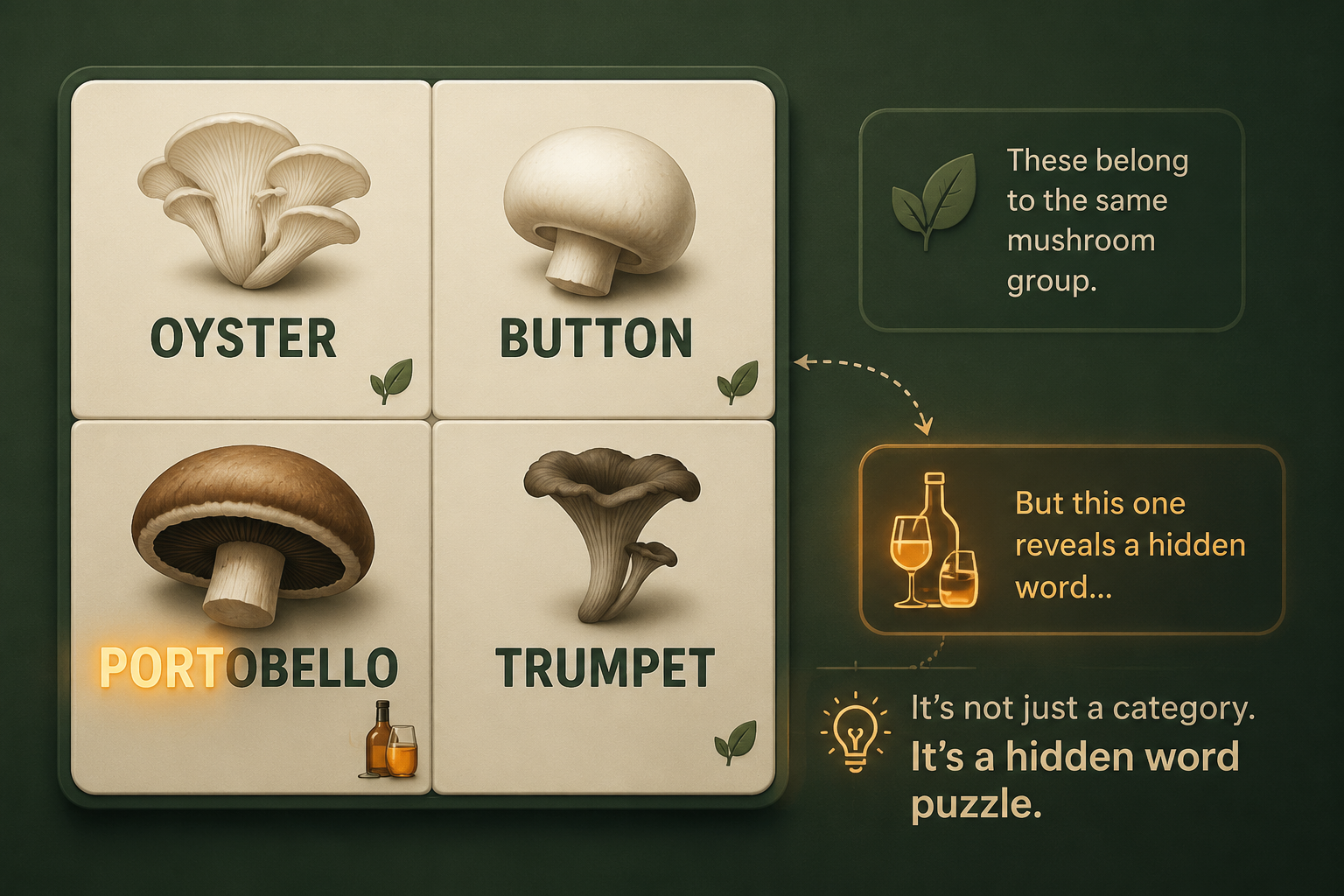
On July 20, 2026, puzzle #1135 offered the kind of fake-out that makes a private mistake log worth keeping. OYSTER, BUTTON, PORTOBELLO, and TRUMPET appeared together. They look like a mushroom-variety answer waiting to be clicked. Forbes noted that its writer initially fell for that set, and TechRadar/Yahoo also documented the same decoy.[5][6]
But PORTOBELLO was not there as a mushroom. It was doing hidden-word work. The first four letters, PORT, belonged to a category of words whose opening letters spell alcoholic drinks. In that puzzle, the solver had to stop treating PORTOBELLO as a whole edible thing and notice the smaller answer embedded at the front.[5][6]
This one bothers me more than the usual red herring because the false set is not sloppy. It is not a random pile of vaguely nature-ish words. It is a legitimate-looking four-item category. That is what makes it useful. The danger in Connections is not only seeing patterns that are weak. It is seeing patterns that are strong but not the one the puzzle is scoring.
The July 20 example adds a second check after the literal-category check: if a set looks complete, inspect each member for hidden strings before submitting. PORTOBELLO contains PORT. Other long words may hide colors, numbers, drinks, card ranks, state abbreviations, musical notes, or short names. A tempting semantic group should survive that mechanical scan.
There is also a useful asymmetry here. OYSTER, BUTTON, and TRUMPET can all help lure you into the mushroom reading, even if none of them ends up being the relevant answer for that imagined category. PORTOBELLO is the decisive misdirection because it can carry both readings at once: literal mushroom on the surface, PORT underneath. The constructor only needs one word to turn a plausible set into bait.
Hidden strings are not meanings; they are extraction instructions
Once you have seen PORTOBELLO become PORT, you start reading long words differently. Not all long words are traps, and over-scanning every tile can make you slow and jumpy. But when a word is unusually specific, especially a compound or a proper-looking term, it is worth asking whether the answer is sitting inside it.
The shift is from “what category does this word belong to?” to “what operation am I supposed to perform on this word?” That operation might be taking the first four letters, the last syllable, a sound-alike chunk, or a word hidden across the middle. PORTOBELLO teaches the first version cleanly: take the opening string and classify that string, not the full word.
This is where semantic memory and wordplay checks have to cooperate. A semantic scan finds the mushroom set. A mechanism scan tests whether the same words are also behaving as containers, fragments, or sound cues. For a broader solving routine, the semantic side is developed in How to Solve Connections Puzzles Using Semantic Memory; the mushroom file is a reminder not to let semantic familiarity end the search too early.
MUSHROOM can also be a reference, not a fungus
Another appearance lives in pop culture rather than biology. Archive documentation includes mushroom in Super Mario-themed Connections material, where the relevant association is the Mario power-up world rather than a mushroom variety or the verb “to mushroom.”[7][9]
This is a faster check, but it still changes solving behavior. When a word is an ordinary object with a famous franchise life, test whether the grid contains other items from that cultural system. MUSHROOM can point to Mario. RING might point to Sonic, jewelry, boxing, phones, or circles. The object is not the category until you know which universe is using it.
The mistake to avoid is treating pop culture as trivia floating outside the puzzle’s normal logic. In Connections, a cultural reference is just another level of meaning. It sits beside grammar, sound, literal category, and hidden text. The solver’s job is to identify the level quickly enough to stop forcing the wrong one.
The cap category: shared physical feature, not shared identity
On January 30, 2024, Rock Paper Shotgun documented MUSHROOM in a category of things with caps, alongside PEN, TOOTH, and KNEE.[8] This is one of those categories that feels obvious after the reveal and slightly rude before it. A mushroom has a cap. A pen has a cap. A tooth has a cap. A knee has a kneecap.
The useful distinction is that these items do not belong to the same family. They share a feature or attached word. That kind of category can look weaker than a clean taxonomy, so intermediate solvers sometimes ignore it while chasing a more elegant set. But Connections is happy to group by property: things with caps, things with tails, things with keys, things with wings, things with shells.
For future grids, ask whether a word is present as an object with a part. If MUSHROOM is not acting as food, verb, sound, hidden string, or Mario object, maybe it is simply something that has a cap. That is less glamorous than PORTOBELLO hiding PORT, but it catches a different class of misses.
A small decoder ring for future mushroom-shaped trouble
| If MUSHROOM seems obvious | Ask this before submitting | What the word may be doing |
|---|---|---|
| It points to fungi | Are there four actual mushroom varieties, or just one or two tempting ones? | Literal category member |
| It feels like a concrete noun | Can it also be an action, like increase rapidly? | Verb/noun switch |
| It looks too specific | Does a smaller string inside it belong somewhere else? | Hidden-word or extraction clue |
| It has a strong first chunk | Do other answers echo that sound or string? | Sound/string starter |
| It has a famous media association | Are other answers from the same fictional universe? | Pop-culture reference |
| It shares no obvious family with nearby words | Do the objects share a part or physical feature? | Shared-feature category |
This is also transferable beyond the daily grid. The same discipline helps with themed variants and adjacent puzzle formats, including cases where the surface theme is loud enough to distract from the actual mechanism. Pattern recognition is not about making one magical guess; it is about reducing the number of bad guesses you make twice. That is why the same study habit applies even when you move into something like Connections Sports Edition hints, where category surfaces can be just as seductive.
The point of keeping a mushroom file is not to worship mushrooms, though the puzzle does make that harder to say with a straight face. It is to train the pause after recognition. When a word seems obvious, ask what role it is playing: sound, verb, literal member, hidden string, cultural reference, or shared-feature object. That pause is often the difference between seeing a category and seeing the constructor’s move.
References
- NYT Connections Answers Explained Monday April 13 #1037 — Forbes, April 12, 2026
- NYT Connections Answer Today, April 13, 2026 — Lifehacker
- Today's Connections hint and answer on Friday 12th April for 306 — Rock Paper Shotgun, April 12, 2024
- NYT Connections Answer Today, August 29, 2025 — Lifehacker
- NYT Connections Answers Explained Monday July 20 — Forbes, July 19, 2026
- NYT Connections hints and answers Monday — Yahoo / TechRadar
- NYT Connections Archive: All Past Answers — WordsRated
- Today's Connections hint and answer on Tuesday 30th January for 233 — Rock Paper Shotgun, January 30, 2024
- The New York Times Connections — Wikipedia
Comments
Join the discussion with an anonymous comment.