
How to Solve Connections Puzzles Using Semantic Memory
Understand how semantic memory shapes every Connections puzzle category and learn targeted strategies to solve each color-coded level with less guessing.
Best for: vocabulary building, word games
A bad Connections guess is annoying. A “one away” guess is worse. You saw the shape of something, trusted it, and then the grid told you that your brain had been helpful in exactly the wrong direction.
That is why the best connections puzzle tips and tricks are not just lists of “watch out for red herrings” and “shuffle the board.” The real problem is more specific: the puzzle gives you 16 familiar words, then asks you to retrieve the right relationship among them under pressure. Sometimes that relationship is meaning. Sometimes it is a shared feature. Sometimes it is a phrase hiding in plain sight. Sometimes it is not meaning at all, but spelling or sound.
That makes Connections feel harder than a straight vocabulary puzzle. Knowing what CREDIT means does not protect you from pairing it with VISA too quickly. In fact, knowing the association well can make the trap stronger.

Connections Is a Retrieval Puzzle, Not a Vocabulary Quiz
One useful way to understand the game comes from Penny Pexman and Emiko Muraki, who describe Connections through semantic memory: the part of memory that stores general knowledge about word meanings, categories, and relationships. Their explanation does not turn every puzzle into a lab experiment, but it gives the daily grid a practical map. Different categories ask you to travel through memory by different routes.[1]
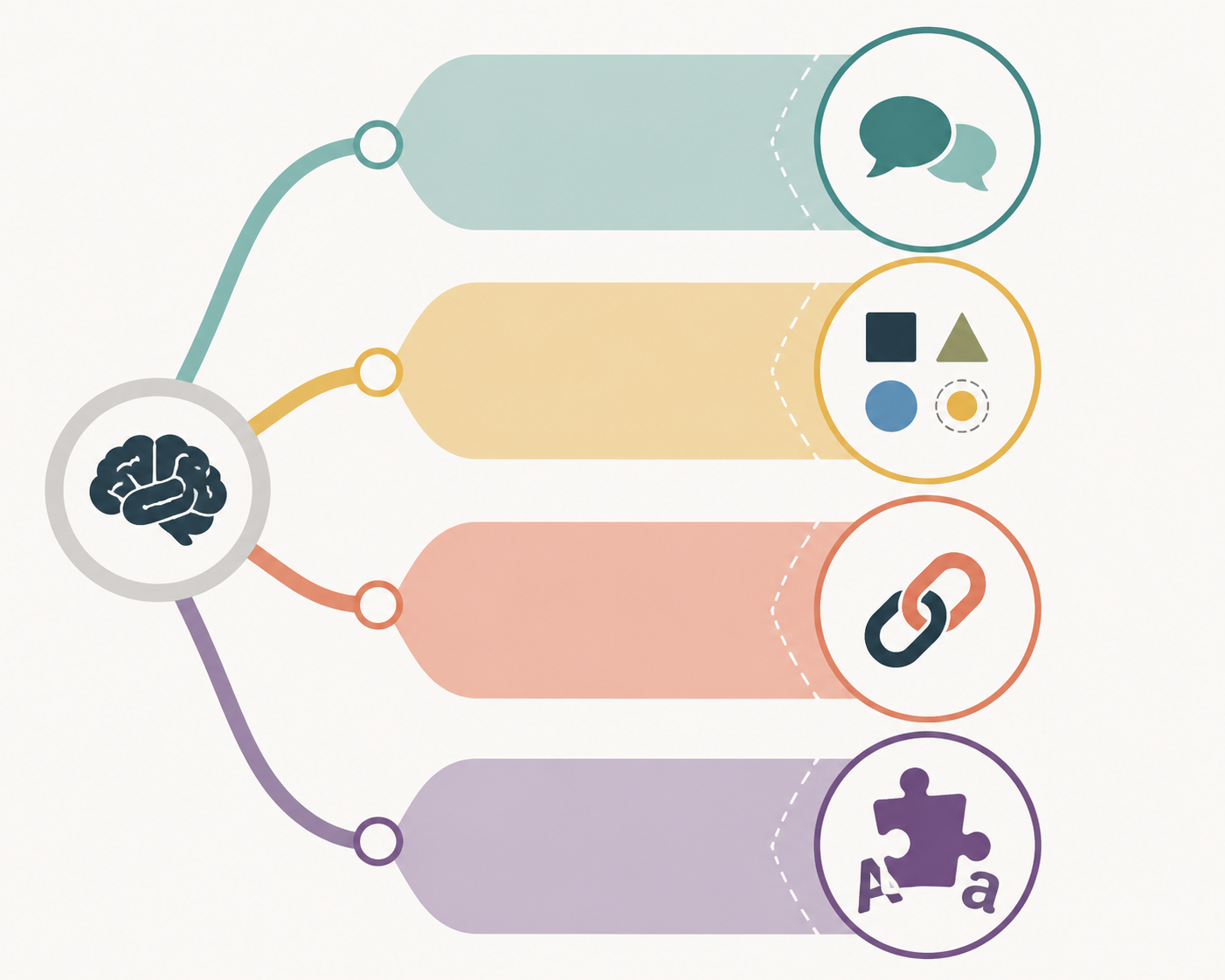
A synonym group asks for direct meaning retrieval. A shared-feature group asks you to notice what objects have in common, often beyond their most obvious resemblance. A phrase category asks you to retrieve stored expressions. A wordplay category asks you to stop treating the tiles primarily as meanings and start treating them as letters or sounds.[1]
That distinction matters because a wrong guess often comes from using the right intelligence in the wrong mode. You keep searching for synonyms when the puzzle wants parts of compound phrases. You keep asking what four things are when the puzzle wants what four words can follow. You keep reading words for meaning when the answer is hiding in their spelling.
| Category style | What your memory is doing | Useful solving question |
|---|---|---|
| Synonyms and close meanings | Direct semantic retrieval | Do these four words point to the same idea, or only live near each other? |
| Shared features | Feature matching and distinctive-feature search | What concrete property do all four share that excludes the tempting fifth? |
| Multi-word phrases | Phrase or idiom retrieval | Can the same missing word come before or after each tile? |
| Wordplay | Spelling or sound manipulation | What happens if I stop reading for meaning and inspect the letters? |
Start With Meaning, But Do Not Submit the First Meaning Cluster
The yellow and green groups often reward the most familiar kind of semantic search: find four words that mean roughly the same thing, belong to the same everyday category, or point to the same common concept. If four tiles all feel like “small,” “angry,” “quick,” or “fake,” you are probably using direct semantic retrieval.
The danger is that “feel related” is a weaker test than “share the category that the puzzle setter needs.” Four words can all belong to the same neighborhood of meaning while only three belong to the answer. Before submitting a simple meaning cluster, name the category in a phrase specific enough that a fifth tile cannot easily sneak in.
For example, in a hypothetical grid, CAT, DOG, HORSE, and COW might look like “animals,” but that label is too broad if LION is also present. A better test asks whether the category is pets, farm animals, zodiac signs, sounds they make, sports mascots, or words that follow another term. The move is not to become suspicious of every easy group. It is to make the easy group earn a clean label before you spend a mistake.
Shared-Feature Groups Need a Narrower Lens
Shared-feature categories are where many otherwise careful players get pushed around. These groups are concrete, so they look easier than wordplay. But the feature has to be distinctive enough to bind exactly four tiles, not just noticeable enough to attract attention.
Muraki and Pexman use the example of a “things with slots” category: TOASTER, VENDING MACHINE, MAILBOX, and COIN-OPERATED BINOCULARS. The trap is that “has a slot” feels obvious once seen, but it may not be the first feature your mind chooses for each object. A toaster is for bread. A mailbox is for mail. A vending machine is for snacks or drinks. Coin-operated binoculars are for viewing. The shared feature is real, but it is not necessarily the defining feature you would retrieve first.[1]
That is the mental switch: move from identity to features. Instead of asking, “What kind of thing is this?” ask, “What physical part, action, material, location, or use could four of these share?” Then test the feature against every remaining tile. If the feature is too broad, it will collect impostors. If it is too private, it will not collect four.
A useful feature-search pass can be quick:
- Parts: Does each object have the same component, opening, handle, cover, blade, slot, or screen?
- Actions: Are they all things you fold, strike, charge, launch, seal, or thread?
- Settings: Do they appear in the same place, such as a kitchen, theater, airport, classroom, or game?
- Roles: Are they all containers, barriers, tools, symbols, warnings, or tokens?
This is also where study habits cross over cleanly. Flexible category switching is the same reason interleaving practice helps learners stop solving every new problem by the method they just used. Connections punishes the same inertia. If the last group was meaning-based, the next one may require a feature scan.
Purple Often Means “Change the Retrieval Route”
Purple categories are not hard only because they are obscure. They are hard because they often require a different kind of retrieval altogether. The words may not be related as standalone meanings. They may be fragments of phrases, members of idioms, homophones, hidden letter patterns, or words that change when a prefix or suffix is added.
For phrase categories, treat each tile as incomplete. Do not ask only what the word means; ask what it commonly sits next to. Can one word precede all four? Can one word follow all four? Are the tiles the beginnings of familiar expressions, titles, brand-like phrases, or idioms? Muraki and Pexman describe this as retrieving multi-word phrases as stored lexical entries rather than assembling them from scratch every time.[1]
This explains why a phrase answer can feel invisible until the missing word appears, then suddenly becomes obvious. Your memory may store “blank check,” “blank slate,” or “blank canvas” as whole expressions. If the puzzle gives only CHECK, SLATE, and CANVAS, the category is not sitting at the level of ordinary word meaning. It is waiting one layer out, in phrase completion. That example is hypothetical, but the operation is the point: try attaching the same word before or after several tiles and listen for familiar chunks.
Wordplay requires an even sharper break. At that point, semantic memory still helps, but meaning can become noise. Read the tiles aloud. Look at first letters, last letters, silent letters, repeated letter strings, abbreviations, keyboard shapes, chemical symbols, Roman numerals, and words inside words. If the grid has stopped rewarding meaning, continuing to search for meaning is just a more sophisticated way to stay stuck.
A compact purple pass might look like this:
- Try phrase completion: one shared word before or after four tiles.
- Try title or expression memory: idioms, sayings, pop-culture phrases, and fixed collocations.
- Try sound: homophones, rhymes, syllables, or words that become another word aloud.
- Try spelling: prefixes, suffixes, initials, hidden words, missing letters, or letter additions.
Red Herrings Work Because Priming Is Fast
Once you know the routes, the red herrings become easier to diagnose. They are not random cruelty. They exploit semantic priming: when one word activates a familiar association, related words become more available in memory. CREDIT and VISA are the clean example. Put them near each other, and the credit-card pathway lights up before you have checked whether each word actually belongs there.[1]

This is why the most tempting group is not always the most stable group. A red herring can contain four words that genuinely relate in ordinary life, but the puzzle’s actual categories may split them apart. Lifehacker reports examples involving dating apps and snake names as traps that look coherent before the full grid is resolved.[3] CNET describes a SpongeBob SquarePants-related example in the same practical spirit: pop-culture knowledge can help, but it can also pull attention toward the wrong organizing principle if you submit too quickly.[4]
The better move is not generic caution. It is source-checking the association. Ask what kind of relationship produced the tempting group. If the answer is “these words remind me of the same thing,” slow down. Reminder strength is not category proof. A valid Connections group usually survives a stricter label: synonyms of X, objects with Y feature, words after Z, words whose letters do A.
The five-word trap is the same interference pattern in a more visible form. Puzzle a Day warns that if five words seem to fit a category, at least one is probably bait, and Lifehacker attributes a similar tip to Connections editor Wyna Liu through secondary reporting rather than a directly accessible New York Times source.[3][5] The practical rule is simple: when you see five, do not ask which four you like best. Ask which one belongs more cleanly to a different retrieval route.
Use Paper Before You Use a Mistake
The board makes guessing feel cheap until the mistake counter reminds you it was not. One low-tech fix is the paper-first method: write possible groups before submitting, especially when you have a tempting cluster but have not explained the leftover words. Puzzle a Day recommends working outside the interface so you can test combinations without burning guesses, and Lifehacker also supports holding back before committing a plausible set.[3][5]
Paper helps because it changes the task from commitment to comparison. You can put CREDIT with VISA, then force yourself to place the other 14 words. If that choice leaves an ugly remainder, the issue is not that CREDIT and VISA are unrelated. The issue is that their relationship may be less useful than another one.
A good paper-first pass does not need to be elaborate:
- Mark obvious meaning clusters, but do not submit them yet.
- Circle any group with five possible members.
- Write a specific label for each possible group.
- Check whether the leftover words suggest a cleaner feature, phrase, or wordplay category.
- Submit the group whose label is narrowest and whose leftovers are least chaotic.
Practice the Switch, Not Just the Archive
Replaying old puzzles can be fun, but improvement comes from noticing what kind of switch you missed. Did you stay in synonym mode too long? Did you accept a broad feature instead of finding the distinctive one? Did you keep reading for meaning when the puzzle had moved to sound?
Puzzgrid is frequently recommended as a practice tool because it gives players more category-recognition reps outside the daily Connections grid.[3][5] The important part is not merely doing more puzzles. It is making each miss diagnostic. After a failed grid, label the miss by retrieval type: meaning, feature, phrase, or wordplay. That small postmortem turns irritation into practice data.
Readers who like the memory side can take the same habit into broader vocabulary work. Stronger word knowledge helps most when it includes associations, contexts, and phrase patterns, not just definitions. That is the difference between memorizing a word in isolation and building the kind of network that helps under pressure, whether through memory techniques or a more deliberate approach to GRE vocabulary flashcards.
A Solving Routine for the Next Grid
Semantic memory will not guarantee a perfect Connections board. The framework comes mainly from one research team’s interpretation of the puzzle, and daily grids still depend on cultural knowledge, editorial taste, and sometimes a category you simply do not know.[1][2] But it does give you a better question than “What four words go together?”
Ask: what kind of relationship am I testing right now?
- If it is meaning, require a precise label before submitting.
- If it is a shared feature, search for the property that includes exactly four and excludes the bait.
- If it is a phrase, try the same missing word before or after multiple tiles.
- If it is wordplay, stop treating the tiles as definitions and inspect sound or spelling.
- If five words seem right, assume priming may be doing some of the work.
That does not make a “one away” miss painless. It does make it less mysterious. The next time a group feels plausible, pause long enough to name the retrieval route before you press submit.
References
- NYT Connections: Tips to improve your game through the science of semantic memory — The Conversation, April 2024
- Tips to improve your NYT Connections game — Western News, April 2024
- The Best Strategies for Winning NYT Connections — Lifehacker
- NYT Connections Puzzle: Here's a Great Hint to Help You Win — CNET
- Tips and Tricks for the NYT Connections Puzzle — Puzzle a Day blog
Apply This Method
Related Methods
- The Study Method Hidden in the Connections Mushrooms Puzzle
The NYT Connections 'mushrooms' category is more than a puzzle answer—it's a direct application of a semantic categorization strategy that research shows can boost free recall by nearly 40%. This article explains how to turn the game's grouping mechanic into an active study protocol.
- How to Master Stroke Symptom Recognition for Medical Training
This guide outlines evidence-based study methods for learning and retaining stroke symptom recognition, combining mnemonic practice with awareness of recall trade-offs, active-recall spaced repetition, and simulation training. Readers will learn how to build a deliberate study strategy that outperforms passive review and prepares them for exams and clinical practice.
- How to Focus on What You Can Control When Studying
Feeling like your study efforts don't pay off? Learn how the circle-of-control framework can help you focus on what you can actually change—study strategies, scheduling, and environment—to reduce anxiety and improve grades.
Comments
Join the discussion with an anonymous comment.