
Why Connections Sports Edition Hints Train Your Brain for Exams
Playing Connections Sports Edition does more than test your sports knowledge. The same pattern-recognition, categorization, and recall skills it demands can sharpen your study habits for exams — here's how to make the transfer work for you.
Best for: biology, history, math
If you open a daily puzzle before you open your notes, that does not automatically mean you are avoiding your exam. It might mean you wanted one task where the rules are clear, the feedback is immediate, and being wrong costs almost nothing. The useful question is not whether Connections Sports Edition is secretly a full study session. It is not. The better question is whether the same mental moves you use while looking for Connections Sports Edition hints can become a warm-up for the kind of thinking exams actually demand.
The answer is yes, within limits. The puzzle can help if you treat it as a place to notice how you think: how you retrieve facts, group clues, resist a tempting category, and decide when a guess is worth spending. It stops helping the moment it becomes a substitute for practicing with the material that will actually be on the test.

What the puzzle asks your brain to do
Connections Sports Edition gives you a 16-word grid and asks you to sort those words into four groups of four. You are allowed four mistakes before the puzzle ends, and the solved categories appear in a color sequence from yellow to green to blue to purple, with yellow generally the easiest and purple the trickiest or most wordplay-dependent category.[1]
That small design carries more cognitive weight than it looks like it should. You are not answering one question at a time. You are holding several possible relationships in your head at once. A word might look like it belongs with a team, a player, a piece of equipment, a venue, a league, or a phrase. You scan, test, hesitate, and revise.
The yellow-to-purple gradient matters because it gives the game a built-in hierarchy. The Athletic’s Connections: Sports Edition Coach page describes the same progression: yellow as the easiest group, then green, blue, and purple as the trickiest category.[2] In practice, that means the puzzle rewards students for doing something they often need to do in school: secure the obvious structure first, then spend attention on edge cases.
Daily hint pages show why this is not generic word matching. The sports layer can require specific recall: Hall of Fame players, team groupings, equipment types, league-related clues, or other categories that only become visible if the player can pull the right association from memory.[3][4] That is not the same as studying chemistry or history, but the operation underneath is familiar: retrieve first, check later.
The transfer is in the moves, not the trivia
Sports trivia will not magically raise an exam grade in a class that has nothing to do with sports. A category about teams, equipment, or famous athletes helps you study only if you recognize the thinking pattern and reuse it with your course material. That is the difference between playing and warming up.
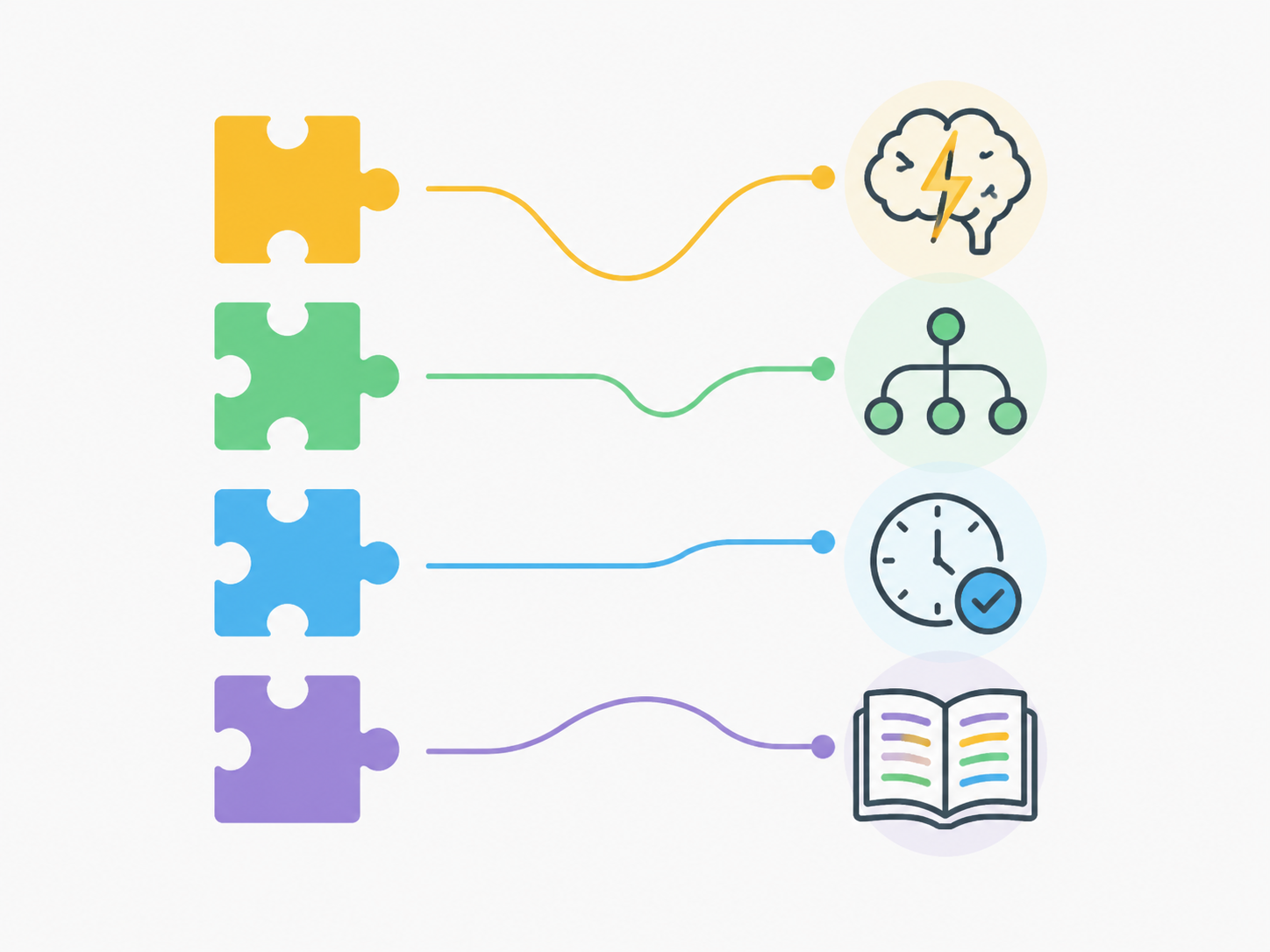
| Puzzle behavior | Study technique it resembles | Exam habit to practice afterward |
|---|---|---|
| Remembering a player, team, league, or object without looking it up | Active recall | Close the notes and retrieve the answer before checking |
| Finding the easiest group before attacking ambiguous clues | Hierarchical organization | Sort concepts into foundations, subtopics, and exceptions |
| Deciding whether to submit a guess under a four-mistake limit | Strategic time management | Choose when to answer, skip, return, or eliminate options |
| Scanning 16 words for several possible relationships at once | Divided-attention reading | Track multiple cues in a passage, diagram, or problem statement |
Active recall: retrieving before you verify
When a clue points toward a Hall of Fame player or a team nickname, the useful part is not that you know sports. The useful part is that you try to pull a fact from memory before checking a hint or answer page. That is the same basic posture students need when they study: answer from memory first, then open the textbook, notes, flashcard, or solution.
Passive studying often feels safer because the correct answer is visible the whole time. You read a paragraph, nod along, and feel familiar with it. The puzzle does not let familiarity do all the work. A word either joins a group or it does not. That little moment of exposure is useful: you find out what you can retrieve without support.
After playing, the transfer is simple. Pick one class and ask yourself one closed-book question before you start reviewing. If the class is biology, name the steps of a process before looking. If it is history, sketch the causes of an event from memory. If it is math, write the method you would try before reading the worked example. The point is not to make the puzzle academic; it is to carry the retrieval habit into the next task.
Hierarchical organization: solve the clean groups first
A good Connections Sports Edition solve rarely treats all 16 words as equally confusing for the same amount of time. You look for the clean category first: maybe a set of teams, a cluster of equipment, or four names that obviously share a role. Once that group is removed, the grid gets quieter. The remaining ambiguity becomes easier to see.
That is close to what students need when a course feels like a pile of unrelated details. Before memorizing every exception, build the top-level structure. What are the four or five major units? Which ideas are foundational? Which terms are examples, and which terms name the category itself? Many students try to learn from the bottom up because the details are what appear in bold. The puzzle reminds you that categories make details easier to place.
The color gradient makes this especially concrete. Yellow is where you look for stable, low-friction structure. Purple is where you expect trickiness, wordplay, or a less obvious link.[1][2] In studying, the equivalent is not color-coded by a game, so you have to create it yourself: core definitions first, standard examples next, mixed cases after that, and exceptions only once the main map exists.
Strategic time management: spend your mistakes carefully
The four-mistake limit changes how the puzzle feels. If wrong guesses were unlimited, you could brute-force your way through the grid. Because they are not, every submission asks a small pacing question: am I confident enough, or should I gather more evidence first? Beebom’s guide and CNET’s daily coverage both describe the four-mistake structure as part of the game’s rules.[1][3]
That maps neatly onto timed exams, especially multiple-choice or mixed-format tests. Students often lose time in two opposite ways. Some guess too quickly because motion feels like progress. Others stare too long because leaving a question blank feels like failure. The puzzle gives a safer version of the same decision: submit, hold, eliminate, or move on.
After the puzzle, notice one decision point. Did you submit because three words felt obvious and the fourth merely looked possible? Did you wait because two categories were tangled together? Did one wrong guess help you see the real boundary? Those observations become exam tactics when you turn them into rules: eliminate first, mark uncertainty, answer the high-confidence items, and return to the trap after your first pass.
Divided-attention reading: scan without losing the whole
The 16-word grid forces a kind of divided attention that students know from dense reading. You cannot stare at one word forever. You have to move across the whole set, keep possible relationships alive, and update them as new combinations appear. One clue might support a team category; another might turn that theory into a dead end.
That resembles what happens in a science passage, a history document set, a data table, or a word problem. You are reading for several layers at once: vocabulary, relationships, exceptions, quantities, and the actual question being asked. The puzzle is much smaller and more playful, but it gives students a clean version of the same mental motion: scan broadly, hold lightly, revise quickly.
A useful transfer exercise is to read one paragraph of course material the way you scan the grid. Circle or list the terms that might belong together. Mark the sentence that changes the category. Notice the detail that looked important but did not actually answer the question. This is where the puzzle habit becomes more than pattern recognition; it becomes a way to manage attention while reading.
How to use hints without turning the puzzle into another tab of procrastination
Connections Sports Edition hints are popular because they let players stay in the puzzle without jumping straight to the answer. That is also what makes them useful as a study analogy. A good hint gives enough direction to restart thinking, not so much that the thinking disappears.
Daily hint pages commonly reveal category nudges or full answers for that day’s puzzle, and recent examples have included sports-specific category types such as Hall of Fame players, team groupings, equipment, and league-related clues.[3][4] Those pages can be fun, but the study value depends on timing. If you read the hints before you have tried to retrieve and group anything, you have mostly practiced recognition. If you struggle first, then use a hint to test a revised theory, you have practiced recovery.
- Try the grid cold for a short, honest stretch before opening hints.
- Write down one possible category before checking whether a hint supports it.
- Use the smallest hint that helps you move again.
- After a wrong guess, name why the false group looked convincing.
- Stop once you are no longer thinking and are only collecting answers.
That last line is the boundary most students already understand but do not always enforce. Hints can support thinking, or they can replace it. The same is true of solution manuals, AI explanations, answer keys, and friends who are a little too quick to explain the homework.
A one-minute transfer routine after you play
The puzzle itself is not the whole warm-up. The transfer happens in the minute after it, when you name what you just did. Without that pause, the game remains fun, which is fine, but the study skill stays hidden.
- Name the easiest category you found. Then name the foundational idea in the subject you are about to study.
- Name the false lead that almost trapped you. Then name one common confusion in your course material.
- Name the moment when you needed a hint or almost needed one. Then decide what kind of support you will allow while studying.
- Name one thing you retrieved from memory. Then retrieve one course fact before opening your notes.
This routine should stay short. If it becomes elaborate, it will compete with the study session it is supposed to start. The goal is simply to cross the bridge from “I solved a puzzle” to “I can use that same move on my exam material.”
Why the sports layer still matters
Connections Sports Edition is not just the original puzzle with a new coat of paint. It launched as a sports-focused version tied to The Athletic, and The New York Times Company has also described NFL-team-specific Connections Sports Edition puzzles created for all 32 NFL teams.[5][6] That specificity matters because the game often asks for domain knowledge, not only general verbal cleverness.
For sports fans, that recognition is part of the pleasure. A name, team, or phrase lights up because it belongs to a world they already know. For studying, the lesson is that recall improves when knowledge is organized inside a domain. A student who knows isolated terms may struggle; a student who knows how those terms cluster has more ways to retrieve them.
That is also why the puzzle has limits as exam preparation. If your upcoming test is on cell respiration, constitutional law, or calculus, sports categories do not supply the content. They only rehearse the habit of pulling content from memory, sorting it, and checking the fit. You still have to do that work with the actual course material.
The fair claim
Connections Sports Edition can be a legitimate cognitive warm-up because its mechanics overlap with exam-relevant behaviors: retrieve without looking, organize from simple to complex, manage limited guesses, and scan competing relationships. That is a practical claim, not a promise that one daily puzzle will transform your grades.
The next time you play, enjoy the puzzle first. Then spend one minute noticing the move you just practiced. Did you recall a fact, rebuild a category, recover from a false lead, or hold back a risky guess? Put that same move into the first few minutes of your study session, where it can do more than help you finish the grid.
References
- How to Play Sports Connections, Beebom.
- Connections: Sports Edition Coach: Hints, facts about puzzle No. 152, The Athletic, February 22, 2025.
- Today's NYT Connections: Sports Edition Hints and Answers for July 3, #648, CNET, July 3, 2026.
- NYT Connections Sports Edition hint and answer today: June 23, 2026, Mashable, June 23, 2026.
- Connections: Sports Edition: How to play, The Athletic, February 10, 2025.
- The Athletic Tests Football Fans With a Connections: Sports Edition Puzzle for Every Team, The New York Times Company.
Apply This Method
Related Methods
- Build One Statute of Limitations Chart for All 1L Exams
Law students often treat statute of limitations as four separate topics across Civil Procedure, Torts, Contracts, and Criminal Law. This guide shows how building a single cross-subject reference chart organized by cause of action replaces separate outlines and directly boosts exam performance.
- The Study Method Hidden in the Connections Mushrooms Puzzle
The NYT Connections 'mushrooms' category is more than a puzzle answer—it's a direct application of a semantic categorization strategy that research shows can boost free recall by nearly 40%. This article explains how to turn the game's grouping mechanic into an active study protocol.
- How to Master Stroke Symptom Recognition for Medical Training
This guide outlines evidence-based study methods for learning and retaining stroke symptom recognition, combining mnemonic practice with awareness of recall trade-offs, active-recall spaced repetition, and simulation training. Readers will learn how to build a deliberate study strategy that outperforms passive review and prepares them for exams and clinical practice.
Comments
Join the discussion with an anonymous comment.