
What Recent Studies Reveal About Heatstroke Prevention Misconceptions
A research-based overview of the most persistent knowledge gaps and misconceptions in heatstroke prevention, drawn from recent KAP surveys and epidemiological data. Health sciences students will learn key findings to inform exam prep, papers, and future clinical or educational practice.
Updated:
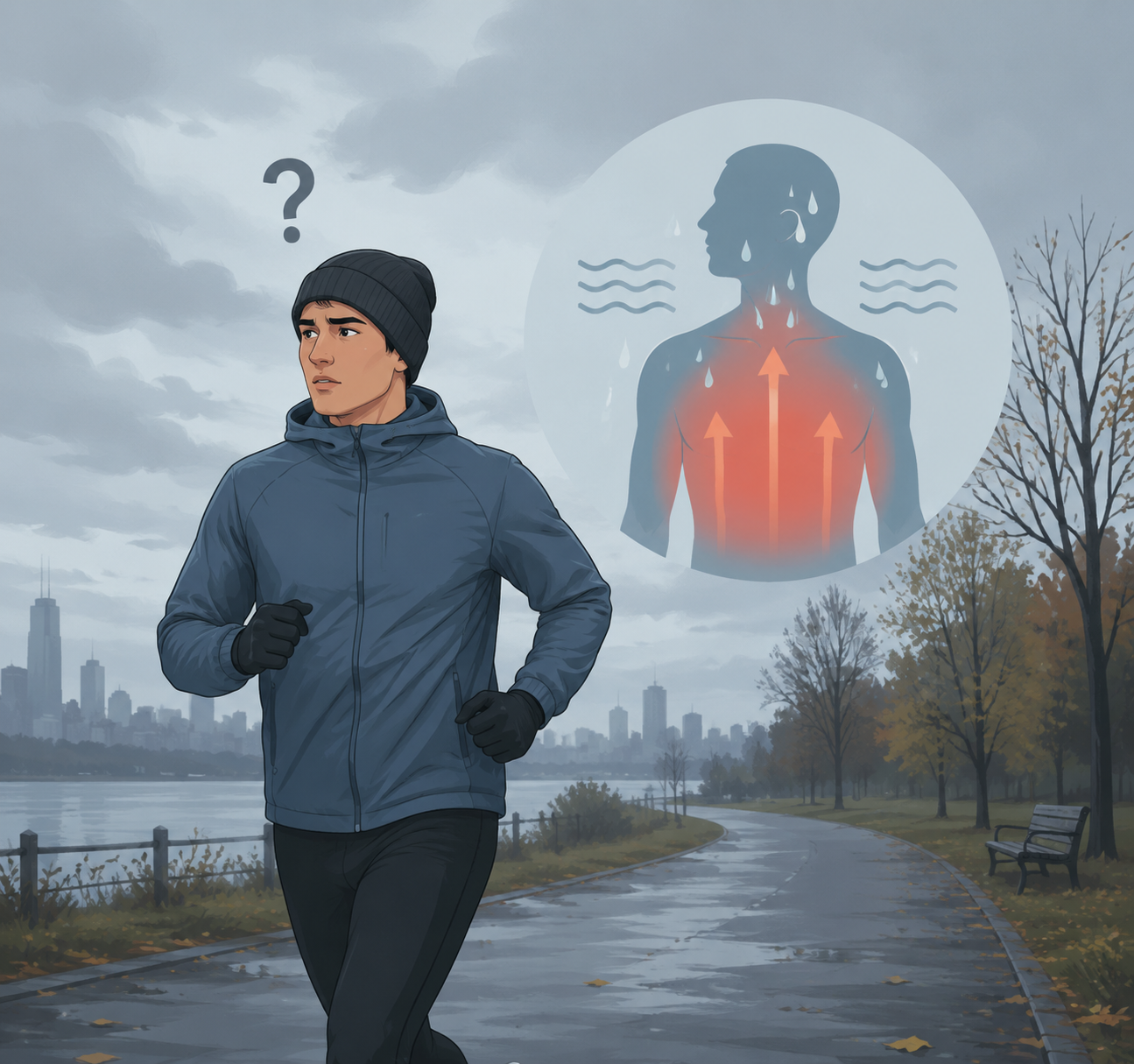
One finding from a recent study of heatstroke prevention misconceptions should stop health sciences students before they reach for another symptom list: 43.25% of 467 respondents endorsed the false statement that heatstroke cannot occur during exercise in cool environments.[1] That is not a harmless quiz error. It creates a false boundary around risk. If a runner, recruit, patient, or athlete is working hard on an overcast day, the person watching them may delay concern precisely because the setting does not look like the stereotype.
For exam prep, that misconception is more useful than another memorized definition. It shows how heatstroke prevention fails upstream: not only when people cannot name symptoms, but when they misread exposure, effort, humidity, treatment, and urgency. The recent KAP evidence points to a narrower, more testable conclusion than “awareness is low.” People may hold specific wrong beliefs, remain uncertain about emergency care, and know prevention facts without consistently acting on them.
The cool-weather misconception changes the whole risk assessment
The cool-environment item matters because it tests whether someone understands heatstroke as a thermoregulation and exertion problem, not just a hot-day problem. A student who misses that distinction may still recognize classic heatstroke language on a multiple-choice exam, but fail a case question where the danger comes from sustained exercise, inadequate cooling, equipment, dehydration, acclimatization status, or delayed stopping.
Zhang et al. also found that 32.55% of respondents could not confirm that heatstroke occurs in humid and hot conditions, while 27% were uncertain whether antipyretics are necessary for treating heatstroke.[1] Those two items point in different directions but create the same educational problem: people are unsure about both when heatstroke risk is present and what kind of response actually fits the physiology.
That uncertainty should be separated from simple ignorance. A person who is unsure about humid conditions may not reject prevention; they may just lack a working model of evaporative cooling. A person who is unsure about antipyretics may be borrowing a fever framework for a heat illness problem. In both cases, the prevention message has to correct the mental model, not just add another warning.
Knowledge helped, but attitude was the stronger direct pathway
The most exam-relevant part of the Zhang et al. study may be its structural equation modeling. In that analysis, attitude toward prevention had a stronger direct association with preventive practice than knowledge did: β=0.431 for attitude compared with β=0.133 for knowledge.[1] That does not mean knowledge is useless. It means factual knowledge, by itself, was the weaker direct driver of reported protective behavior in this sample.

This is where many health education answers become too thin. “Teach people the signs of heatstroke” is necessary, but the SEM result suggests a second question: do they believe the risk applies soon enough, personally enough, and urgently enough to change what they do? Someone can know that heatstroke is dangerous and still keep practicing, delay calling for help, skip hydration planning, or assume a cooler day makes exertional heat illness unlikely.
For papers or short-answer responses, the clean way to phrase the finding is this: in Zhang et al.’s China-based KAP study, knowledge and attitude were not interchangeable predictors. Attitude showed the stronger direct relationship with reported prevention practice, so interventions that only transmit facts may underperform if they do not also affect perceived susceptibility, seriousness, and readiness to act.[1]
| Evidence point | What it measures | What a student should not overclaim |
|---|---|---|
| 43.25% endorsed the cool-environment misconception | A specific false belief about when heatstroke can occur | It does not prove all populations hold the same misconception at the same rate |
| β=0.431 for attitude and β=0.133 for knowledge | Direct associations with reported preventive practice in the SEM model | It does not prove that attitude alone causes behavior change |
| 27% uncertain about antipyretics | Treatment-related uncertainty | It should not be treated as a full clinical management study |
| Only 59.96% always educated family and friends | A reported prevention communication practice | It does not show whether those conversations were accurate or effective |
Prevention practice is where the evidence becomes uncomfortable
Zhang et al. reported that only 59.96% of respondents always educated family and friends about heatstroke prevention.[1] That item is easy to overlook because it sounds softer than a treatment question. It is not. In prevention work, the person who has information but does not pass it along may be the missing link between a warning and an actual behavior change.
A nursing student might read that as patient education. An athletic training student might read it as sideline communication. A public health student might read it as diffusion of risk messages through households. In each frame, the practical issue is the same: the person who recognizes risk has to act before collapse, not after the situation becomes clinically obvious.
The age pattern sharpens the point. In the same study, younger adults aged 18–45 scored lower on both knowledge and preventive practices than older participants.[1] That does not make younger adults uniquely careless; it says the group often associated with work, exercise, commuting, and caregiving may not be the group with the strongest prevention profile in this sample.
Other studies point to the same gap from different angles
Zhang et al. provides the central KAP evidence here, but it is not the only recent source pointing toward a behavior gap. Xu et al.’s Dongyang KAP study of 1,356 participants also identified education level as a significant predictor, with lower education associated with poorer prevention behaviors.[2] Zhang et al. reported a similar education-level pattern.[1] Together, those findings support a cautious conclusion: prevention education cannot assume that access to a warning produces equal readiness to act across educational groups.
A U.S. survey from the Annenberg Public Policy Center adds a different kind of evidence. In July 2024, two-thirds of Americans surveyed did not know the location of their nearest cooling center.[3] That is not the same as a KAP score, and it does not measure whether someone would use a cooling center if they knew where it was. Still, it captures a practical failure point: a person may accept heat warnings in general and still lack the one local detail needed during a dangerous heat event.
Military surveillance adds another boundary case. Among active-duty U.S. service members, heatstroke incidence rose 16.5% in 2024 and another 6.9% in 2025, after a four-year decline.[4] This is a specific high-risk population, not a stand-in for the general public. Its usefulness for students is different: it shows that heat illness risk persists in organized settings where training, hierarchy, and protocols already exist.
Read together, these sources do not prove one universal misconception pattern across China, the United States, and the military. They do support a shared practical concern: prevention can fail at several points before emergency care begins. People may misunderstand when heatstroke can occur, underestimate their own exposure, lack local cooling information, or remain in high-exertion environments despite formal safety systems.
Cold water immersion corrects a treatment misconception
Treatment misconceptions deserve attention because they expose another way the wrong model can persist. Expert clinical commentary identifies cold water immersion as the most effective treatment for exertional heatstroke and reports near-100% survival when it is initiated within 30–60 minutes.[5][6] That claim should not be treated as equivalent to the KAP survey findings; it comes from evidence-informed clinical commentary rather than the same type of original cross-sectional survey data.
For students, the key lesson is not to turn this into a full emergency protocol. The key lesson is that heatstroke is not fever. If students or laypeople map heatstroke onto ordinary fever treatment, they may overvalue antipyretics and undervalue immediate cooling. That is why the 27% uncertainty about antipyretics in Zhang et al. matters: it flags a treatment assumption that can delay the action that matters most.[1]
How to use these findings in exams, papers, and patient education
When using this evidence academically, keep the distinction between constructs clear. Knowledge is what a person knows or believes to be true. Attitude is how they evaluate the risk and the value of prevention. Practice is what they report doing. Zhang et al.’s SEM result is useful because it compares the direct associations of these constructs instead of treating “education” as a single undifferentiated answer.[1]
- For an exam answer, use the cool-environment misconception to show that heatstroke risk is not limited to visibly hot settings.
- For a paper, describe the attitude-practice pathway carefully as an association reported in one KAP study, not as proof that attitude alone causes behavior.
- For patient education, pair symptom recognition with concrete action prompts: stop activity, cool rapidly, seek emergency help, and know where cooling resources are.
- For public health planning, treat cooling-center awareness as a behavioral access issue, not merely an information deficit.
- For athletic or occupational settings, remember that organized environments still need early stopping decisions, not just written policies.
The limitations should be visible whenever these studies are cited. The major KAP studies discussed here were conducted in Ningbo and Dongyang, China, so their exact percentages should not be generalized to all populations without additional evidence.[1][2] The Annenberg survey was conducted in July 2024, and cooling-center awareness may shift over time.[3] The military incidence data describes active-duty service members, a population with distinctive exertional, environmental, and organizational exposures.[4]
Those limits do not make the findings weak; they keep the conclusions honest. The safest synthesis is that recent evidence identifies measurable misconceptions and behavior gaps, not just vague lack of awareness. Correcting facts is necessary, but prevention education that does not change perceived risk, urgency, and readiness to act will leave the most dangerous misconceptions intact.
References
- Knowledge, attitude and practice toward heat stroke prevention among the public in Ningbo, China: a cross-sectional study. Frontiers in Public Health, 2025.
- Knowledge, attitude and practice toward heatstroke prevention among residents in Dongyang, China: a cross-sectional study. PubMed, 2024.
- As temperatures break records, many are unaware of symptoms of heat-related illnesses. Annenberg Public Policy Center, July 2024.
- Update: Heat Illness, Active Component, U.S. Armed Forces, 2024. Health.mil MSMR, 2025.
- Dangerous Myths of Exertional Heat Stroke. Medbridge.
- Debunking Heat Illness Myths. Training & Conditioning.
Comments
Join the discussion with an anonymous comment.