
What the PS22 Chorus Can Teach Us About Studying
The PS22 Chorus's teaching method reveals four evidence-backed study techniques—emotional encoding, collaborative learning, low-stakes repetition, and authentic goals—that can boost motivation and retention for any student.
Updated:
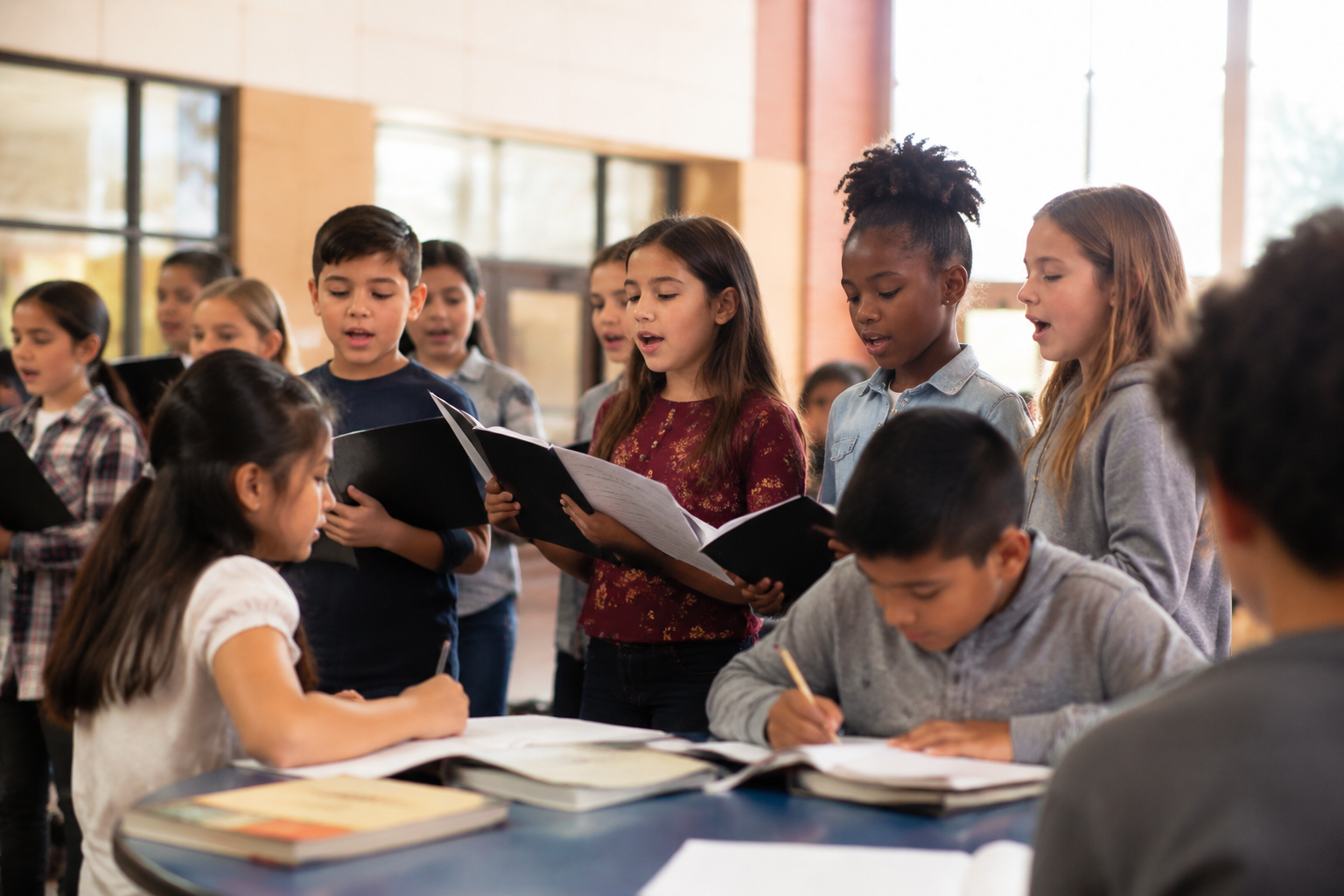
The strange thing about the PS22 Chorus is not that a public elementary-school choir covered Coldplay. Plenty of school groups sing pop songs. The strange thing is that a non-audition chorus, meeting during the ordinary school week, can produce performances that look remembered in the whole-body sense: faces alert, entrances disciplined, children watching one another closely enough to make a cafeteria feel like a rehearsal room with stakes.
That is a study problem before it is a music story. Most students do not fail to remember material because they have never heard of flashcards, planners, or review schedules. They fail because the material has no emotional charge, no social pull, no rhythm of low-pressure retrieval, and no audience beyond a future test. PS22 is useful because it makes those missing pieces visible.
The basic model is simple enough to resist mythmaking. The PS22 Chorus was founded in 2000 at Public School 22 in Staten Island, New York. It typically includes about 60 to 90 fifth-grade students each year, does not operate as a magnet or audition-only program, and rehearses twice a week during school hours.[1] That matters. The learning environment is not built by selecting only the most polished children first.
Gregg Breinberg, the chorus director often known as Mr. B, has described the center of the work less as polish than connection. In an NPR profile, he traced part of his “let’s have fun with it” approach to a student who had been rejected elsewhere for rocking while singing; instead of treating that movement as a flaw, he adapted his teaching around the energy the child brought into the room.[2] That is the part worth carrying into studying: before a student can sustain attention, the room has to offer a reason to enter.
PS22 Is a Case, Not a Controlled Study
A fair reading does not turn PS22 into proof that singing Coldplay raises grades. The chorus is an elementary-school music program with a long public record, not a randomized trial of study techniques. Its usefulness is more modest and more practical: it shows a repeatable pattern that lines up with what learning science already says about memory, motivation, retrieval, and peer explanation.
The pattern looks like this:
| What happens in the chorus | What a student can borrow |
|---|---|
| A song is treated as something to feel and understand, not only execute. | Attach meaning, stakes, story, or personal relevance to material before drilling it. |
| Students draw energy from one another and learn inside a group. | Explain material to peers, let questions expose weak spots, and use social accountability carefully. |
| Songs return through repeated rehearsals in a supportive setting. | Use active recall and spaced retrieval before the test makes recall high-stakes. |
| Performances have real audiences, from families and online viewers to major public events. | Study toward a visible use: teaching, presenting, discussing, solving, or recording. |
Make the Material Matter Before You Try to Memorize It
The most transferable PS22 habit is not “study with music.” It is the habit of giving material an emotional handle before asking students to repeat it. A chorus student does not memorize a lyric as a neutral string of words. The lyric has mood, breath, timing, a face across the room, and the minor terror of coming in late. That combination gives memory more to hold.
Music is unusually good at recruiting many parts of the brain at once. Save The Music Foundation describes music training as involving regions including the prefrontal cortex, motor cortex, corpus callosum, auditory cortex, hippocampus, and cerebellum simultaneously.[3] That does not mean a biology chapter becomes easy if you hum it. It does suggest why emotionally and physically engaged rehearsal feels different from staring at a page until the words blur.
For studying, emotional encoding can be smaller and less dramatic than students expect. A student learning the causes of a war can first ask, “Whose decision becomes irreversible here?” A student learning cell respiration can attach each stage to a resource problem: what the cell needs, what it spends, what it gets back. A student learning a formula can write one sentence about the kind of real situation where using the formula would prevent a bad guess.
The point is not to pretend every topic is inspiring. Some material is dry, and dressing it up too aggressively can waste time. The useful move is to give the brain one reason to care before repetition begins: a consequence, a conflict, a person affected, a mistake the concept prevents, or a question the student actually wants answered.
- Before rereading a section, write one sentence that starts, “This matters because…”
- Before memorizing a term, connect it to a concrete example, even a simple hypothetical one.
- Before solving a problem set, identify the mistake this method is designed to prevent.
- Before reviewing notes, mark the two ideas that feel most confusing, irritating, surprising, or useful.
A fifth-grader in the NPR profile, Jacob King, said chorus is “what makes me want to go to school.”[2] That sentence is not an academic outcome measure. It is something more immediate: a reminder that motivation often begins as attendance, attention, and willingness to try in front of other people.
Use Repetition That Feels Safe Enough to Survive
Rehearsal is not glamorous. It is entering again, missing again, correcting again, and discovering that the correction did not ruin you. PS22’s covers can look effortless online, but the learning mechanism underneath is repetition inside a room where students are expected to improve without being treated as finished products.
Breinberg once wrote that, for the chorus’s 2011 cover of Coldplay’s “Paradise,” the group rehearsed only twice per song.[4] That anecdote is tempting because it sounds like a secret shortcut. It should be read more carefully. A polished result after unusually few rehearsals says something about accumulated routine, group responsiveness, and a specific moment in a specific program. It is not a normal benchmark for a student learning algebra proofs or anatomy terms alone at 11 p.m.
The study version is not “repeat less.” It is “repeat earlier, with less fear.” Students often save recall for the exam, when the cost of not knowing is highest. A better pattern is to make retrieval routine while mistakes are still cheap: close the book and write what you remember, explain the process out loud, answer yesterday’s questions again, or rebuild a diagram from memory.
This is where active recall matters more than another beautiful set of notes. Retrieval practice asks the brain to produce an answer, not merely recognize one. Spacing those attempts over time keeps the material from living only in short-term familiarity. It also narrows the planning-vs-execution gap: a review plan becomes real only when the student actually tries to retrieve something.
A useful low-stakes repetition cycle can be plain:
- Read or watch the lesson once with attention.
- Close the source and write the main ideas from memory.
- Check what is missing without turning the correction into self-punishment.
- Return after a delay and retrieve again before rereading.
- Use the retrieved material in a problem, explanation, discussion, or mini-presentation.
The “safe” part is not softness. It is design. If every attempt to remember feels like a verdict, students avoid the attempt. If errors are expected early, repetition becomes something the student can tolerate long enough for memory to change.
Let Other Students Make Your Gaps Visible
Group learning works badly when it becomes shared distraction, unequal labor, or one prepared student dragging everyone else through the assignment. PS22 points to a better version: students are not merely near one another; they are listening, adjusting, entering together, and borrowing energy from the group.

Amber Nobis, a PS22 chorus member quoted by NPR, explained the feeling simply: “being around the people you love will give you more energy.”[2] In study terms, that energy is useful only if it turns into work: explaining, questioning, checking, and trying again.
The strongest student move here is teaching. When you explain a concept to someone else, you find the seams in your own understanding. The sentence that sounded clear in your head suddenly needs an example. The formula you “knew” suddenly needs a reason. The historical event you memorized suddenly needs a cause, a sequence, and a consequence.
A study group does not need to be large. Two students can divide a chapter and teach it back. Three can each bring one problem they missed and walk through the error. An online group can work too, as long as the tool serves the explanation instead of replacing it; for example, structured channels like the ones in this guide to Discord spoiler channels for study groups can keep answers hidden long enough for everyone to attempt retrieval first.
The rule is simple: if the group lets you remain passive, it is not doing the PS22 job. Someone should be listening for your entrance. Someone should notice when you fake the hard part.
Aim Practice at a Real Audience
PS22’s public visibility can easily become the loudest part of the story: viral videos, celebrity attention, major stages. But for studying, the important mechanism is smaller. A real audience changes the seriousness of practice. It gives students a reason to clean up timing, clarify meaning, and keep going after the first recognizable version.
The chorus has carried that mechanism across very different settings. In 2020, during the COVID-19 graduation period, PS22 students performed Coldplay’s “The Scientist” virtually, a format that made the song function as both performance and farewell.[5] In 2026, reports described the chorus as part of the FIFA World Cup Final halftime show plans connected with Coldplay.[6] Those are not ordinary classroom conditions, but they make the same point: audience gives rehearsal a destination.
Students can build smaller versions without turning studying into theater. Prepare to teach one confusing topic to a friend. Record a three-minute explanation and watch it once for clarity. Bring one solved problem to office hours and defend each step. Volunteer to summarize a reading in class. Join a discussion with one claim you can support from memory.
The audience should be real enough to create care, but not so punishing that it kills practice. A study group, tutor, classmate, teacher, parent, or even a future version of yourself reviewing a recording can be enough. The question is whether the goal changes how carefully you prepare.
What the Broader Music Research Can and Cannot Say
There is supportive research around music education, but it should not be made to say more than it says. Chorus America’s 2009 Chorus Impact Study reported that 80% of educators said choir participation improves academic achievement, while 71% of parents reported increased self-confidence and 69% reported improved memory among children who sing in choirs.[7] Those are perceptions reported in a specific study year, not proof that PS22’s method causes academic gains.
Advocacy summaries also report achievement differences associated with music programs, including a 90.2% graduation rate in schools with music programs compared with 72.9% in schools without them, along with higher SAT scores among music students by 63 points verbal and 44 points math.[8] Those figures are useful as context, but they are not a clean causal claim. Schools with music programs may differ from schools without them in many other ways.
So the careful conclusion is not “join choir and your grades will rise.” It is that PS22 dramatizes conditions that learning science and classroom experience already take seriously: attention deepens when material has meaning, recall improves through repeated retrieval, peer explanation exposes gaps, and authentic purpose makes practice easier to sustain.
Borrow the Sequence, Not the Stage
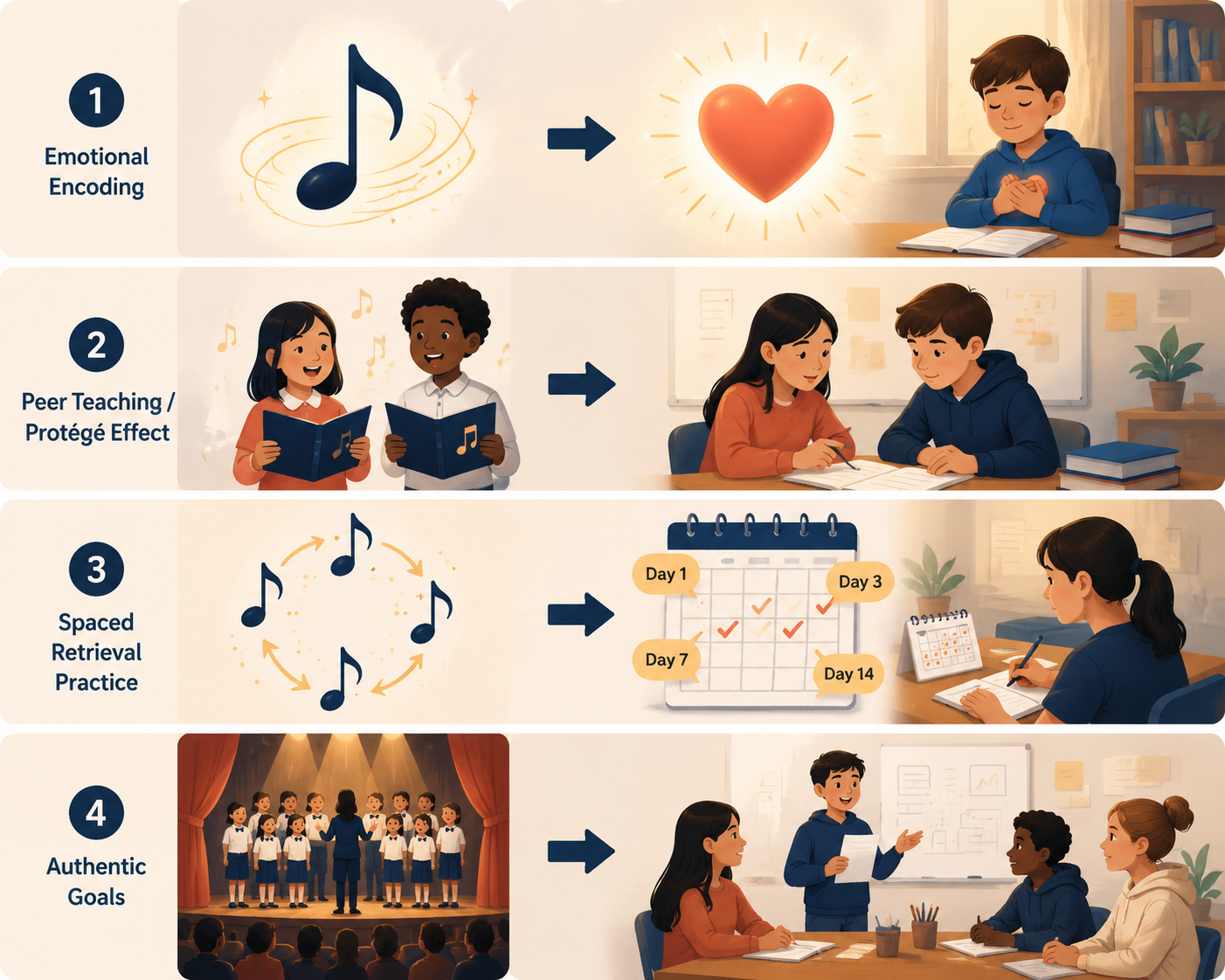
A student does not need a choir room, a viral cover, or a Coldplay song to use the PS22 lesson. The adaptable sequence is quieter: make the material matter, retrieve it before you feel ready, let another person hear your thinking, and aim the work at a real use.
For one chapter, that might mean choosing the most consequential idea, closing the book to rebuild the explanation from memory, teaching it to a classmate, and preparing one question for discussion. For one problem type, it might mean explaining why the method works, solving from memory after a delay, comparing errors with a peer, and presenting the clean solution. For vocabulary, it might mean attaching each term to a scenario, self-quizzing across several days, and using the words in an actual answer.
The lesson from PS22 is not that music magically improves grades. It is that learning sticks better when practice feels connected, social, repeated, and aimed at something real.
References
- PS22 Chorus, Wikipedia
- Meet the kids behind the viral PS22 Chorus, NPR, 2026
- Benefits of Music Education on the Brain, Save The Music Foundation
- PS22 Chorus: What's the secret to their success?, Christian Science Monitor, 2011
- With graduation approaching, PS 22 Chorus performs one final song virtually: Coldplay’s ‘The Scientist’, silive.com, 2020
- FIFA World Cup Final halftime show: PS 22 Chorus, Staten Island, Justin Bieber, Madonna, Shakira, BTS, FOX 5 NY
- The Chorus Impact Study, Chorus America, 2009
- Music Education Statistics, Children’s Music Workshop
Comments
Join the discussion with an anonymous comment.