
A Student Guide to the Meteorite Building Blocks of Life
The Bennu asteroid samples contain all five DNA/RNA bases and 33 amino acids—the most complete set of life's chemical ingredients ever found in space. This guide explains what was discovered, how scientists verified it, and what it means for the origin of life, with study-ready facts for biology and chemistry students.
Updated:
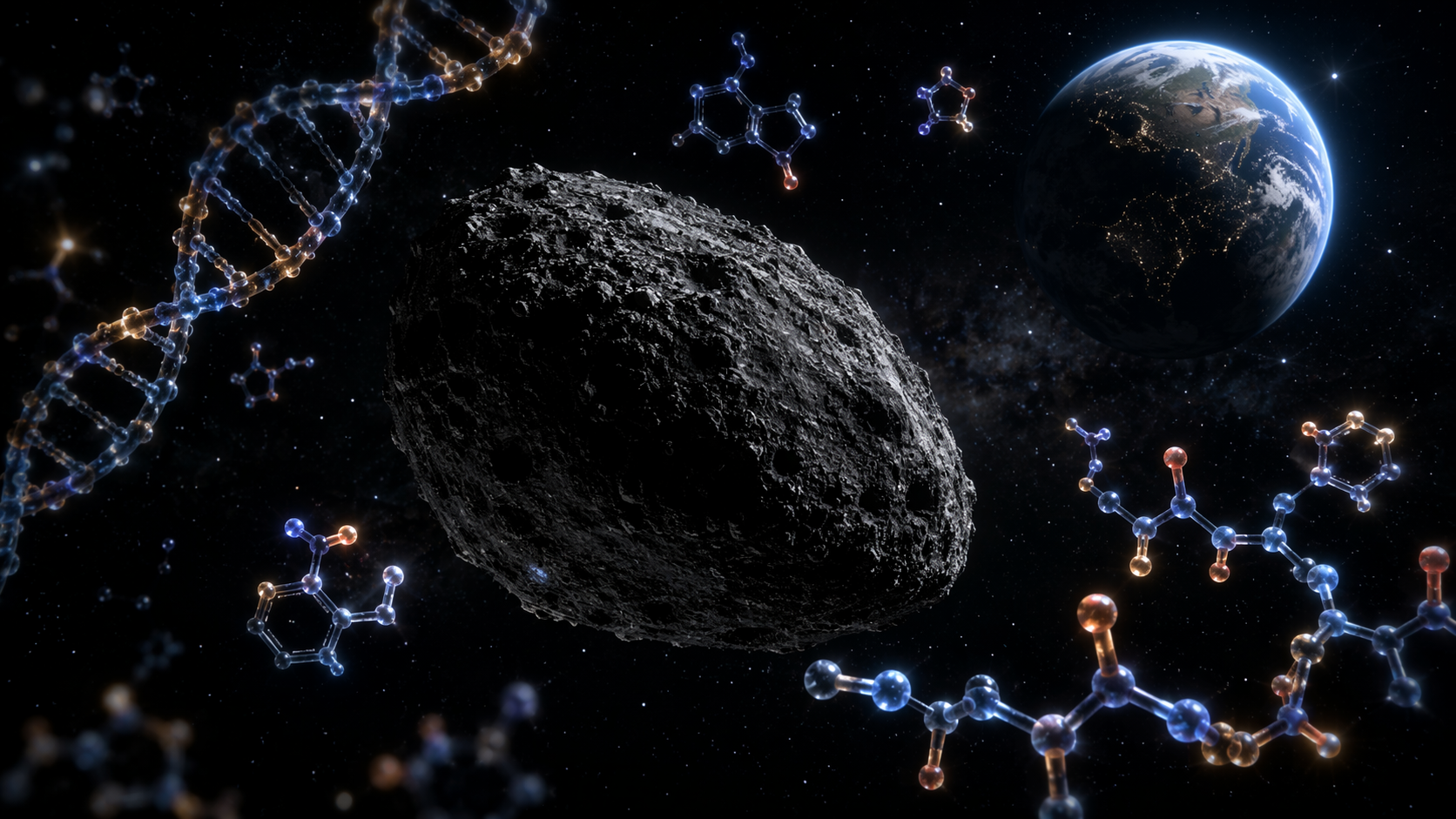
The Bennu result is exciting, but the useful version is more specific than the headline. NASA’s OSIRIS-REx mission brought back 121.6 grams of dark asteroid regolith in 2023, collected from asteroid Bennu and sealed before it ever reached Earth’s atmosphere.[1] In that material, scientists reported all five nucleobases used in DNA and RNA, 33 amino acids, abundant ammonia, and minerals that record an ancient salty-water environment.[2][3] That is not evidence that Bennu had life. It is evidence that a surprisingly complete set of life-related chemistry existed in an asteroid sample that was handled with unusually strong contamination control.
For studying this discovery, that distinction is the whole game. “Building blocks” means molecules and chemical settings that life on Earth uses or could use. It does not mean cells, metabolism, fossils, genes, membranes, or anything that reproduced. If a quiz asks what Bennu showed, the safe answer is: Bennu contains many chemical ingredients relevant to prebiotic chemistry, not life itself.
What Scientists Actually Found in the Bennu Sample
The Bennu inventory is easier to study if you do not treat every compound as the same kind of “life molecule.” Nucleobases, amino acids, ammonia, and evaporite minerals answer different biological and chemical questions. Lumping them together makes the discovery sound bigger for about ten seconds and then much harder to explain.
| Finding | What it is | Why it matters | What it does not prove |
|---|---|---|---|
| All five nucleobases: adenine, guanine, cytosine, thymine, uracil | The bases used in DNA and RNA | Shows that the full DNA/RNA base set can be present in extraterrestrial organic material | Does not prove DNA, RNA, genes, or organisms existed on Bennu |
| 33 amino acids, including 14 proteinogenic amino acids | Organic molecules with amino and carboxyl groups; some are used to build proteins | Shows that many protein-related and non-protein amino acids formed or survived in asteroid material | Does not prove proteins existed |
| Ammonia at about 13.6 μmol/g | A nitrogen-rich molecule important in prebiotic reaction chemistry | Supports the idea that Bennu’s parent body had chemically useful nitrogen available | Does not count as a biomarker by itself |
| Trona, halite, sylvite, and thenardite | Salts and evaporite minerals | Record ancient brines that evaporated after liquid water existed in Bennu’s parent body | Do not prove a habitable ecosystem existed |
Start with the nucleobases. DNA uses adenine, guanine, cytosine, and thymine. RNA uses adenine, guanine, cytosine, and uracil. Bennu samples contained all five: A, G, C, T, and U.[2] That is why this result lands differently from a vague “organic molecules found in space” headline. The reported set maps directly onto the genetic alphabet students learn in biology.
But a nucleobase is not a nucleotide, and a nucleotide is not a genome. A nucleobase is one component. To get a nucleotide, biology also needs a sugar and phosphate. To get DNA or RNA, those units must be linked into polymers with sequence. Bennu’s nucleobases matter because they show that genetic components can exist off Earth, not because they show that Bennu carried genetic information.
The amino acid result is just as important, and just as easy to overstate. The Nature Astronomy study reported 33 amino acids in Bennu: 14 proteinogenic amino acids, meaning amino acids used by Earth life to build proteins, plus 19 non-protein amino acids.[2] Proteinogenic does not mean “made by proteins.” It means “used in proteins.” Non-protein amino acids can still be chemically interesting; they simply are not among the standard set that ribosomes use to build proteins in living organisms.
That split is worth memorizing because it prevents a common mistake. “Bennu had amino acids” is true. “Bennu had protein ingredients” is partly true, because 14 of the reported amino acids are protein-building amino acids.[2] “Bennu had proteins” is not supported by the evidence.
Ammonia belongs in a different mental folder. It is not one of the genetic letters and it is not an amino acid, but it supplies nitrogen chemistry that can feed prebiotic reaction networks. Bennu’s ammonia abundance was reported at about 13.6 μmol/g, roughly 75 times higher than the abundance reported for asteroid Ryugu samples.[2] That comparison matters because Ryugu is another returned asteroid sample, not a random Earth rock picked up after weathering on the ground.
Why the Sample Return Matters More Than a Regular Meteorite Fall
Meteorites are scientifically valuable, but they usually arrive the messy way: through Earth’s atmosphere, onto Earth’s surface, into Earth’s weather, microbes, dust, and handling. Bennu was different. OSIRIS-REx collected material directly from the asteroid, sealed it in space, and returned it to Earth for controlled curation.[1] That chain does not magically remove every analytical problem, but it gives scientists a much cleaner starting point.
This is why Bennu is stronger classroom evidence than “scientists found organics in a meteorite” by itself. The question is not only whether a molecule appears in the instrument readout. The question is whether the molecule plausibly belonged to the asteroid before humans, air, water, plastics, solvents, or lab surfaces had a chance to add it.
The verification chain is the part students should not skip. For Bennu, the argument depends on the returned-sample context, blank controls, comparisons among different sample fractions, and isotope measurements. Trace-level nucleobases especially need this kind of caution because tiny amounts of terrestrial contamination can look impressive if the sentence leaves out how little material is being measured.
- Sealed sample: Bennu material was collected and sealed before Earth exposure, making it cleaner than ordinary meteorite finds.[1]
- Blank controls: scientists analyzed control materials to check what the containers, handling, and lab procedures might contribute.
- Compound identification: the reported inventory separates nucleobases, amino acids, ammonia, and soluble organic matter instead of treating all organics as one category.[2]
- Isotope checks: isotopic signatures help distinguish extraterrestrial organic chemistry from common Earth contamination.
- Comparison samples: Ryugu and meteorite data provide context, but they do not erase Bennu’s status as one asteroid sample.
A good short-response answer can mention this without becoming a methods section: Bennu’s chemistry is persuasive because the sample was returned pristine and because the team checked for contamination rather than simply assuming every detected organic molecule was extraterrestrial.
The Water Story Is Written in Salts, Not in a Little Puddle
Bennu itself is not being described as a wet little world today. The water evidence points backward, to Bennu’s parent body: a larger asteroid from which Bennu later formed. The Nature study reported an evaporite sequence in Bennu samples, including trona, halite, sylvite, and thenardite, minerals associated with salty brines that evaporated.[3]
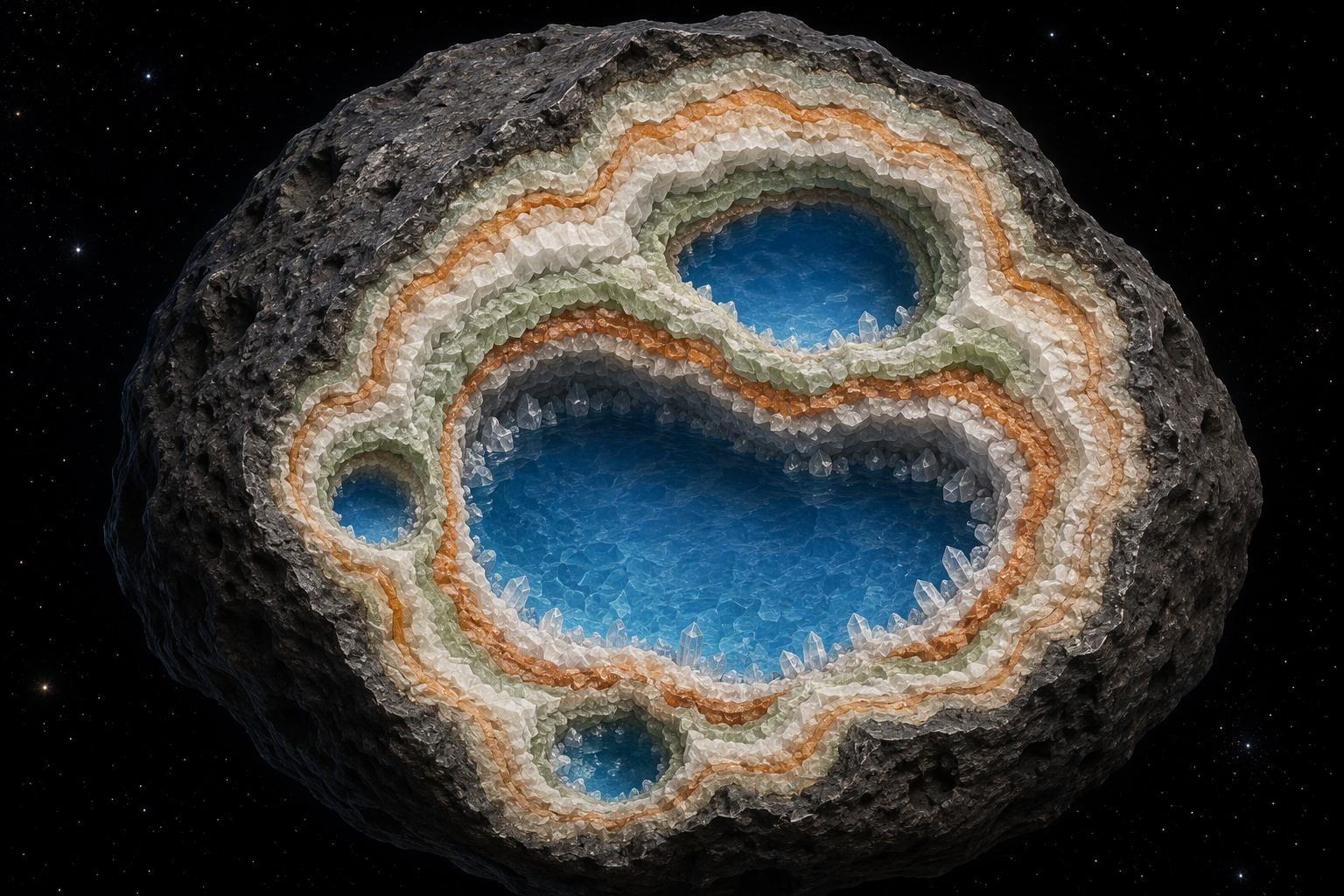
This is a nice place to slow down because “water on an asteroid” can sound cartoonish. The claim is mineralogical. If salty liquid water moves through rock and later evaporates, it can leave behind a sequence of salts. Bennu’s reported evaporite minerals point to ancient brines and evaporation conditions around 20–55°C.[3] That temperature range is chemically interesting because it is mild enough for many organic molecules to survive while still allowing reactions to happen.
The brine evidence also keeps the discovery from being just a molecule scavenger hunt. Nucleobases and amino acids tell us what compounds were present. Evaporite minerals tell us something about the environment that processed them. In origin-of-life chemistry, setting matters: molecules do not just appear on a list; they form, dissolve, react, concentrate, degrade, or get trapped depending on temperature, water activity, pH, salts, and radiation.
The Chirality Result Complicates the Easy Version
Amino acids can come in mirror-image forms, often described as left-handed and right-handed. Earth life overwhelmingly uses left-handed amino acids in proteins. Some meteorite studies have reported left-handed excesses, which made it tempting to argue that extraterrestrial delivery helped push early Earth toward the handedness biology uses.
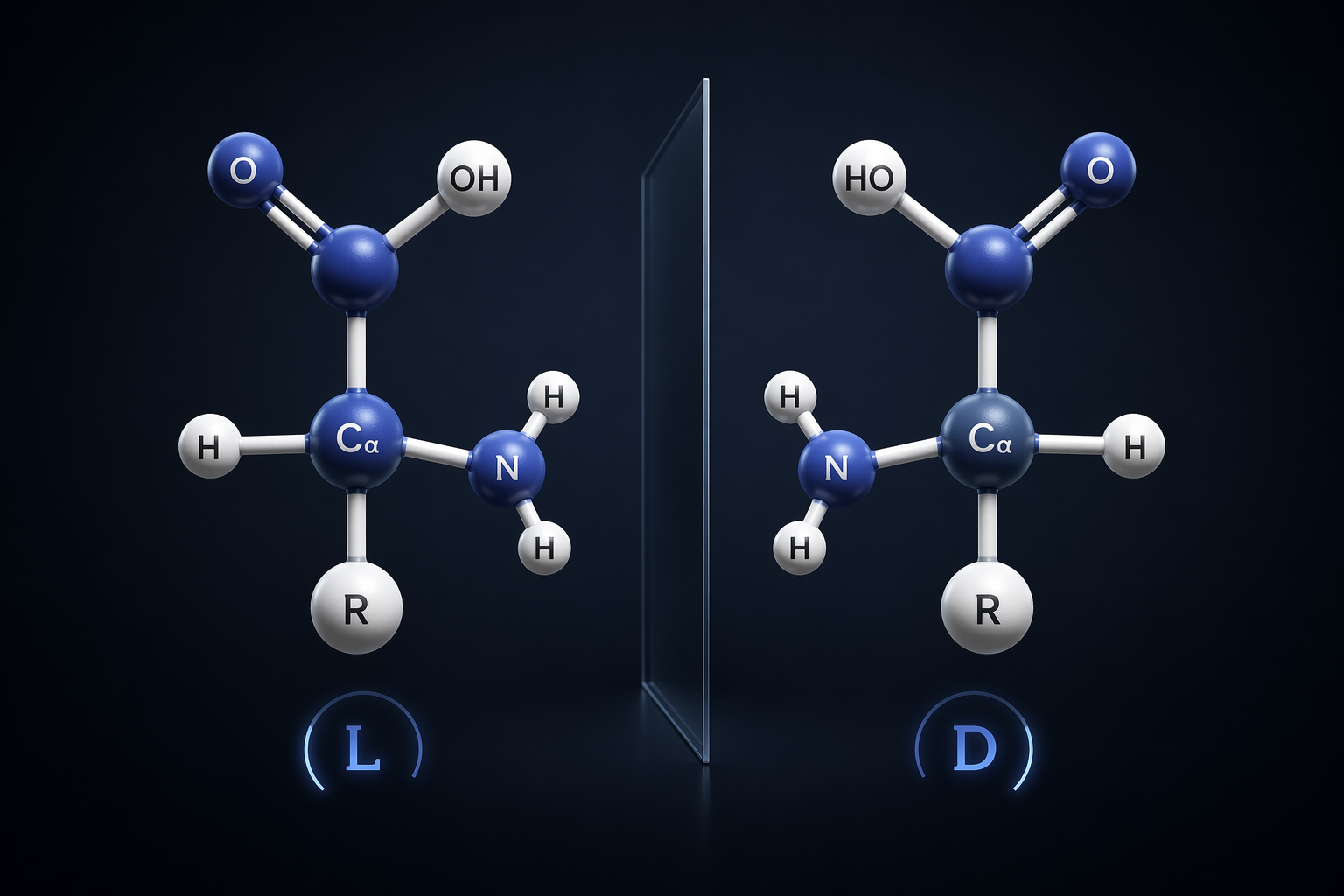
Bennu did not give that simple story a clean win. Its amino acids were reported as racemic mixtures, meaning roughly equal left- and right-handed forms, unlike the left-handed bias seen in some meteorites.[2] That does not make the Bennu amino acids unimportant. It means Bennu does not directly explain why life on Earth selected left-handed amino acids.
For studying, keep two sentences separate. Bennu supports the idea that amino acids can form in extraterrestrial settings. Bennu does not show that asteroids delivered a left-handed excess that determined biological chirality on Earth. Those are different claims, and the second one is still unsettled.
The 2026 Glycine Update Is a Refinement, Not a Collapse
The chemistry is still moving. In February 2026, reporting on work by Baczynski and colleagues described a revised interpretation for Bennu’s glycine, the simplest amino acid: its isotopic signatures were more consistent with formation in frozen, radiation-exposed ice than with the warmer liquid-water Strecker synthesis pathway that had been a common assumption.[4]
That update should not be filed under “scientists were wrong, therefore ignore the result.” It is more precise than that. The presence of glycine remains part of the amino acid inventory. What changed is the best-supported pathway for how at least some of that glycine formed. A simpler warm-water explanation gave way to a colder ice-and-radiation route.[4]
This is exactly how a good lab discussion should handle revision. The observation and the mechanism are not the same thing. If later isotope work changes the proposed mechanism, the compound does not vanish from the sample. The explanation gets narrower.
What Bennu Means for Origin-of-Life Questions
Bennu strengthens one major idea: prebiotic chemistry does not have to be an Earth-only process. An asteroid parent body can preserve nucleobases, amino acids, ammonia-rich soluble organic matter, and mineral evidence of ancient brines.[2][3] If similar materials struck early Earth, they could have added useful chemical ingredients to environments where life later emerged.
That “could have” is doing real work. The Bennu sample does not show the first cell forming. It does not show a direct chain from asteroid chemistry to RNA, metabolism, membranes, or natural selection. It also comes from one asteroid, so it cannot automatically represent every asteroid or every meteorite. Comparisons with Ryugu and meteorites are useful, but comparison is not the same as universal proof.
The strongest exam-ready conclusion is balanced: Bennu provides the best evidence so far that many chemical ingredients associated with life can form or persist beyond Earth and may have contributed to early Earth’s chemistry. It does not settle how life began, why biology uses left-handed amino acids, or whether Bennu’s chemical inventory is typical of asteroids in general.
How to Turn This Into Study Material
If you need to use this in class, build your notes around distinctions, not buzzwords. The easy-to-grade mistake is writing “life was found on Bennu.” The stronger answer names the sample, the molecule groups, the verification logic, and the limits.
- Mission fact: OSIRIS-REx returned 121.6 g of sealed Bennu regolith in 2023.[1]
- Genetic chemistry fact: Bennu samples contained all five DNA/RNA nucleobases.[2]
- Protein chemistry fact: Bennu samples contained 33 amino acids, including 14 proteinogenic amino acids.[2]
- Environmental chemistry fact: evaporite minerals record ancient brines at about 20–55°C.[3]
- Limit: Bennu’s amino acids were racemic, so the sample does not solve the origin of biological left-handedness.[2]
- Revision: 2026 glycine isotope work favored formation in frozen, radiation-exposed ice rather than a warmer Strecker pathway.[4]
For a longer assignment, you can turn these points into a one-page guide using a syllabus-to-study-guide method. If you use AI tools to summarize the Bennu papers, treat the tool as a note organizer, not as the source of truth; the guidance in how to use AI study tools effectively is a safer fit than pasting in a headline and accepting the first summary. For memorizing the molecule groups, AI flashcard generators can help, as long as you check every card against the actual findings.
References
- NASA's Asteroid Bennu Sample Reveals Mix of Life's Ingredients — NASA, Jan 2025
- Abundant ammonia and nitrogen-rich soluble organic matter in samples from asteroid (101955) Bennu — Nature Astronomy, 2025
- An evaporite sequence from ancient brine recorded in Bennu samples — Nature, 2025
- Asteroid Bennu reveals a new pathway to life's chemistry — ScienceDaily, Feb 2026
Comments
Join the discussion with an anonymous comment.