
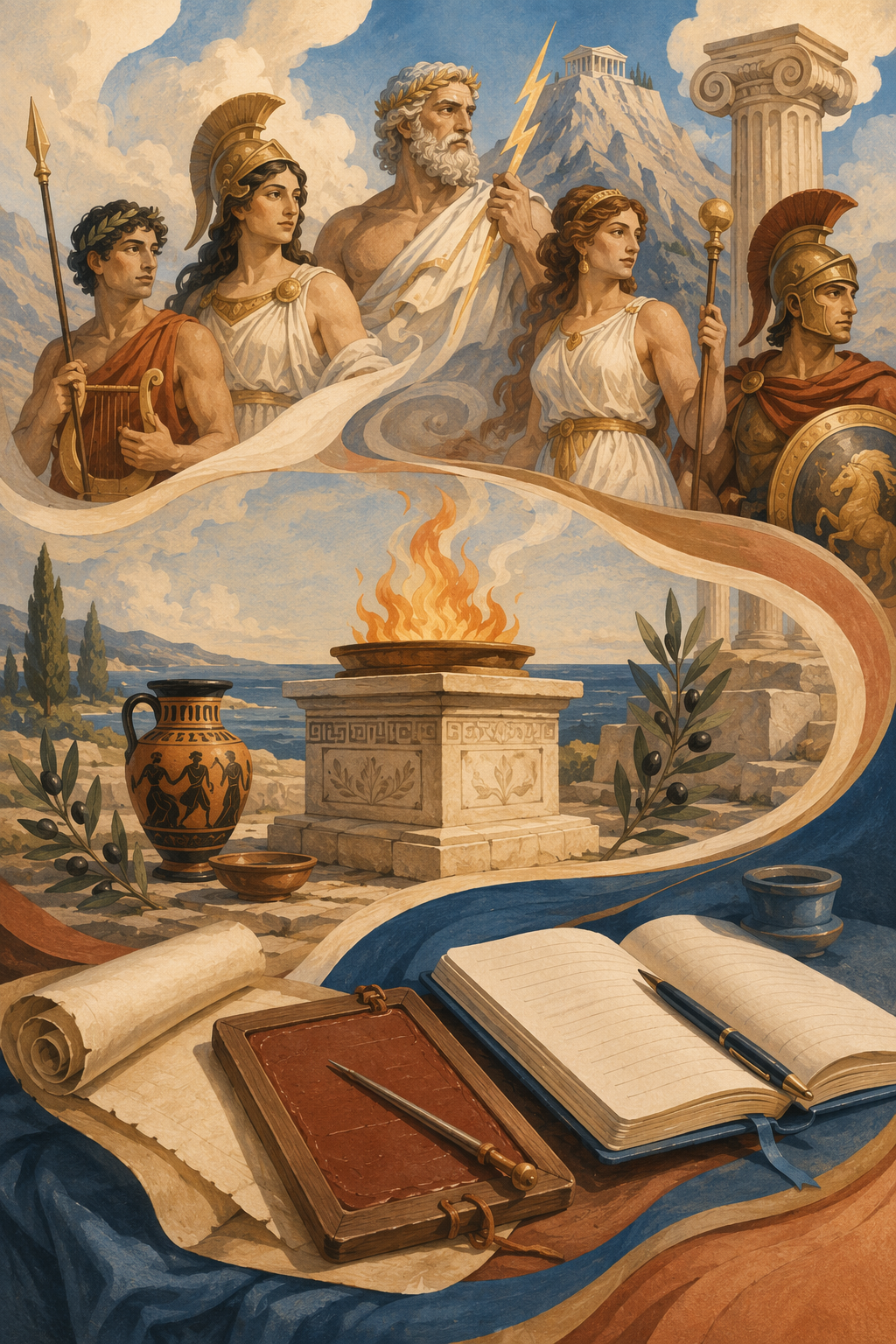
How to Study Ancient Greek Mythology and Rituals
Discover a systematic way to learn ancient Greek mythology and religious rituals — from the twelve Olympians and heroic cycles to animal sacrifice, festivals, and mystery cults — using active recall, memory palaces, and curated primary sources.
Updated:
If you are starting to study ancient Greek rituals and mythology, begin with a simple answer: learn the gods and heroic cycles first, learn ritual practice next, and test yourself with primary-source passages all the way through. The order matters. If you meet Athena only as “goddess of wisdom,” the Panathenaea looks like decorative background. If you know Athena as a civic protectress with temples, processions, offerings, and a city that honored her publicly, the myth starts behaving like part of a religious system.
A good first map does not need every variant. It needs enough structure that a new name has somewhere to land. Dr. Carla Ionescu’s Greek mythology study guidance recommends starting with the twelve Olympians, then using Theoi.com as a path into ancient sources such as Hesiod, Homer, Apollodorus, and tragedians, rather than treating it as a trivia dump.[1] That is the right kind of scaffolding: helpful, temporary, and always pointing back toward older texts.
Start With A Working Map, Not A Perfect Canon
Greek mythology is crowded because it was never one clean textbook. Stories shift by poet, city, cult, period, and purpose. Your first task is not to flatten that mess into one “correct” version. Your first task is to build a map sturdy enough that variations become interesting instead of paralyzing.
| Layer | What to learn first | What it helps you understand |
|---|---|---|
| Pantheon | The twelve Olympians, their domains, symbols, family ties, and major places | Why gods appear in certain stories, cities, rituals, and conflicts |
| Heroic cycles | Heracles, Perseus, Theseus, Achilles, Odysseus, Jason, and the big family curses | How myths organize identity, glory, punishment, travel, kinship, and divine interference |
| Ritual practice | Sacrifice, libations, festivals, temples, altars, oracles, and mystery cults | How myth connected to public worship, civic life, and repeated action |
| Study reinforcement | Flashcards, active recall, memory palaces, source notes, and timed review | How to retain names without losing relationships and context |
This route also prevents a common exam problem: knowing a list of names but not knowing what kind of evidence you are looking at. A myth in Hesiod, a scene in Homer, a hymn to Demeter, a vase showing sacrifice, and a temple plan do not all answer the same question. They belong in conversation, but they are not interchangeable.
Build The Olympian Foundation
The twelve Olympians are the fastest way to stop feeling lost. Do not memorize them as celebrity profiles. Memorize each god as a cluster: domain, symbol, family connection, favorite conflicts, and places or rituals that regularly attach to them.
| Olympian | First associations to learn | Study cue |
|---|---|---|
| Zeus | Sky, kingship, thunder, oaths, fatherhood | Ask who has authority and who violates it |
| Hera | Marriage, queenship, legitimacy, anger at Zeus’s affairs | Track family order and revenge |
| Poseidon | Sea, earthquakes, horses | Watch travel, storms, and contested cities |
| Demeter | Agriculture, grain, mother-daughter loss | Connect her to Persephone and seasonal ritual |
| Athena | Wisdom, war strategy, crafts, civic protection | Attach her to Athens, heroes, and public honor |
| Apollo | Prophecy, music, healing, plague, purification | Place him near Delphi and ritual consultation |
| Artemis | Hunting, wild animals, young women, childbirth boundaries | Notice transitions and vulnerable bodies |
| Ares | War violence | Distinguish battlefield rage from Athena’s strategy |
| Aphrodite | Sexual desire, beauty, attraction, dangerous persuasion | Do not reduce her to romance |
| Hephaestus | Metalwork, craft, fire, divine disability | Look for made objects and awkward divine households |
| Hermes | Travel, messages, boundaries, trade, trickery | Follow crossings: roads, thresholds, worlds |
| Dionysus | Wine, theater, ecstasy, altered social order | Connect myth to festivals and performance |
Make your first flashcards relational, not just factual. A weak card asks, “What is Athena goddess of?” A better card asks, “Why does Athena matter to Athens, heroes, crafts, and strategic war?” Another useful card asks, “How are Apollo and Dionysus different kinds of divine disruption?” These cards force comparison, which is where mythology starts becoming usable.
For the first week, keep the family tree small. Learn the older divine generations through Hesiod’s Theogony only far enough to understand succession: older powers, Titan conflict, Zeus’s rule, and the divine order that later myths assume. You can add alternate genealogies after you know why genealogy matters in the first place.
Use Retellings As Orientation, Then Move Toward Sources
There is nothing shameful about starting with a readable retelling. Edith Hamilton’s Mythology remains a classic reference, and D’Aulaires’ Book of Greek Myths is often recommended for younger readers because it gives beginners a clear entry point.[2] Stephen Fry’s Mythos can also make the cast less intimidating. The mistake is staying there forever.
Once you can recognize the main gods, begin pairing retellings with short primary-source selections: Hesiod for origins and divine order, Homer for heroic values and divine intervention, the Homeric Hymns for gods in cultic language, and tragedy for myth under civic and ethical pressure. Theoi.com is useful here because its pages often gather ancient passages by figure or theme, letting you move from a modern summary to the older evidence behind it.[1]
Add The Heroic Cycles Before You Chase Every Story
After the Olympians, study heroes in clusters. This is where many students accidentally waste time. They read one Heracles labor, then one Trojan War scene, then a Persephone retelling, then an Orpheus video, and everything feels equally important. Instead, give each heroic cycle its own folder in your notes.
- Heracles: labors, violence, purification, service, apotheosis, and the problem of heroic excess.
- Perseus: divine aid, impossible tasks, Medusa, rescue, and dynastic consequences.
- Theseus: Athens, monsters, political identity, abandonment, and civic self-presentation.
- Achilles: wrath, honor, mortality, glory, grief, and the cost of heroic excellence.
- Odysseus: cunning, return, hospitality, disguise, storytelling, and household restoration.
- Jason and the Argonauts: quest structure, divine support, foreign danger, Medea, and broken obligations.
Then add three myth sequences that often act like bridges between story and ritual: Persephone and Demeter, Prometheus, and Orpheus. Persephone brings you toward agriculture, loss, return, and the Eleusinian Mysteries. Prometheus brings you toward sacrifice, fire, and the relationship between gods and mortals. Orpheus brings you toward death, song, descent, and later religious imagination.
A practical note-taking format helps here. For each cycle, write five lines: main figures, central conflict, divine involvement, key places, and later ritual or cultural connection. If you cannot fill the “divine involvement” line, you probably know the plot but not the mythic system.
The Conceptual Hinge: Greek Religion Was Practice-Heavy
Before moving into rituals, adjust the category in your head. Ancient Greek religion was not organized like many modern belief systems. Britannica notes that the Greeks had no exact word equivalent to the modern English “religion”; terms such as eusebeia, often translated as piety, and threskeia, cult or worship, point toward reverence and practice. It also emphasizes that correct practice, or orthopraxy, mattered more than correct doctrine, or orthodoxy.[3]
That does not mean belief was irrelevant. It means your study questions should change. Instead of asking only, “What did Greeks believe about Apollo?” ask, “Where was Apollo honored, what rituals addressed him, what did worshippers seek, and how did myth explain or complicate those practices?” A god is not just a character. A god is also a recipient of offerings, a presence in civic space, a power invoked before action, and a figure whose stories helped communities think.
Study Sacrifice As A Public Act, Not A Dark Footnote
Animal sacrifice, especially thysia, belongs near the center of your ritual notes. World History Encyclopedia describes animal sacrifice as the central ritual act in Greek religion, with pigs, sheep, goats, and cattle offered at outdoor altars and the meat shared among worshippers; it also notes that the animal’s sex could match the deity’s gender, such as a sow for Demeter or a ram for Zeus.[4]

The Cleveland State University HIS 337 pressbook gives the mechanics more texture: participants sprinkled seeds, killed the animal, burned thighbones wrapped in fat for the god, then cooked and shared the meat among worshippers.[5] That sequence is worth learning because it corrects two beginner mistakes at once. Sacrifice was not only destruction, and it was not only private devotion. It was offering, performance, distribution, and community meal.
Notice what this does to myth. Prometheus is not just the clever Titan who steals fire. In Greek mythic thinking, he is tied to the strange settlement between gods and humans: the gods receive their portion, humans receive theirs, and ritual marks the boundary. Once you know thysia, the myth stops being a loose trickster story and starts explaining why an altar, smoke, bones, fat, fire, and cooked meat all matter.
Temples Housed Gods; Altars Held The Action
Students often picture worship happening inside a temple because later religious architecture trains them to think that way. For Greek practice, reverse the instinct. The Metropolitan Museum of Art’s essay on Greek gods and religious practices explains that temples housed cult statues, while altars stood outside for public sacrifice.[6] The altar was not decorative architecture. It was where the ritual act happened.
When reading or looking at material culture, mark the difference between temple, altar, statue, procession, and offering. A vase image of a procession, an excavated altar, and a literary hymn each give different access to worship. Keep them in the same notebook section, but do not make them say the same thing.
Festivals Put Myth On A Civic Calendar
Festivals are where the myths stop floating. The Panathenaea, for example, honored Athena with processions and sacrifices, while the Olympic Games combined athletic competition with religious observance and a sacred truce.[6] These events were not sidebars to “real” mythology. They show how communities returned to gods at set times, in public, through repeated acts.
Dionysus is the easiest place to see the payoff. If you study him only as a god of wine, you miss theater, altered social order, and public performance. If you attach him to festival contexts, tragedy no longer looks like a random literary genre that happens to use myths. It becomes part of a civic-religious world in which performance, competition, worship, and myth speak to one another.
For each festival you study, make a compact card with four prompts: deity honored, public actions, civic setting, and mythic associations. Do not try to memorize every festival at once. Start with the Panathenaea, Dionysian festivals, the Olympic Games, and the Eleusinian Mysteries because they force you to connect gods, place, ritual, and community.
Oracles And Mystery Cults Need Separate Study Habits
Oracles belong in your notes under decision-making. Delphi’s Pythia and Dodona’s oak leaves are not just atmospheric details. They show people seeking divine communication before action. When an epic, tragedy, or myth includes an oracle, ask who consults, what answer is given, who interprets it, and what goes wrong between hearing and acting.
Mystery cults need more restraint. The Eleusinian Mysteries are essential to a Greek religion study plan because Demeter and Persephone connect myth to ritual experience, agricultural anxiety, and hopes surrounding death. But the secrecy matters. Do not pretend a modern summary can reconstruct every hidden detail. Learn what can be responsibly stated: the mythic center, the association with Eleusis, initiation, secrecy, and the fact that not all Greek religious practice was equally public.
Read Primary Sources With A Guide Beside You
A college-level mythology course usually does not separate myth from ritual for long. The University of Pennsylvania’s Greek and Roman Mythology course on Coursera has more than 280,596 enrollments and a 4.8 rating, and its structure includes Homer, later Roman material, and a unit on ritual and religion using primary texts such as the Homeric Hymns.[7] The numbers do not prove the course is perfect; they do show that mythology-plus-ritual is a normal academic path, not a niche obsession.
| Source | Use it for | Beginner warning |
|---|---|---|
| Hesiod, Theogony | Divine generations, succession, Zeus’s order | Do not turn the genealogy into a memorization swamp |
| Homer, Iliad | Heroic honor, divine intervention, mortality, war | Track gods as agents, not background decoration |
| Homer, Odyssey | Return, hospitality, disguise, divine favor and obstruction | Notice ritual gestures and social rules |
| Homeric Hymns | Gods in praise language, cultic associations, myth tied to worship | Read slowly; hymnic praise has its own logic |
| Greek tragedy | Myth under civic, ethical, and family pressure | A tragedy is not just a plot summary with sadder lighting |
| Apollodorus | Mythographic organization and cross-referencing | Useful for orientation, but not the only ancient voice |
When using Theoi.com, start with the overview, then scroll to the ancient quotations. Copy one short passage into your notes and label it by author, work, figure, and question. For example: “Homeric Hymn to Demeter — Demeter/Persephone — what does the hymn show about grief, divine anger, and ritual origins?” That label is more useful than a page of copied mythology facts.
Make The Knowledge Stick With Active Recall
Only after the content map is clear should you choose tools. Flashcards, memory palaces, Quizlet, Anki, and AI-generated decks are reinforcement systems. They are not a replacement for knowing why Athena belongs with Athens, why sacrifice happens outside, or why Demeter’s grief matters ritually.
Use active recall for the material that actually needs retrieval: names, domains, symbols, family ties, source passages, festival associations, and ritual sequences. If you want the cognitive-study side, this site’s guide to active recall and retention is the more general companion; here, the mythology-specific rule is simple: every card should point to a relationship, not just an isolated label.
- Weak card: “Apollo = ?”
- Better card: “Name four Apollo domains and one ritual site associated with him.”
- Weak card: “What is thysia?”
- Better card: “Put the thysia sequence in order: seeds, killing, thighbones and fat, burning, cooking, shared meat.”
- Weak card: “Who is Persephone?”
- Better card: “How does the Persephone myth connect Demeter, agriculture, loss, return, and Eleusis?”
Quizlet is quick for simple matching. Anki is better when you want spaced repetition and long-term review. If you are choosing between apps, use a learning-style app stack guide such as this study app selection walkthrough. If you use AI to generate a first deck, treat it as a draft and check every claim against your course materials or primary-source guide; the site’s guide to AI flashcard generation is useful for building the workflow without outsourcing judgment.
Use A Memory Palace For Places, Not Just Names
The method of loci, or memory palace, has ancient Greek roots as a technique for memorizing lengthy speeches, and The Learning Scientists describes how it can be adapted for structured recall.[8] For mythology, do not build a palace full of random statues. Build a palace that preserves relationships.
One room can hold the Olympians: Zeus at the high window, Poseidon near a basin, Demeter beside stored grain, Athena at a worktable, Apollo near a tripod or instrument, Dionysus near theater masks. Another hallway can hold heroic cycles in order: Perseus with Medusa, Heracles with labor markers, Theseus at a civic gate, Achilles at a battlefield, Odysseus at a doorway, Jason beside a ship. Keep the images vivid, but attach each image to a question you need to answer.
A Practical Four-Week Study Route
The schedule can stretch or compress depending on your class, but the sequence should stay mostly intact. Names first, cycles next, ritual practice next, source integration throughout.
| Time | Main work | Output |
|---|---|---|
| Week 1 | Twelve Olympians, domains, symbols, basic family relationships | One pantheon chart and 40-60 active recall cards |
| Week 2 | Heroic cycles and major myth patterns | One-page notes for Heracles, Perseus, Theseus, Achilles, Odysseus, Jason, Persephone, Prometheus, and Orpheus |
| Week 3 | Sacrifice, temples and altars, festivals, oracles, mystery cults | Ritual cards organized by action, place, deity, and community function |
| Week 4 | Primary-source passages, comparison practice, exam review | Short passage annotations and mixed recall tests |
For a semester course, repeat the cycle at a slower pace as new readings arrive. For an exam week, protect the same order but shorten the readings. A sustainable weekly plan is easier with a template like an evidence-based weekly study schedule. If the exam is close, use a 48-hour cram schedule to triage: pantheon, heroic cycles, ritual sequence, primary-source IDs, then practice questions.
What To Do The Night Before A Quiz
Do not reread the chapter three times and call it studying. Spend the first block drawing the Olympian chart from memory. Spend the second block writing the heroic cycles without notes. Spend the third block explaining thysia, temples and altars, one festival, one oracle, and one mystery cult aloud. Spend the final block on source IDs and weak flashcards.
If you are preparing for a specialized mythology competition or school exam, the National Mythology Exam may be relevant, but it should not take over a broader course plan. Its usefulness depends on whether your teacher’s exam rewards the same kind of recall. For most class exams, you need names plus interpretation: who acts, which god matters, what ritual or civic setting changes the meaning, and what the source actually says.
Choose Resources By Job
The best resource depends on what you are trying to do. A beginner needs orientation. A student writing a paper needs source trails. A student facing a cumulative exam needs retrieval practice. Do not ask one book, site, or app to do all three jobs.
| Resource type | Good use | Limit |
|---|---|---|
| Edith Hamilton or D’Aulaires | Fast orientation to major stories and figures | Secondary retelling, not final evidence |
| Stephen Fry | Readable narrative momentum | Modern voice can smooth over ancient variation |
| Theoi.com | Source pathway into ancient passages | Use quotations and citations, not just summary boxes |
| Hesiod, Homer, Homeric Hymns | Primary evidence for mythic and religious language | Requires slower reading and guidance |
| Coursera or Study.com | Structured lessons and review support | Check alignment with your syllabus |
| Quizlet or Anki | Active recall and spaced review | Only as good as the cards you make |
Study.com’s mythology study guide is described as covering 8 chapters with 106 video lessons and serving a platform used by more than 30 million students.[9] That kind of resource can help when you need short explanations, but videos should produce notes, cards, or practice answers. Watching is not the same as retrieving.
By the end of a solid first pass, you should be able to name the Olympians without panic, place the major heroes into cycles, explain why thysia and festivals matter, distinguish temples from altars, describe how oracles and mystery cults change the picture, and read selected primary passages with a guide. At that point, you are no longer collecting myths randomly. You are studying mythology and ritual as one interlocking system.
References
- 3 Ways to Study Greek Mythology — wikiHow
- An Introduction to Greek Mythology — Mensa for Kids
- Greek religion | Beliefs, History, & Facts — Britannica
- Ancient Greek Religion — World History Encyclopedia
- Celebrating the Gods: Animal Sacrifice and Festivals — Cleveland State University
- Greek Gods and Religious Practices — The Metropolitan Museum of Art
- Greek and Roman Mythology — Coursera / University of Pennsylvania
- Bad Memory? Try the Techniques of the Ancient Greeks — The Learning Scientists
- Mythology Study Guide — Study.com
Comments
Join the discussion with an anonymous comment.