
How Archaeologists Study an Ancient Sword Found in Poland
This article uses the 2026 discovery of a 2,700-year-old bronze sword in Poland to walk through the step-by-step scientific methods archaeologists use to analyze ancient artifacts—from field context to lab analysis.
Updated:
Why the find starts with the ground
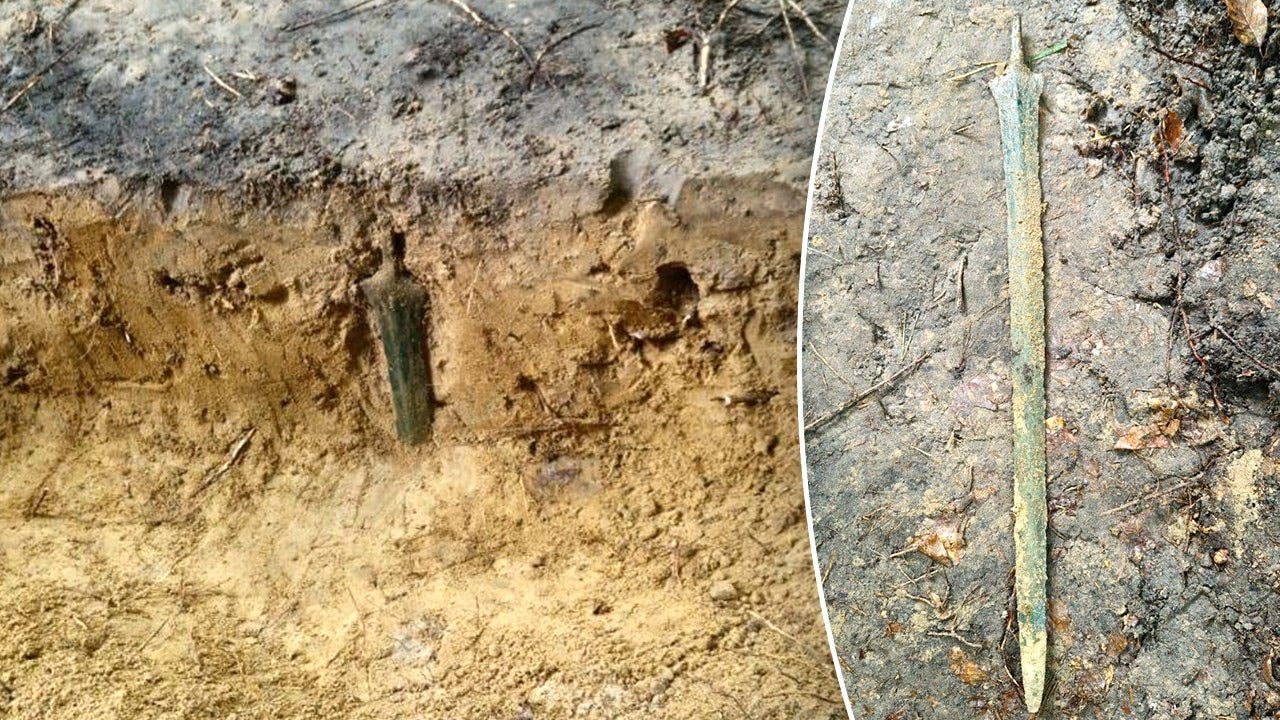
In the Gdańsk Forest District, licensed metal detectorist Marcin Wiśniewski came across a bronze sword standing vertically upright in sandy forest soil, and he did the one thing that made the discovery scientifically valuable: he left it in place and reported it instead of trying to lift it himself. [1][2] That restraint preserved the part of the find archaeologists cannot recreate later: the sword’s position in the ground.
That position is not a dramatic detail for a headline; it is evidence. A sword that survives upright in the soil gives archaeologists a chance to ask whether it was placed there deliberately, how deep it was buried, and whether the surrounding sediment suggests a single act of deposition rather than later disturbance. The interpretive weight sits in the context first, not in the metal.
The find is now under the authority of the Provincial Office for the Protection of Monuments, with Deputy Provincial Heritage Conservator Joanna Tymińska involved in the case. [1] That matters because once a discovery moves into official care, the object stops being just a striking artifact and becomes a documented archaeological context with records, custody, and a chain of observation.
What the sword can say before any lab touches it
Even before conservation begins, the sword already tells a limited story. It is about 60 cm long, cast in bronze, and it has a tang that once held an organic grip material such as wood, bone, or antler, which has since decayed. [2] Its blade also carries decorative grooves and engraved arc patterns, and those details are useful because archaeologists can compare them with other swords whose dates are already better established. [2][3]
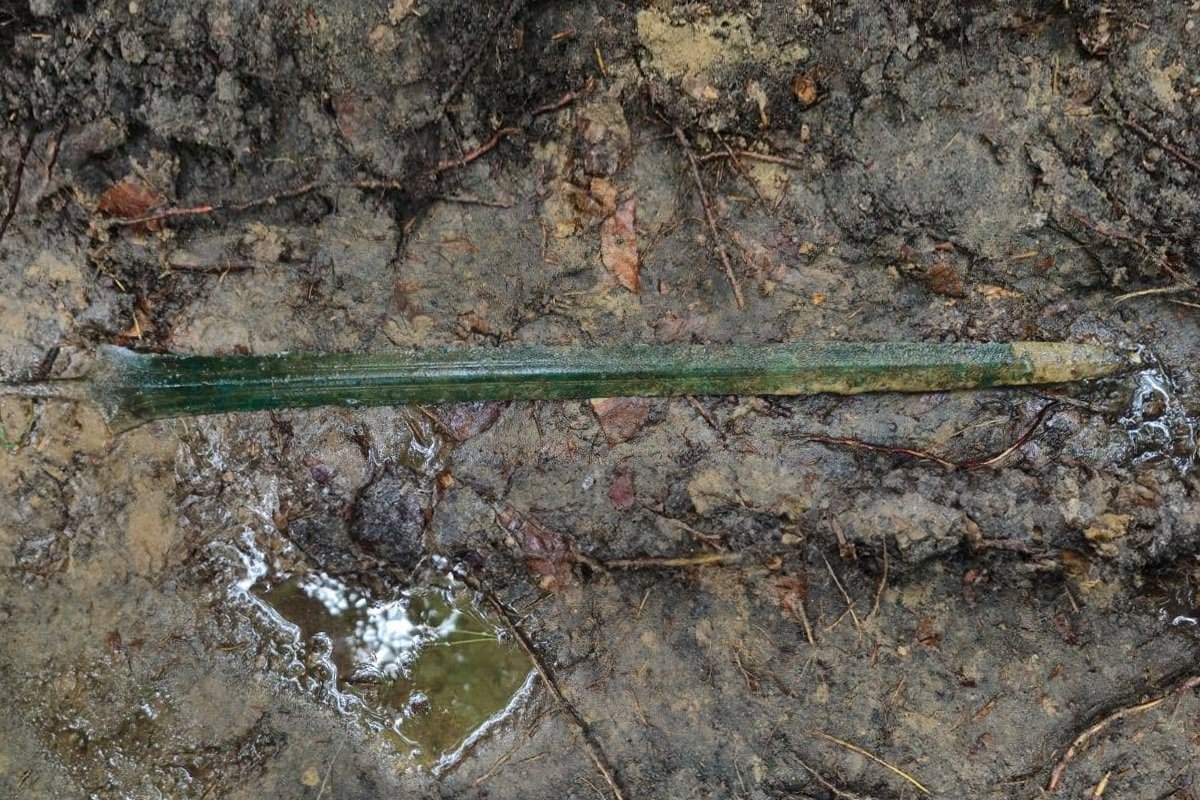
On that basis, archaeologists have placed it in the 4th and 5th Bronze Age periods, roughly 900-700 BCE. [3] That is a typological date, not a lab date: it comes from the sword’s form and decoration, not from a chemical test. Students often skip that distinction, which is exactly how an old object gets promoted too quickly into a confident story.
The comparison set matters here. Regional Bronze Age swords are rare enough that two similar antenna-hilted examples found in the same area in the 1920s are still worth mentioning, even though those pieces were lost during WWII. [1][4] A comparison from Scotland’s Isle of Shuna also matters, because a sword there was found upright and interpreted as a ritual offering, which makes the Polish sword’s position more suggestive without making it conclusive. [3]
Which analyses are planned next
The next stage is not glamorous, but it is where the case either sharpens or stays vague. A Polish conservation lab is expected to use non-destructive X-ray imaging, X-ray fluorescence spectrometry, and microwear analysis, but as of July 2026 those results have not been published. [3] Each method asks a different question, and none of them substitutes for the others.
- X-ray imaging can show internal structure and casting flaws without cutting the sword open.
- XRF spectrometry can identify the alloy composition and help compare the metal recipe with other Bronze Age objects.
- Microwear analysis can look for edge damage, polish, and other traces that may point toward combat, repeated handling, or ceremonial use.
That sequence is the real lesson. X-rays do not prove how the sword was used; XRF does not prove why it was buried; microwear does not by itself explain deposition. Put together, though, they can tell archaeologists whether the blade was made carefully, carried hard, damaged in use, or treated as an object with a different kind of value before it entered the ground.
Ritual deposit or lost weapon?
The upright position makes ritual deposition plausible, especially when paired with the comparison to other upright swords, but it does not close the case on its own. [2][3] A weapon lost in unusual circumstances can sometimes end up in an awkward position; a deliberate offering can also look simpler in the ground than it was in life. Only the surviving context, the typology, and the planned analyses can separate those possibilities with any discipline.
The “herd of cattle” comparison gives a useful way to think about Bronze Age value: this was not a casual object, and the metal alone would have represented serious wealth. [4] But that comparison is still secondary to the archaeological question. Wealth explains why the sword mattered; evidence explains what kind of act put it in the ground.
For now, the strongest answer is also the most careful one. The sword is important because its context survived, its date can be bracketed typologically, and a full conservation and analysis phase is underway. [1][3] Whether it turns out to be a ritual offering, a deposited weapon, or something more complicated, the argument will come from the sequence of methods, not from the bronze by itself.
References
- Detectorist finds 2,700-year-old Bronze Age sword in Poland — Notes from Poland, 2026-06-19
- 2,700-year-old Bronze Age sword found standing upright in Polish forest may be a ritual offering — Archaeologymag.com, 2026-06
- Ornate Bronze Age sword discovery was likely a ritual offering — Heritage Daily, 2026-06
- 2,700-year-old Bronze Age sword found in Poland — The History Blog, 2026-06
Comments
Join the discussion with an anonymous comment.