
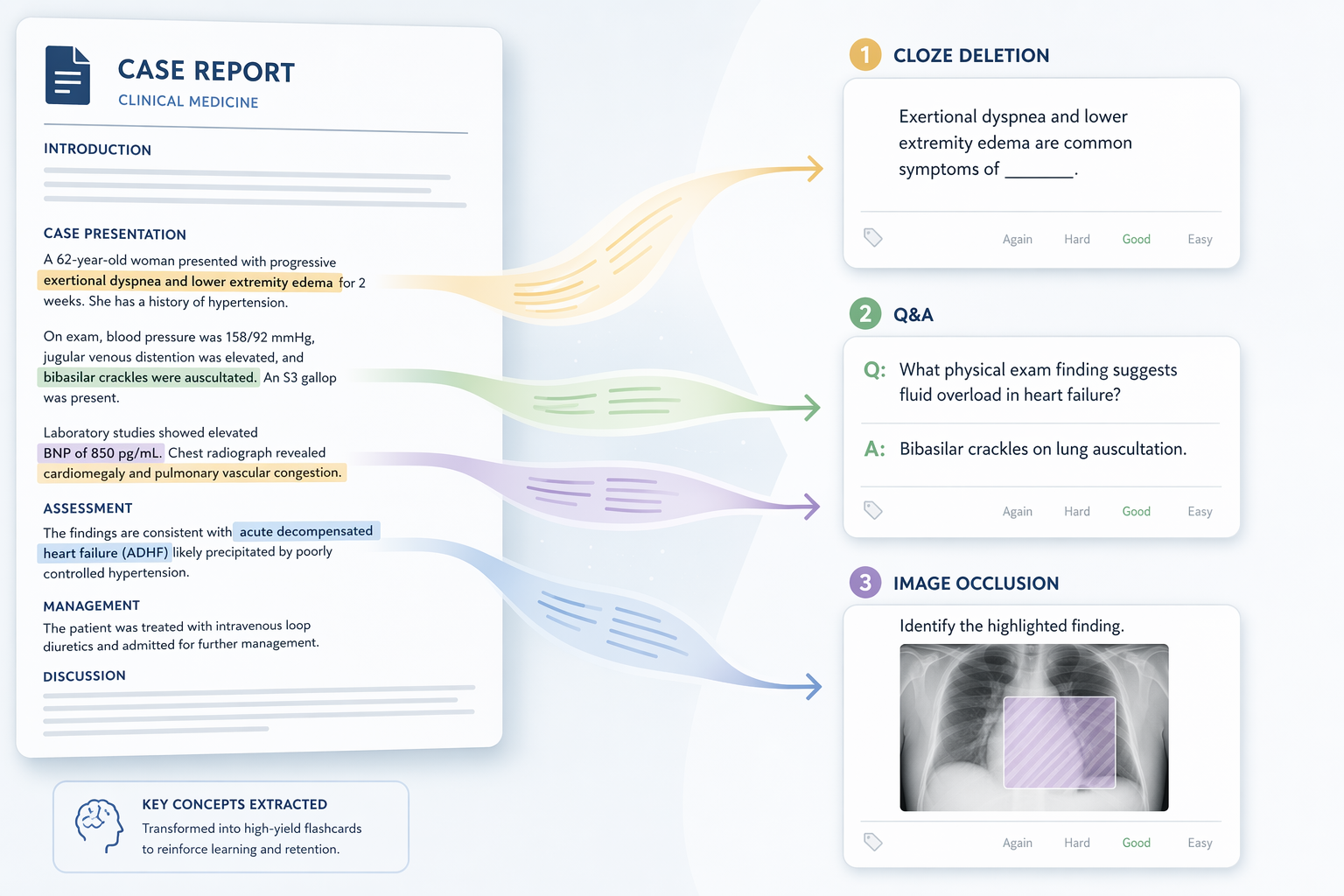
How to Study a Tongue Cancer Case Study with Anki
Learn how to transform a real tongue cancer case report into effective Anki flashcards using cloze deletions, Q&A cards, and image occlusion. This step-by-step guide shows medical students how to study clinical case studies actively instead of just re-reading them.
Updated:
A tongue cancer treatment case study looks deceptively “done” after one careful read. You highlight the age, underline the lesion size, circle the operation, maybe star the pathology result. Then the PDF closes, and the details that would actually make the case useful—risk factor, staging, margin status, neck management, reconstruction, outcome—start leaking out.
Anki helps only if it interrupts that leak. The point is not to turn every sentence into a flashcard. The point is to decide, sentence by sentence, what the case is asking you to remember later, and which card format can test that memory without flattening the patient into a trivia list.
There is a modest evidence reason to take this seriously. In a small single-institution study of first-year medical students, Mehta et al. reported that the above-median exam group had studied 146,144 total Anki cards compared with 81,209 in the below-median group, and averaged 565 cards per day compared with 389. The study had 25 respondents and a 60% response rate, so it supports an association between Anki use and exam performance, not proof that more cards caused higher scores.[1]
That distinction matters. A large, sloppy deck can still train shallow recognition. A smaller deck built from a clinical case can be stronger if each card asks for one retrievable idea and preserves enough context to keep the answer clinically honest.
The Worked Case: Useful, But Not Definitive
The worked example here is the Credé et al. case report of a 26-year-old woman with a history of acute myeloid leukemia treatment who later presented with a persistent tongue ulcer. The report gives enough of the diagnostic-to-treatment arc to build several useful card types: demographics, risk factor, presentation, lesion description, diagnosis, clinical staging, operation, pathology, and outcome.[2]
One caveat belongs near the front: the article has an expression of concern related to peer review integrity. The notice does not state that the clinical details are disputed, but this is a reason to use the case as a study-workflow example rather than as an authoritative source on tongue cancer management.[3]
For management rules, staging tables, and current treatment standards, use your curriculum and professional guidelines. NCCN lists Head and Neck Cancers Guidelines Version 1.2026, but the guideline content requires access through the NCCN site, so this article will not reproduce those tables.[4]
First Pass: Extract Learnable Units, Not Pretty Highlights
Before opening Anki, make a rough extraction table. This is the part students want to skip because it feels slower than copying a sentence. It is also where most of the learning happens.
| Case detail | What to extract | Why it matters for review | Likely Anki format |
|---|---|---|---|
| 26-year-old female | Young patient with oral tongue SCC | Prevents anchoring only on older classic risk profiles | Basic Q&A or tag context |
| Prior AML treatment | History of AML treated with chemotherapy and radiation; reported 10–20× increased second malignancy risk | Links hematology treatment history with later solid tumor risk | Cloze or Basic Q&A |
| Persistent tongue ulcer for 4 months | Non-healing oral ulcer duration | Turns a narrative symptom into a red-flag presentation | Basic Q&A |
| 15 × 20 × 15 mm exophytic lesion | Size and morphology of the lesion | Supports staging and lesion recognition | Cloze or image occlusion if an image is available |
| Moderately differentiated squamous cell carcinoma | Histologic diagnosis | Connects biopsy/pathology to management | Cloze |
| cT2N0M0 | Clinical stage elements before surgery | Tests staging language without inventing a treatment rule | Cloze |
| Partial glossectomy, neck dissection levels I–III, radial forearm free flap | Operation and reconstruction | Separates primary tumor control, nodal management, and functional reconstruction | Basic Q&A |
| R0 pT1pN0 | Final pathology and margin/nodal status | Forces comparison between clinical staging and postoperative pathology | Cloze or Basic Q&A |
Notice what the table does not do. It does not create a card that says, “How is tongue cancer treated?” from one patient. It does not imply that every young patient with tongue cancer has the same risk history. It keeps the case specific where the evidence is specific.
The Credé et al. case reports prior AML treatment and notes a 10–20-fold increased risk of second malignancy after such treatment. That is a good cross-linking fact because it connects two areas that students often study in separate weeks: leukemia survivorship and later solid malignancy risk.[2]
Convert Each Unit Into the Card Type It Deserves
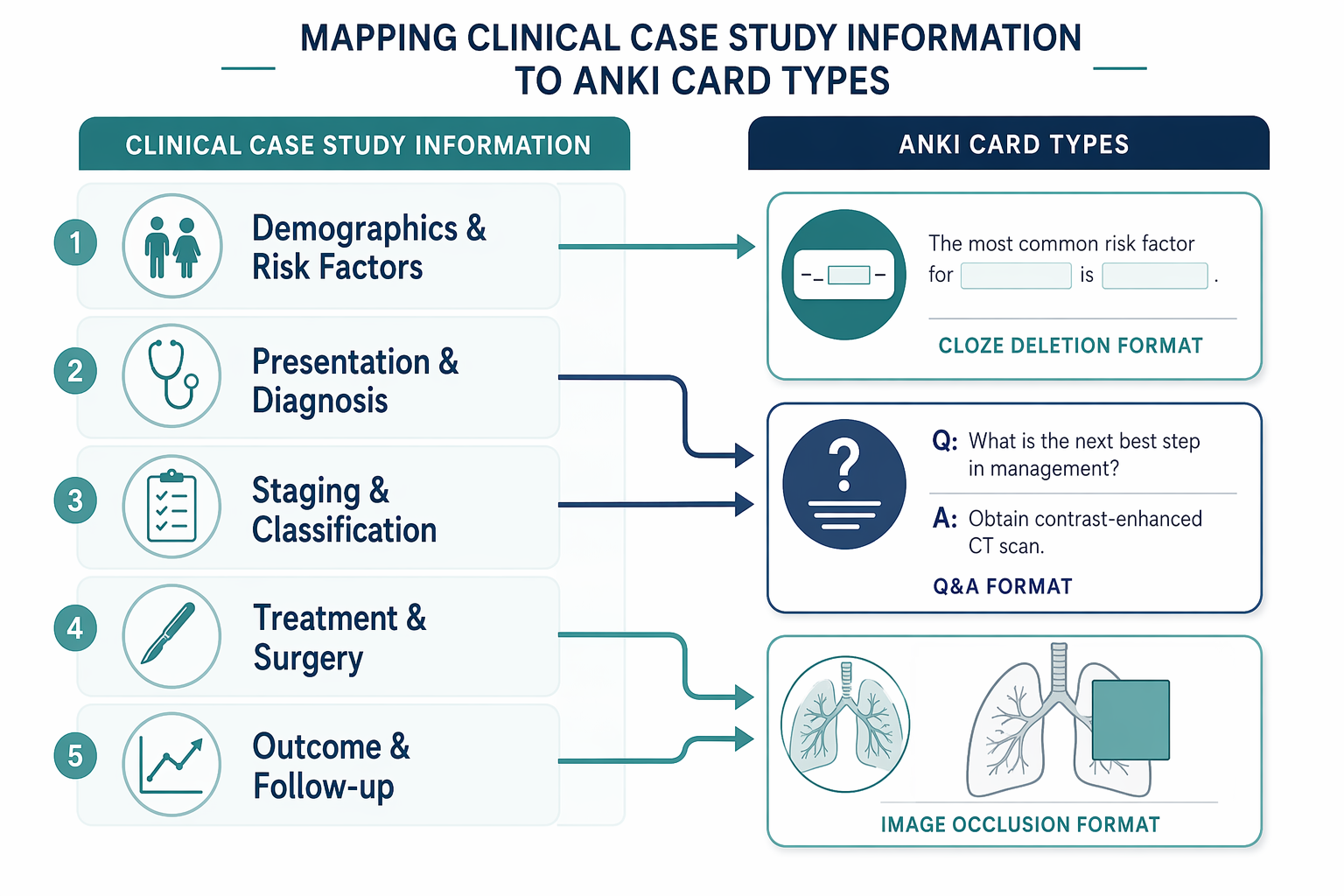
The easiest bad deck is a stack of generic Basic cards. Basic cards are useful, but not for everything. Staging labels, definitions, and paired facts often work better as cloze deletions. Decisions and rationales usually need Q&A. Anatomy, lesion appearance, and operative fields belong in image occlusion when you have a suitable image.
Use cloze deletion for staging and paired facts
Cloze cards are strongest when one missing term completes a structured statement. They are weak when they hide half a paragraph and ask you to guess what the author wanted.
- In the Credé et al. case, the initial clinical stage was {{c1::cT2N0M0}}.[2]
- The final pathology after surgery was {{c1::R0 pT1pN0}}.[2]
- The tongue lesion was described as a {{c1::15 × 20 × 15 mm}} exophytic lesion.[2]
- The biopsy showed {{c1::moderately differentiated squamous cell carcinoma}}.[2]
Those cards test recall of exact labels and measurements. They do not ask the student to explain why the operation was chosen. That explanation needs a different shape.
Use Basic Q&A for decisions, rationales, and comparisons
A Basic card should make the decision visible. If the front of the card can be answered by memorizing one noun, it may be a cloze card pretending to be a reasoning card.
| Front | Back |
|---|---|
| In the Credé et al. tongue cancer case, what major operation was performed after the cT2N0M0 diagnosis? | Partial glossectomy with neck dissection of levels I–III and reconstruction using a radial forearm free flap.[2] |
| Why is the patient’s prior AML treatment worth preserving on a tongue SCC card? | It creates a cross-concept link: the case report notes a 10–20× increased risk of second malignancy after prior AML treatment, so the oral cancer is not just an isolated anatomy fact.[2] |
| What is the difference between cT2N0M0 and pT1pN0 in this case? | cT2N0M0 describes the preoperative clinical staging; pT1pN0 describes the postoperative pathologic staging after resection.[2] |
| What does R0 add to the final pathology card? | It indicates resection with negative margins in the reported case, which changes how the outcome is interpreted.[2] |
The strongest Q&A cards usually include enough context in the prompt to prevent a free-floating answer. “What surgery treats tongue cancer?” is too broad for one case. “What operation was used in this cT2N0M0 oral tongue SCC case?” keeps the answer attached to the patient and avoids turning a case report into a guideline.
Use image occlusion only when the image teaches something
Image occlusion is not decoration. Use it when covering a label, border, node level, lesion location, or reconstructive flap forces a useful recall act. If the image is just a stock photo of a mouth, skip it.
- Occlude the oral tongue lesion location if the case image clearly shows it.
- Occlude neck dissection levels I–III on a labeled neck anatomy diagram.
- Occlude the radial forearm free flap donor site on a reconstructive surgery diagram.
- Avoid occluding random visual features that were not part of the diagnostic or treatment reasoning.
If you are new to Anki setup, deck importing, or mobile syncing, use a general setup guide such as The Complete Guide to Downloading Anki Flashcards instead of letting installation details swallow the clinical workflow. If you are MCAT-focused, How to Use Anki for the MCAT: A Complete Step-by-Step Guide is a better place for the broader setup decisions.
Build the Deck Around Notes, Tags, and One Patient Arc
A case deck should not feel like eight unrelated facts. Use one note structure and tags so the cards stay connected during review.
| Deck element | Example |
|---|---|
| Deck | Clinical Cases::Oncology::Oral Tongue SCC |
| Patient tag | case_crede_2012 |
| Topic tags | oral_scc, head_neck, staging, surgery, survivorship |
| Card-type tags | cloze, basic_qa, image_occlusion |
| Source note | Credé et al. 2012; expression of concern noted separately |
The source note is not busywork. Six months later, when you see the card about AML survivorship and second malignancy risk, you should be able to tell whether that fact came from a lecture, a board review book, a guideline, or a single case report with a publication caveat.
If you use premade decks or AI-generated cards, keep the same standard. The useful question is not whether manual card creation is morally better. It is whether the card forces you to decide what the case is testing. The decision framework in Anki Decks Download vs. AI-Generated Decks applies well here: automation can save time, but it can also hide the extraction step where clinical understanding forms.
A Compact Card Set From the Case
A usable first-pass deck from this case might contain 10 to 15 cards. More is not automatically better. The deck should cover the full patient arc without making separate cards for every adjective.
| Card type | Prompt |
|---|---|
| Basic Q&A | What was unusual about the patient profile in the Credé et al. tongue SCC case? → A 26-year-old woman with prior AML treatment.[2] |
| Cloze | The patient had a persistent tongue ulcer for {{c1::4 months}} before diagnosis.[2] |
| Cloze | The lesion was described as {{c1::exophytic}} and measured {{c2::15 × 20 × 15 mm}}.[2] |
| Cloze | Biopsy showed {{c1::moderately differentiated squamous cell carcinoma}}.[2] |
| Cloze | The initial clinical stage was {{c1::cT2N0M0}}.[2] |
| Basic Q&A | What surgical treatment was reported? → Partial glossectomy, levels I–III neck dissection, and radial forearm free flap reconstruction.[2] |
| Basic Q&A | Why include the neck dissection level in the card? → It preserves the nodal-management part of the treatment, not just the primary tumor resection. |
| Cloze | Final pathology was {{c1::R0 pT1pN0}}.[2] |
| Basic Q&A | What changed from clinical to pathologic staging in the reported case? → The case moved from cT2N0M0 clinically to pT1pN0 pathologically.[2] |
| Basic Q&A | What source caveat should be attached to this case deck? → The case report has an expression of concern regarding peer review integrity.[3] |
That last card may feel non-medical, but it teaches a habit clinical students need: the reliability of a source is part of the learning context. You do not need to dramatize it. You do need to remember it.
Add Contrast Cards Only After the Main Case Is Stable
Once the worked case is reviewable, comparison cards can help prevent overlearning one patient as if she represents all tongue cancer care. The contrast should stay stage-dependent and treatment-focused.
For example, Memorial Sloan Kettering’s patient story about Jessica Tar describes stage 2 tongue cancer treated with surgery alone.[5] CK Birla Hospital’s account of Sameena describes advanced disease with bilateral neck metastases treated with radical resection and chemoradiotherapy.[6] The Patient Story’s account of Red describes stage 3 tongue cancer treated with 40% tongue resection, flap reconstruction, and 30 radiation sessions.[7]
| Comparison prompt | What the card should test |
|---|---|
| Why should a surgery-only stage 2 story not be generalized to advanced disease with bilateral neck metastases? | Treatment intensity changes with stage and nodal involvement; the card tests comparison, not memorization of one patient story. |
| How does Red’s stage 3 treatment story differ from the Credé et al. case? | It adds a more extensive resection and radiation course, showing how case details can change the treatment arc.[2][7] |
| What is the danger of making one card that asks, “How is tongue cancer treated?” | It collapses stage, nodal status, resectability, pathology, and patient factors into a fake universal answer. |
These are not guideline cards. They are comparison cards. If your exam expects current treatment algorithms, build those from lectures, assigned texts, and guideline access rather than from patient stories.
Review the Case Beside Your Curriculum
A case deck works best when it is reviewed alongside the resource that gives the systematic frame. After a head and neck lecture, unsuspend the staging and surgery cards. After a pathology session, add or revise the histology and margin cards. After UWorld or a textbook chapter, add comparison cards only where they correct a gap.
- If a lecture contradicts or updates the case framing, edit the card rather than protecting the original wording.
- If a card asks for two answers, split it before it becomes a review burden.
- If a card only tests recognition of a sentence you copied, rewrite it as a clinical prompt.
- If you cannot explain why a card exists, suspend it.
For a different specialty example of the same case-to-card habit, see What ER Doctor Stroke Survival Stories Reveal About Learning. The disease changes; the extraction standard does not.
The Reusable Method
For the next clinical case report, use the same sequence: extract the patient arc, separate case facts from general rules, choose the card type that matches the information, tag the source clearly, and review the cards with your main curriculum.
- Mark demographics, risk factors, presentation, diagnosis, staging, treatment, pathology, and outcome.
- Turn labels and paired facts into cloze deletions.
- Turn decisions and rationales into Basic Q&A cards.
- Use image occlusion only for anatomy or visible findings that require spatial recall.
- Add contrast cards only when another case changes the clinical judgment.
- Keep guideline-level management in guideline-level resources.
One tongue cancer treatment case study will not teach all of oral oncology. It can, however, become a compact review asset: one patient, multiple retrieval angles, and enough context that the cards still mean something when they come due weeks later.
References
- Anki as an adjunct to medical school education. PubMed Central. 2023. link
- Squamous cell carcinoma of the tongue in a 26-year-old female after treatment for acute myeloid leukemia. PubMed Central. 2012. link
- Expression of concern. PubMed Central. link
- Head and Neck Cancers, Version 1.2026. NCCN. 2026. link
- Jessica Tar. Memorial Sloan Kettering Cancer Center. link
- Tongue cancer survivor Sameena’s story. CK Birla Hospital. link
- Red’s Stage 3 Tongue Cancer Story. The Patient Story. link
Comments
Join the discussion with an anonymous comment.