
How Dirty Rain Affects Your Health
Dirty rain events in 2025–2026 have raised concerns about health risks. This article explains what causes dirty rain, what symptoms to watch for, and how to protect yourself and your family.
Updated:
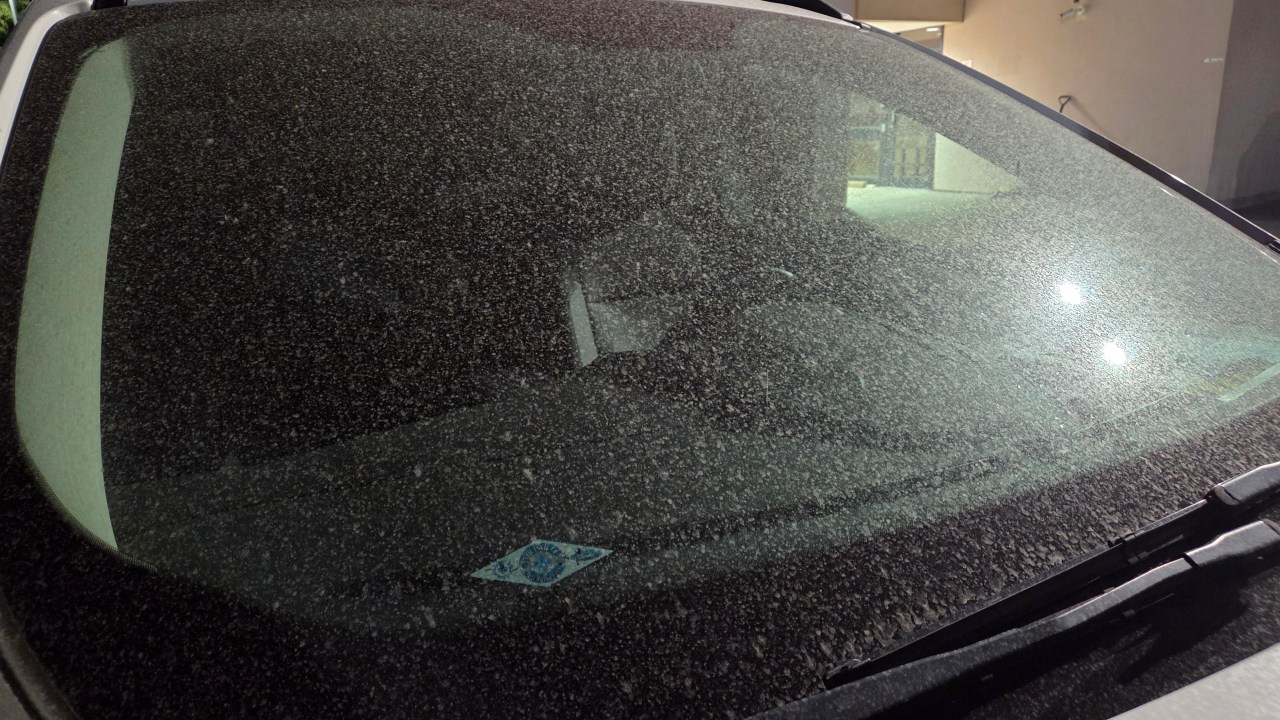
Dirty rain looks worse than it usually is. When it dries on a windshield, porch railing, patio table, or sidewalk, it can leave a tan or muddy film that makes the rain seem chemically wrong. In the 2025–2026 dirty rain events described by the National Weather Service, the main explanation is more ordinary and more useful to understand: dust lifted from drought-parched southwestern soils, carried long distances by wind, then scavenged out of the air by falling rain—not acid rain and not industrial poison falling from the clouds.[1]
That distinction matters for health. The visible residue is what gets attention, but the bigger concern is not whether a car needs washing. It is what people breathe before, during, and after the rain: fine dust particles, and in some regions or circumstances, biological material such as fungal spores. For most healthy adults with brief exposure, dirty rain is unlikely to cause lasting harm. For children, older adults, people with asthma or COPD, and people with heart or lung disease, the dust behind dirty rain deserves more care.
What Dirty Rain Is—and What It Is Not
Dirty rain happens when raindrops fall through dusty air and pull particles down with them. The rain acts a little like a scrubber. It cleans some dust out of the atmosphere, then leaves that dust behind as streaks, speckles, or mud-colored residue after the water evaporates.
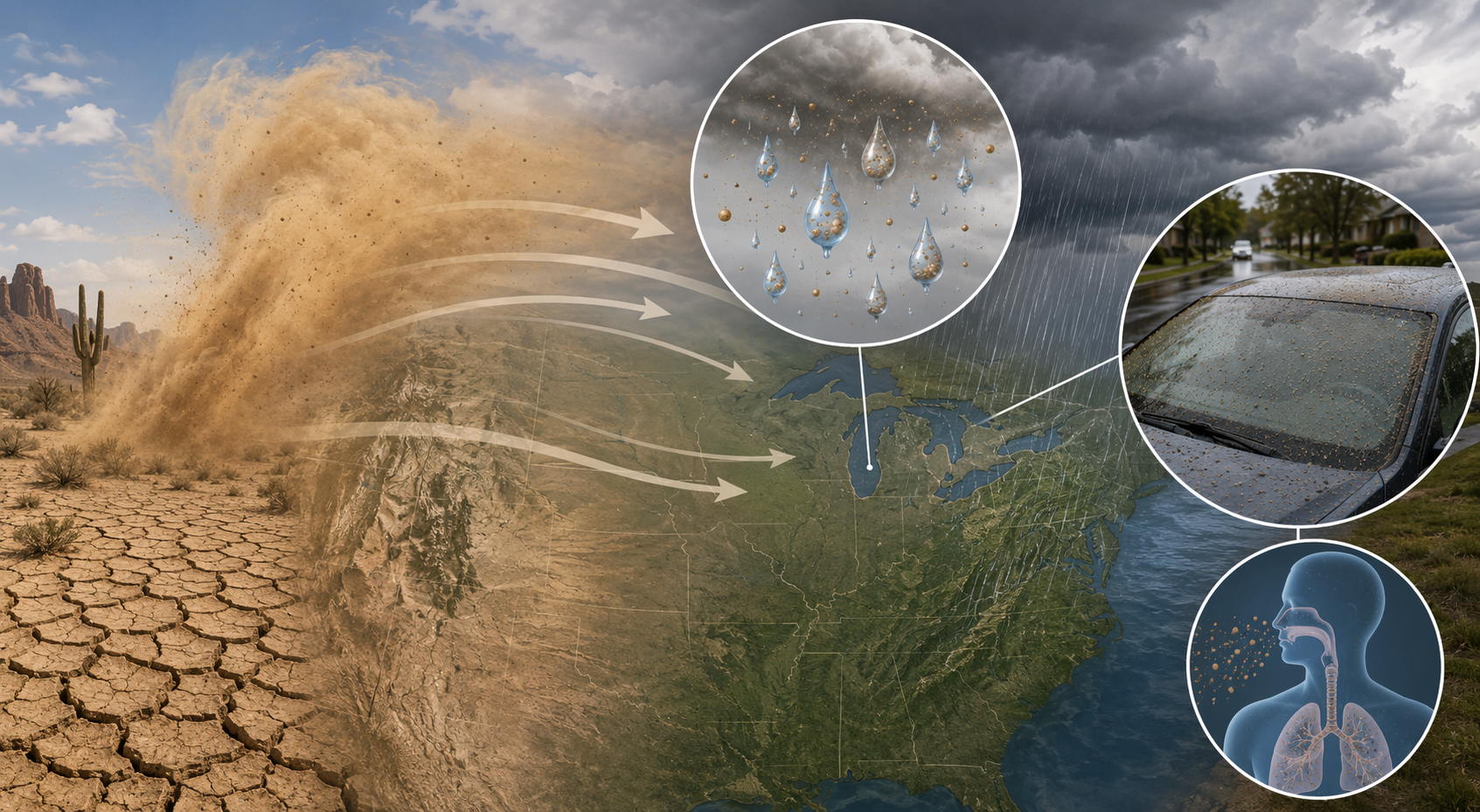
The 2025 events that made people search for “dirty rain health effects” were tied to strong winds lifting dry soil from the Southwest and carrying it hundreds of miles into other regions.[1] That is different from acid rain, which is associated with sulfur dioxide and nitrogen oxides from industrial and combustion sources. It is also different from “black rain” events linked to soot or oil-fire smoke. The phrase “dirty rain” sounds like a single diagnosis, but in these events it mainly describes how the rain looked after dust mixed into it.
This is why a quick “don’t worry” is not quite good enough. The rain itself is not being treated as a toxic liquid in the current weather explanations. But the air mass that produced the dirty rain can still contain particles small enough to irritate airways or reach deep into the lungs.
Why It Kept Showing Up in 2025–2026
The dirty rain reports did not come out of nowhere. The underlying weather pattern included repeated dust events in the Southwest. El Paso saw its highest number of dust storms since the 1930s in 2025, and New Mexico recorded 50 dust storms in the first quarter of 2025 alone.[2] Those figures do not prove that every dirty windshield hundreds of miles away came from the same plume, but they do show why the atmosphere had more dust available to move.
Once dust is airborne, distance stops being reassuring. Larger grains settle faster, but finer particles can travel much farther. A storm that starts as a visibility problem near dry soil can become a hazy-sky and dirty-rain problem in places that do not think of themselves as dust-storm country.
That helps explain why people in the Midwest, Great Lakes, and Mid-Atlantic could see residue after rain even though they were far from desert landscapes. The local mess was real. The source was not necessarily local.
The Health Issue Is Mostly in the Air, Not on the Hood of the Car
The most important dirty rain health effects come from inhalation. Dust storms and dust-laden air can contain PM10, particles small enough to be inhaled, and PM2.5, particles small enough to reach deep into the lungs and, in some cases, enter the bloodstream. The World Health Organization identifies sand and dust storms as a health concern partly because of this particulate matter burden.[3]
The American Lung Association gives the practical version of the same warning: dust can trigger coughing, wheezing, asthma attacks, bronchitis symptoms, and cardiovascular stress, especially in people who already have lung or heart disease.[4] Readers who followed wildfire smoke health effects research will recognize the pathway. Dirty rain and wildfire smoke are different events, but both can involve fine particles that are more important medically than what is visible on outdoor surfaces.
The residue left after rain is unpleasant, but touching a dusty car or rinsing patio furniture is not usually the main exposure. Sweeping dried dust, leaf-blowing it, or letting children play outside while the air is still dusty can put particles back into breathing range. Rain may remove some dust from the air, but it does not guarantee that every particle has settled or that outdoor air is immediately clean.
The American Lung Association notes that particles from dust storms can remain airborne from hours up to 10 days after an event.[4] That wide range is a reminder to look at actual conditions rather than the calendar. If the sky is still hazy, surfaces are drying into powder, or local air quality remains poor, exposure may still be happening.
Where Valley Fever Fits—and Where It Does Not
Valley fever is the part of dirty rain coverage that can sound most frightening, so it needs careful boundaries. The disease is caused by breathing in Coccidioides fungal spores, which live in soil in parts of the western United States. Dust can move soil material into the air, and broader research and public health reporting connect dust exposure with valley fever risk in affected regions.[5][6]
That does not mean every dirty rain event contains valley fever spores. It also does not mean that a person who saw dusty rain in Michigan, Ohio, Pennsylvania, or another downwind state should assume a fungal infection. The risk depends on where the dust came from, what soil was disturbed, how much material was inhaled, and individual susceptibility.
There is also a useful distinction between local haboobs and long-range dust transport. Some discussions of desert dust storms warn against assuming that every dramatic wall of dust lofts fungal spores from deeper soil layers. Long-range dust from drought-stressed or disturbed soils is a different exposure question. The safer conclusion is narrow: valley fever is a real dust-related disease concern in endemic or expanding regions, but dirty rain alone is not proof that infectious spores were present.
Public health numbers show why the disease should not be dismissed. California reported about 12,500 valley fever cases in 2024, its highest annual total on record, and more than 5,500 cases in the first half of 2025.[5] The CDC lists groups at higher risk for severe illness, including adults 60 and older, people with weakened immune systems, pregnant people, people with diabetes, and Black or Filipino people.[6]
Symptoms: Irritation Now, Warning Signs Later
A dusty-rain episode can cause symptoms that show up quickly, especially if someone was outdoors while dust was moving or cleaned dried residue without respiratory protection. These symptoms can overlap with allergies, viral infections, smoke exposure, and ordinary spring irritation, so the timing and persistence matter.
| What you notice | What it may mean | What to do |
|---|---|---|
| Coughing, throat irritation, runny nose, or eye irritation soon after dusty air | Common short-term irritation from dust particles | Move indoors, close windows, rinse eyes with clean water if irritated, and avoid stirring up dried dust |
| Wheezing, chest tightness, or increased rescue inhaler use | Possible asthma or COPD flare | Follow the existing asthma/COPD action plan and contact a clinician if symptoms do not settle |
| Shortness of breath, chest pain, faintness, or severe wheezing | Potential urgent respiratory or cardiovascular stress | Seek urgent medical care |
| Persistent cough with fever and fatigue lasting beyond 7–10 days | Possible infection signal, including valley fever when exposure geography makes it plausible | Ask a clinician whether testing is appropriate |
Valley fever symptoms often resemble a respiratory infection and can include cough, fever, fatigue, shortness of breath, headache, night sweats, muscle aches, joint pain, and rash.[6] Many infections resolve without treatment, but some become serious. The practical line for a reader is not to panic after one dusty rainstorm; it is to avoid ignoring a cough-plus-fever illness that drags on, especially after travel to or residence in a region where Coccidioides is known to occur.
Children deserve a lower threshold for caution because they breathe more air relative to body size and may keep playing hard even when the air is dusty. Older adults and people with heart or lung disease also have less room for “wait and see” when wheezing, chest tightness, or shortness of breath appears. Similar precautions appear in wildfire smoke health risk guidance because the body does not care whether fine particles arrived by smoke plume or dust plume once they are being inhaled.
What Actually Reduces Exposure
The useful response is boring in the best way: reduce breathing exposure. Scrubbing every outdoor surface immediately may make the yard look better, but if the cleaning method sends dried dust back into the air, it can increase the exposure that matters most.
- Stay indoors during heavy dust, dirty rain, or lingering haze when possible, especially for children, older adults, and people with asthma, COPD, or heart disease.
- Close windows and doors, and use recirculated air in a car or home HVAC system so dusty outdoor air is not being pulled inside.
- Run a portable air cleaner with a HEPA filter if available, especially in bedrooms or the room where a vulnerable person spends the most time.
- If outdoor exposure cannot be avoided, use a well-fitting N95 respirator rather than a cloth or surgical mask, which is not designed to seal and filter fine particles as effectively.
- Clean dusty surfaces with wet methods when practical. Rinsing or wiping keeps more material out of the air than dry sweeping or leaf blowing.
- Keep medications and action plans accessible for people with asthma or COPD, and do not wait for symptoms to become severe before moving indoors.
The CDC also recommends avoiding dusty areas when possible in places where valley fever is a concern, using air filtration indoors, and wearing an N95 respirator when dusty exposure cannot be avoided.[6] The American Lung Association gives similar dust-storm advice, including staying inside, closing windows, and using high-efficiency filtration when available.[4]
When It Is Reasonable to Go Back Outside
There is no universal hour count that makes outdoor air safe after dirty rain. A light residue after a rain shower is different from a major dust event followed by wind, drying surfaces, and visible haze. The better cues are local air quality, visibility, wind, and symptoms in the people most likely to react.
For a healthy adult, brief outdoor tasks after the air clears are unlikely to be a major concern. For a child with asthma, an older neighbor sweeping a porch, or someone recovering from a respiratory infection, the threshold should be more conservative. If dust is still visible in the air, if dried residue is being disturbed, or if coughing starts quickly outdoors, that is useful information—not overreaction.
Dirty rain is usually not poisonous rain. It is also not harmless scenery. The visible mud is the part people notice, but the health question is about what reached the lungs before the dust settled and what gets stirred up afterward. The most sensible response is to reduce inhalation, protect vulnerable people first, and treat persistent respiratory symptoms as something worth checking rather than something to explain away.
References
- Dirty Rain, National Weather Service.
- The dust storms spreading deadly diseases across the US, BBC Future.
- Sand and dust storms, World Health Organization.
- Dust Storms and Your Health, American Lung Association.
- Valley Fever, California Department of Public Health.
- About Valley Fever, Centers for Disease Control and Prevention.
Comments
Join the discussion with an anonymous comment.